Tuesday, July 9, 2013

Why We Must Fight and Defeat the False Media Narrative About the Reasons For Serena Williams Extraordinary Success As the Best Female Tennis Player in the World


 RICHARD WILLIAMS
(b. 1942)

All,

With all due respect to Serena's current coach (see BBC article below) I must push back very hard against the incredible amount of outright false, distorted, and thoroughly dishonest misinformation that is currently being spread by the tennis media in charting Serena's (ongoing!) success on the court over the past year. I simply can't believe the barrage of straightup LIES and sheer propaganda that is being foisted on the public and how naive and clueless so many people in the general tennis community seem to be about Serena's ACTUAL phenomenal record of success that she has ALWAYS had--and long before she ever met Patrick Mouratoglou!  This is not to say that her  present coach is not a skilled professional or even that he doesn't have Serena's best interests at heart--in fact he alone is not even the real issue here--but come on now let's get real--HE IS NOT 'THE MAN' BEHIND HER SUCCESS as this headline arrogantly--and stupidly--proclaims. NOT EVEN CLOSE. In fact as I've stated before this absurdly transparent attempt on the part of the media and former white tennis players like Jim Courier (who really made some ridiculously egregious statements yesterday on Tennis Channel about how much Serena's current coach is responsible for her record over the past 12 months) is nothing more after all is said and done than a condescending and ultimately racist assertion by the media, some former players, and Serena's many former detractors in and out of the game who are now trying to pretend they are her "friends" since it's crystal clear she's on the brink of breaking nearly every major historical record left in women's tennis.

So it is in that major and most important context that I share the following astounding statistics about Serena's extraordinary career that she amassed LONG BEFORE she staried "working with" Mouratoglou in June 2012. What the following stats will reveal is that RICHARD AND ORACENE--AND ESPECIALLY RICHARD--are clearly and largely responsible for Serena's success since it was the self taught Mr. Wlliams who taught EVERYONE in the Williams family how to play tennis--as even Oracene openly and honestly admits!--and who first taught the sisters how to play at age 4 and 5. It wasn't until the sisters were 10 and 11 that Richard even sought out other coaches and settled on Rick Macci who proceeded--in collaboration with Richard--to coach Venus and Serena for the next four years whereupon Venus formally began her professional career at age 14 in 1994 and Serena followed three years later. And it's very significant to add that Richard, Oracene and the girls accomplished all this AFTER Venus compiled a 63-0 record (and Serena was 46-3) for girls in California who played tennis in the 12 and under division --which as it turned out were the ONLY junior level matches the two sisters ever played because Richard was wise and perceptive enough--he even said as much--not to burn out his two young phenoms too early. So in honor of the tremendous coaching job and guidance that Richard and Oracene provided for their two daughters I present the following FACTS as evidence that the real "man behind Serena's career" is indeed HER FATHER and not her current coach. I know this FACT really sticks in the craw of many people who simply don't like or respect Richard because of his overall "personality"--and to a LIMITED degree I can well understand why some of Richard's personal behavior can upset people. After all the man is far from perfect and obviously has his own personal faults and shortcomings but the truth of the matter is that in the final analysis Richard is no different from ANYONE ELSE in that respect. I mean NOBODY'S PERFECT and despite whatever problems some people may have with Richard, I for one WILL ALWAYS DEEPLY RESPECT, HONOR, AND SUPPORT what he has accomplished with his two daughters through a dynamic combination of LOVE, PATIENCE, DISCIPLINE, PERSEVERANCE, COURAGE, KNOWLEDGE, AND DETERMINATION--all sterling qualities and values which have IMO--and that of many others!--collectively made Serena THE BEST FEMALE PLAYER IN TENNIS HISTORY. What follows is the detailed empirical PROOF of exactly what Serena's two parents--and especially her father--have done as COACHES in shaping and providing real leadership in the formation, expansion, and growth of Serena's amazing career. The FACT that in the past 10 years Venus and Serena between them have won 23 of the 24 Grand Slam titles that ALL AMERICAN TENNIS PLAYERS COMBINED HAVE WON--AND THAT INCLUDES BOTH MEN AND WOMEN is not only a profound tribute to the astonishing GENIUS, savvy, innovation, and genuine INSIGHT that Richard Williams has brought to the game via his daughters but is an INDICTMENT of the nearly ALL WHITE USTA who despite having many sponsored programs and coaches throughout the country as well as MILLIONS OF DOLLARS in their well endowed budgets have utterly FAILED to accomplish anywhere near the gigantic success of ONE BLACK MAN AND ONE BLACK WOMAN over the past 15 years. Just THINK about those incredible FACTS for a moment. No matter what others falsely claim Serena's current coach is not even remotely close to matching what Richard and Oracene have done. My point is this: For once let's give the proper credit to black people for a change--they've earned it!-- and stop pretending that the "real narrative describing or acknowledging an African American's major success lies elsewhere--because the reality is that it doesn't...For the record then consider the following FACTS about Serena's unprecedented career and the obvious role her parents have played in it:

--Serena won four straight GS titles in just one seven month period from June 2002 to January 2003 which she herself dubbed the "Serena Slam." (she won again five months later at Wimbledon in June 2003)--and all finals were against Venus. The four straight Grand Slam finals they played from June of 2002 to January 2003 were the only time in tennis history that the same two people played against each other in four straight GS finals
--Serena was 94-8 in 2002 and 2003 winning 12 titles and was runnerup in four other tournaments

--Serena had already won Grand Slam titles on all four surfaces by the time she was 21 from 1999-2002

--Serena and Venus won 12 straight Grand slam doubles titles from 1998-2010; Serena also won two gold medals in doubles in the Olympic Games in 2000 and 2008 with Venus

--Serena was the Number One ranked player in the world five different times from 2002 to 2011

--Serena won six Grand Slam singles titles from 1998-2003 and she won seven more from 2005-2010 before she was out most of 2011 with injuries--so much for the completely phony and absolutely false argument that Serena hasn't really been "consistent" throughout her career!

--15 different players other than Serena have been ranked Number One in the WTA at some time or another since Serena began playing professionally in 1998 and Serena is the ONLY PLAYER in the last 15 years who has a WINNING RECORD against EVERY SINGLE ONE OF THEM--an extraordinary record that she established LONG BEFORE she ever met her current coach

Kofi


http://www.bbc.co.uk/sport/0/tennis/22956601


Wimbledon 2013: 
The man behind Serena Williams's success
By Simon Austin BBC Sport 
June 24, 2013
 
When Patrick Mouratoglou's dream of becoming a top tennis player was blocked by his businessman father, he vowed to scale the heights as a coach instead.

The last 12 months have seen him realise that ambition spectacularly.

Mouratoglou, 43, started working with Serena Williams last June, just days after she had suffered a humiliating defeat to Virginie Razzano, ranked 111, in the first round of the French Open.

Since then, the American has embarked on one of the most remarkable runs in the entire history of women's tennis, which Mouratoglou himself encapsulated on Facebook on 10 June.

"Anniversary of one year of collaboration with Serena," he wrote. "Three Grand Slam titles, two Olympic Gold medals (single and doubles), winner of the Masters Cup, 11 titles, back to number one in the world, oldest number one in the history of the game, 74 matches won out of 77, 31-match winning streak and still counting. Serena is just unique."

The collaboration has seen Mouratoglou, little-known outside tennis circles a year ago, become the subject of front-page stories because of speculation about a romantic relationship with Williams.

Williams' record with Mouratoglou:

Won 74 of 77 matches
Lost only two of 28 matches v top-10 opponents
Won Wimbledon, Olympics, US Open, Masters Cup and French Open
Won 31 matches in a row
Just two short of Martina Navratilova/ Chris Evert's record of 18 Grand Slam titles
Regained world number one ranking and oldest number one in history of women's game


He says Williams has improved several facets of her game in the last 12 months. "Firstly, I think she moves better on the court, which is so important.

"And she is more consistent, meaning her low level is now much higher than it used to be. She doesn't have to rely only on her champion's mentality to come through a match on a bad day."

Williams, now 31, is also competing in more tournaments and many observers have spoken about a happier, friendlier and more motivated athlete.

One of them is former world number one Tracy Austin, who told BBC Sport: "In the past, it seemed like Serena could get bored, as it all came so easily to her. It seems Patrick has made it interesting.

"To wake up every day and feel challenged, and like you have something to improve on and get better on, is phenomenal for an athlete .

"When you have someone in your corner who is not only a great coach but also a great motivator, it's special. Serena has also spoken about the fact she'll look up now and see Patrick in her box and he'll never change his expression, which is so different from her father, who always seemed to be in a different seat and would leave in the middle of matches. Patrick seems to me to be a real stabilising force for her.

"Serena seems in a really good place right now. She's settled, hungry, fit, healthy and confident, which is not a bad combination."

Mouratoglou has reignited Williams' passion for tennis, says former world number one Tracy Austin

Mouratoglou agrees that Williams has less "ups and downs" than she used to.

"You have to remember that tennis players are human beings," he said. "They cannot keep motivated at their best throughout the whole of their careers. But you have to say this - even when Serena was having those downs, she was still winning Grand Slam titles, which is incredible. She really is amazing.

"Serena had already won 13 Grand Slams when we started working together, but had the will to go on, to keep practicing hard, to keep looking for ways to improve. That requires a special frame of mind, the mindset of a very special champion."


 SERENA WILLIAMS WITH HER 2013 FRENCH OPEN TROPHY


https://www.facebook.com/pages/The-Panopticon-Review/342702882479366


Why doesn't Serena Williams get the credit she deserves?

IF you want to spark a reaction on Twitter, just say something complimentary about Serena Williams.

"I can't stand the sight of her - she's the person who ruined women's tennis," was one of the more printable responses to a comment I posted last Thursday evening suggesting that Williams had not received enough praise for a staggering demolition of Sara Errani in the semi-final of the French Open that saw her lose just a solitary game.

Two days later, and Williams was defeating Maria Sharapova in straight sets to claim a 16th grand slam title. Did that lead to an outpouring of superlatives? Not exactly.

Most of the public acclaim appeared grudging at best, while the media response to Williams' 43rd victory from 45 matches this season was muted in comparison to the deluge of column inches that accompanied Rafael Nadal's victory over David Ferrer a day later.

In part, that reflects the extent to which women's tennis is still seen as something of a poor relation compared to the version of the game that is played by men, but it isn't always like this and it is hard to avoid the conclusion that something specific is involved when it comes to Williams.

It is equally hard to avoid the conclusion that that 'something specific' is related to issues of race and femininity, thorny subjects undoubtedly, but ones that cannot be ignored when one of the greatest sportswomen of our era is being denied the credit she deserves.

What is it about Williams we either dislike or distrust? The most common criticism hurled in her direction is that her playing style is predicated solely on power, and that her naturally muscular physique somehow gives her an unfair advantage over her opponents.

This is a desperately flawed argument for a number of reasons. For a start, you don't become the best player in the world simply because of an ability to hit the ball hard.

Yes, Williams' preferred playing style owes much to the strength of her shots, particularly when it comes to her serve, which is significantly superior to that of most other female players.

But her athleticism, precision and ability to consistently keep hitting the lines under the most intense of pressure mark her out as a supreme technician.

Particularly on the forehand, she can mix things up much more than she gets credit for, but even if her game was solely about strength, it's not as if such an approach is against the rule book.

So much of Nadal's play revolves around his repeatedly heavy hitting from the back of the court, his metronomic consistency and the competitive instinct that enables him to keep balls alive that other players would give up on.

In Nadal, that is a ferocious will to win. In Williams, it is somehow regarded as unsportsmanlike.

Is the distinction because Williams is black? It must surely play a part for some people on some level, yet it would be wrong to claim that society, particularly in this country and the United States, is completely uncomfortable with the idea of a physically powerful black champion.

On the football field, the likes of Patrick Vieira and Yaya Toure were lauded for their physical attributes. Americans are used to black footballers and basketballers using their size and strength to their advantage. Nobody seems to complain about the way Usain Bolt towers over his rivals in the 100m.

Yet the common denominator in all of these situations is that the athlete in question is a man. Try to think of examples of powerful black females - and the word 'powerful' here can have both physical and emotional connotations - and it quickly becomes apparent that Williams is blazing something of a trail.

The leading female sprinters are perhaps comparable, but none have dominated their sport in the way Williams has over the last decade-and-a-half, and so none have been subjected to the same sniping and judgement. The same can be said of Nicola Adams, another black sportswoman who has achieved success in a sphere where strength is all-important.

In many ways, Williams is a new type of champion, challenging conventions of what is deemed desirable in a sport that has strong, pre-conceived notions of what a women's number one should look like, and how she should perform and conduct herself on the court.

Williams' behaviour is often held up as another defect, and there have been times when she has strayed beyond the boundaries of acceptability, most notably when she threatened a lineswoman during the final of the 2009 US Open.

Again though, different things seem to be demanded of Williams than of other players. Roger Federer is no stranger to swearing on court, and can be churlish and argumentative in his press dealings, yet he is held up as the ideal sporting gentleman. John McEnroe's entire persona was built around his combativeness and fiery personality.

Williams isn't allowed to be like that, even though she would only be half the player she is if she didn't have an unquenchable need to succeed.

That competitiveness has enabled her to tower over her rivals, another stick that is used to beat her down. "It's an extremely weak time for women's tennis," is the cry, evoking a previous halcyon era, but conveniently forgetting that that halcyon era never really existed.

Steffi Graf, one of Williams' rivals for the title of the greatest of all time, once won a French Open final 6-0, 6-0, yet you don't find many people saying she had it easy.

Williams has overcome multiple obstacles to reach the pinnacle of the game, and continues to tackle adversity at every turn.

In 2011, she almost died after suffering a pulmonary embolism, yet within little more than a year, she was beating Agnieszka Radwanska at Wimbledon to claim her fifth All England title.

Later this month, she will return to SW19 at Wimbledon in an attempt to defend her crown. Perhaps in years to come, we will fully appreciate how privileged we are to be able to witness her achievements.

Monday, July 8, 2013

Civil Rights, African American Citizens, and the Venal Racism of the U.S. Supreme Court in the 21st Century


WEEKEND EDITION JULY 5-7, 2013

All of Us or None

Civil Rights and the Supreme Court: Why We Can’t Celebrate

by DEVON CARBADO, KIMBERLÉ CRENSHAW and CHERYL HARRIS

The recent Supreme Court decisions striking down the federal Defense of Marriage Act (in United States v. Windsor) and reaffirming the California Supreme Court’s rejection of the challenge to Proposition 8—the state ban on gay marriage (in Hollingsworth v. Perry)—mark a major moment in United States civil rights history.  No longer can the federal government discriminate against legally married gays and lesbians, and same sex couples may now legally marry in California.  Though in neither case did the Court go so far as to prohibit states from denying gay and lesbian couples the right to marry, the cases nonetheless constitute a significant milestone.  These outcomes were far from certain in the hands of an institution that only recently had legitimized the prerogative of states to criminally prosecute gays and lesbians, and to deny them basic rights as a legitimate expression of moral opprobrium. But things have changed.  Windsor and Perry are now not only part of our constitutional infrastructure; they are part of the American story of civil rights reform.  In this respect, we have come a long way.  That we have travelled this distance should be cause for celebration.  And, yet, we cannot.

We can’t celebrate because despite the affirmation of one set of rights, another—the civil rights of African Americans—is being relentlessly undermined.  Continuing a decade-long trend of attacking and eroding legal remedies for racial inequality, the Supreme Court effectively gutted the Voting Rights Act –the most powerful and productive civil rights provision secured through the Civil Rights Movement’s bloodiest struggles against racial domination.  In Shelby v. Holder, for the first time in over a century, the Supreme Court ruled that despite the fourteenth amendment’s express grant of authority to Congress to remedy racial discrimination, Congress’ actions were unconstitutional.   This was not merely a narrow ruling regarding congressional intentions that might have invited Congressional clarification.  Instead the Court overturned Congress’ bi-partisan conclusions, supported by voluminous evidence, that the promise of racial equality in the democratic arena required ongoing protective measures, and substituted its own groundless judgment that voting rights protections imposed unjust burdens on unfairly stigmatized states.  In so doing, the Court afforded states’ rights greater constitutional concern than individuals’ rights, trading on an old and sadly familiar constitutional technique to suppress racial equality.  Given the current fractured political landscape, the power that the Court so brazenly grabbed from Congress’ grasp may never be restored.  This will further erase the very limited collective memory we have of the sacrifice of the thousands of lives irreparably damaged or lost to achieve these and other civil rights protections.

Yet notwithstanding this aggressive assault on civil rights, and the fact that these rights formed the very terrain out of which more recent demands for equality grew, there was very little public outcry.  This muted response cannot be attributed to any confusion about the inevitable consequences of this devastating loss.  Indeed, in the immediate wake of the decision, various Republican politicians have quickly and unapologetically moved forward to install highly restrictive and unnecessary voter identification laws previously blocked by the VRA, knowing full well, and intending the negative impact those laws will have on people of color and poor people.

We cannot celebrate because even though the Court did not declare affirmative action per se unconstitutional, its ruling in Fisher v. University of Texas will make such policies far more difficult to sustain.  In sending the case back to the lower court, the Supreme Court made a formal nod to precedent in affirming that diversity constituted a crucial interest for an academic institution, but stealthily departed from prior case law in ratcheting up the evidentiary standard that the university is required to meet in order to justify its most limited use of race.  Rather than strike down affirmative action outright, the Court has subjected it to the risk of death by a thousand cuts.   The Court’s ideological hostility to policies that seek to dismantle racial inequality is masked behind technical evidentiary rulings that lighten the load for those opposed to diversity and place potentially insurmountable burdens on those who carry the imperatives of racial justice forward. Indeed, while the Court’s majority lowered the bar to embrace Abigail Fisher’s claim that her equal protection rights were violated in the absence of any evidence that she had qualifications superior to those students who were admitted, it ruled that the lower court’s evaluation of the University’s extensive evidence justifying its use of race was not stringent enough, essentially requiring the school to jump over an even higher hurdle to support the policy.   Although asserting that these results flow from neutral principles, the Court’s decisions reveal that in effect there are different standards for different claimants—a difference that decidedly is not colorblind but is marked by race.   While the case is not over, and the university will have another chance at bat, we should not lose sight of the fact that the game is now rigged.    White claimants along with aggrieved Southern States are the new recipients of the Court’s interventionist sympathies.   Together with Shelby, these decisions reflect conservative racial politics dressed up as race-neutral, colorblind constitutional jurisprudence, a repackaging of resistance to racial equality that we cannot celebrate.

We can’t celebrate because the Roberts’ Court continues to impose heavier burdens on those who seek to prove employment discrimination in the workplace—an ongoing problem verified by repeated studies and investigations.  In two decisions that remained largely under the radar, the Court required plaintiffs alleging employment discrimination to essentially submit proof beyond a reasonable doubt in the context of civil cases where the standard is less.   Researchers over the past decade have demonstrated that cases asserting race-based discrimination are the most difficult to win, in part because of the kinds of aggressive interpretations of the statutes that the Court has imposed and that lower courts have adopted.   The most recent decisions reflect the Court’s zero-sum approach to equality, previewed in a prior ruling that effectively framed efforts to minimize disparate impact discrimination against minorities as intentional discrimination against whites.  In Ricci v. Destefano, the New Haven firefighters case, the Court held that the City’s efforts to avoid the racially exclusionary effects of its promotional test by cancelling the test results for everyone and looking for a less discriminatory metric was itself a form of intentional race based discrimination against whites.  This move effectively placed such disparate impact claims on the critical conditions list, with Justice Scalia seemingly anxiously and peevishly awaiting the opportunity to declare this bedrock provision of the employment discrimination act to be unconstitutional.

We can’t celebrate because the Court continues to frame racial remediation efforts no matter what the context—in education, in employment, in voting—as racial preferences or reverse discrimination.   What is even more distressing is that many liberals and progressives frame racial remediation in this way as well.  For example, the standard liberal defense of affirmative action is that the policies are racial preferences that are necessary to ensure diversity.  This framing of affirmative action is precisely what Justice Scalia traded on when he cast the stigma of preferential treatment around the fundamental right of non-discrimination in voting, referring to the Voting Rights Act as a “racial entitlement.”

We can’t celebrate because the Supreme Court cases this term reflect a more general phenomenon whereby African Americans are becoming increasingly irrelevant in social justice advocacy. Whether via calls to “get beyond the black/white paradigm” or the slogan that “gays are the new blacks,” efforts to discuss African Americans as the appropriate subjects of civil rights interventions are regarded as out of step with current realities.  We are to seek remedies for racial inequality without using the “r” word and particularly admonished to avoid any reference to specific forms of anti-black racism.  Apparently, we are to acquiesce to the view that the country—and certainly the Supreme Court—is sick and tired of African American civil rights claims (read: racial grievances), but not sick and tired of African American inequality.  The yawning and sometimes widening inequalities that still exist are, if ever acknowledged, typically framed as a product of our alleged cultural dysfunction.

 We can’t celebrate because our President, our leaders and our advisors tell us that we cannot hope to achieve effective coalition by drawing attention to racial inequality.  They insist that we have to find another register in which to make our concerns speak to those who are not concerned about us.  We cannot celebrate because we know what gay rights advocates know: that an inequality that can’t be named cannot be addressed.

We cannot celebrate because African Americans cannot benefit from the kind of empathy that played at least a partial role in mobilizing the public to support marriage equality.  We know that when appeals to be treated as an equal are pitched so that “persuadables” can understand this imperative through the lives of a loved relative, trusted colleague or dear friend, we who have been America’s Others will not gain traction or empathy through such ties.  We cannot celebrate because we know that we are not able to have our difference minimized, because our difference defines not only who we are in the eyes of fellow Americans, but also defines who other Americans imagine themselves to be.


While we join in acknowledging with respect the work and sacrifice that went into achieving the gain of the marriage equality decisions, we do so with the sobriety that comes from recognizing the Court’s decisions for what they are—a vision of equality that appears to create winners and losers but in the end shortchanges everyone. Formal equality—the idea that we all just want to be treated the same—was never the only objective of the civil rights movement, the women’s movement, nor any social movement.  The African American freedom struggle was not over when the Supreme Court decided Brown, or the Civil Rights Act was passed.  Nor was the women’s movement over when women got the right to vote or were no longer excluded from military combat.   Immigration rights will not be won if the bill before Congress is passed, nor will the right to marry resolve the ongoing patterns of discrimination against LGBT people. We cannot celebrate because we recognize that despite the myriad constraints imposed by those who stand against human rights in all its various dimensions, we should not accept the current terrain as the map of our possibilities. What we can do is celebrate the clarity that comes from speaking the truth about where things are—a truth that must be reckoned with as a necessary if insufficient precondition towards realizing our freedom dreams.

All of us or none.


Devon Carbado teaches Constitutional Criminal Procedure, Constitutional Law, Critical Race Theory, and Criminal Adjudication. He is an outstanding teacher who was elected Professor of the Year by the UCLA School of Law classes of 2000 and 2006.  In 2003 he received the Law School’s Rutter Award for Excellence in Teaching, and he has also received the University’s Distinguished Teaching Award, the Eby Award for the Art of Teaching. He writes in the areas of critical race theory, employment discrimination, criminal procedure, constitutional law, and identity. He is editor of Race Law Stories (Foundation Press) (with Rachel Moran), and is working on a book on employment discrimination tentatively titled “Acting White” (Oxford University Press) (with Mitu Gulati).  In 2005 Professor Carbado was named an inaugural recipient of the Fletcher Foundation Fellowship.  Modeled on the Guggenheim fellowships, it is awarded to scholars whose work furthers the goals of Brown v. Board of Education.

KimberlĂ© Crenshaw is a Professor of Law at UCLA and Columbia Law School. She is a leading authority in the area of Civil Rights, Black feminist legal theory, and race, racism and the law.  Her articles have appeared in the Harvard Law Review, National Black Law Journal, Stanford Law Review and Southern California Law Review. She is the founding coordinator of the Critical Race Theory Workshop, and the co-editor of the volume, Critical Race Theory: Key Documents That Shaped the Movement. Crenshaw has been executive director of the African American Policy Forum, a legal think tank since she co-founded it in 1996.

Cheryl Harris, Rosalinde and Arthur Gilbert Professor of Civil Liberties and Civil Rights at UCLA School of law, began her teaching career at Chicago-Kent College of Law in 1990, after more than a decade in practice that included criminal appellate and trial work, and municipal government representation as a senior attorney for the city of Chicago. As the National Co-Chair for the National Conference of Black Lawyers for several years, she developed expertise in international human rights, particularly concerning South Africa. Professor Harris was a key organizer of several major conferences both in South Africa and in the United States that helped establish a dialogue between U.S. legal scholars and South African lawyers during the development of South Africa’s first democratic constitution in 1994.   Harris is the author of leading works in Critical Race Theory including the highly influential “Whiteness as Property” (Harv. L. Rev.). Her work has also taken up the relationship among race, gender and property, and most recently has focused on race, equality and the Constitution through the re-examination of Plessy v. Ferguson and Grutter v. Bollinger.


Tuesday, July 2, 2013

The U.S. Supreme Court Strikes Down Major Provision of Historic 1965 Voting Rights Act, Assaults African American Citizenship Rights and Upholds White Supremacy

All,

This is the most heinous, cruel, and truly despicable "legal" decision that the Supreme Court has handed down since it formally and once again "legally" and "officially" enshrined the U.S. as an openly white supremacist apartheid state "after slavery" via their overt sanctioning of Jim Crow segregation as the "law of the Land" in their notoriously racist Plessy vs. Ferguson ruling in 1896.  Moreover, this extremely reactionary Republican dominated court led by the openly rightwing ideologue Chief Justice John Roberts and anchored by three of the most pro-white supremacist, sexist, and pro-corporate associate justices in the history of the court--Antonin Scalia, Samuel Alito, and the most backward, self hating, and disgustingly servile UNCLE TOM ever to hold a major position in a major branch of the U.S. government--Clarence Thomas--has created the most openly anti-black and anti-Latino court since the 19th century (remember what happened to Dred Scott?).  As the Chief Justice Roger Taney ruled in that infamous 1857 case (and like today it was a statement on behalf of a "majority" opinion) "the black man has NO RIGHTS that a white man need respect."  So stay tuned for much, much more on all this from me and many other folks both later today and all day tomorrow (and beyond).  One thing is 100% certain from this point onward however:  If we don't wake up from our self imposed political coma and organize, build, and sustain a massive national movement on an unprecedented scale to make real hardcore DEMANDS on this Court, this Congress and--yes people!!--this President as well, ALL will not only be lost for us and the present generations but many more to come.  For confirmation of this absolutely bedrock fact just ask yourselves what has happened and continues to happen to us since not only 1863 but 1963?...

Kofi


Ku Klux Kourt Kills King's Dream Law, Replaces Voting Rights Act With Katherine Harris Acts
25 June 2013
By Greg Palast

Truthout | News Analysis
Protestors gather outside of the U.S. Supreme Court in support of Section 5 of the Voting Rights Act of 1965, in Washington, Feb. 27, 2013. The Supreme Court on Tuesday morning, June 25, 2013, announced a vote of 5 to 4 in the Shelby County, Ala. v. Holder case, striking down part of the act. (Photo: Christopher Gregory / The New York Times)


They might as well have burned a cross on Dr. King's grave. The Jim Crow majority on the Supreme Court just took away the vote of millions of Hispanic and African-American voters by wiping away Section 4 of the Voting Rights Act of 1965.

When I say "millions" of voters of color will lose their ballots, I'm not kidding.   Let's add it up.

Last year, the GOP Secretary of State of Florida Ken Detzner tried to purge 180,000 Americans, mostly Hispanic Democrats, from the voter rolls. He was attempting to break Katherine Harris' record.

Detzner claimed that all these brown folk were illegal "aliens."

But Section 4 of the Voting Rights Act requires that 16 states with a bad history of blocking black and brown voters must "pre-clear" with the US Justice Department any messing around with voter rolls or voting rules. And so Section 4 stopped Detzner from the racist brown-out. 

I'll admit there were illegal aliens on Florida voter rolls - two of them. Let me repeat that: TWO aliens - one a US Marine serving in Iraq (not yet a citizen); the other an Austrian who registered as a Republican.

We can go from state to state in Dixie and see variations of the Florida purge game.

Yet the 5-to-4 Supreme Court majority ruled, against all evidence, that, "Blatantly discriminatory evasions [of minority voting rights] are rare." As there's no more racially bent voting games played in states including Florida, Georgia, Arizona and Alaska (yes, pre-clearance goes WAY north of the Confederacy), then, the justices said, there's no more reason for pre-clearance.

Whom do they think they're fooling? The court itself, just last week, ruled that Arizona's law requiring the showing of citizenship papers was an unconstitutional attack on Hispanic voters. Well, Arizona's a Section 4 state.

You'll love this line from the Ku Klux Kourt majority. They wrote that the "coverage" of Section 4 applies to states where racially bent voting systems are now "eradicated practices."

"Eradicated?" I assume they didn't see the lines of black folk in Florida last November. That was the result of the deliberate reduction in the number of polling places and early voting hours in minority areas. Indeed, if the Justice Department, wielding Section 4, didn't block Florida from half its ballot-box trickery, Obama would have lost that state's electoral votes.
And that's really what's going on here: the problem is not that the court majority is racist. They're worse: they're Republicans.

We've had Republicans, like the great Earl Warren, who put on the robes and take off their party buttons.

But this crew, beginning with Bush v. Gore, is viciously partisan. They note that "minority candidates hold office at unprecedented levels." And the Republican Supremes mean to put an end to that. See "Obama" and "Florida" above.
And when they say "minority," they mean "Democrat."

Because that's the difference between 1965 and today. When the law was first enacted - based on the personal pleas of Martin Luther King - African-Americans were blocked by politicians who did not like the color of their skin.

But today, it's the color of minority voters' ballots - overwhelmingly Democratic blue - which is the issue.

In California - one of the "Old South" states that is singled out for pre-clearance - an astonishing 40 percent of voter registration forms were rejected by the Republican Secretary of State on cockamamie clerical grounds. When civil rights attorney Robert F. Kennedy and I investigated, we learned that the reject pile was overwhelmingly Chicano and Asian - and overwhelmingly Democratic.

How? Jim Crow ain't gone; he's moved into cyberspace. The new trick is lynching by laptop: removing voters, as was done in Florida and Arizona (and a dozen other states) by using poisoned databases to pick out "illegal" and "felon" and "inactive" voters - who all happen to be of the Hispanic or African-American persuasion. The GOP, for all the tears of its consultants, knows it can't rock these votes, so they block these votes.

Despite the racial stench of today's viciously antidemocratic ruling, the GOP majority knew they were handicapping the next presidential run by a good 6 million votes. (That's the calculation that RFK and I came up with for racially bent vote loss in 2004 - and the GOP will pick up at least that in the next run.)

And the court knew full well that their ruling today was the same as stuffing several hundred thousand GOP red votes into the ballot boxes for the 2014 Congressional races.

The races have not yet started, but the "Katherine count" has already begun.


It was investigative reporter Greg Palast, for The Guardian and BBC Television who uncovered Katherine Harris' purge of black voters in 2000. He is also the author of the recent New York Times bestseller, Billionaires & Ballot Bandits: How to Steal and Election in 9 Easy Steps. His film, Election Files, may be downloaded without charge at www.GregPalast.com.

Copyright, Truthout. May not be reprinted without permission.


Greg Palast's
investigative reports are broadcast by BBC Television's Newsnight. His new book is Billionaires & Ballot Bandits: How to Steal an Election in 9 Easy Steps (7 Stories Press/Palast Investigative Fund).
 

"Remember:  Everything that Hitler did was legal.

--Dr. Martin Luther King, Jr.

"At this moment in civil rights, gay is the new black. Black is the old gay. One group’s rights ascend, while the other’s descend.  Rights do matter, and so we should absolutely rejoice in the victories and mourn the set-backs of this Supreme Court term.  Most important, however, the focus of the beautiful struggle should be on justice, rather than rights,  for people of color, women, and the L.G.B.T. community.   All of the people will be free, or none of them will." 
--Paul Butler

All,

Paul Butler makes one of the most lucid, mature, and politically/intellectually honest statements about what the twin decisions  made by the present reactionary Supreme Court over the past two days really mean with respect to the 'racial' and 'sexual' dimensions of affirmative action, voting rights, same-sex marriage, and most importantly the essential constitutional protection and defense (or systematic evisceration and denial) of those civil rights.  However, by properly focusing on JUSTICE instead of merely RIGHTS, Butler returns us ALL to what is really at stake in these so-called "legal" battles and exposes the fundamental ideological and political dynamics of the ongoing life and death struggle (literally!) that informs and guides  our absolutely necessary and inevitable struggles for power, self determination, and human rights.  Without those elements there is no justice, no freedom, and no equality--no matter what 'the law' says.  Remember:  Slavery, Jim Crow apartheid, and systemic institutional discrimination against gays and lesbians were all (and in far too many cases nationwide still are) LEGAL and as such were (and are) sanctioned and upheld by the Supreme Court...

Kofi

Gay Is the New Black
by Paul Butler
JUNE 26, 2013
New York Times

Paul Butler is a law professor at Georgetown University and a former United States Department of Justice prosecutor. He is the author of "Let’s Get Free: A Hip-Hop Theory of Justice.''


 PAUL BUTLER

So, a black lesbian married couple living in Texas can now file a joint federal income tax return but, without the proper I.D., they might not be able to vote. The civil rights movement isn’t over, but its limitations have been exposed.

Civil rights work well when discrimination is formal, legal and explicit. The Supreme Court, back when African-Americans were the poster children for civil rights, was unanimous in its Brown v. Board of Education decision that the “colored” and “white” signs be removed from the schoolhouse doors. When the problems got thornier -- when, for example, public schools remained segregated because whites moved to the suburbs or sent their kids to private schools -- civil rights didn’t help so much.

When legal remedies are less clear, there is more of an opening for animus, conscious or unconscious, to seep in. For example, Justice Antonin Scalia voted to overturn a part of the Voting Rights Act after claiming, during oral argument, that Congress only re-authorized it because it was “racial entitlement.” But he criticized the court’s decision to overturn the Defense of Marriage Act a “jaw-dropping" assertion of "judicial supremacy over the people’s representatives in Congress.”

The majority of the Supreme Court now seems friendlier to gays than to people of color. Perhaps the main reason is that discrimination against gays is obvious. Most states don’t allow them to get married. That kind of bias is much easier to understand than, say, a claim that a law requiring voters to show identification discriminates against Latinos.

Perhaps another reason for the court’s greater receptivity is that the gay movement has a white face and the justices find it easier to relate. And a third reason might be that some of the justices, like many other Americans, are suffering from racial fatigue. In both the voting rights and affirmative action cases decided this week, the subtext is why is the struggle for racial equality taking so long?

When, however, the gay civil rights movement evolves beyond basic discrimination issues, the court probably will not be as open to its claims. I was moved by Justice Anthony Kennnedy’s support of the “dignity and status” of gay people, but I wonder if his analysis would be different if the issue was whether a transgendered woman with male genitalia has a right to use a women’s restroom, or whether bisexuals have a right to be housed in prison units designed to protect gay inmates.

At this moment in civil rights, gay is the new black. Black is the old gay. One group’s rights ascend, while the other’s descend. Rights do matter, and so we should absolutely rejoice in the victories and mourn the set-backs of this Supreme Court term. Most important, however, the focus of the beautiful struggle should be on justice, rather than rights, for people of color, women, and the L.G.B.T. community. All of the people will be free, or none of them will.


Join Room for Debate on Facebook and follow updates on twitter.com/roomfordebate.

OP-ED COLUMNIST

Joining Together in Justice
By CHARLES M. BLOW
June 26, 2013
New York Times


Proponents of equality have reason to both cheer and cry this week.


Damon Winter/The New York Times
Charles M. Blow

This week, in a series of rulings, the Supreme Court lay bare once more a continuing divide in this country about the role and limits of government in ensuring — or denying — equality.

In the University of Texas at Austin affirmative action case, the Voting Rights Act case and the same-sex marriage cases, the court drew a line between policies that explicitly articulate exclusion and those that implicitly and effectually remedy exclusion — both current and historical.

Proponents of racial diversity were on the losing end of those rulings, and same-sex marriage proponents were on the winning end.

The court set a higher bar for including race as one factor among many in university admissions and struck down a key provision of the Voting Rights Act. But it also voided the Defense of Marriage Act and declined to decide the Proposition 8 case, effectively allowing same-sex marriage in California.

One movement for equality had its spirits lifted and another had them crushed.

But the truth is that these movements are not wholly dissimilar. All combatants for justice are cousins. Jim Crow and Jim Queer are of a kind. So, given what happened on the racial civil rights front this week, the LGBT civil rights movement would be wise to take heed.

Overcoming blatantly unconstitutional laws is only a first step in the never-ending march toward justice. It is in the decades that follow that discriminatory policies can become more illusory. That’s when, even if the net effect of a law is that it is discriminatory, the law itself may not be seen as such. In this murky period intent can be deemed unknowable and effect can be deemed inadvertent.

This is when the courts — and the law — can essentially say that if you can throw a rock and hide your hand, you can in turn hide your guilt. This is when personal discrimination fades into the fog of a more ominous and amorphous structural discrimination. This is when legacy injustice, which can reverberate for generations through a population, is assigned term limits. Fatigue grows in the wake of fairness.

That’s the fight equality movements must mount when they grow up — shadowboxing.

I sincerely believe that in my lifetime, gay marriage will be legal in the whole of the country. But it is unlikely that the LGBT community will become more than a minority group. I also know that the changing of laws does not work in tandem with the changing of hearts, which means that minority groups are always vulnerable. When the laws change, some things simply become subterfuge. In striking down Section 4 of the Voting Rights Act, Chief Justice John G. Roberts Jr. wrote, “things have changed dramatically.” But I submit that so have certain tactics.

Just ask black civil rights leaders still fighting a huge prison industrial complex, police policies like stop-and-frisk and predatory lending practices. Ask women’s rights leaders still fighting for equal pay, defending a woman’s right to sovereign authority of her own body — including full access to a wide range of reproductive options. Ask pro-immigration groups fighting a wave of anti-immigrant sentiment.

To those celebrating the gay rights victory, this is your moment. Enjoy it. To racial diversity warriors, mourn. But not for long. In the morning we must all rise together and remember what Winston Churchill reportedly said: “Success is not final, failure is not fatal, it is the courage to continue that counts.”

Remember also what the Rev. Dr. Martin Luther King Jr. wrote from the Birmingham jail: “Injustice anywhere is a threat to justice everywhere.”

And remember that it is no coincidence that there is quite a bit of overlap among the states that were covered by the Voting Rights Act, those that have constitutional bans on same-sex marriage, those with some of the most restrictive abortion laws and those that have considered or passed some of the strictest anti-immigrant bills.

Racial hostility, homophobia and misogyny are braided together like strands of the same rope. When we fight one, we fight them all.

Engaging in combat as a coalition reinforces and expands everyone’s power, reach and influence. We must realize that if everyone can see the sameness in these struggles, rather than the differences, we will be able to see that America is already a majority minority country.


I invite you to join me on Facebook and follow me on Twitter, or e-mail me at chblow@nytimes.com.
http://www.nytimes.com/2013/06/26/us/supreme-court-ruling.html?nl=us&emc=edit_cn_20130625&_r=0

https://www.facebook.com/pages/The-Panopticon-Review/342702882479366

All,

This vicious ruling represents another frontal assault and rightwing attack on the human and constitutional rights of African American citizens and the national legal defense and expansion of the philosophy and practice of white supremacy in the 21st century...

Kofi

Supreme Court Invalidates Key Part of Voting Rights Act
By ADAM LIPTAK
Published: June 25, 2013
New York Times
              Stephen Crowley/The New York Times
Wade Henderson, president and C.E.O. of the Leadership Conference on Civil and Human Rights, criticized the decision on Tuesday.


WASHINGTON — The Supreme Court on Tuesday effectively struck down the heart of the Voting Rights Act of 1965 by a 5-to-4 vote, freeing nine states, mostly in the South, to change their election laws without advance federal approval.
 
Drew Angerer for The New York Times
Representative John Lewis of Georgia, center left, and Representative John Conyers Jr. of Michigan, right, at a news conference. The Voting Rights Act covered nine states, mostly in the South.

The court divided along ideological lines, and the two sides drew sharply different lessons from the history of the civil rights movement and the nation’s progress in rooting out racial discrimination in voting. At the core of the disagreement was whether racial minorities continued to face barriers to voting in states with a history of discrimination.

“Our country has changed,” Chief Justice John G. Roberts Jr. wrote for the majority. “While any racial discrimination in voting is too much, Congress must ensure that the legislation it passes to remedy that problem speaks to current conditions.”

The decision will have immediate practical consequences. Texas announced shortly after the decision that a voter identification law that had been blocked would go into effect immediately, and that redistricting maps there would no longer need federal approval. Changes in voting procedures in the places that had been covered by the law, including ones concerning restrictions on early voting, will now be subject only to after-the-fact litigation.

President Obama, whose election as the nation’s first black president was cited by critics of the law as evidence that it was no longer needed, said he was “deeply disappointed” by the ruling.

Justice Ruth Bader Ginsburg summarized her dissent from the bench, an unusual move and a sign of deep disagreement. She cited the words of the Rev. Dr. Martin Luther King Jr. and said his legacy and the nation’s commitment to justice had been “disserved by today’s decision.”

She said the focus of the Voting Rights Act had properly changed from “first-generation barriers to ballot access” to “second-generation barriers” like racial gerrymandering and laws requiring at-large voting in places with a sizable black minority. She said the law had been effective in thwarting such efforts.

The law had applied to nine states — Alabama, Alaska, Arizona, Georgia, Louisiana, Mississippi, South Carolina, Texas and Virginia — and to scores of counties and municipalities in other states, including Brooklyn, Manhattan and the Bronx.

Chief Justice Roberts wrote that Congress remained free to try to impose federal oversight on states where voting rights were at risk, but must do so based on contemporary data. But the chances that the current Congress could reach agreement on where federal oversight is required are small, most analysts say.

Justices Antonin Scalia, Anthony M. Kennedy, Clarence Thomas and Samuel A. Alito Jr. joined the majority opinion. Justice Ginsburg was joined in dissent by Justices Stephen G. Breyer, Sonia Sotomayor and Elena Kagan.

The majority held that the coverage formula in Section 4 of the Voting Rights Act, originally passed in 1965 and most recently updated by Congress in 1975, was unconstitutional. The section determined which states must receive clearance from the Justice Department or a federal court in Washington before they made minor changes to voting procedures, like moving a polling place, or major ones, like redrawing electoral districts.

Section 5, which sets out the preclearance requirement, was originally scheduled to expire in five years. Congress repeatedly extended it: for five years in 1970, seven years in 1975, and 25 years in 1982. Congress renewed the act in 2006 after holding extensive hearings on the persistence of racial discrimination at the polls, again extending the preclearance requirement for 25 years. But it relied on data from the 1975 reauthorization to decide which states and localities were covered.

The current coverage system, Chief Justice Roberts wrote, is “based on 40-year-old facts having no logical relationship to the present day.”

“Congress — if it is to divide the states — must identify those jurisdictions to be singled out on a basis that makes sense in light of current conditions,” he wrote. “It cannot simply rely on the past.”

The decision did not strike down Section 5, but without Section 4, the later section is without significance — unless Congress passes a new bill for determining which states would be covered.

It was hardly clear, at any rate, that the court’s conservative majority would uphold Section 5 if the question returned to the court in the unlikely event that Congress enacted a new coverage formula. In a concurrence, Justice Thomas called for striking down Section 5 immediately, saying that the majority opinion had provided the reasons and had merely left “the inevitable conclusion unstated.”

The Supreme Court had repeatedly upheld the law in earlier decisions, saying that the preclearance requirement was an effective tool to combat the legacy of lawless conduct by Southern officials bent on denying voting rights to blacks.

Critics of Section 5 say it is a unique federal intrusion on state sovereignty and a badge of shame for the affected jurisdictions that is no longer justified.

The Voting Rights Act of 1965 was one of the towering legislative achievements of the civil rights movement, and Chief Justice Roberts said its “strong medicine” was the right response to “entrenched racial discrimination.” When it was first enacted, he said, black voter registration stood at 6.4 percent in Mississippi, and the gap between black and white registration rates was more than 60 percentage points.

In the 2004 election, the last before the law was reauthorized, the black registration rate in Mississippi was 76 percent, almost four percentage points higher than the white rate. In the 2012 election, Chief Justice Roberts wrote, “African-American voter turnout exceeded white voter turnout in five of the six states originally covered by Section 5.”

The chief justice recalled the Freedom Summer of 1964, when the civil rights workers James Chaney, Andrew Goodman and Michael Schwerner were murdered near Philadelphia, Miss., while seeking to register black voters. He mentioned Bloody Sunday in 1965, when police officers beat marchers in Selma, Ala.

“Today,” Chief Justice Roberts wrote, “both of those towns are governed by African-American mayors. Problems remain in these states and others, but there is no denying that, due to the Voting Rights Act, our nation has made great strides.”

Justice Ginsburg, in her dissent from the bench, drew a different lesson from those events, drawing on the words of Dr. King.

“The great man who led the march from Selma to Montgomery and there called for the passage of the Voting Rights Act foresaw progress, even in Alabama,” she said. “ ‘The arc of the moral universe is long,’ he said, but ‘it bends toward justice,’ if there is a steadfast commitment to see the task through to completion.”

In her written dissent, Justice Ginsburg said that Congress was the right body to decide whether the law was still needed and where. Congress reauthorized the law in 2006 by large majorities; the vote was 390 to 33 in the House and unanimous in the Senate. President George W. Bush, a Republican, signed the bill into law, saying it was “an example of our continued commitment to a united America where every person is valued and treated with dignity and respect.”

The Supreme Court considered the constitutionality of the 2006 extension of the law in a 2009 decision, Northwest Austin Municipal Utility District Number One v. Holder. But it avoided answering the central question, and it seemed to give Congress an opportunity to make adjustments. Congress, Chief Justice Roberts noted on Tuesday, did not respond.

Justice Ginsburg suggested in her dissent that an era had drawn to a close with the court’s decision on the Voting Rights Act, in Shelby County v. Holder, No. 12-96.

“Beyond question, the V.R.A. is no ordinary legislation,” she wrote. “It is extraordinary because Congress embarked on a mission long delayed and of extraordinary importance: to realize the purpose and promise of the Fifteenth Amendment,” the Reconstruction-era amendment that barred racial discrimination in voting and authorized Congress to enforce it.

“For a half century,” she wrote, “a concerted effort has been made to end racial discrimination in voting. Thanks to the Voting Rights Act, progress once the subject of a dream has been achieved and continues to be made.”

“The court errs egregiously,” she concluded, “by overriding Congress’s decision.”
By THE EDITORIAL BOARD
June 25, 2013
New York Times

The conservative majority on the Roberts Court issued another damaging and intellectually dishonest ruling on Tuesday. It eviscerated enforcement of the Voting Rights Act, in which Congress kept the promise of a vote for every citizen. But it did not rule on the constitutional validity of the idea that some places have such strong records of discrimination that they must seek federal approval before they may change their voting rules. Instead, the 5-to-4 ruling usurped Congress’s power and struck down the formula that it has repeatedly reauthorized to determine which states fall into that category.

The Supreme Court invited Congress to rewrite the formula, which has a disingenuous ring. The justices know full well that lawmakers, who failed to expand the coverage formula in 2006, are extremely unlikely to do it now. And so the preclearance rule lies dormant.

The Justice Department is still free to sue jurisdictions over their voting policies after the fact, and should, as often as necessary, because such lawsuits will become an even more important tool to ensure justice. But that is not a long-term substitute for the preclearance rule. As Justice Ruth Bader Ginsburg noted in her impassioned dissent, such suits have proved to be a less effective tool against politicians determined to find ways block access to the polls. The jurisdictions covered by the preclearance rule are, for the most part, firmly in that category.

Chief Justice John Roberts Jr., writing for the majority, was right when he said that the formula used to determine the jurisdictions that are covered was written long ago, but, if anything, it is too narrow. Chief Justice Roberts was entirely wrong when he wrote that the states can no longer “be divided into two groups: those with a recent history of voting tests and low voter registration and turnout, and those without those characteristics.”

In 2006, when Congress reauthorized the voting law after extensive hearings, Representative F. James Sensenbrenner Jr., a conservative Republican from Wisconsin, said the formula is not outdated and “states covered are not unfairly punished under the coverage formula.”

Currently, Justice Ginsburg wrote in dissent that Congress, “with overwhelming support in both houses,” had concluded that the preclearance rule should “continue in force, unabated,” because that would “facilitate completion of the impressive gains thus far made; and second, continuance would guard against backsliding.” She said that that decision was “well within Congress’s province to make and should elicit this court’s unstinting approbation.”

Speaking of racially motivated barriers to voting, Justice Ginsburg said: “Early attempts to cope with this vile infection resembled battling the Hydra. Whenever one form of voting discrimination was identified and prohibited, others sprang up in its place.” She added: “When confronting the most constitutionally invidious form of discrimination, and the most fundamental right in our democratic system, Congress’s power to act is at its height.”

The real problem with the invalidated formula, in our view, is that it does not cover all the jurisdictions that have imposed or tried to impose techniques like racially discriminatory voter-identification laws.

Invidious and pervasive voting discrimination has not come to an end, as Chief Justice Roberts suggested with his complaint that “Congress did not use the record it compiled to shape a coverage formula grounded in current conditions.” Congress has compiled a huge record showing that gerrymandering, use of at-large voting in cities with a sizable black minority to eliminate the power of minority votes and other barriers to equality in voting justifies the clearance formula the court struck down as failing to meet “current needs.”

The future of the Voting Rights Act of 1965 now lies in the hands of President Obama and Congress. If we had a federal government that was not paralyzed by partisanship, this ruling would serve as an inspiration to take action. Congressional Democrats would quickly prepare a more expansive formula, and the Republicans who voted for the old formula just seven years ago would support the new one.

President Obama quickly said he was “deeply disappointed” at the ruling and called on Congress to enact a new formula. Tragically, we cannot count on either legislative action or strong follow-through from the White House.

https://www.facebook.com/pages/The-Panopticon-Review/342702882479366\

Below is an email from Rashad Robinson of the organization ColorOfChange.org. Rashad started a petition on the MoveOn website, where anyone can start their own online petition.


Dear MoveOn member,

Just hours ago, the United States Supreme Court handed down a decision in the case of Shelby County v. Holder that gutted a signature achievement of the Civil Rights Movement, the Voting Rights Act of 1965, placing millions of people of color, women, and young people at the mercy of a dysfunctional Congress.

While I was hoping that the Supreme Court would do the right thing, after hearing the arguments, it's hard to be shocked at today's result. Justice Scalia even described the reauthorization of the Voting Rights Act as, "the perpetuation of a racial entitlement." Since it was uttered from Scalia's lips, that phrase "racial entitlement" has lingered in my mind for months now.

For Black people, voting has never been an entitlement.  It is a right that has been earned through extraordinary sacrifice.

But many people don't realize that the freedom to vote is not a right that is guaranteed in the Constitution.  And that crucial shortcoming in our nation's most important legal document is what gave an ideologically charged court the room to sweep away our freedom.

We need a constitutional amendment that guarantees the freedom to vote for every citizen regardless of race or where they live. 

We must keep rising. Join me in starting a new movement for an amendment that enshrines the freedom to vote in the U.S. Constitution.

It is no coincidence that at the height of rising Black civic participation—with a Black family in the White House—the right wing is hell-bent on proclaiming the end of racism and the end of the need to protect minorities against government discrimination.

For decades, the Voting Rights Act has protected voters in pockets of the country with a history of racially discriminatory voting practices. Just this past election, it allowed the Justice Department to block attempts by Texas, South Carolina, and Florida to implement discriminatory voting rules.

And when you dig into the types of right-wing voter suppression bills that are spreading across the country, it is clear that they are aimed at stopping a rising American majority of young people, women, and people of color.

While the Voting Rights Act has successfully created the space for a rising level of Black participation, this ruling shows that it's not enough.  Shifting times and shifting demographics demand a new approach to protecting the freedom to vote.

On the shoulders of the Civil Rights Movement, let's keep rising, together. Click here to pledge your support for a constitutional amendment that guarantees the freedom to vote for all citizens.

The Voting Rights Act was the result of decades of hard work, of advocacy, of protests and marches, and courage before fire hoses and police dogs. It was one of the crowning achievements of a generation.

Over the next few months, ColorOfChange.org, with the support of partners, will provide a roadmap to expand voter participation—so that together, we can keep rising.

Thanks and Peace,

Rashad Robinson, Executive Director, ColorOfChange.org

This petition was created on MoveOn's online petition site, where anyone can start their own online petitions. ColorOfChange.org didn't pay us to send this email—we never rent or sell the MoveOn.org list.

Want to support our work? MoveOn Civic Action is entirely funded by our 8 million members—no corporate contributions, no big checks from CEOs. And our tiny staff ensures that small contributions go a long way. Chip in here.


This email was sent to Kofi Natambu on June 25, 2013.

Saturday, June 22, 2013

Martin Bernal, Renowned Multidisciplinary Scholar on Africa's Major Cultural and Social Influence On Western Civilization and the Author of 'Black Athena' Dies At 76

All,
Dr. Bernal was a groundbreaking scholar and polymath who did very valuable and extensive research and writing about the historical, cultural, linguistic, and philosophical connections and relationships between Africa and Europe and the major impact and influence Africa had on the identity, development, and evolution of ancient Greek society and by extension Western civilization in general.  We are all forever in his debt because of his profound and courageous work and example.
Kofi  
Martin Bernal, who taught at Cornell for almost 30 years.
 Harvey Ferdschneider/Photo

 
Martin Bernal, ‘Black Athena’ Scholar, Dies at 76
By PAUL VITELLO
June 22, 2013
New York Times


Martin Bernal, whose three-volume work “Black Athena” ignited an academic debate by arguing that the African and Semitic lineage of Western civilization had been scrubbed from the record of ancient Greece by 18th- and 19th-century historians steeped in the racism of their times, died on June 9 in Cambridge, England. He was 76.  

The cause was complications of myelofibrosis, a bone marrow disorder, said his wife, Leslie Miller-Bernal.

“Black Athena” opened a new front in the warfare over cultural diversity already raging on American campuses in the 1980s and ’90s. The first volume, published in 1987 — the same year as “The Closing of the American Mind,” Allan Bloom’s attack on efforts to diversify the academic canon — made Mr. Bernal a hero among Afrocentrists, a pariah among conservative scholars and the star witness at dozens of sometimes raucous academic panel discussions about how to teach the foundational ideas of Western culture.

Mr. Bernal, a British-born and Cambridge-educated polymath who taught Chinese political history at Cornell from 1972 until 2001, spent a fair amount of time on those panels explaining what his work did not mean to imply. He did not claim that Greek culture had its prime origins in Africa, as some news media reports described his thesis. He said only that the debt Greek culture owed to Africa and the Middle East had been lost to history.

His thesis was this: For centuries, European historians of classical Greece had hewed closely to the origin story suggested by Plato, Herodotus and Aeschylus, whose writings acknowledged the Greek debt to Egyptian and Semitic (or Phoenician) forebears.

But in the 19th century, he asserted, with the rise of new strains of racism and anti-Semitism along with nationalism and colonialism in Europe, historians expunged Egyptians and Phoenicians from the story. The precursors of Greek, and thus European, culture were seen instead as white Indo-European invaders from the north.

In the first volume of “Black Athena,” which carried the forbidding double subtitle “The Afroasiatic Roots of Classical Civilization: The Fabrication of Ancient Greece — 1785-1985,” Mr. Bernal described his trek through the fields of classical Greek literature, mythology, archaeology, linguistics, sociology, the history of ideas and ancient Hebrew texts to formulate his theory of history gone awry (though he did not claim expertise in all these subjects).

The scholarly purpose of his work, he wrote in the introduction, was “to open up new areas of research to women and men with far better qualifications than I have,” adding, “The political purpose of ‘Black Athena,’ is, of course, to lessen European cultural arrogance.”


He published “Black Athena 2: The Archaeological and Documentary Evidence” in 1991, and followed it in 2006 with “Black Athena 3: The Linguistic Evidence.”

Another book, “Black Athena Writes Back,” published in 2001, was a response to his critics, who were alarmed enough by Mr. Bernal’s work to publish a collection of rebuttals in 1996, “Black Athena Revisited.”

One critic derided Mr. Bernal’s thesis as evidence of “a whirling confusion of half-digested reading.” Some were more conciliatory. J. Ray, a British Egyptologist, wrote, “It may not be possible to agree with Mr. Bernal, but one is the poorer for not having spent time in his company.”

Stanley Burstein, a professor emeritus of ancient Greek history at California State University, Los Angeles, said Mr. Bernal’s historiography — his history of history-writing on ancient Greece — was flawed but valuable. “Nobody had to be told that Greece was deeply influenced by Egypt and the Phoenicians, or that 19th-century history included a lot of racial prejudice,” he said in a phone interview Tuesday. “But then, nobody had put it all together that way before.”

The specific evidence cited in his books was often doubtful, Professor Burstein added, but “he succeeded in putting the question of the origins of Greek civilization back on the table.”

Martin Gardiner Bernal was born on March 10, 1937, in London to John Desmond Bernal, a prominent British scientist and radical political activist, and Margaret Gardiner, a writer. His parents never married, a fact their son asserted with some pride in interviews.

“My father was a communist and I was illegitimate,” he said in 1996. “I was always expected to be radical because my father was.”

His grandfather Alan Gardiner was a distinguished Egyptologist.

Mr. Bernal graduated from King’s College, Cambridge, in 1957, earned a diploma of Chinese language from Peking University in 1960 and did graduate work at the University of California, Berkeley, in 1963 and Harvard in 1964. He received his Ph.D. in Oriental studies from Cambridge in 1966 and remained there as a fellow until he was recruited by Cornell.

His other books, which also focused on the theme of intercultural borrowing, were “Chinese Socialism Before 1907” (1976) and “Cadmean Letters: The Westward Diffusion of the Semitic Alphabet Before 1400 B.C.” (1990).

Besides his wife, he is survived by his sons, William, Paul and Patrick; a daughter, Sophie; a stepson, Adam; a half-sister, Jane Bernal; and nine grandchildren.

Mr. Bernal was asked in 1993 if his thesis in “Black Athena” was “anti-European.” He replied: “My enemy is not Europe, it’s purity — the idea that purity ever exists, or that if it does exist, that it is somehow more culturally creative than mixture. I believe that the civilization of Greece is so attractive precisely because of those mixtures.”


Friday, June 21, 2013

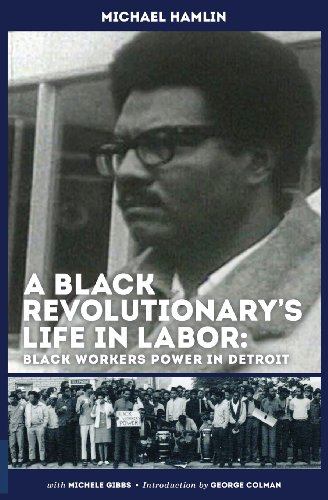
Herb Boyd Reviews Mike Hamlin's New Book about the Social and Political History of Radical Black Labor Struggles in Detroit in the 1960s and '70s

MIKE HAMLIN IN THE LATE 1960S


MIKE HAMLIN IN 2013

Book Review
By Herb Boyd 

Mike Hamlin, Labor Activist and Revolutionary Tells Very Important Story of Legendary Radical Black Labor Movements in Detroit During the 1960s and '70s and Strips Away the Myths


A Black Revolutionary’s Life in Labor:  Black Workers Power in Detroit.  by Mike Hamlin (wlth Michelle Gibbs)  Against the Tide,  2013


     Among the most redeeming and rewarding moments in Michael Hamlin’s “A Black Revolutionary’s Life in Labor:  Black Workers Power in Detroit” (Against the Tide,  2013) is his analysis of the several organizations in which he was a vital force, a significant member.   His first-hand account offers in vivid detail the strengths and weaknesses of such promising formations as the Dodge Revolutionary Union Movement, the League of Revolutionary Black Workers, the Black Workers’ Congress, and several other less prominent groups.

     Not only was Hamlin a founder and leader of some of these organizations, his maturity and calm under pressure was the tissue that held them together in times of tension and disagreement that threatened to tear them apart.  Hamlin also provides readers with insightful profiles of a few of the notable Detroit figures in the movement, including the late Ken Cockrel and John Watson, both of whom were with him at the very beginning of his labor activism.

     Without the diligence and commitment of Michele Gibbs, Hamlin’s memoir may be like so many others that are waiting to be written.  She returned to Detroit from her home in Oaxaca, Mexico at a most propitious moment and her very presence not only resuscitated Hamlin who had been stricken with life-threating ailments but she stayed around for several weeks interviewing him, gathering much of the material that was critical in shaping this engrossing book.

      In fewer than a hundred pages of narrative Hamlin and Gibbs touch on riveting chapters of the revolutionary’s political development, an odyssey that began in the cotton fields of Mississippi, continued in Ecorse, Michigan, and finally settled in Detroit.  Hamlin succinctly summarizes his apartheid days under Jim Crow, contrasting it with the Jewish Holocaust.  “Instead of big death camps,” he writes, “the South had little pockets of them, but everywhere.”

      He experienced a number of memorable moments coming of age in Michigan and he recounts an incident when he was in the fifth grade that had a powerful effect on him.  “The teacher said that I had done something and I replied, ‘I didn’t aim to do it.’  All my classmates laughed, thinking that this was a funny way to talk.  My reaction to that was to keep quiet and listen.”

      Keeping quiet and listening carefully and intently were important attributes for Hamlin during his days in the Army when soldiers are practically driven toward a “nihilistic outlook,” he recalls.  “Once your life is devalued, you carry out orders no matter what they ask you to do.” Fortunately, Hamlin’s mindset was stronger than the gung-ho orientation instilled by drill sergeants and ranking officers, and after mustering out he returned to Detroit and got a job as a truck driver at the Detroit News.  It was here that he met Cockrel and Watson who worked on the trucks delivering the papers to various outlets.

      The three bonded and from their daily discussions about the terrible political conditions, particularly the rampant police brutality in the city, they decided it was time to do something about it.   

      Following a method they lifted from V.I Lenin, they launched the Inner City Voice newspaper in 1967.  The paper would be a vehicle for the voiceless black workers many of whom like General Baker, gravitated to it at first from the factories from Detroit and then across the nation as the RUMs morphed under the umbrella of the League of Revolutionary Black Workers.  As the League’s influence and cache spread it cast a fresh light of optimism on the possibility of a working class upheaval, that long awaited “dictatorship of the proletariat.” 

    But the rebellion was stillborn and Hamlin waxes poignant on how and why that pregnant moment fell so disappointingly short.  “It’s interesting the way all the organizations began to dissolve at the same time,” Hamlin laments.  “We know of the efforts of COINTELPRO (a program put into effect by J. Edgar Hoover to destroy the left, including the black movement) to inject as much confusion as possible through infiltration.  We also know the effect of the calculated flooding of our communities with hard drugs.  But there was also the tendency internally, after some successes, to begin to believe in your own invulnerability.  Then personal ego takes the place of group betterment.”

    To this explanation, Hamlin adds a list of internal contradictions that erupted at the League’s headquarters in Highland Park where sympathetic white supporters were the targets of abuse, and where the occurrences of rape fueled the general onset of demoralization.  Some of these issues were spelled out by Hamlin during his recent appearance at the Left Forum in New York City.

      Hamlin is as impressive a storyteller as he is a social scientist, and this expertise is extended across a tableau of problems that curtailed the progressive forces who rallied around such formidable and charismatic leaders as Baker, Cockrel, Watson, et al.  He believes it was their level of commitment, especially for Cockrel and Watson that was responsible for their early deaths.

     Thanks to the dedication of Gibbs and the unconditional love of his wife, Joann, Hamlin is still with us, though not without health issues that makes it difficult for him to resume that relentless, energetic activism that is his legacy. 

      “A Black Revolutionary’s Life in Labor” reaches well beyond this corridor of struggle, and the pages are deftly complemented by essays from George Colman and Charles Simmons, and the photos, Gibbs poetry and illustrations, a study guide, and appendix fill out the rich tapestry of Hamlin’s remarkable sojourn that continues to find inspiration in the students he teaches and the troubled Americans he counsels.

      Towards the end of the book, Hamlin offers this assessment of where we stand and what’s to be done:  “What the situation today lacks is the third component, a revolutionary organization rooted in the masses with the working class to lead it.”

      We might also an additional lack—a strong and vigorous Mike Hamlin.  


"FINALLY GOT THE NEWS" 

Groundbreaking documentary produced by the League of Revolutionary Black workers (LRBW) in 1970:


FOR FURTHER INFORMATION ON RADICAL BLACK LABOR MOVEMENT HISTORY IN DETROIT AND ELSEWHERE FROM THIS PERIOD PLEASE CLICK ON THE FOLLOWING LINKS:

http://en.wikipedia.org/wiki/League_of_Revolutionary_Black_Workers


http://libcom.org/library/league-revolutionary-black-workers


http://www.historyisaweapon.com/defcon1/rbwstudy.html

http://againstthetidebooks.com/2013/04/


Herb Boyd is a journalist, activist, teacher, and has authored or edited 22 books, including his most recent one, Civil Rights: Yesterday & Today. His book Baldwin's Harlem, a biography of James Baldwin, was a finalist for a 2009 NAACP Image Award. In 1995, with Robert Allen, he was a recipient of an American Book Award for Brotherman--The Odyssey of Black Men in America, an anthology. We Shall Overcome, a media-fusion book with narration by the late Ossie Davis and Ruby Dee, is used in classrooms all over the world, as is his Autobiography of a People and The Harlem Reader. His articles can be found in such publications as The Black Scholar, The Final Call, the Amsterdam News, Cineaste, Downbeat, and The Network Journal, among others.

Among the highlights of his remarkable journalistic career was an invitation to fly on Air Force One with President Obama, whom he has interviewed on several occasions.

Over the last decade or so, Boyd has scripted several documentaries, including several with Keith Beauchamp on cold cases of martyrs from the civil rights era that were shown on Biography Channel and TV One. With filmmaker Eddie Harris, he was the writer on three documentaries--Trek to the Holy Land, Cri de Coeur (Cry from the Heart), and Slap the Donkey, that tracks the Rev. Al Sharpton's presidential bid in 2004. The latter film was recently selected to be screened at the Montreal Film Festival in 2010. Boyd is also a frequent guest on national television and radio shows, as well as a keynote speaker at many functions sponsored by noted community and college organizations, where his commentaries on African American culture and politics have earned him an increasingly large audience and popularity. For more than forty years, he has taught at institutions of higher learning. Currently, he teaches at the College of New Rochelle in the Bronx and at City College New York, and is also a national and international correspondent for Free SpeechTV.org, a media company that specializes in Internet television.


http://vimeo.com/46740150

"Finally Got the News"  (1970)

from Libcom Dot Org 10 months ago:

Documentary about the League of Revolutionary Black Workers, a radical black workers' group based in the car factories of Detroit. Through interviews with members, supporters and opponents as well as footage of leafleting and picket lines, Finally Got the News documents their attempts to build a radical black workers' organisation that would take on both racist management and unions and fight to improve conditions for all workers, black and white.


Finally Got the News from Libcom Dot Org on Vimeo.