A TRIBUTE TO YURI KOCHIYAMA AND AN APPRECIATION OF HER WORK AND LIFE ON HER 93rd BIRTHDAY: May 19, 2014

Passing It On - A Memoir By Yuki Kochiyama (2004)
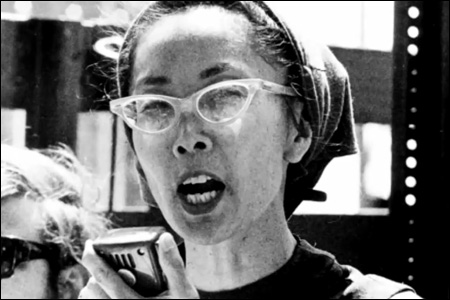
YURI KOCHIYAMA speaking at an anti-war demonstration and rally in Central Park, 1968. (Photo courtesy of Kochiyama family)
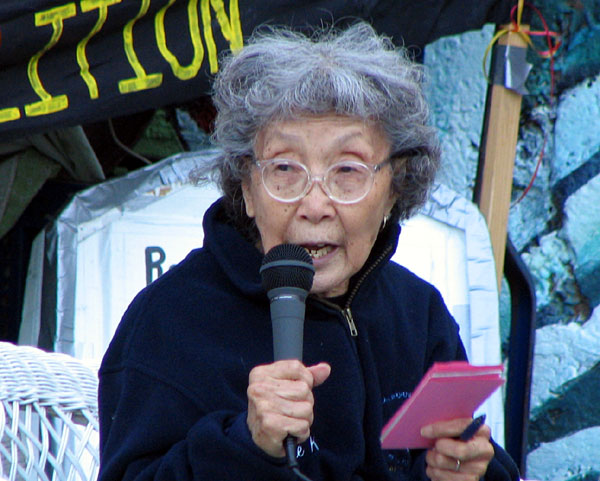
YURI KOCHIYAMA
(b. May 19, 1921)

Editors: Marjorie Lee, Audee Kochiyama-Holman and Akemi Kochiyama-Sardinha
Paperback: $17.00
ISBN-10: 0-934052-37-9
ISBN-13: 978-0934052375
Cloth Edition: $27.00
ISBN-10: 0-934052-38-7
Product Details:
Paperback: 256 pages
Categories: Asian American; Asian American Movement; Autobiography/ Biography/Memoir; Civil Rights; Gender and Sexuality; Internment; Japanese; Japanese American; Race Relations; Women's Studies
Table of Contents
Family
World War II And Internment Camps
Work And Friendship With Malcolm X & Harlem Freedom Schools
Organization Of Afro-American Unity
Hiroshima Atomic Bomb Survivors
Civil Rights In The South
Third World, Anti-Imperialist And Anti-Apartheid Struggles
Native American Sovereignty
Puerto Rican Independence
Vietnam War
Venceremos Brigade
Asian American Movement
Japanese American Redress And Reparations
Defense Of Political Prisoners
National And International Human Rights Movements
Anti-War Movements
Description:
Passing It On - A Memoir by Yuri Kochiyama is the account of Kochiyama, an extraordinary Japanese American woman who spoke out and fought shoulder-to-shoulder with African Americans, Native Americans, Latinos, Asian Americans and whites for social justice, civil rights, and prisoner and women's rights in the United States and internationally for more than half a century. A prolific writer and speaker on human rights, Kochiyama has spoken at more than 100 colleges, universities and high schools in the United States and Canada.
"This is my grandmother's memoir. It expresses the primary values and themes that have guided and directed her life, and it describes some of the struggles, movements, moments, and people that have most significantly inspired her to become the person that she is today." - Akemi Kochiyama-Sardinha.
This memoir received the Gustavus Myers Outstanding Book Award for 2004. The award honored "authors and books that challenge ways of thinking and acting, that allow the many faces and facets of bigotry to replicate over and over again," according to Loretta J. Williams, former director of the Gustavus Myers Center for the Study of Bigotry and Human Rights.
Experpt:
I was born Mary Yuriko Nakahara on May 19, 1921, and raised in San Pedro, California, a predominantly white working-class neighborhood. Aside from my twin brother Peter, I also had an older brother, Arthur, whom we called "Art." My parents were Issei (first- generation Japanese) so our home life was traditional in that we spoke Japanese and ate Japanese food and were expected to behave as proper Japanese children. Outside our home, though, I was very much an "all-American" girl. As a teenager and young adult, I volunteered at the YWCA, the Girls Scouts, and the Homer Toberman Settlement House that served the Mexican community in San Pedro. I taught arts and crafts, tennis, first aide to teenagers at the Red Cross, and Sunday School at my local Presbyterian Church. The day Pearl Harbor was bombed--December 7, 1941--changed all of our lives. Every American, of whatever background, was affected. Before the war, I was seeing America with American eyes. What happened to Japanese Americans after Pearl Harbor made me see the world and America with entirely new eyes -Japanese American eyes. In many ways, this marked the beginning of my political awakening and development. What follows are my memories, reflections, and beliefs about some of the major events of my life, people I have encountered, and movements I have supported and been involved in. Although I focus mainly on the many people I have encountered, befriended, and learned from since I left San Pedro, my political convictions had already taken root while growing up in my hometown. I must admit that my passion and zeal to address human and social injustices were already taking shape within me as a young girl.
Reviews:
"A legacy of humility and resolve, vitality and resistance, and, perhaps most important of all, hope for the future." -- Angela Davis
"Insight into social conditions and social justice for all who are oppressed."--Gustavus Myers Outstanding Book Award for 2004
"Yuri Kochiyama has fashioned an extraordinary life of commitment to peace, equality, and social justice." -- Angela Davis
Civil Rights Activist Yuri Kochiyama on her Internment in a WWII Japanese American Detention Camp & Malcolm X’s Assassination:
http://www.democracynow.org/2008/2/20/civil_rights_activist_yuri_kochiyama_remembers
http://www.democracynow.org/2008/2/20/civil_rights_activist_yuri_kochiyama_remembers
RELATED:
Civil Rights Pioneer Gloria Richardson, 91, on How Women Were Silenced at 1963 March on Washington
David Paterson Invokes Paul Robeson, Harriet Tubman, Malcolm X in Remembrance of Jazz Legend Max Roach
TOPICS:
Malcolm X, African-American History
GUESTS:
Yuri Kochiyama, longtime civil rights activist, interned at a U.S. concentration camp during World War II, friend of Malcolm X and with him as he died. Yuri Kochiyama is the author of Passing It On, a memoir.
RELATED:
Manning Marable on "Malcolm X: A Life of Reinvention"
May 21, 2007 | STORY
Civil Rights Activist Yuri Kochiyama Remembers the Day of Malcolm X’s Assassination to Her Internment in a WWII Japanese-American Detention Camp
Feb 21, 2006 | STORY:
On the 41st Anniversary of the Assassination of Malcolm X, "The Ballot or the Bullet"
Forty-three years ago this week, Malcolm X was gunned down in the Audubon Ballroom in Harlem. Yuri Kochiyama cradled his head as he lay dying on the stage. Kochiyama’s activism began after the bombing of Pearl Harbor, when she and her family were held in an internment camp along with more than 100,000 Japanese in the United States. [includes rush transcript]
TRANSCRIPT
AMY GOODMAN:
We go from the prison camps at Guantanamo to an earlier era of imprisonment here in the United States. This week marks the sixty-sixth anniversary of President Franklin Delano Roosevelt’s signing of the executive order that forced more than 120,000 men, women and children of Japanese descent into internment camps. This included nearly 70,000 American citizens. The US Supreme Court upheld the establishment of the internment camps after civil rights pioneer Fred Korematsu was jailed for refusing to be interned.
Korematsu said years later, “In order for things like this to never happen, we have to protest… so don’t be afraid to speak up.”
We now turn to an interview that we played earlier last year with civil rights activist Yuri Kochiyama. Her father was detained in 1942, hours after Pearl Harbor was attacked. He died soon after. The rest of Yuri Kochiyama’s family was eventually sent to an internment camp. She recalled the day federal agents detained her father.
YURI KOCHIYAMA:
I lived in San Pedro, California, which is, you know, on the west side of California, and it’s where many, many Japanese lived. Well, the Japanese were mostly all living on the West Coast: Washington, Oregon, California and parts of Arizona. And that’s the number one war zone. But immediately, the newspaper headlines were “Get the Japs Out!” and people like —- who is the guy, that general on the West Coast, the top one, the top general? I can’t think of his name. He said, “The only good Jap is a dead Jap.” And, anyway, not just the newspaper headlines, but there were signs all over. “Get the Japs out! Get the Japs out!” And -—
AMY GOODMAN:
You were a teacher? You were teaching that day that Pearl Harbor was bombed?
YURI KOCHIYAMA:
No. No. I had just finished junior college. No, I wasn’t teaching. But I was teaching Sunday school. And I had been teaching about a year and a half. It was a place where I felt very comfortable. But that day, when I went in, I could just feel something was different. And, of course, because that’s all people were thinking about is —
AMY GOODMAN:
Were you the only Japanese American at the Sunday school?
YURI KOCHIYAMA: Oh, yeah. It was really what’s called a white church. So I took all the kids home, as I usually do. They pack in the car, sit on top of each other, and I take about ten of the kids home. And then, when I came home, I was — just made it home. I knew my father had come back from the hospital, so I came back early, too. And just a few minutes later, three tall white men, I could see through the window. They were right there at the door.
And so I went there to see who they were. And they all, you know, put their — like a wallet out, which had the FBI card. And they said, “Is there a Seichi Nakahara living here?” I said, “Yes, that’s my father.” They said, “Where is he right now? We need to see him.” I said, “Oh, he’s sleeping in bed.” I said, “He just came home.” I don’t know if it was that morning or the day before, he came home from ulcer surgery. And they said, “Well, where is he?” And I pointed to one of the bedrooms. And they went in and got —- it was done so quickly, it didn’t even take a half of a minute, I don’t think. And I didn’t dare ask a question. They were going out the door immediately. And then, I just called my mother, who was right down the street to say, “Come home quick. The FBI just came and took pop.” And -—
AMY GOODMAN:
He was the first person, Japanese American, arrested after the bombing of Pearl Harbor?
YURI KOCHIYAMA:
That’s what we heard, but I don’t know if it was the first. They could have been doing it all over, but I think he was one of the first, because the first — in twenty-four hours, I didn’t — I don’t think they were —- well, they did find the Japanese still very quickly. So I’m sure they had a list. And -—
AMY GOODMAN:
What was his job, that they went after him?
YURI KOCHIYAMA: Well, he was in the fishing business. That’s why it hit all fishermen, because they knew then that the fishermen knew the waters, and if the Japanese ships got close enough, would the Japanese fishermen in America help the Japanese? But, actually, I tell you, the Japanese Americans and even the Isseis, first generation, who could not become Americans, they were so American. And yet, the hysteria about the suspicion of Japanese people was very, very strong. And, anyway, by the end of the day, I think all the Japanese people were calling their friends to say, “Did anyone come to your home and take your father or mother?”
AMY GOODMAN:
How long was your father held for?
YURI KOCHIYAMA:
Well, he was picked up on December 7th. And, of course, he wasn’t getting any better, because they didn’t do anything for him while he was in the —- first, he was in prison. And my mother kept begging, “Please let him go to a hospital, and then when he gets some treatment, then he could go back to the prison.” But we didn’t realize that when they did take him to the hospital, he was the only Japanese that was taken there, and all the other prisoners, every single one of the prisoners, were Americans, all white, no black or brown or anyone else. And I -—
AMY GOODMAN:
In the hospital.
YURI KOCHIYAMA: What?
AMY GOODMAN: In the hospital.
YURI KOCHIYAMA:
Yes, in the only hospital in our town, San Pedro Hospital. And then they put a sheet around his bed, and it said, “Prisoner of war.” And we hadn’t — us kids didn’t get to go see my father yet, but my mother got permission, and she said when she saw the sheet with the “prisoner of war,” and she saw the reaction of all the American prisoners who were just brought in from Wake Island, she didn’t think he was going to last. And so, she asked the head of that hospital, could he be given a room by himself and get some medication or something, and then when he was feeling better, could they take him back to the prison, because that hospital, she said, was probably worse than prison, because here were all these Americans who had been injured, you know, in Wake Island or other islands, and at least in the prison, he would be in a — probably in a cell by himself.
AMY GOODMAN:
When, ultimately, did he get released? How long was he held?
YURI KOCHIYAMA: He came home. He was home not even twelve hours. He came home, it was around dinner time, 5:30. And they had a nurse come with him. And we put him in his own bedroom. And the nurse was the only one that stayed in that room. And by the next morning, she woke us up and said, “He’s gone.”
AMY GOODMAN:
Were you rounded up, as well?
YURI KOCHIYAMA:
Not then. No. They were only rounding up first generation Japanese.
AMY GOODMAN:
So your father died —
YURI KOCHIYAMA:
We were American citizens.
AMY GOODMAN:
Your father died after being released?
YURI KOCHIYAMA:
Yeah.
AMY GOODMAN:
Immediately after.
YURI KOCHIYAMA:
He was only home not even twelve hours, and he was gone. So, we didn’t get to talk to him. We don’t think he could have talked the way he looked, jumbled or mumbled. We couldn’t tell if he could see. We would put our hands in front of him. We didn’t know if he could hear. And it was so fast, he was gone.
AMY GOODMAN:
We only have a minute. But were you detained, your family, after?
YURI KOCHIYAMA:
Everybody was. Every person of Japanese ancestry, 120,000 from those three states, for three-and-a-half states, because it was the number one war zone, so 120,000 —
AMY GOODMAN:
And how long —
YURI KOCHIYAMA:
What?
AMY GOODMAN:
And how long were you held for?
YURI KOCHIYAMA:
Well, everybody was — at least two years, I think. And then, because there was this case, and nobody hears of, called the Endo case, where they found out in that case that actually the United States government had no right to take all the people into prison camps when there was nothing really official that could have said that we did some wrong to this country.
AMY GOODMAN: Yuri Kochiyama, describing the Japanese internment in World War II. When we come back from break, she’ll talk about the day Malcolm X was assassinated, forty-three years ago this week. She cradled his head as he lay dying. Stay with us.
AMY GOODMAN: Forty-three years ago tomorrow, on February 21, 1965, Malcolm X was shot dead as he spoke at the Audubon Ballroom in Harlem. He had just taken the stage, when shots rang out, riddling his body with bullets. He was thirty-nine years old. We continue now with our interview with Yuri Kochiyama. She was Malcolm X’s friend. She was in the Audubon Ballroom the day he was killed. After he was shot, she rushed to the stage, cradled his head in her arms as he lay dying. Yuri Kochiyama talked about that fateful day.
YURI KOCHIYAMA: The date was February 21st. It was a Sunday. Well, prior to that date, I think that whole week there was a lot of rumors going on in Harlem that something might happen to Malcolm. But I think Malcolm showed all along, especially around that time, that there were rumors going on. He was aware, because there were things even in the newspaper, that there was some, I think — I don’t know if it was a misunderstanding or just disagreeing about some things that Elijah Muhammad and Malcolm were talking about. They were personal things. But Malcolm was aware that Elijah seemed to be feeling a little — what would be — oh, I’m so sorry that I’m messing this up — but on some very personal issues, there was disagreement between Elijah and Malcolm, and I think there was even talk that was going on, and after the assassination, however, many black people felt it could have been by people who had infiltrated or that the police department and FBI may have actually planted in the Nation of Islam.
AMY GOODMAN:
Describe that day. Malcolm came out on the stage, but first he was introduced by someone else. You were sitting in the audience? Where were you?
YURI KOCHIYAMA:
No. He was sitting in the little room right next to the stage. And Brother Benjamin was doing the speaking. But everyone noticed that even the guards seemed a little upset, and it was because they said that those who were invited to speak that day, that none of them showed up. And, of course, the crowd in there, about 400 people, realizing something was amiss, did feel that something was going wrong.
AMY GOODMAN:
You mean that speakers were invited who didn’t show?
YURI KOCHIYAMA:
Mm-hmm.
AMY GOODMAN:
Where were you sitting?
YURI KOCHIYAMA: I think about the tenth — equivalent to about the tenth row from the podium and almost right across — well, in the middle, where the two guys got up and said — one of them yelled, “Take your hands out of my pocket!” When everybody started just looking at them, the two guys. They were, like, fighting.
AMY GOODMAN:
They had stood up as Malcolm X was speaking, very close to the beginning of his speech.
YURI KOCHIYAMA:
Yes, he was just going to speak. And Malcolm just said, “OK, brothers, let’s just break it up.” But what happened was, it seemed to suck in all his guards closer to what was happening. And then —
AMY GOODMAN:
A kind of diversion.
YURI KOCHIYAMA:
The diversion, right. Everybody was looking there. When — because we were all watching the two guys in the audience, and everybody was watching, and the guards themselves moved from their post. They’re supposed to be protecting Malcolm. Well, Malcolm first said, “OK, now, let’s break it up.” But because Malcolm had left the podium, he was just a perfect target to be shot. And I don’t know if it was two or three men, right in front, went up and started shooting. Well, by that time, the whole place was chaotic. I mean, people were chasing — some of them chasing after those two guys, and people were yelling and screaming and others — because they let women and children in at the very end, the decision. The kids were — could be crying or just running to get near their mother, and mothers were trying to shield the kids. And I guess the two guys who did the — what was the word you said?
AMY GOODMAN:
The diversion?
YURI KOCHIYAMA:
Diversion. They shot a few times, you know, not to hit anyone, but just, I think, to make the place look even more chaotic there. And Malcolm had told his men, especially the very close Muslims, not to bring any arms, that they didn’t want to frighten the women and children. And so, no one was supposed to bring anything, but one Muslim, and I think thank goodness that one did have a gun, and he’s the only one that shot one of the people who came to assassinate. If he wasn’t there with a gun, I think they would have all fled. And then, anyway, you know the three men who were charged, none of them were even there, and they proved it at the end.
AMY GOODMAN: So when Malcolm was shot and he was laying on the stage, you ran up?
YURI KOCHIYAMA:
Yes, because I saw a young brother pass me, and he seemed to know just where to go or how to get up on the stage. And he acted just like — what do you call it? You call it, not a guard. Well, like one of Malcolm’s security anyway. And he went up, and I followed him. And he went to the back, and he pulled the curtains to see if there was anyone in the back. And at that time, I mean, Malcolm had fallen straight back, and he was on his back, lying on the floor. And so I just went there and picked up his head and just put it on my lap. People ask, “What did he say?” He didn’t say anything. He was just having a difficult time breathing.
AMY GOODMAN:
What did you say to him?
YURI KOCHIYAMA:
I said, “Please, Malcolm, please, Malcolm, stay alive.” But he was hit so many times. Then a lot of people came on stage. They tore his shirt so they could see how many times he was hit. People said it was like about thirteen times. I mean, the most visible is the one here on his chin. He was hit somewhere else in the face, and then he was just peppered all over on his chest.
AMY GOODMAN:
Betty, his wife Betty Shabazz, was there with the children.
YURI KOCHIYAMA:
Yes. At the very end, he called her. He had told her before not to come, because he was afraid something was going to happen. Then at the end, he changed his mind and called her and said, “Come, right away. They’re almost starting.” And he said, “Please bring the children. There’s nothing to worry about.” And so, she brought them. They had four children, and she was pregnant. And, you know, shortly after, she had two more.
AMY GOODMAN:
She also came up on the stage, as Malcolm lay there dying?
YURI KOCHIYAMA:
Yes.
AMY GOODMAN: And what did you do then?
YURI KOCHIYAMA:
When someone told me to go to the side room, and they handed me, you know, a milk bottle and the youngest child, and so they just said, “Feed the baby.” Betty was right there with Malcolm.
AMY GOODMAN: You had met Malcolm years before in a Brooklyn courtroom.
YURI KOCHIYAMA: Right.
AMY GOODMAN: Can you describe the scene there?
YURI KOCHIYAMA: Oh, yes. Well, I’ll never forget that day. I mean, it was unexpected. Even though Malcolm could show up anywhere, you know, at any time and wherever his people are. And, well, all of a sudden, someone walked into the foyer, the first floor of the courthouse in Brooklyn. And all of the young kids — they were all black — they were all running downstairs to the foyer, and here was Malcolm coming in through the front door. No guards. He was there just by himself. I was quite surprised, because it was a dangerous time for him. And all of the kids, they were maybe between seventeen and twenty-five, that age, and they were such energetic kids who — they really, like, mobbed him with admiration. Everybody wanted to shake his hands.
And as I watched, about twenty-five yards away, I felt so bad that I wasn’t black, that this should be just a black thing. But the more I see them all so happily shaking his hands and Malcolm so happy, I said, “Gosh darn it, I’m going to try to meet him somehow.” And so, I kept getting closer, and I said, “If he looks up once, I’m going to run over there and see if I could shake his hand.” And so, that’s what I did.
There was a time where — maybe he didn’t look up, but I may have just thought he did or wished he did. And so, then I yelled and said, “Malcolm, can I shake your hands, too?” because all these young people were. And he said “What for?” And I didn’t know at first what to say. “What for?” I said, “Because what you’re doing for your people.” And he said, “And what am I doing for my people?” Now, I thought, “What would I say to that?” And so I said, “You’re giving directions.” And then, he just changed and said — he came out of the center of that, you know, where everybody was there, came out and he stuck his hands out. So I ran and grabbed it. I couldn’t believe that I was shaking Malcolm X’s hand. And I was just so sorry that my son, who was sixteen, who wanted to come so much, but he had an exam in high school and he didn’t think he could miss that exam, so he missed seeing Malcolm then. He met him later.
AMY GOODMAN:
You were there because people — you were among hundreds who were arrested, protesting for jobs for Puerto Rican and black construction workers?
YURI KOCHIYAMA:
Yes.
AMY GOODMAN:
So that started your relationship with Malcolm X. It was just really a month before John F. Kennedy was assassinated —- would be assassinated in Dallas. October 16, 1963 -—
YURI KOCHIYAMA:
Right.
AMY GOODMAN:— was the day that you met him.
YURI KOCHIYAMA:
Right. October 16 is when I met Malcolm. And —
AMY GOODMAN:
And JFK was killed on November 22.
YURI KOCHIYAMA:
He was killed — yeah, John Kennedy was killed on November 22.
AMY GOODMAN:
But for the next two years, you would meet with Malcolm regularly. Can you talk about the meetings, the sessions that he had that you would attend?
YURI KOCHIYAMA:
Well, they had regular meetings, you know. But it seems like Elijah and Malcolm’s problems were getting a little more serious, and I think because FBI played a role in it, and, of course, they knew which ones of the people in NOI may have had some kind of ill feelings.
AMY GOODMAN:
Nation of Islam.
YURI KOCHIYAMA:
Mm-hmm. And things got more serious. There were more articles in the newspaper, and everyone knew that Malcolm’s life was in danger. But also, about that time, I didn’t realize until you said right now, that Kennedy was killed only two months?
AMY GOODMAN: Only a month after you and Malcolm X first met.
YURI KOCHIYAMA:
Only a month after. Oh, because it was November.
AMY GOODMAN:
Right. It was the last two years also of Malcolm X’s life. 1963 to 1965, when he was assassinated, as well.
YURI KOCHIYAMA: Right.
AMY GOODMAN: You received — Malcolm X wrote you postcards through his trip through Africa and his journey to Mecca.
YURI KOCHIYAMA:
Yes.
AMY GOODMAN:
What did he write to you in these postcards?
YURI KOCHIYAMA:
Well, he sent eleven and from nine countries. There were two countries he went twice. But at the time that he went to Africa, all the major African conferences were happening. Two were even happening in England. And Malcolm went to all of these, and, of course, all the most progressive presidents of African nations were at these conferences. So he got to meet almost all the top ones. I mean, there was Ghana’s Nkrumah or Tanzania’s [Nyerere]. I can’t even think of all of them, but he met about eleven of them, and they were as excited to meet him.
He wanted to learn all about the different countries in Africa. And he — the Africans and he talked about the colonization that took place. Well, it could have happened from even as early as the 1600s, but it was mostly 1700, 1800. And the big day that we’ve got to remember is, I think, 1885. That was where all those European countries took over African countries. What was the name of that? Gosh, I would forget the name. Wait. It might come back to us.
AMY GOODMAN:
Well, let me ask you about this. When Malcolm came back, he was also talking about an expanded attitude about human rights, something he had talked about before, as well. Not so much civil rights, but the rights of African Americans to be fully equal was an issue of international human rights.
YURI KOCHIYAMA:
Oh, yes. And that’s why Malcolm thought that this civil rights thing was really nothing, because African people don’t have to wait until some president of another country, even United States, would give civil rights. I mean, Africans already have human rights. And he felt, too, that it was too narrowed down when they would be using words that they were just fighting for civil rights. And I think what was so wonderful is that Malcolm taught his group, American — well, black Americans here, about the history of Africa, where they became colonized, and then he told the people in Africa what was happening here, how blacks were treated, and that many of the African young people didn’t even know anything hardly about slavery, because this country never told them anything.
AMY GOODMAN:
Yuri Kochiyama, he also came to your house to meet with survivors of the atomic bombing of Hiroshima/Nagasaki: Hibakusha, the survivors.
YURI KOCHIYAMA: Yes, right.
AMY GOODMAN: Can you talk about that?
YURI KOCHIYAMA:
Well, we were all so happy, I mean, especially Japanese Americans and even other Asian Americans, that Malcolm would be interested. But Malcolm was interested in every group, and especially when he would hear the kind of harassments and all the negative things that always seemed to be happening to people of color. And he knew about Asian history so well. We couldn’t believe it.
AMY GOODMAN: Yuri Kochiyama remembering Malcolm X. Forty-three years ago tomorrow, on February 21, 1965, Malcolm X was assassinated in the Audubon Ballroom in Harlem. He had just taken the stage, when shots rang out, riddling his body with bullets. He was thirty-nine. Yuri Kochiyama ran to the stage. She had been there to listen to him that day, and she cradled his head. Yuri Kochiyama and her family also interned as a result of FDR’s executive order after Pearl Harbor bombing with over 100,000 other Japanese and Japanese Americans in this country.
http://www.h-net.org/reviews/showrev.php?id=11765
Diane C. Fujino. Heartbeat of Struggle: The Revolutionary Life of Yuri Kochiyama. Minneapolis: University of Minnesota Press, 2005. xxxviiii + 396 pp. $60.00 (cloth), ISBN 978-0-8166-4592-3; $19.95 (paper), ISBN 978-0-8166-4593-0.
Reviewed by Yasuhiro Katagiri
(Department of American Civilization, Tokai University, Kanagawa, Japan)
Published on H-1960s (May, 2006)
A Passion for Life, Liberty, and the Pursuit of Happiness
In 1969, Bill Hosokawa published a landmark book on the history of Japanese Americans. Entitled Nisei: The Quiet Americans, it told the important story of a relatively small but nevertheless significant component of the American population--the Issei ("first generation" Japanese immigrants) and Nisei ("second generation" American-born children of those Japanese immigrant parents) who encountered formidable racial prejudice and discrimination, particularly after the outbreak of the Second World War.
When Hosokawa's book came out, some within the Japanese-American community, most of whom were younger Sansei ("third generation" Japanese Americans), vigorously protested that the Nisei--Hosokawa's generation--had by no means been "quiet" and that the book's very characterization of Nisei as such was offensive, for it would perpetuate "an undesirable stereotype" of the entire Japanese-American population.[1] As Hosokawa has contended, however, the majority of Nisei, who were interned during the war years in spite of their American citizenship, endured their hardships quietly, believing that the best and surest way to show loyalty was to support the nation's war effort--even its misguided and racist relocation program.
In 2005, another landmark book in the field of Japanese-American studies appeared. Authored by Diane C. Fujino, a Japanese American, Heartbeat of Struggle traces the eventful life of Yuri Kochiyama, a Nisei woman who was transformed from a relatively "quiet" American into "the most prominent Asian American [civil and human rights] activist to emerge during the 1960s" (p. xxii). Heartbeat of Struggle is not in fact the first biography of Kochiyama. In 1998, a Japanese journalist profiled Kochiyama, and in 2004 she wrote her own memoir, which received an "Outstanding Book Award" from the Gustavus Myers Center for the Study of Bigotry and Human Rights in Boston.[2]
But these works do not diminish the value of Heartbeat of Struggle. The extraordinary life of Kochiyama had remained largely unknown and unattended by scholars until Fujino, an associate professor of Asian American studies at the University of California at Santa Barbara, produced what is believed to be "the first U.S. biography of an Asian American woman activist" (p. xxxi). Fujino's book is a much enlarged and more complete version of her earlier work entitled "Revolutions from the Heart: The Making of an Asian American Woman Activist, Yuri Kochiyama," which was included in a 1997 anthology entitled Dragon Ladies.[3] Based on this earlier publication, extensive archival research, and interviews with Kochiyama, immediate family members, and longtime friends from the full spectrum of her life, Fujino passionately recounts and reconstructs the "political life" of Kochiyama, who has spoken out and fought shoulder-to-shoulder with blacks, Native Americans, Asian Americans, Hispanic Americans as well as whites for civil rights and social justice over the past four decades (pp. xxvii-xxviii).
Yuri Kochiyama was born Mary Yuriko Nakahara on May 19, 1921, in San Pedro, California, a small coastal town south of Los Angeles. Her immigrant parents were both well educated, and her father owned and operated a successful store, selling fresh fish, meat, fruits, vegetables, and other daily commodities to the U.S. Navy and Japanese passenger liners, which operated between the West Coast of the United States and Japan. Raised in a comfortable, custom-built Spanish-style house in the white section of the town and surrounded by her loving parents and two brothers, Kochiyama spent her youth being "apolitical, provincial, naive, and ultrapatriotic" (p. xxii). "Our home life was traditional in that we spoke Japanese and ate Japanese food and were expected to behave as proper Japanese children," she reminisced in her memoir, "but "outside our home ... I was very much an 'all-American' girl."[4]
On December 7, 1941, Kochiyama's cozy life was suddenly shattered when the Japanese Imperial Forces bombed Pearl Harbor. Within a few hours after the bombing, the Federal Bureau of Investigation (FBI) apprehended Kochiyama's father, a severe diabetic, who was viewed as a subversive. In the end, the FBI was unable to substantiate its suspicions and eventually released him several weeks later. But deprived of proper medical attention while in detention, Kochiyama's father passed away in late January 1942.
For thousands of Japanese Americans, the ensuing mass hysteria, fear, racial antagonism, and eventual incarceration literally represented "shattered dreams." At the same time, the outbreak of the war also "inaugurated ... [a] racial awakening" of twenty-year-old Kochiyama (p. xxii). Before the war, she saw "America with American eyes." But what happened to Japanese Americans after Pearl Harbor made her "see the world and America with entirely new eyes--Japanese American eyes."[5] Her traumatic experiences had awakened her to the existence of racial and social injustice in the United States. Kochiyama could no longer naively profess that she was "a color-blind patriot" (p. 1).
In April 1942, only a few months after her father's untimely death, she and her family were ordered to leave their well-appointed house in San Pedro and were sent to the Santa Anita Assembly Center in California, where they were billeted in horse stalls at a former racetrack. Six months later, Kochiyama, along with her mother and older brother, were moved by train from California to a more permanent incarceration camp--the War Relocation Authority (WRA)'s Jerome Relocation Center in Arkansas. The Jerome and Rohwer Relocation Centers in Arkansas were the only two Japanese-American internment camps located in the South, which the Office of War Information (OWI) had once hypocritically termed "new pioneer communities" for those evacuees.[6] Nearly 8,500 Japanese and Japanese Americans were incarcerated at Jerome, located in the midst of a dismal swampland in southeastern Arkansas and surrounded by barbed-wire entanglements.[7]
A few months after Kochiyama arrived at Jerome, by which time 122,000 men, women, and children (including 70,000 "American citizens") were interned at ten war relocation centers, the Department of War began to form the U.S. Army's 442nd Regimental Combat Team, a segregated unit composed of all Nisei soldiers. When the recruitment plan for the 442nd was announced, many Nisei, in both the Hawaiian Islands and the relocation centers, responded enthusiastically. Eventually, in April 1943, the unit began to train at Camp Shelby, located near Hattiesburg, Mississippi.[8]
Soon, however, the young Nisei women at Jerome learned that the Nisei soldiers at Camp Shelby were not welcome at the United Service Organization (USO) in Hattiesburg. In response, they quickly organized their own USO, where Kochiyama met and fell in love with her future husband and "comrade"--Masayoshi William "Bill" Kochiyama, a Nisei soldier from New York City. When the war broke out, Bill Kochiyama happened to live in California, and he was interned at the Tanforan Assembly Center in San Bruno before being sent to the Topaz Relocation Center in Utah.[9] Having spent one year at the camp, he volunteered to join the newly organized Japanese-American combat unit.
In the spring of 1944, Yuri and Bill planned to marry at Camp Shelby, but a conflict with their families prevented their exchanging vows at that time. They decided to postpone their marriage until Bill could return from his overseas military duty. As the 442nd demonstrated its military prowess on the battlefronts in Italy and France, even the WRA began to praise the Nisei soldiers. "[The] devotion to America and gallantry in action," according to the WRA's booklet entitled Nisei in Uniform, should not be "determined by the slant of the eyes or the color of the skin."[10] The 442nd eventually became the most decorated combat unit in the history of the U.S. Army.[11]
While waiting for Bill's safe return from Europe, Kochiyama decided to remain in Hattiesburg and work with the "Aloha USO" for Japanese Americans.[12] Her main duties included taking care of the families of the Japanese-American soldiers, finding them adequate housing, and doing "anything else to help them settle and feel at home" in Mississippi's racially segregated society.[13] These experiences also helped transform Kochiyama's "colorblind worldview." As Fujino notes, "For the first time, she was being forced to recognize her own racial identity, to see herself not just as an individual but as a member of a targeted group" (pp. 50-51). Furthermore, what Kochiyama witnessed and encountered on a daily basis in Mississippi--the citadel of racial segregation and discrimination in the South--made it "increasingly difficult [for her] to deny" unfair and discriminatory treatment toward not only her own race but also blacks (p. 51).
After the war came to an end, Kochiyama moved to New York City in January 1946 and married Bill. The newlywed couple moved into a low-income housing project--the Amsterdam Houses in central Manhattan--which were predominantly occupied by blacks and Puerto Ricans. As Kochiyama got to know her neighbors, she began to understand more clearly the parallel between the way blacks were treated in the segregated South and the way Japanese Americans were evacuated and incarcerated. The connecting factors, Kochiyama recognized, were "senseless degradation, brutality, and hatred wrought by fear and ignorance" which was ultimately "caused by racism."[14] That conviction was reinforced in 1958, when Daisy Bates, the president of the National Association for the Advancement of Colored People (NAACP)'s Arkansas branch and the mentor of the "Little Rock Nine," visited New York. Kochiyama had an opportunity to meet her and started to "take a serious interest in the civil rights movement."[15]
In late 1960, the Kochiyama family, now with six children, moved to a new housing project in Harlem--the Manhattanville Houses--which was intended to accommodate low-income black and Hispanic families. The move to Harlem--a "university-without-walls" as Kochiyama has described it--put her and her family in the political, social, and cultural brew of the 1960s, including an incipient black nationalist movement, to which Kochiyama would soon be drawn (p. 134). It was under these circumstances that Kochiyama, at the age of forty, developed her political activism. While holding a series of community gatherings in their new home with guest speakers such as James Peck, a white leader of the Congress of Racial Equality (CORE) who had participated in the 1961 Freedom Ride, Yuri and Bill joined the Harlem Parents Committee in 1963. Working with the NAACP, CORE, and other civil rights organizations, the grassroots committee demanded a better and integrated public school system in Harlem. In so doing, they initiated school boycotts and even opened their own "Freedom School" in October 1963.
Until the end of 1963, Kochiyama's activism, as Fujino observes, "could be described as liberal-progressive," reflecting her belief that the best way for racial minorities to advance their political, social, and economic status would be "integration into White America" (p. 123). But her faith in the teachings of Martin Luther King Jr. was altered when she met and became friends with Malcolm X, then with the Nation of Islam, who "revolutionize[d] her political vision" (p. 135). Inspired by his vision of black self-determination, Kochiyama soon joined the Organization of Afro-American Unity (OAAU).[16]
Then tragedy struck. On February 21, 1965, Malcolm X was assassinated at the Audubon Ballroom. Kochiyama was in the audience, and it was she who cradled the dying OAAU leader's head in her arms. Fujino contends that by the time of Malcolm X's death, Kochiyama's politics and activism had undergone a significant shift, "moving from integration and nonviolence to self-determination and self-defense" (p. 162). Kochiyama's ideological transformation had certainly been influenced by Malcolm X. But it also reflected the emergence of radical politics espoused by those blacks who began to reject the traditional and moderate goals of the civil rights movement.[17]
As Kochiyama's immersion in the broadly defined "Black Power" movement deepened in the latter half of the 1960s, her visibility as a Japanese-American woman prompted the FBI--which Kochiyama believed had shortened her father's life--to place her under surveillance. One FBI agent even claimed in late 1966 that Kochiyama might be a "Red Chinese agent" (p. 174). Her children also came under state surveillance. In April 1965, only a few days after fifteen-year-old Audee Kochiyama arrived at McComb, Mississippi, with eight other student volunteers to register black voters, the Mississippi State Sovereignty Commission--the state's "segregation watchdog agency"--dispatched one of its investigators to ascertain whether Audee, who "appear[ed] to be of Chinese extraction," was "subversive or communist."[18]
In the 1970s, Kochiyama remained a political activist. In 1977, she participated in and was arrested during the take-over of the Statue of Liberty by Puerto Rican nationalists who demanded independence for the Caribbean island, an end to discrimination against Puerto Ricans in the United States, and freedom for their compatriots in prison.[19] She regarded her fellow political prisoners as "the heartbeat of the struggle."[20] But as Fujino's book title suggests, it was Kochiyama herself whom many have regarded as "the heartbeat," "pumping life and energy into the Movement and sustaining the struggle" (p. xxiv).
As Fujino reveals, Kochiyama's activism has encompassed "revolutionary and reformist, nationalist and internationalist, and separatist and integrationist elements" (p. xxvi). Yet her core and primary belief is that civil and human rights activism in the United States should forge unity among racially and ethnically diverse communities. "My priority would be to fight against polarization," she explained in a 1993 documentary film on her life, and, "I think there are so many issues that all people of color should come together on."[21]
Despite its great significance, Heartbeat of Struggle unfortunately has some minor flaws. Fujino might, for instance, have offered a more complete explanation and interpretation of Kochiyama's complicated political beliefs, including how she was able to reconcile her belief in both integration and separation. At one point, Fujino explains that Kochiyama's views were "profoundly shaped by the eclectic radicalism" espoused by Malcolm X and Robert F. Williams, who, as the president of the Monroe, North Carolina, branch of the NAACP, advocated armed self-defense (p. 188). Readers of Fujino's book would naturally like to know whether Kochiyama ever experienced any inner turmoil as result of her--at times--contradictory views.
Fujino might also have trimmed some of the many lengthy and sometimes tedious block quotations, which hinder the book's readability and the flow of the author's interpretations. Finally, the lack of a bibliography, although perhaps due to the demands of the publisher, is regrettable and diminishes the book's value as an academic work.
Yet Heartbeat of Struggle is an extraordinary work which details the life of a remarkable woman who has fought for racial and social justice her entire life. Regardless of whether readers sympathize with Kochiyama's political views, she is undoubtedly an intriguing, inspiring, and instructive individual and truly one of the "most incessant" civil and human rights activists in the United States (p. 275).
Notes
[1]. Bill Hosokawa, Nisei: The Quiet Americans (New York: William Morrow, 1969; reprint, Niwot: University Press of Colorado, 1992), p. 502.
[2]. Mayumi Nakazawa, The Life and Times of Yuri Kochiyama [in Japanese] (Tokyo: Bungei-Shunju, 1998); Yuri Nakahara Kochiyama, Passing It On: A Memoir (Los Angeles: UCLA Asian American Studies Center Press, 2004); Annie Nakao, "Oakland: Inspired by Malcolm X, Asian American Activist Makes Her Own Story," San Francisco Chronicle, September 9, 2005, p. F3; (http://www.sfgate.com/cgibin/article.cgi?file=%2Fc%2Fa%2F2005%2F09%2F09%2FEBGIBEG0QU1.DTL); and, "2004 Gustavus Myers Outstanding Book Award Winners Advancing Human Rights," Gustavus Myers Center for the Study of Bigotry and Human Rights, Boston (http://www.myerscenter.org/pages/04winners.htm).
[3]. Diane C. Fujino, "Revolutions from the Heart: The Making of an Asian American Woman Activist, Yuri Kochiyama," in Dragon Ladies: Asian American Feminists Breathe Fire, ed. Sonia Shah (Boston: South End, 1997), pp. 169-181.
[4]. Kochiyama, Passing It On, p. xxiii.
[5]. Ibid., p. xxiii.
[6]. Japanese Relocation, prod. Bureau of Motion Pictures, Office of War Information, Washington, D.C., 1943, MPEG1 movie, Internet Archive, San Francisco (http://www.archive.org/download/Japanese1943/Japanese1943.mpg).
[7]. Roger Daniels, Prisoners without Trial: Japanese Americans in World War II (New York: Hill and Wang, 1993), p. 131; and Alice Yang Murray, ed., What Did the Internment of Japanese Americans Mean?, Historians at Work Series (Boston: Bedford/St. Martin's, 2000), pp. 9-20. Japanese American Relocation Digital Archives (JARDA) at (http://jarda.cdlib.org/) is an excellent online educational resource created and maintained by the California Digital Library.
[8]. Yasuhiro Katagiri, "Fighting against the Southern Way of Life: The 442nd Japanese-American Regimental Combat Team in Mississippi" [in Japanese with an English abstract], Journal of Kyoritsu Area Studies,11 (Spring 1997): pp. 17-36; and Thelma Chang, "I Can Never Forget": Men of the 100th/442nd (Honolulu: Sigi Productions, 1991).
[9]. U.S. Commission on Wartime Relocation and Internment of Civilians, Personal Justice Denied: Report of the Commission on Wartime Relocation and Internment of Civilians (Seattle: University of Washington Press, 1997), p. 136.
[10]. War Relocation Authority, Nisei in Uniform (Washington, D.C.: GPO, n.d. [1945]), n.p., vertical file: "Camp Shelby, Undated, 1943-1958," Mississippiana Collection, William D. McCain Library and Archives, University of Southern Mississippi, Hattiesburg.
[11]. Most Decorated: The Nisei Soldiers, prod. Peter Kenney, dir. Robert Lihani, A & E Networks, New York, 1994.
[12]. Herbert M. Sasaki, "An Oral History with Mr. Herbert M. Sasaki," recorded interview by Yasuhiro Katagiri, September 2, 1993, transcript, pp. 50-51, Mississippi Oral History Program, Center for Oral History and Cultural Heritage, University of Southern Mississippi; William T. Schmidt, "The Impact of Camp Shelby in World War II on Hattiesburg, Mississippi," Journal of Mississippi History 39 (February 1977): p. 46; and Ronald Smothers, "Japanese-Americans Recall War Service," New York Times, June 19, 1995, p. A8.
[13]. Kochiyama, Passing It On, p. 17.
[14]. Ibid., p. 7.
[15]. Ibid., p. 45.
[16]. Yuri Kochiyama, "A History of Linkage: African and Asian, African American and Asian American," Shades of Power: Newsletter of the Institute for Multiracial Justice 1 (Spring 1998): p. 3; (http://modelminority.com/modules.php?name=News&file=article&sid=156>; and Norimitsu Onishi, "Harlem's Japanese Sister: Immigrants' Daughter Who Embraced Malcolm X Keeps a Radical Flame Alive," New York Times, September 22, 1996, sec. 1, p. 41.
[17]. Yasuhiro Katagiri, "Tough Enough to Take It and Big Enough to Hit Back: Beyond the Backlash Thesis?," review of Lance Hill, The Deacons for Defense: Armed Resistance and the Civil Rights Movement, online posting, January 7, 2005, H-1960s discussion list (http://h-net.msu.edu/cgi-bin/logbrowse.pl?trx=vx&list=h-1960s&month= 0501&week=a&msg=W19cvLe2DCxwueNs0n2XcA&user&pw).
[18]. Yasuhiro Katagiri, The Mississippi State Sovereignty Commission: Civil Rights and States' Rights (Jackson: University Press of Mississippi, 2001), p. 6; A. L. Hopkins, "Investigation in Pike County," investigative report, April 20, 1965, record nos. 2-36-2-48-1-1-1 to 2-1-1, p. 1-1-1, Records of the Mississippi State Sovereignty Commission, Archives and Library Division, Mississippi Department of Archives and History, Jackson.
[19]. Miguel Melendez, We Took the Streets: Fighting for Latino Rights with the Young Lords (New York: St. Martin's, 2003), pp. 199-212.
[20]. Kochiyama, Passing It On, p. 187.
[21]. Yuri Kochiyama: Passion for Justice, produced and directed by Rea Tajiri and Pat Saunders, National Asian American Telecommunications Association, San Francisco, 1993.
If there is additional discussion of this review, you may access it through the list discussion logs at: http://h-net.msu.edu/cgi-bin/logbrowse.pl.
Citation: Yasuhiro Katagiri. Review of Fujino, Diane C., Heartbeat of Struggle: The Revolutionary Life of Yuri Kochiyama. H-1960s, H-Net Reviews. May, 2006.
URL: http://www.h-net.org/reviews/showrev.php?id=11765
Copyright © 2006 by H-Net, all rights reserved. H-Net permits the redistribution and reprinting of this work for nonprofit, educational purposes, with full and accurate attribution to the author, web location, date of publication, originating list, and H-Net: Humanities & Social Sciences Online. For any other proposed use, contact the Reviews editorial staff at hbooks@mail.h-net.msu.edu.
YURI KOCHIYAMA
http://encyclopedia.densho.org/Yuri%20Kochiyama/
Yuri Kochiyama
Name Yuri Kochiyama
Born May 19 1921
Birth Location San Pedro, CA
Generational Identifier
Nisei
Prominent Japanese American human rights activist in Harlem (1960s-1999) and Oakland (1999-present). Yuri Kochiyama (1921– ) worked with Malcolm X and Black Power organizations. Leader of the Asian American and redress movements in New York City. During World War II, she organized an extensive letter writing campaign to Nisei soldiers.
Contents
1 Before the War
2 Wartime Detention
3 Postwar Life
4 For More Information
5 Footnotes
Before the War
Mary Yuri Nakahara was born on May 19, 1921, in San Pedro, California, one of three children of immigrants Seiichi Nakahara, a fishmerchant entrepreneur with social connections to the Japanese elite, and Tsuyako "Tsuma" (Sawaguchi) Nakahara, a college-educated homemaker and occasional piano teacher. Kochiyama's community service began in her youth as a Sunday school teacher and leader of numerous girls' groups. In the late 1930s, when few Nisei participated in mainstream organizations, Kochiyama became the first female student body officer (vice president) at San Pedro High School and played on the school's tennis team. She was also a sports writer for the San Pedro News-Pilot. Some contend that her social consciousness began in childhood, where she befriended new students, rooted for the underdog sports team, and had her mother drop her off blocks from school, embarrassed by her family's relative affluence and fancy car. But Kochiyama denies having any political awareness, stating that she got car sick.
She graduated from high school in 1939 and Compton Junior College in 1941. Years later, her journalism and English majors and art minor served her well as a writer for Movement newspapers and an illustrator of political picket signs. But at the time, her ethical humanitarianism, rooted in Christianity, provided few clues of her later radicalism. Instead, she wanted to marry and have children.
Given her domestic aspirations it is curious that she gained little housekeeping and childcare training, preoccupied instead with extracurricular activities. Her twin brother Peter, who did the most chores, was tolerant of his sister's limited housework, but her older brother Art was not. Peter attributed his siblings' conflict to "Mary [being] so different and Art [being] just such a typical Nisei."[1] While lacking any feminist consciousness, her behaviors foreshadowed her rebelliousness and ability to circumvent making housework her individual responsibility.
Wartime Detention
On December 7, 1941, Kochiyama had barely returned home from teaching Sunday school when three FBI agents arrived. Kochiyama's father, home recovering from ulcer surgery, was whisked away and, unbeknownst to the family for days, detained at the Terminal Island federal penitentiary. Rumors abounded that her father was an enemy spy and Kochiyama was expelled from several organizations. The family believed Nakahara's arrest arose from his supplying Japanese ships docking in San Pedro harbor and hosting Japanese ship officials at his home. Three other issues were prominent to the FBI. First, FBI records show that Nakahara's name was found among the papers of Itaru Tachibana, a Japanese naval officer arrested in June 1941 on espionage charges, as a result of Nakahara's 1937 donation to the Nippon Kaigun Kyokai or Japanese Navy Association. Second, the FBI intercepted a cable declining a visit with Nakahara from his childhood friend Kichisaburo Nomura, the Japanese Ambassador negotiating peace with the US throughout 1941. Third, Nakahara served as head of the San Pedro Japanese Association and the Central Japanese Association of Southern California in the early 1920s.[2] None of these activities rendered Nakahara subversive. It is now known that Nakahara was one of 1,300 Japanese American community leaders detained within the first 48 hours of Pearl Harbor. Nakahara's six-week detention aggravated his health problems and he died on January 21, 1942, the day after his release.
Her father's premature death and her own incarceration, first at the Santa Anita assembly center and then at Jerome, Arkansas, did not awaken any political outrage in Kochiyama. But she gained racial pride inside the all-Japanese environment, and coped by being of service and keeping busy. She and other young women welcomed new arrivals at the camp's entrance with upbeat tunes. She also organized her Sunday school teens, the Crusaders, to write to Nisei soldiers, including Kochiyama's twin brother. In time, the Crusaders—disbursed to camps at Poston, Heart Mountain, Topaz, Rohwer, and Jerome—were sending holiday greetings and letters to some 3,000 Nisei soldiers. One Crusader remembered how Kochiyama's kindnesses and activities helped offset her deep loneliness. Kochiyama's gradual awareness of social problems was mixed with ambivalence about being subjected to racism. She wrote in her camp diary: "But not until I myself actually come up against prejudice and discrimination will I really understand the problems of the Nisei."[3]
Kochiyama's correspondence became public news, as she printed excerpts from soldiers' letters in her Jerome camp newspaper column, "Nisei in Khaki." She also supported Nisei solders at the Jerome USO, where she met her future husband, the charming and strikingly handsome Pvt. Bill Kochiyama.
Postwar Life
In early 1946, Yuri moved to New York City to marry Bill, recently returned from overseas. They raised six children, Billy, Audee, Aichi, Eddie, Jimmy, and Tommy. The Kochiyamas displayed fairly conventional gender roles, except that their many overnight guests and visitors often helped with housework. They were unusually active in community service, particularly supporting Japanese and Chinese American soldiers enroute to the Korean War. Every Friday and Saturday night, they opened their home for social gatherings, often with a hundred people, half of whom were strangers, crammed into their small housing project apartment. They also published an eight-page family newsletter, Christmas Cheer, annually from 1950 to 1968.
As the Civil Rights Movement grew, Yuri began inviting activists to speak at their open houses. In 1960, a move to Harlem inadvertently expanded their activism. With Yuri as the family's leading force, the Kochiyamas worked with the Harlem Parent's Committee, organizing school boycotts to demand quality education for inner-city children. Yuri was among the 600 arrested for blocking the entrance of a construction site to demand jobs for Black and Puerto Rican workers. In October 1963, at a Brooklyn courthouse, she met Malcolm X and boldly inquired if he might support integration. Instead of his transformation, she found herself unexpectedly drawn to his audacious proclamations for Black liberation.
In June 1964, at Yuri's invitation, Malcolm arrived at the Kochiyamas's to meet Japanese Hibakusha (atomic bomb survivors) and journalists on a world peace tour. She began attending the weekly Liberation School sessions of his Organization of Afro-American Unity. Kochiyama and her oldest son were in the audience at Harlem's Audubon Ballroom in 1965, when Malcolm X was assassinated. A photograph in Life magazine shows Kochiyama offering comfort to the slain leader, yet there is no mention of her by name or any acknowledgement of an Asian American presence at Malcolm's talk.
Kochiyama was soon working with the most militant Black nationalist organizations in Harlem, including the Republic of New Africa. When the police and FBI intensified their repression of Black activists, Yuri immersed herself in the struggles to support political prisoners, providing non-stop letter writing—often at two or three in the morning—prison visits, and activist mobilizations. She linked her support for incarcerated activists to her own wartime imprisonment, denouncing the unfairness of U.S. laws and practices.
Though relatively new to activism, the intensity of her work and connections with Black Power made Kochiyama a leader of the emerging Asian American Movement in the late 1960s. In New York City, she joined Asian Americans for Action and was a featured speaker at Hiroshima Day events, denouncing U.S. imperialism in Vietnam, Okinawa, and elsewhere. She supported ethnic studies at the City College of New York and the hiring of Chinese constructions workers at Confucius Plaza. She became a foremost bridge between the Black and Asian movements and between East and West Coast activists. California youth sought her guidance on visits to New York and took her two youngest sons to Los Angeles to live with Yellow Brotherhood activists. Her older children were active in the Asian American and Third World movements.
In the 1980s, Bill, who headed the media committee, and Yuri organized with Concerned Japanese Americans and later the East Coast Japanese Americans for Redress to demand that New York be added as a site of a Commission on Wartime Relocation and Internment of Civilians (CWRIC) hearings. During Bill's testimony in New York, Yuri and others defiantly marched in with political art, previously banned by CWRIC. Yuri testified before CWRIC in Washington D.C. She continues to link this victory to calls for Black reparations and her wartime experiences to oppose the post-9/11 "war on terrorism."
Kochiyama is one of the most prominent Asian American activists of the 20th century. Her life is featured in her memoirs, Passing It On (2004); the biography, Heartbeat of Struggle: The Revolutionary Life of Yuri Kochiyama (2005); and two documentaries, Yuri Kochiyama: Passion for Justice (1993) and Mountains that Take Wing (2009), as well as in hundreds of articles and films. She is revered for her six decades of intensive social justice commitments and for her compassionate focus on the individuals involved in the movement.[4]
Authored by Diane C. Fujino
For More Information
Fujino, Diane C. Heartbeat of Struggle: The Revolutionary Life of Yuri Kochiyama. Minneapolis, MN: University of Minnesota Press, 2005.
———. "Grassroots Leadership and Afro-Asian Solidarities: Yuri Kochiyama's Humanizing Radicalism." In Want to Start a Revolution?: Radical Women in the Black Freedom Struggle, edited by Dayo F. Gore, Jeanne Theoharis, and Komozi Woodard, 294-316. New York: New York University Press, 2009.
———. "The Black Liberation Movement and Japanese American Activism: The Radical Activism of Richard Aoki and Yuri Kochiyama." In Afro Asia: Revolutionary Political and Cultural Connections between African Americans and Asian Americans, edited by Fred Ho and Bill V. Mullen, 165-187. Durham, NC: Duke University Press, 2008.
Kochiyama, Yuri. Passing It On—A Memoir. Edited by Marjorie Lee, Akemi Kochiyama-Sardinha, and Audee Kochiyama-Holman. Los Angeles: UCLA Asian American Studies Center, 2004.
Mountains that Take Wing: Angela Davis and Yuri Kochiyama. Documentary. Directed by C.A. Griffith and H.L.T. Quan. Chicago: QUAD Productions, 2009.
Nakazawa, Mayumi. Yuri: The Life and Times of Yuri Kochiyama. Tokyo: Bungenshugu, 1998. [A Japanese-language biography.]
Yuri Kochiyama: Passion for Justice. Documentary. Directed by Rea Tajira and Pat Saunders. 1993.
Top
Footnotes
↑ Diane C. Fujino, Heartbeat of Struggle: The Revolutionary Life of Yuri Kochiyama (Minneapolis, MN: University of Minnesota Press, 2005), 19.
↑ FBI file of Seiichi Nakahara, Aug 27, 1941; Dec 6, 1941; Dec 23, 1941; Jan 23, 1942; June 22, 1943; Kenji Murase, "An 'Enemy Alien's' Mysterious Fate," National Japanese American Historical Society (winter 1997), 4-5, 14.
↑ Kochiyama diary, vol. 2, September 9, 1942.
↑ Diane C. Fujino, "Grassroots Leadership and Afro-Asian Solidarities: Yuri Kochiyama's Humanizing Radicalism," in Want to Start a Revolution?: Radical Women in the Black Freedom Struggle, eds. Dayo F. Gore, Jeanne Theoharis, and Komozi Woodard (New York: New York University Press, 2009), 294-316.
Kochiyama, Yuri (1921-) | The Black Past: Remembered and Reclaimed
http://www.blackpast.org/aah/kochiyama-yuri-1921
Yuri Kochiyama was born Mary Yuriko Nakahara on May 19, 1921 and raised in San Pedro, California, in a small working-class neighborhood. When Pearl Harbor was bombed, the life of Yuri’s family took a turn for the worse. Her father, a first-generation Japanese immigrant, was arrested by the FBI. When President Franklin Roosevelt signed the Executive Order 9066 ordering the removal of persons of Japanese descent from “strategic areas,” Yuri and her family were sent to an internment camp in Jerome, Arkansas. Due to these events, Yuri started seeing the parallels between the treatment of African Americans in Jim Crow South and the incarceration of Japanese Americans in remote internment camps during World War II. Subsequently she decided to devote her life to struggles against racial injustice.
In 1946, Yuri married Bill Kochiyama, a veteran of the 442nd Regiment. The couple moved to New York City where her political activism would flourish. They had two girls and four boys; most of them would become actively involved in black liberation struggles, the anti-war movement, and the Asian-American movement. In 1960 the family moved to a low-income housing project in Harlem. Yuri and her family invited many civil rights activists, such as the Freedom Riders, to their home gatherings. They also became members of the Harlem Parents Committee, a grassroots organization fighting for safer streets and integrated education. In 1963, Yuri met Malcolm X and they cultivated a friendship that would strongly influence Yuri’s political career. Yuri had been listening to Malcolm’s speech when he was assassinated while speaking to the Organization of Afro-American Unity (OAAU) members. Yuri’s keen interest in equality and justice led her to work for the sake of political prisoners in the U.S. and other parts of the world in her later years. Yuri was nominated for the Nobel Peace Prize in 2005 for her tireless struggles against imperialism and racism.
Sources:
Yuri Kochiyama, Passing It On – A Memoir, ed. Marjorie Lee, Akemi Kochiyama-Sardinha, and Audee Kochiyama-Holman (Los Angeles: UCLA Asian American Studies Center Press, 2004); “Yuri Kochiyama: With Justice in Her Heart” (an interview transcript) http://www.rwor.org/a/v20/980-89/986/yuri.htm . “Yuri Kochiyama,” National Women’s History Project, http://www.nwhp.org/tlp/biographies/kochiyama/kochiyama-bio.html .
Contributor:
Tsuchiya, Kazuyo
University of California, San Diego
Entry Categories:
20th Century Black Liberation New York People Political Activists Women
- See more at: http://www.blackpast.org/aah/kochiyama-yuri-1921#sthash.elXJlorl.dpuf
http://www.npr.org/blogs/codeswitch/2013/08/19/209258986/the-japanese-american-internee-who-met-malcolm-x
http://en.wikipedia.org/wiki/Yuri_Kochiyama
Yuri Kochiyama
From Wikipedia, the free encyclopedia
Yuri Kochiyama (born May 19, 1921) is a Japanese American human rights activist.
Contents
1 Early life
2 Activist work
3 Media
4 References
5 External links
Early life
Born Mary Nakahara, Yuri was born and raised in San Pedro, California. Mostly sheltered during her childhood, she grew up in a predominantly white neighborhood with a lifestyle that included sports and Sunday school.
Her life changed on December 7, 1941, when the Japanese Empire bombed Pearl Harbor. Soon after the bombings, the Federal Bureau of Investigation arrested her father, whom they considered a "suspect" who could threaten national security. While her father was in federal prison he was denied medical care, and by the time he was released on January 20, 1942, he had become too sick to speak. Her father died the day after his release.[1]
Soon after the death of her father, the U.S. government ordered Yuri, her mother and brother to leave their home in San Pedro. They were "evacuated" to a converted horse stable at the Santa Anita Assembly Center for several months and then moved again to the War Relocation Authority concentration camp at Jerome, Arkansas, where they lived for the next three years. While interned, she met her future husband, Bill Kochiyama, a Nisei soldier fighting for the United States. The couple was married in 1946.[1]
Activist work
In 1960, Kochiyama and her husband Bill moved to Harlem in New York City and joined the Harlem Parents Committee. She became acquainted with Malcolm X and was a member of his Organization of Afro-American Unity, following his departure from the Nation of Islam. She was present at his assassination on February 21, 1965, at the Audubon Ballroom in Harlem, and held him in her arms as he lay dying.[2]
In 1977, Kochiyama joined the group of Puerto Ricans that took over the Statue of Liberty to draw attention to the struggle for Puerto Rican independence. Kochiyama and other activists demanded the release of five Puerto Rican nationalists who were jailed in the United States for more than 20 years. According to Kochiyama, despite a strong movement enabling them to occupy the statue for nine hours, they intended to "give up peacefully when the police came." The five Puerto Ricans were eventually released.
Kochiyama also became a mentor during the Asian American movement that grew during and after the Vietnam War protests. Many young activists came to her for help for several of the Asian American protests. Due to her experience and her ability to interrelate African American and Asian American activist issues, Yuri and her husband could secure reparations and government apologies for injustices toward Asian Americans such as the Japanese American internment. President Ronald Reagan signed the Civil Liberties Act in 1988 which, among other things, awarded $20,000 to each Japanese American internment survivor. The process of issuing reparation checks is ongoing.
Over the years, Kochiyama has dedicated herself to various causes, such as the rights of political prisoners, working on behalf of Mumia Abu-Jamal, nuclear disarmament, and reparations for Japanese American internment.
In 2005, Kochiyama was nominated for the Nobel Peace Prize through the “1,000 Women for the Nobel Peace Prize 2005” project.
Media
Kochiyama appeared as herself in the TV movie Death of a Prophet — The Last Days of Malcolm X in 1981.
Kochiyama appeared in the 12 award winning documentary, "All Power to the People!" (1996), by Chinese-Jamaican-American filmmaker Lee Lew-Lee for ZDF-Arte, broadcast in 21 nations and the U.S. between 1996-2001
Kochiyama was the subject of the documentary film, Yuri Kochiyama: Passion for Justice (1999), from Japanese American filmmaker Rea Tajiri and African American filmmaker Pat Saunders.
Kochiyama and her husband, Bill Kochiyama, were featured in the documentary, My America...or Honk if You Love Buddha by the Academy Award-nominated filmmaker Renee Tajima-Peña.
Kochiyama is the subject of a documentary film called "Mountains That Take Wing" Mountains That Take Wing (2009) by C.A. Griffith & L.T. Quan.[1]
Kochiyama's speeches were published in Discover Your Mission: Selected Speeches & Writings of Yuri Kochiyama (1998), by Russell Muranaka.
Kochiyama is the subject of a play, Yuri and Malcolm X, by Japanese American playwright, Tim Toyama.
Kochiyama is the subject of the play Bits of Paradise by Marlan Warren (showcased at The Marsh Theater, San Francisco, 2008), as well as a documentary currently in production, Bits of Paradise: Missives of Hope which focuses on the letter-writing campaign led by Kochiyama during her internment (Producer: Marlan Warren).
Kochiyama is mentioned in the Blue Scholars' album Bayani on the title track and has a track titled in her honor in their 2011 album Cinemetropolis
References
^ Jump up to: a b "Yuri Kochiyama," Diane C. Fujino. Densho Encyclopedia (19 Mar 2013).
Jump up ^ "Immigrants' Daughter Who Embraced Malcom X Keeps a Radical Flame Alive." Norimitsu Onishi, New York Times (22 Sep 1996).
External links
National Women's History Project about Kochiyama
The Last Revolutionary, by Melissa Hung from the East Bay Express
Civil Rights Activist Yuri Kochiyama Remembers Her Life, the Day of Malcolm X’s Assassination to Her Internment in a WWII Japanese-American Detention Camp from Democracy Now!
Yuri Kochiyama in the Freedom Fighters trailer on YouTube
Bits of Paradise play about Yuri Kochiyama on YouTube
Documentary in production about Yuri Kochiayama's Crusaders
"Yuri Kochiyama" by Diane C. Fujino from Densho Encyclopedia
Korematsu said years later, “In order for things like this to never happen, we have to protest… so don’t be afraid to speak up.”
We now turn to an interview that we played earlier last year with civil rights activist Yuri Kochiyama. Her father was detained in 1942, hours after Pearl Harbor was attacked. He died soon after. The rest of Yuri Kochiyama’s family was eventually sent to an internment camp. She recalled the day federal agents detained her father.
YURI KOCHIYAMA:
I lived in San Pedro, California, which is, you know, on the west side of California, and it’s where many, many Japanese lived. Well, the Japanese were mostly all living on the West Coast: Washington, Oregon, California and parts of Arizona. And that’s the number one war zone. But immediately, the newspaper headlines were “Get the Japs Out!” and people like —- who is the guy, that general on the West Coast, the top one, the top general? I can’t think of his name. He said, “The only good Jap is a dead Jap.” And, anyway, not just the newspaper headlines, but there were signs all over. “Get the Japs out! Get the Japs out!” And -—
AMY GOODMAN:
You were a teacher? You were teaching that day that Pearl Harbor was bombed?
YURI KOCHIYAMA:
No. No. I had just finished junior college. No, I wasn’t teaching. But I was teaching Sunday school. And I had been teaching about a year and a half. It was a place where I felt very comfortable. But that day, when I went in, I could just feel something was different. And, of course, because that’s all people were thinking about is —
AMY GOODMAN:
Were you the only Japanese American at the Sunday school?
YURI KOCHIYAMA: Oh, yeah. It was really what’s called a white church. So I took all the kids home, as I usually do. They pack in the car, sit on top of each other, and I take about ten of the kids home. And then, when I came home, I was — just made it home. I knew my father had come back from the hospital, so I came back early, too. And just a few minutes later, three tall white men, I could see through the window. They were right there at the door.
And so I went there to see who they were. And they all, you know, put their — like a wallet out, which had the FBI card. And they said, “Is there a Seichi Nakahara living here?” I said, “Yes, that’s my father.” They said, “Where is he right now? We need to see him.” I said, “Oh, he’s sleeping in bed.” I said, “He just came home.” I don’t know if it was that morning or the day before, he came home from ulcer surgery. And they said, “Well, where is he?” And I pointed to one of the bedrooms. And they went in and got —- it was done so quickly, it didn’t even take a half of a minute, I don’t think. And I didn’t dare ask a question. They were going out the door immediately. And then, I just called my mother, who was right down the street to say, “Come home quick. The FBI just came and took pop.” And -—
AMY GOODMAN:
He was the first person, Japanese American, arrested after the bombing of Pearl Harbor?
YURI KOCHIYAMA:
That’s what we heard, but I don’t know if it was the first. They could have been doing it all over, but I think he was one of the first, because the first — in twenty-four hours, I didn’t — I don’t think they were —- well, they did find the Japanese still very quickly. So I’m sure they had a list. And -—
AMY GOODMAN:
What was his job, that they went after him?
YURI KOCHIYAMA: Well, he was in the fishing business. That’s why it hit all fishermen, because they knew then that the fishermen knew the waters, and if the Japanese ships got close enough, would the Japanese fishermen in America help the Japanese? But, actually, I tell you, the Japanese Americans and even the Isseis, first generation, who could not become Americans, they were so American. And yet, the hysteria about the suspicion of Japanese people was very, very strong. And, anyway, by the end of the day, I think all the Japanese people were calling their friends to say, “Did anyone come to your home and take your father or mother?”
AMY GOODMAN:
How long was your father held for?
YURI KOCHIYAMA:
Well, he was picked up on December 7th. And, of course, he wasn’t getting any better, because they didn’t do anything for him while he was in the —- first, he was in prison. And my mother kept begging, “Please let him go to a hospital, and then when he gets some treatment, then he could go back to the prison.” But we didn’t realize that when they did take him to the hospital, he was the only Japanese that was taken there, and all the other prisoners, every single one of the prisoners, were Americans, all white, no black or brown or anyone else. And I -—
AMY GOODMAN:
In the hospital.
YURI KOCHIYAMA: What?
AMY GOODMAN: In the hospital.
YURI KOCHIYAMA:
Yes, in the only hospital in our town, San Pedro Hospital. And then they put a sheet around his bed, and it said, “Prisoner of war.” And we hadn’t — us kids didn’t get to go see my father yet, but my mother got permission, and she said when she saw the sheet with the “prisoner of war,” and she saw the reaction of all the American prisoners who were just brought in from Wake Island, she didn’t think he was going to last. And so, she asked the head of that hospital, could he be given a room by himself and get some medication or something, and then when he was feeling better, could they take him back to the prison, because that hospital, she said, was probably worse than prison, because here were all these Americans who had been injured, you know, in Wake Island or other islands, and at least in the prison, he would be in a — probably in a cell by himself.
AMY GOODMAN:
When, ultimately, did he get released? How long was he held?
YURI KOCHIYAMA: He came home. He was home not even twelve hours. He came home, it was around dinner time, 5:30. And they had a nurse come with him. And we put him in his own bedroom. And the nurse was the only one that stayed in that room. And by the next morning, she woke us up and said, “He’s gone.”
AMY GOODMAN:
Were you rounded up, as well?
YURI KOCHIYAMA:
Not then. No. They were only rounding up first generation Japanese.
AMY GOODMAN:
So your father died —
YURI KOCHIYAMA:
We were American citizens.
AMY GOODMAN:
Your father died after being released?
YURI KOCHIYAMA:
Yeah.
AMY GOODMAN:
Immediately after.
YURI KOCHIYAMA:
He was only home not even twelve hours, and he was gone. So, we didn’t get to talk to him. We don’t think he could have talked the way he looked, jumbled or mumbled. We couldn’t tell if he could see. We would put our hands in front of him. We didn’t know if he could hear. And it was so fast, he was gone.
AMY GOODMAN:
We only have a minute. But were you detained, your family, after?
YURI KOCHIYAMA:
Everybody was. Every person of Japanese ancestry, 120,000 from those three states, for three-and-a-half states, because it was the number one war zone, so 120,000 —
AMY GOODMAN:
And how long —
YURI KOCHIYAMA:
What?
AMY GOODMAN:
And how long were you held for?
YURI KOCHIYAMA:
Well, everybody was — at least two years, I think. And then, because there was this case, and nobody hears of, called the Endo case, where they found out in that case that actually the United States government had no right to take all the people into prison camps when there was nothing really official that could have said that we did some wrong to this country.
AMY GOODMAN: Yuri Kochiyama, describing the Japanese internment in World War II. When we come back from break, she’ll talk about the day Malcolm X was assassinated, forty-three years ago this week. She cradled his head as he lay dying. Stay with us.
AMY GOODMAN: Forty-three years ago tomorrow, on February 21, 1965, Malcolm X was shot dead as he spoke at the Audubon Ballroom in Harlem. He had just taken the stage, when shots rang out, riddling his body with bullets. He was thirty-nine years old. We continue now with our interview with Yuri Kochiyama. She was Malcolm X’s friend. She was in the Audubon Ballroom the day he was killed. After he was shot, she rushed to the stage, cradled his head in her arms as he lay dying. Yuri Kochiyama talked about that fateful day.
YURI KOCHIYAMA: The date was February 21st. It was a Sunday. Well, prior to that date, I think that whole week there was a lot of rumors going on in Harlem that something might happen to Malcolm. But I think Malcolm showed all along, especially around that time, that there were rumors going on. He was aware, because there were things even in the newspaper, that there was some, I think — I don’t know if it was a misunderstanding or just disagreeing about some things that Elijah Muhammad and Malcolm were talking about. They were personal things. But Malcolm was aware that Elijah seemed to be feeling a little — what would be — oh, I’m so sorry that I’m messing this up — but on some very personal issues, there was disagreement between Elijah and Malcolm, and I think there was even talk that was going on, and after the assassination, however, many black people felt it could have been by people who had infiltrated or that the police department and FBI may have actually planted in the Nation of Islam.
AMY GOODMAN:
Describe that day. Malcolm came out on the stage, but first he was introduced by someone else. You were sitting in the audience? Where were you?
YURI KOCHIYAMA:
No. He was sitting in the little room right next to the stage. And Brother Benjamin was doing the speaking. But everyone noticed that even the guards seemed a little upset, and it was because they said that those who were invited to speak that day, that none of them showed up. And, of course, the crowd in there, about 400 people, realizing something was amiss, did feel that something was going wrong.
AMY GOODMAN:
You mean that speakers were invited who didn’t show?
YURI KOCHIYAMA:
Mm-hmm.
AMY GOODMAN:
Where were you sitting?
YURI KOCHIYAMA: I think about the tenth — equivalent to about the tenth row from the podium and almost right across — well, in the middle, where the two guys got up and said — one of them yelled, “Take your hands out of my pocket!” When everybody started just looking at them, the two guys. They were, like, fighting.
AMY GOODMAN:
They had stood up as Malcolm X was speaking, very close to the beginning of his speech.
YURI KOCHIYAMA:
Yes, he was just going to speak. And Malcolm just said, “OK, brothers, let’s just break it up.” But what happened was, it seemed to suck in all his guards closer to what was happening. And then —
AMY GOODMAN:
A kind of diversion.
YURI KOCHIYAMA:
The diversion, right. Everybody was looking there. When — because we were all watching the two guys in the audience, and everybody was watching, and the guards themselves moved from their post. They’re supposed to be protecting Malcolm. Well, Malcolm first said, “OK, now, let’s break it up.” But because Malcolm had left the podium, he was just a perfect target to be shot. And I don’t know if it was two or three men, right in front, went up and started shooting. Well, by that time, the whole place was chaotic. I mean, people were chasing — some of them chasing after those two guys, and people were yelling and screaming and others — because they let women and children in at the very end, the decision. The kids were — could be crying or just running to get near their mother, and mothers were trying to shield the kids. And I guess the two guys who did the — what was the word you said?
AMY GOODMAN:
The diversion?
YURI KOCHIYAMA:
Diversion. They shot a few times, you know, not to hit anyone, but just, I think, to make the place look even more chaotic there. And Malcolm had told his men, especially the very close Muslims, not to bring any arms, that they didn’t want to frighten the women and children. And so, no one was supposed to bring anything, but one Muslim, and I think thank goodness that one did have a gun, and he’s the only one that shot one of the people who came to assassinate. If he wasn’t there with a gun, I think they would have all fled. And then, anyway, you know the three men who were charged, none of them were even there, and they proved it at the end.
AMY GOODMAN: So when Malcolm was shot and he was laying on the stage, you ran up?
YURI KOCHIYAMA:
Yes, because I saw a young brother pass me, and he seemed to know just where to go or how to get up on the stage. And he acted just like — what do you call it? You call it, not a guard. Well, like one of Malcolm’s security anyway. And he went up, and I followed him. And he went to the back, and he pulled the curtains to see if there was anyone in the back. And at that time, I mean, Malcolm had fallen straight back, and he was on his back, lying on the floor. And so I just went there and picked up his head and just put it on my lap. People ask, “What did he say?” He didn’t say anything. He was just having a difficult time breathing.
AMY GOODMAN:
What did you say to him?
YURI KOCHIYAMA:
I said, “Please, Malcolm, please, Malcolm, stay alive.” But he was hit so many times. Then a lot of people came on stage. They tore his shirt so they could see how many times he was hit. People said it was like about thirteen times. I mean, the most visible is the one here on his chin. He was hit somewhere else in the face, and then he was just peppered all over on his chest.
AMY GOODMAN:
Betty, his wife Betty Shabazz, was there with the children.
YURI KOCHIYAMA:
Yes. At the very end, he called her. He had told her before not to come, because he was afraid something was going to happen. Then at the end, he changed his mind and called her and said, “Come, right away. They’re almost starting.” And he said, “Please bring the children. There’s nothing to worry about.” And so, she brought them. They had four children, and she was pregnant. And, you know, shortly after, she had two more.
AMY GOODMAN:
She also came up on the stage, as Malcolm lay there dying?
YURI KOCHIYAMA:
Yes.
AMY GOODMAN: And what did you do then?
YURI KOCHIYAMA:
When someone told me to go to the side room, and they handed me, you know, a milk bottle and the youngest child, and so they just said, “Feed the baby.” Betty was right there with Malcolm.
AMY GOODMAN: You had met Malcolm years before in a Brooklyn courtroom.
YURI KOCHIYAMA: Right.
AMY GOODMAN: Can you describe the scene there?
YURI KOCHIYAMA: Oh, yes. Well, I’ll never forget that day. I mean, it was unexpected. Even though Malcolm could show up anywhere, you know, at any time and wherever his people are. And, well, all of a sudden, someone walked into the foyer, the first floor of the courthouse in Brooklyn. And all of the young kids — they were all black — they were all running downstairs to the foyer, and here was Malcolm coming in through the front door. No guards. He was there just by himself. I was quite surprised, because it was a dangerous time for him. And all of the kids, they were maybe between seventeen and twenty-five, that age, and they were such energetic kids who — they really, like, mobbed him with admiration. Everybody wanted to shake his hands.
And as I watched, about twenty-five yards away, I felt so bad that I wasn’t black, that this should be just a black thing. But the more I see them all so happily shaking his hands and Malcolm so happy, I said, “Gosh darn it, I’m going to try to meet him somehow.” And so, I kept getting closer, and I said, “If he looks up once, I’m going to run over there and see if I could shake his hand.” And so, that’s what I did.
There was a time where — maybe he didn’t look up, but I may have just thought he did or wished he did. And so, then I yelled and said, “Malcolm, can I shake your hands, too?” because all these young people were. And he said “What for?” And I didn’t know at first what to say. “What for?” I said, “Because what you’re doing for your people.” And he said, “And what am I doing for my people?” Now, I thought, “What would I say to that?” And so I said, “You’re giving directions.” And then, he just changed and said — he came out of the center of that, you know, where everybody was there, came out and he stuck his hands out. So I ran and grabbed it. I couldn’t believe that I was shaking Malcolm X’s hand. And I was just so sorry that my son, who was sixteen, who wanted to come so much, but he had an exam in high school and he didn’t think he could miss that exam, so he missed seeing Malcolm then. He met him later.
AMY GOODMAN:
You were there because people — you were among hundreds who were arrested, protesting for jobs for Puerto Rican and black construction workers?
YURI KOCHIYAMA:
Yes.
AMY GOODMAN:
So that started your relationship with Malcolm X. It was just really a month before John F. Kennedy was assassinated —- would be assassinated in Dallas. October 16, 1963 -—
YURI KOCHIYAMA:
Right.
AMY GOODMAN:— was the day that you met him.
YURI KOCHIYAMA:
Right. October 16 is when I met Malcolm. And —
AMY GOODMAN:
And JFK was killed on November 22.
YURI KOCHIYAMA:
He was killed — yeah, John Kennedy was killed on November 22.
AMY GOODMAN:
But for the next two years, you would meet with Malcolm regularly. Can you talk about the meetings, the sessions that he had that you would attend?
YURI KOCHIYAMA:
Well, they had regular meetings, you know. But it seems like Elijah and Malcolm’s problems were getting a little more serious, and I think because FBI played a role in it, and, of course, they knew which ones of the people in NOI may have had some kind of ill feelings.
AMY GOODMAN:
Nation of Islam.
YURI KOCHIYAMA:
Mm-hmm. And things got more serious. There were more articles in the newspaper, and everyone knew that Malcolm’s life was in danger. But also, about that time, I didn’t realize until you said right now, that Kennedy was killed only two months?
AMY GOODMAN: Only a month after you and Malcolm X first met.
YURI KOCHIYAMA:
Only a month after. Oh, because it was November.
AMY GOODMAN:
Right. It was the last two years also of Malcolm X’s life. 1963 to 1965, when he was assassinated, as well.
YURI KOCHIYAMA: Right.
AMY GOODMAN: You received — Malcolm X wrote you postcards through his trip through Africa and his journey to Mecca.
YURI KOCHIYAMA:
Yes.
AMY GOODMAN:
What did he write to you in these postcards?
YURI KOCHIYAMA:
Well, he sent eleven and from nine countries. There were two countries he went twice. But at the time that he went to Africa, all the major African conferences were happening. Two were even happening in England. And Malcolm went to all of these, and, of course, all the most progressive presidents of African nations were at these conferences. So he got to meet almost all the top ones. I mean, there was Ghana’s Nkrumah or Tanzania’s [Nyerere]. I can’t even think of all of them, but he met about eleven of them, and they were as excited to meet him.
He wanted to learn all about the different countries in Africa. And he — the Africans and he talked about the colonization that took place. Well, it could have happened from even as early as the 1600s, but it was mostly 1700, 1800. And the big day that we’ve got to remember is, I think, 1885. That was where all those European countries took over African countries. What was the name of that? Gosh, I would forget the name. Wait. It might come back to us.
AMY GOODMAN:
Well, let me ask you about this. When Malcolm came back, he was also talking about an expanded attitude about human rights, something he had talked about before, as well. Not so much civil rights, but the rights of African Americans to be fully equal was an issue of international human rights.
YURI KOCHIYAMA:
Oh, yes. And that’s why Malcolm thought that this civil rights thing was really nothing, because African people don’t have to wait until some president of another country, even United States, would give civil rights. I mean, Africans already have human rights. And he felt, too, that it was too narrowed down when they would be using words that they were just fighting for civil rights. And I think what was so wonderful is that Malcolm taught his group, American — well, black Americans here, about the history of Africa, where they became colonized, and then he told the people in Africa what was happening here, how blacks were treated, and that many of the African young people didn’t even know anything hardly about slavery, because this country never told them anything.
AMY GOODMAN:
Yuri Kochiyama, he also came to your house to meet with survivors of the atomic bombing of Hiroshima/Nagasaki: Hibakusha, the survivors.
YURI KOCHIYAMA: Yes, right.
AMY GOODMAN: Can you talk about that?
YURI KOCHIYAMA:
Well, we were all so happy, I mean, especially Japanese Americans and even other Asian Americans, that Malcolm would be interested. But Malcolm was interested in every group, and especially when he would hear the kind of harassments and all the negative things that always seemed to be happening to people of color. And he knew about Asian history so well. We couldn’t believe it.
AMY GOODMAN: Yuri Kochiyama remembering Malcolm X. Forty-three years ago tomorrow, on February 21, 1965, Malcolm X was assassinated in the Audubon Ballroom in Harlem. He had just taken the stage, when shots rang out, riddling his body with bullets. He was thirty-nine. Yuri Kochiyama ran to the stage. She had been there to listen to him that day, and she cradled his head. Yuri Kochiyama and her family also interned as a result of FDR’s executive order after Pearl Harbor bombing with over 100,000 other Japanese and Japanese Americans in this country.
http://www.h-net.org/reviews/showrev.php?id=11765
Diane C. Fujino. Heartbeat of Struggle: The Revolutionary Life of Yuri Kochiyama. Minneapolis: University of Minnesota Press, 2005. xxxviiii + 396 pp. $60.00 (cloth), ISBN 978-0-8166-4592-3; $19.95 (paper), ISBN 978-0-8166-4593-0.
Reviewed by Yasuhiro Katagiri
(Department of American Civilization, Tokai University, Kanagawa, Japan)
Published on H-1960s (May, 2006)
A Passion for Life, Liberty, and the Pursuit of Happiness
In 1969, Bill Hosokawa published a landmark book on the history of Japanese Americans. Entitled Nisei: The Quiet Americans, it told the important story of a relatively small but nevertheless significant component of the American population--the Issei ("first generation" Japanese immigrants) and Nisei ("second generation" American-born children of those Japanese immigrant parents) who encountered formidable racial prejudice and discrimination, particularly after the outbreak of the Second World War.
When Hosokawa's book came out, some within the Japanese-American community, most of whom were younger Sansei ("third generation" Japanese Americans), vigorously protested that the Nisei--Hosokawa's generation--had by no means been "quiet" and that the book's very characterization of Nisei as such was offensive, for it would perpetuate "an undesirable stereotype" of the entire Japanese-American population.[1] As Hosokawa has contended, however, the majority of Nisei, who were interned during the war years in spite of their American citizenship, endured their hardships quietly, believing that the best and surest way to show loyalty was to support the nation's war effort--even its misguided and racist relocation program.
In 2005, another landmark book in the field of Japanese-American studies appeared. Authored by Diane C. Fujino, a Japanese American, Heartbeat of Struggle traces the eventful life of Yuri Kochiyama, a Nisei woman who was transformed from a relatively "quiet" American into "the most prominent Asian American [civil and human rights] activist to emerge during the 1960s" (p. xxii). Heartbeat of Struggle is not in fact the first biography of Kochiyama. In 1998, a Japanese journalist profiled Kochiyama, and in 2004 she wrote her own memoir, which received an "Outstanding Book Award" from the Gustavus Myers Center for the Study of Bigotry and Human Rights in Boston.[2]
But these works do not diminish the value of Heartbeat of Struggle. The extraordinary life of Kochiyama had remained largely unknown and unattended by scholars until Fujino, an associate professor of Asian American studies at the University of California at Santa Barbara, produced what is believed to be "the first U.S. biography of an Asian American woman activist" (p. xxxi). Fujino's book is a much enlarged and more complete version of her earlier work entitled "Revolutions from the Heart: The Making of an Asian American Woman Activist, Yuri Kochiyama," which was included in a 1997 anthology entitled Dragon Ladies.[3] Based on this earlier publication, extensive archival research, and interviews with Kochiyama, immediate family members, and longtime friends from the full spectrum of her life, Fujino passionately recounts and reconstructs the "political life" of Kochiyama, who has spoken out and fought shoulder-to-shoulder with blacks, Native Americans, Asian Americans, Hispanic Americans as well as whites for civil rights and social justice over the past four decades (pp. xxvii-xxviii).
Yuri Kochiyama was born Mary Yuriko Nakahara on May 19, 1921, in San Pedro, California, a small coastal town south of Los Angeles. Her immigrant parents were both well educated, and her father owned and operated a successful store, selling fresh fish, meat, fruits, vegetables, and other daily commodities to the U.S. Navy and Japanese passenger liners, which operated between the West Coast of the United States and Japan. Raised in a comfortable, custom-built Spanish-style house in the white section of the town and surrounded by her loving parents and two brothers, Kochiyama spent her youth being "apolitical, provincial, naive, and ultrapatriotic" (p. xxii). "Our home life was traditional in that we spoke Japanese and ate Japanese food and were expected to behave as proper Japanese children," she reminisced in her memoir, "but "outside our home ... I was very much an 'all-American' girl."[4]
On December 7, 1941, Kochiyama's cozy life was suddenly shattered when the Japanese Imperial Forces bombed Pearl Harbor. Within a few hours after the bombing, the Federal Bureau of Investigation (FBI) apprehended Kochiyama's father, a severe diabetic, who was viewed as a subversive. In the end, the FBI was unable to substantiate its suspicions and eventually released him several weeks later. But deprived of proper medical attention while in detention, Kochiyama's father passed away in late January 1942.
For thousands of Japanese Americans, the ensuing mass hysteria, fear, racial antagonism, and eventual incarceration literally represented "shattered dreams." At the same time, the outbreak of the war also "inaugurated ... [a] racial awakening" of twenty-year-old Kochiyama (p. xxii). Before the war, she saw "America with American eyes." But what happened to Japanese Americans after Pearl Harbor made her "see the world and America with entirely new eyes--Japanese American eyes."[5] Her traumatic experiences had awakened her to the existence of racial and social injustice in the United States. Kochiyama could no longer naively profess that she was "a color-blind patriot" (p. 1).
In April 1942, only a few months after her father's untimely death, she and her family were ordered to leave their well-appointed house in San Pedro and were sent to the Santa Anita Assembly Center in California, where they were billeted in horse stalls at a former racetrack. Six months later, Kochiyama, along with her mother and older brother, were moved by train from California to a more permanent incarceration camp--the War Relocation Authority (WRA)'s Jerome Relocation Center in Arkansas. The Jerome and Rohwer Relocation Centers in Arkansas were the only two Japanese-American internment camps located in the South, which the Office of War Information (OWI) had once hypocritically termed "new pioneer communities" for those evacuees.[6] Nearly 8,500 Japanese and Japanese Americans were incarcerated at Jerome, located in the midst of a dismal swampland in southeastern Arkansas and surrounded by barbed-wire entanglements.[7]
A few months after Kochiyama arrived at Jerome, by which time 122,000 men, women, and children (including 70,000 "American citizens") were interned at ten war relocation centers, the Department of War began to form the U.S. Army's 442nd Regimental Combat Team, a segregated unit composed of all Nisei soldiers. When the recruitment plan for the 442nd was announced, many Nisei, in both the Hawaiian Islands and the relocation centers, responded enthusiastically. Eventually, in April 1943, the unit began to train at Camp Shelby, located near Hattiesburg, Mississippi.[8]
Soon, however, the young Nisei women at Jerome learned that the Nisei soldiers at Camp Shelby were not welcome at the United Service Organization (USO) in Hattiesburg. In response, they quickly organized their own USO, where Kochiyama met and fell in love with her future husband and "comrade"--Masayoshi William "Bill" Kochiyama, a Nisei soldier from New York City. When the war broke out, Bill Kochiyama happened to live in California, and he was interned at the Tanforan Assembly Center in San Bruno before being sent to the Topaz Relocation Center in Utah.[9] Having spent one year at the camp, he volunteered to join the newly organized Japanese-American combat unit.
In the spring of 1944, Yuri and Bill planned to marry at Camp Shelby, but a conflict with their families prevented their exchanging vows at that time. They decided to postpone their marriage until Bill could return from his overseas military duty. As the 442nd demonstrated its military prowess on the battlefronts in Italy and France, even the WRA began to praise the Nisei soldiers. "[The] devotion to America and gallantry in action," according to the WRA's booklet entitled Nisei in Uniform, should not be "determined by the slant of the eyes or the color of the skin."[10] The 442nd eventually became the most decorated combat unit in the history of the U.S. Army.[11]
While waiting for Bill's safe return from Europe, Kochiyama decided to remain in Hattiesburg and work with the "Aloha USO" for Japanese Americans.[12] Her main duties included taking care of the families of the Japanese-American soldiers, finding them adequate housing, and doing "anything else to help them settle and feel at home" in Mississippi's racially segregated society.[13] These experiences also helped transform Kochiyama's "colorblind worldview." As Fujino notes, "For the first time, she was being forced to recognize her own racial identity, to see herself not just as an individual but as a member of a targeted group" (pp. 50-51). Furthermore, what Kochiyama witnessed and encountered on a daily basis in Mississippi--the citadel of racial segregation and discrimination in the South--made it "increasingly difficult [for her] to deny" unfair and discriminatory treatment toward not only her own race but also blacks (p. 51).
After the war came to an end, Kochiyama moved to New York City in January 1946 and married Bill. The newlywed couple moved into a low-income housing project--the Amsterdam Houses in central Manhattan--which were predominantly occupied by blacks and Puerto Ricans. As Kochiyama got to know her neighbors, she began to understand more clearly the parallel between the way blacks were treated in the segregated South and the way Japanese Americans were evacuated and incarcerated. The connecting factors, Kochiyama recognized, were "senseless degradation, brutality, and hatred wrought by fear and ignorance" which was ultimately "caused by racism."[14] That conviction was reinforced in 1958, when Daisy Bates, the president of the National Association for the Advancement of Colored People (NAACP)'s Arkansas branch and the mentor of the "Little Rock Nine," visited New York. Kochiyama had an opportunity to meet her and started to "take a serious interest in the civil rights movement."[15]
In late 1960, the Kochiyama family, now with six children, moved to a new housing project in Harlem--the Manhattanville Houses--which was intended to accommodate low-income black and Hispanic families. The move to Harlem--a "university-without-walls" as Kochiyama has described it--put her and her family in the political, social, and cultural brew of the 1960s, including an incipient black nationalist movement, to which Kochiyama would soon be drawn (p. 134). It was under these circumstances that Kochiyama, at the age of forty, developed her political activism. While holding a series of community gatherings in their new home with guest speakers such as James Peck, a white leader of the Congress of Racial Equality (CORE) who had participated in the 1961 Freedom Ride, Yuri and Bill joined the Harlem Parents Committee in 1963. Working with the NAACP, CORE, and other civil rights organizations, the grassroots committee demanded a better and integrated public school system in Harlem. In so doing, they initiated school boycotts and even opened their own "Freedom School" in October 1963.
Until the end of 1963, Kochiyama's activism, as Fujino observes, "could be described as liberal-progressive," reflecting her belief that the best way for racial minorities to advance their political, social, and economic status would be "integration into White America" (p. 123). But her faith in the teachings of Martin Luther King Jr. was altered when she met and became friends with Malcolm X, then with the Nation of Islam, who "revolutionize[d] her political vision" (p. 135). Inspired by his vision of black self-determination, Kochiyama soon joined the Organization of Afro-American Unity (OAAU).[16]
Then tragedy struck. On February 21, 1965, Malcolm X was assassinated at the Audubon Ballroom. Kochiyama was in the audience, and it was she who cradled the dying OAAU leader's head in her arms. Fujino contends that by the time of Malcolm X's death, Kochiyama's politics and activism had undergone a significant shift, "moving from integration and nonviolence to self-determination and self-defense" (p. 162). Kochiyama's ideological transformation had certainly been influenced by Malcolm X. But it also reflected the emergence of radical politics espoused by those blacks who began to reject the traditional and moderate goals of the civil rights movement.[17]
As Kochiyama's immersion in the broadly defined "Black Power" movement deepened in the latter half of the 1960s, her visibility as a Japanese-American woman prompted the FBI--which Kochiyama believed had shortened her father's life--to place her under surveillance. One FBI agent even claimed in late 1966 that Kochiyama might be a "Red Chinese agent" (p. 174). Her children also came under state surveillance. In April 1965, only a few days after fifteen-year-old Audee Kochiyama arrived at McComb, Mississippi, with eight other student volunteers to register black voters, the Mississippi State Sovereignty Commission--the state's "segregation watchdog agency"--dispatched one of its investigators to ascertain whether Audee, who "appear[ed] to be of Chinese extraction," was "subversive or communist."[18]
In the 1970s, Kochiyama remained a political activist. In 1977, she participated in and was arrested during the take-over of the Statue of Liberty by Puerto Rican nationalists who demanded independence for the Caribbean island, an end to discrimination against Puerto Ricans in the United States, and freedom for their compatriots in prison.[19] She regarded her fellow political prisoners as "the heartbeat of the struggle."[20] But as Fujino's book title suggests, it was Kochiyama herself whom many have regarded as "the heartbeat," "pumping life and energy into the Movement and sustaining the struggle" (p. xxiv).
As Fujino reveals, Kochiyama's activism has encompassed "revolutionary and reformist, nationalist and internationalist, and separatist and integrationist elements" (p. xxvi). Yet her core and primary belief is that civil and human rights activism in the United States should forge unity among racially and ethnically diverse communities. "My priority would be to fight against polarization," she explained in a 1993 documentary film on her life, and, "I think there are so many issues that all people of color should come together on."[21]
Despite its great significance, Heartbeat of Struggle unfortunately has some minor flaws. Fujino might, for instance, have offered a more complete explanation and interpretation of Kochiyama's complicated political beliefs, including how she was able to reconcile her belief in both integration and separation. At one point, Fujino explains that Kochiyama's views were "profoundly shaped by the eclectic radicalism" espoused by Malcolm X and Robert F. Williams, who, as the president of the Monroe, North Carolina, branch of the NAACP, advocated armed self-defense (p. 188). Readers of Fujino's book would naturally like to know whether Kochiyama ever experienced any inner turmoil as result of her--at times--contradictory views.
Fujino might also have trimmed some of the many lengthy and sometimes tedious block quotations, which hinder the book's readability and the flow of the author's interpretations. Finally, the lack of a bibliography, although perhaps due to the demands of the publisher, is regrettable and diminishes the book's value as an academic work.
Yet Heartbeat of Struggle is an extraordinary work which details the life of a remarkable woman who has fought for racial and social justice her entire life. Regardless of whether readers sympathize with Kochiyama's political views, she is undoubtedly an intriguing, inspiring, and instructive individual and truly one of the "most incessant" civil and human rights activists in the United States (p. 275).
Notes
[1]. Bill Hosokawa, Nisei: The Quiet Americans (New York: William Morrow, 1969; reprint, Niwot: University Press of Colorado, 1992), p. 502.
[2]. Mayumi Nakazawa, The Life and Times of Yuri Kochiyama [in Japanese] (Tokyo: Bungei-Shunju, 1998); Yuri Nakahara Kochiyama, Passing It On: A Memoir (Los Angeles: UCLA Asian American Studies Center Press, 2004); Annie Nakao, "Oakland: Inspired by Malcolm X, Asian American Activist Makes Her Own Story," San Francisco Chronicle, September 9, 2005, p. F3; (http://www.sfgate.com/cgibin/article.cgi?file=%2Fc%2Fa%2F2005%2F09%2F09%2FEBGIBEG0QU1.DTL); and, "2004 Gustavus Myers Outstanding Book Award Winners Advancing Human Rights," Gustavus Myers Center for the Study of Bigotry and Human Rights, Boston (http://www.myerscenter.org/pages/04winners.htm).
[3]. Diane C. Fujino, "Revolutions from the Heart: The Making of an Asian American Woman Activist, Yuri Kochiyama," in Dragon Ladies: Asian American Feminists Breathe Fire, ed. Sonia Shah (Boston: South End, 1997), pp. 169-181.
[4]. Kochiyama, Passing It On, p. xxiii.
[5]. Ibid., p. xxiii.
[6]. Japanese Relocation, prod. Bureau of Motion Pictures, Office of War Information, Washington, D.C., 1943, MPEG1 movie, Internet Archive, San Francisco (http://www.archive.org/download/Japanese1943/Japanese1943.mpg).
[7]. Roger Daniels, Prisoners without Trial: Japanese Americans in World War II (New York: Hill and Wang, 1993), p. 131; and Alice Yang Murray, ed., What Did the Internment of Japanese Americans Mean?, Historians at Work Series (Boston: Bedford/St. Martin's, 2000), pp. 9-20. Japanese American Relocation Digital Archives (JARDA) at (http://jarda.cdlib.org/) is an excellent online educational resource created and maintained by the California Digital Library.
[8]. Yasuhiro Katagiri, "Fighting against the Southern Way of Life: The 442nd Japanese-American Regimental Combat Team in Mississippi" [in Japanese with an English abstract], Journal of Kyoritsu Area Studies,11 (Spring 1997): pp. 17-36; and Thelma Chang, "I Can Never Forget": Men of the 100th/442nd (Honolulu: Sigi Productions, 1991).
[9]. U.S. Commission on Wartime Relocation and Internment of Civilians, Personal Justice Denied: Report of the Commission on Wartime Relocation and Internment of Civilians (Seattle: University of Washington Press, 1997), p. 136.
[10]. War Relocation Authority, Nisei in Uniform (Washington, D.C.: GPO, n.d. [1945]), n.p., vertical file: "Camp Shelby, Undated, 1943-1958," Mississippiana Collection, William D. McCain Library and Archives, University of Southern Mississippi, Hattiesburg.
[11]. Most Decorated: The Nisei Soldiers, prod. Peter Kenney, dir. Robert Lihani, A & E Networks, New York, 1994.
[12]. Herbert M. Sasaki, "An Oral History with Mr. Herbert M. Sasaki," recorded interview by Yasuhiro Katagiri, September 2, 1993, transcript, pp. 50-51, Mississippi Oral History Program, Center for Oral History and Cultural Heritage, University of Southern Mississippi; William T. Schmidt, "The Impact of Camp Shelby in World War II on Hattiesburg, Mississippi," Journal of Mississippi History 39 (February 1977): p. 46; and Ronald Smothers, "Japanese-Americans Recall War Service," New York Times, June 19, 1995, p. A8.
[13]. Kochiyama, Passing It On, p. 17.
[14]. Ibid., p. 7.
[15]. Ibid., p. 45.
[16]. Yuri Kochiyama, "A History of Linkage: African and Asian, African American and Asian American," Shades of Power: Newsletter of the Institute for Multiracial Justice 1 (Spring 1998): p. 3; (http://modelminority.com/modules.php?name=News&file=article&sid=156>; and Norimitsu Onishi, "Harlem's Japanese Sister: Immigrants' Daughter Who Embraced Malcolm X Keeps a Radical Flame Alive," New York Times, September 22, 1996, sec. 1, p. 41.
[17]. Yasuhiro Katagiri, "Tough Enough to Take It and Big Enough to Hit Back: Beyond the Backlash Thesis?," review of Lance Hill, The Deacons for Defense: Armed Resistance and the Civil Rights Movement, online posting, January 7, 2005, H-1960s discussion list (http://h-net.msu.edu/cgi-bin/logbrowse.pl?trx=vx&list=h-1960s&month= 0501&week=a&msg=W19cvLe2DCxwueNs0n2XcA&user&pw).
[18]. Yasuhiro Katagiri, The Mississippi State Sovereignty Commission: Civil Rights and States' Rights (Jackson: University Press of Mississippi, 2001), p. 6; A. L. Hopkins, "Investigation in Pike County," investigative report, April 20, 1965, record nos. 2-36-2-48-1-1-1 to 2-1-1, p. 1-1-1, Records of the Mississippi State Sovereignty Commission, Archives and Library Division, Mississippi Department of Archives and History, Jackson.
[19]. Miguel Melendez, We Took the Streets: Fighting for Latino Rights with the Young Lords (New York: St. Martin's, 2003), pp. 199-212.
[20]. Kochiyama, Passing It On, p. 187.
[21]. Yuri Kochiyama: Passion for Justice, produced and directed by Rea Tajiri and Pat Saunders, National Asian American Telecommunications Association, San Francisco, 1993.
If there is additional discussion of this review, you may access it through the list discussion logs at: http://h-net.msu.edu/cgi-bin/logbrowse.pl.
Citation: Yasuhiro Katagiri. Review of Fujino, Diane C., Heartbeat of Struggle: The Revolutionary Life of Yuri Kochiyama. H-1960s, H-Net Reviews. May, 2006.
URL: http://www.h-net.org/reviews/showrev.php?id=11765
Copyright © 2006 by H-Net, all rights reserved. H-Net permits the redistribution and reprinting of this work for nonprofit, educational purposes, with full and accurate attribution to the author, web location, date of publication, originating list, and H-Net: Humanities & Social Sciences Online. For any other proposed use, contact the Reviews editorial staff at hbooks@mail.h-net.msu.edu.
YURI KOCHIYAMA
http://encyclopedia.densho.org/Yuri%20Kochiyama/
Yuri Kochiyama
Name Yuri Kochiyama
Born May 19 1921
Birth Location San Pedro, CA
Generational Identifier
Nisei
Prominent Japanese American human rights activist in Harlem (1960s-1999) and Oakland (1999-present). Yuri Kochiyama (1921– ) worked with Malcolm X and Black Power organizations. Leader of the Asian American and redress movements in New York City. During World War II, she organized an extensive letter writing campaign to Nisei soldiers.
Contents
1 Before the War
2 Wartime Detention
3 Postwar Life
4 For More Information
5 Footnotes
Before the War
Mary Yuri Nakahara was born on May 19, 1921, in San Pedro, California, one of three children of immigrants Seiichi Nakahara, a fishmerchant entrepreneur with social connections to the Japanese elite, and Tsuyako "Tsuma" (Sawaguchi) Nakahara, a college-educated homemaker and occasional piano teacher. Kochiyama's community service began in her youth as a Sunday school teacher and leader of numerous girls' groups. In the late 1930s, when few Nisei participated in mainstream organizations, Kochiyama became the first female student body officer (vice president) at San Pedro High School and played on the school's tennis team. She was also a sports writer for the San Pedro News-Pilot. Some contend that her social consciousness began in childhood, where she befriended new students, rooted for the underdog sports team, and had her mother drop her off blocks from school, embarrassed by her family's relative affluence and fancy car. But Kochiyama denies having any political awareness, stating that she got car sick.
She graduated from high school in 1939 and Compton Junior College in 1941. Years later, her journalism and English majors and art minor served her well as a writer for Movement newspapers and an illustrator of political picket signs. But at the time, her ethical humanitarianism, rooted in Christianity, provided few clues of her later radicalism. Instead, she wanted to marry and have children.
Given her domestic aspirations it is curious that she gained little housekeeping and childcare training, preoccupied instead with extracurricular activities. Her twin brother Peter, who did the most chores, was tolerant of his sister's limited housework, but her older brother Art was not. Peter attributed his siblings' conflict to "Mary [being] so different and Art [being] just such a typical Nisei."[1] While lacking any feminist consciousness, her behaviors foreshadowed her rebelliousness and ability to circumvent making housework her individual responsibility.
Wartime Detention
On December 7, 1941, Kochiyama had barely returned home from teaching Sunday school when three FBI agents arrived. Kochiyama's father, home recovering from ulcer surgery, was whisked away and, unbeknownst to the family for days, detained at the Terminal Island federal penitentiary. Rumors abounded that her father was an enemy spy and Kochiyama was expelled from several organizations. The family believed Nakahara's arrest arose from his supplying Japanese ships docking in San Pedro harbor and hosting Japanese ship officials at his home. Three other issues were prominent to the FBI. First, FBI records show that Nakahara's name was found among the papers of Itaru Tachibana, a Japanese naval officer arrested in June 1941 on espionage charges, as a result of Nakahara's 1937 donation to the Nippon Kaigun Kyokai or Japanese Navy Association. Second, the FBI intercepted a cable declining a visit with Nakahara from his childhood friend Kichisaburo Nomura, the Japanese Ambassador negotiating peace with the US throughout 1941. Third, Nakahara served as head of the San Pedro Japanese Association and the Central Japanese Association of Southern California in the early 1920s.[2] None of these activities rendered Nakahara subversive. It is now known that Nakahara was one of 1,300 Japanese American community leaders detained within the first 48 hours of Pearl Harbor. Nakahara's six-week detention aggravated his health problems and he died on January 21, 1942, the day after his release.
Her father's premature death and her own incarceration, first at the Santa Anita assembly center and then at Jerome, Arkansas, did not awaken any political outrage in Kochiyama. But she gained racial pride inside the all-Japanese environment, and coped by being of service and keeping busy. She and other young women welcomed new arrivals at the camp's entrance with upbeat tunes. She also organized her Sunday school teens, the Crusaders, to write to Nisei soldiers, including Kochiyama's twin brother. In time, the Crusaders—disbursed to camps at Poston, Heart Mountain, Topaz, Rohwer, and Jerome—were sending holiday greetings and letters to some 3,000 Nisei soldiers. One Crusader remembered how Kochiyama's kindnesses and activities helped offset her deep loneliness. Kochiyama's gradual awareness of social problems was mixed with ambivalence about being subjected to racism. She wrote in her camp diary: "But not until I myself actually come up against prejudice and discrimination will I really understand the problems of the Nisei."[3]
Kochiyama's correspondence became public news, as she printed excerpts from soldiers' letters in her Jerome camp newspaper column, "Nisei in Khaki." She also supported Nisei solders at the Jerome USO, where she met her future husband, the charming and strikingly handsome Pvt. Bill Kochiyama.
Postwar Life
In early 1946, Yuri moved to New York City to marry Bill, recently returned from overseas. They raised six children, Billy, Audee, Aichi, Eddie, Jimmy, and Tommy. The Kochiyamas displayed fairly conventional gender roles, except that their many overnight guests and visitors often helped with housework. They were unusually active in community service, particularly supporting Japanese and Chinese American soldiers enroute to the Korean War. Every Friday and Saturday night, they opened their home for social gatherings, often with a hundred people, half of whom were strangers, crammed into their small housing project apartment. They also published an eight-page family newsletter, Christmas Cheer, annually from 1950 to 1968.
As the Civil Rights Movement grew, Yuri began inviting activists to speak at their open houses. In 1960, a move to Harlem inadvertently expanded their activism. With Yuri as the family's leading force, the Kochiyamas worked with the Harlem Parent's Committee, organizing school boycotts to demand quality education for inner-city children. Yuri was among the 600 arrested for blocking the entrance of a construction site to demand jobs for Black and Puerto Rican workers. In October 1963, at a Brooklyn courthouse, she met Malcolm X and boldly inquired if he might support integration. Instead of his transformation, she found herself unexpectedly drawn to his audacious proclamations for Black liberation.
In June 1964, at Yuri's invitation, Malcolm arrived at the Kochiyamas's to meet Japanese Hibakusha (atomic bomb survivors) and journalists on a world peace tour. She began attending the weekly Liberation School sessions of his Organization of Afro-American Unity. Kochiyama and her oldest son were in the audience at Harlem's Audubon Ballroom in 1965, when Malcolm X was assassinated. A photograph in Life magazine shows Kochiyama offering comfort to the slain leader, yet there is no mention of her by name or any acknowledgement of an Asian American presence at Malcolm's talk.
Kochiyama was soon working with the most militant Black nationalist organizations in Harlem, including the Republic of New Africa. When the police and FBI intensified their repression of Black activists, Yuri immersed herself in the struggles to support political prisoners, providing non-stop letter writing—often at two or three in the morning—prison visits, and activist mobilizations. She linked her support for incarcerated activists to her own wartime imprisonment, denouncing the unfairness of U.S. laws and practices.
Though relatively new to activism, the intensity of her work and connections with Black Power made Kochiyama a leader of the emerging Asian American Movement in the late 1960s. In New York City, she joined Asian Americans for Action and was a featured speaker at Hiroshima Day events, denouncing U.S. imperialism in Vietnam, Okinawa, and elsewhere. She supported ethnic studies at the City College of New York and the hiring of Chinese constructions workers at Confucius Plaza. She became a foremost bridge between the Black and Asian movements and between East and West Coast activists. California youth sought her guidance on visits to New York and took her two youngest sons to Los Angeles to live with Yellow Brotherhood activists. Her older children were active in the Asian American and Third World movements.
In the 1980s, Bill, who headed the media committee, and Yuri organized with Concerned Japanese Americans and later the East Coast Japanese Americans for Redress to demand that New York be added as a site of a Commission on Wartime Relocation and Internment of Civilians (CWRIC) hearings. During Bill's testimony in New York, Yuri and others defiantly marched in with political art, previously banned by CWRIC. Yuri testified before CWRIC in Washington D.C. She continues to link this victory to calls for Black reparations and her wartime experiences to oppose the post-9/11 "war on terrorism."
Kochiyama is one of the most prominent Asian American activists of the 20th century. Her life is featured in her memoirs, Passing It On (2004); the biography, Heartbeat of Struggle: The Revolutionary Life of Yuri Kochiyama (2005); and two documentaries, Yuri Kochiyama: Passion for Justice (1993) and Mountains that Take Wing (2009), as well as in hundreds of articles and films. She is revered for her six decades of intensive social justice commitments and for her compassionate focus on the individuals involved in the movement.[4]
Authored by Diane C. Fujino
For More Information
Fujino, Diane C. Heartbeat of Struggle: The Revolutionary Life of Yuri Kochiyama. Minneapolis, MN: University of Minnesota Press, 2005.
———. "Grassroots Leadership and Afro-Asian Solidarities: Yuri Kochiyama's Humanizing Radicalism." In Want to Start a Revolution?: Radical Women in the Black Freedom Struggle, edited by Dayo F. Gore, Jeanne Theoharis, and Komozi Woodard, 294-316. New York: New York University Press, 2009.
———. "The Black Liberation Movement and Japanese American Activism: The Radical Activism of Richard Aoki and Yuri Kochiyama." In Afro Asia: Revolutionary Political and Cultural Connections between African Americans and Asian Americans, edited by Fred Ho and Bill V. Mullen, 165-187. Durham, NC: Duke University Press, 2008.
Kochiyama, Yuri. Passing It On—A Memoir. Edited by Marjorie Lee, Akemi Kochiyama-Sardinha, and Audee Kochiyama-Holman. Los Angeles: UCLA Asian American Studies Center, 2004.
Mountains that Take Wing: Angela Davis and Yuri Kochiyama. Documentary. Directed by C.A. Griffith and H.L.T. Quan. Chicago: QUAD Productions, 2009.
Nakazawa, Mayumi. Yuri: The Life and Times of Yuri Kochiyama. Tokyo: Bungenshugu, 1998. [A Japanese-language biography.]
Yuri Kochiyama: Passion for Justice. Documentary. Directed by Rea Tajira and Pat Saunders. 1993.
Top
Footnotes
↑ Diane C. Fujino, Heartbeat of Struggle: The Revolutionary Life of Yuri Kochiyama (Minneapolis, MN: University of Minnesota Press, 2005), 19.
↑ FBI file of Seiichi Nakahara, Aug 27, 1941; Dec 6, 1941; Dec 23, 1941; Jan 23, 1942; June 22, 1943; Kenji Murase, "An 'Enemy Alien's' Mysterious Fate," National Japanese American Historical Society (winter 1997), 4-5, 14.
↑ Kochiyama diary, vol. 2, September 9, 1942.
↑ Diane C. Fujino, "Grassroots Leadership and Afro-Asian Solidarities: Yuri Kochiyama's Humanizing Radicalism," in Want to Start a Revolution?: Radical Women in the Black Freedom Struggle, eds. Dayo F. Gore, Jeanne Theoharis, and Komozi Woodard (New York: New York University Press, 2009), 294-316.
Kochiyama, Yuri (1921-) | The Black Past: Remembered and Reclaimed
http://www.blackpast.org/aah/kochiyama-yuri-1921
Yuri Kochiyama was born Mary Yuriko Nakahara on May 19, 1921 and raised in San Pedro, California, in a small working-class neighborhood. When Pearl Harbor was bombed, the life of Yuri’s family took a turn for the worse. Her father, a first-generation Japanese immigrant, was arrested by the FBI. When President Franklin Roosevelt signed the Executive Order 9066 ordering the removal of persons of Japanese descent from “strategic areas,” Yuri and her family were sent to an internment camp in Jerome, Arkansas. Due to these events, Yuri started seeing the parallels between the treatment of African Americans in Jim Crow South and the incarceration of Japanese Americans in remote internment camps during World War II. Subsequently she decided to devote her life to struggles against racial injustice.
In 1946, Yuri married Bill Kochiyama, a veteran of the 442nd Regiment. The couple moved to New York City where her political activism would flourish. They had two girls and four boys; most of them would become actively involved in black liberation struggles, the anti-war movement, and the Asian-American movement. In 1960 the family moved to a low-income housing project in Harlem. Yuri and her family invited many civil rights activists, such as the Freedom Riders, to their home gatherings. They also became members of the Harlem Parents Committee, a grassroots organization fighting for safer streets and integrated education. In 1963, Yuri met Malcolm X and they cultivated a friendship that would strongly influence Yuri’s political career. Yuri had been listening to Malcolm’s speech when he was assassinated while speaking to the Organization of Afro-American Unity (OAAU) members. Yuri’s keen interest in equality and justice led her to work for the sake of political prisoners in the U.S. and other parts of the world in her later years. Yuri was nominated for the Nobel Peace Prize in 2005 for her tireless struggles against imperialism and racism.
Sources:
Yuri Kochiyama, Passing It On – A Memoir, ed. Marjorie Lee, Akemi Kochiyama-Sardinha, and Audee Kochiyama-Holman (Los Angeles: UCLA Asian American Studies Center Press, 2004); “Yuri Kochiyama: With Justice in Her Heart” (an interview transcript) http://www.rwor.org/a/v20/980-89/986/yuri.htm . “Yuri Kochiyama,” National Women’s History Project, http://www.nwhp.org/tlp/biographies/kochiyama/kochiyama-bio.html .
Contributor:
Tsuchiya, Kazuyo
University of California, San Diego
Entry Categories:
20th Century Black Liberation New York People Political Activists Women
- See more at: http://www.blackpast.org/aah/kochiyama-yuri-1921#sthash.elXJlorl.dpuf
http://www.npr.org/blogs/codeswitch/2013/08/19/209258986/the-japanese-american-internee-who-met-malcolm-x
http://en.wikipedia.org/wiki/Yuri_Kochiyama
Yuri Kochiyama
From Wikipedia, the free encyclopedia
Yuri Kochiyama (born May 19, 1921) is a Japanese American human rights activist.
Contents
1 Early life
2 Activist work
3 Media
4 References
5 External links
Early life
Born Mary Nakahara, Yuri was born and raised in San Pedro, California. Mostly sheltered during her childhood, she grew up in a predominantly white neighborhood with a lifestyle that included sports and Sunday school.
Her life changed on December 7, 1941, when the Japanese Empire bombed Pearl Harbor. Soon after the bombings, the Federal Bureau of Investigation arrested her father, whom they considered a "suspect" who could threaten national security. While her father was in federal prison he was denied medical care, and by the time he was released on January 20, 1942, he had become too sick to speak. Her father died the day after his release.[1]
Soon after the death of her father, the U.S. government ordered Yuri, her mother and brother to leave their home in San Pedro. They were "evacuated" to a converted horse stable at the Santa Anita Assembly Center for several months and then moved again to the War Relocation Authority concentration camp at Jerome, Arkansas, where they lived for the next three years. While interned, she met her future husband, Bill Kochiyama, a Nisei soldier fighting for the United States. The couple was married in 1946.[1]
Activist work
In 1960, Kochiyama and her husband Bill moved to Harlem in New York City and joined the Harlem Parents Committee. She became acquainted with Malcolm X and was a member of his Organization of Afro-American Unity, following his departure from the Nation of Islam. She was present at his assassination on February 21, 1965, at the Audubon Ballroom in Harlem, and held him in her arms as he lay dying.[2]
In 1977, Kochiyama joined the group of Puerto Ricans that took over the Statue of Liberty to draw attention to the struggle for Puerto Rican independence. Kochiyama and other activists demanded the release of five Puerto Rican nationalists who were jailed in the United States for more than 20 years. According to Kochiyama, despite a strong movement enabling them to occupy the statue for nine hours, they intended to "give up peacefully when the police came." The five Puerto Ricans were eventually released.
Kochiyama also became a mentor during the Asian American movement that grew during and after the Vietnam War protests. Many young activists came to her for help for several of the Asian American protests. Due to her experience and her ability to interrelate African American and Asian American activist issues, Yuri and her husband could secure reparations and government apologies for injustices toward Asian Americans such as the Japanese American internment. President Ronald Reagan signed the Civil Liberties Act in 1988 which, among other things, awarded $20,000 to each Japanese American internment survivor. The process of issuing reparation checks is ongoing.
Over the years, Kochiyama has dedicated herself to various causes, such as the rights of political prisoners, working on behalf of Mumia Abu-Jamal, nuclear disarmament, and reparations for Japanese American internment.
In 2005, Kochiyama was nominated for the Nobel Peace Prize through the “1,000 Women for the Nobel Peace Prize 2005” project.
Media
Kochiyama appeared as herself in the TV movie Death of a Prophet — The Last Days of Malcolm X in 1981.
Kochiyama appeared in the 12 award winning documentary, "All Power to the People!" (1996), by Chinese-Jamaican-American filmmaker Lee Lew-Lee for ZDF-Arte, broadcast in 21 nations and the U.S. between 1996-2001
Kochiyama was the subject of the documentary film, Yuri Kochiyama: Passion for Justice (1999), from Japanese American filmmaker Rea Tajiri and African American filmmaker Pat Saunders.
Kochiyama and her husband, Bill Kochiyama, were featured in the documentary, My America...or Honk if You Love Buddha by the Academy Award-nominated filmmaker Renee Tajima-Peña.
Kochiyama is the subject of a documentary film called "Mountains That Take Wing" Mountains That Take Wing (2009) by C.A. Griffith & L.T. Quan.[1]
Kochiyama's speeches were published in Discover Your Mission: Selected Speeches & Writings of Yuri Kochiyama (1998), by Russell Muranaka.
Kochiyama is the subject of a play, Yuri and Malcolm X, by Japanese American playwright, Tim Toyama.
Kochiyama is the subject of the play Bits of Paradise by Marlan Warren (showcased at The Marsh Theater, San Francisco, 2008), as well as a documentary currently in production, Bits of Paradise: Missives of Hope which focuses on the letter-writing campaign led by Kochiyama during her internment (Producer: Marlan Warren).
Kochiyama is mentioned in the Blue Scholars' album Bayani on the title track and has a track titled in her honor in their 2011 album Cinemetropolis
References
^ Jump up to: a b "Yuri Kochiyama," Diane C. Fujino. Densho Encyclopedia (19 Mar 2013).
Jump up ^ "Immigrants' Daughter Who Embraced Malcom X Keeps a Radical Flame Alive." Norimitsu Onishi, New York Times (22 Sep 1996).
External links
National Women's History Project about Kochiyama
The Last Revolutionary, by Melissa Hung from the East Bay Express
Civil Rights Activist Yuri Kochiyama Remembers Her Life, the Day of Malcolm X’s Assassination to Her Internment in a WWII Japanese-American Detention Camp from Democracy Now!
Yuri Kochiyama in the Freedom Fighters trailer on YouTube
Bits of Paradise play about Yuri Kochiyama on YouTube
Documentary in production about Yuri Kochiayama's Crusaders
"Yuri Kochiyama" by Diane C. Fujino from Densho Encyclopedia