Tuesday, January 2, 2024

HENRY A. GIROUX SPEAKING, PART 2

"Trump Ousted. The Spirit of Insurgent Democracy Is Rising”, Truthout, November 10, 2020 (excerpted) by Henry A. Giroux

https://truthout.org/articles/trump-ousted-the-spirit-of-insurgent-democracy-is-rising/
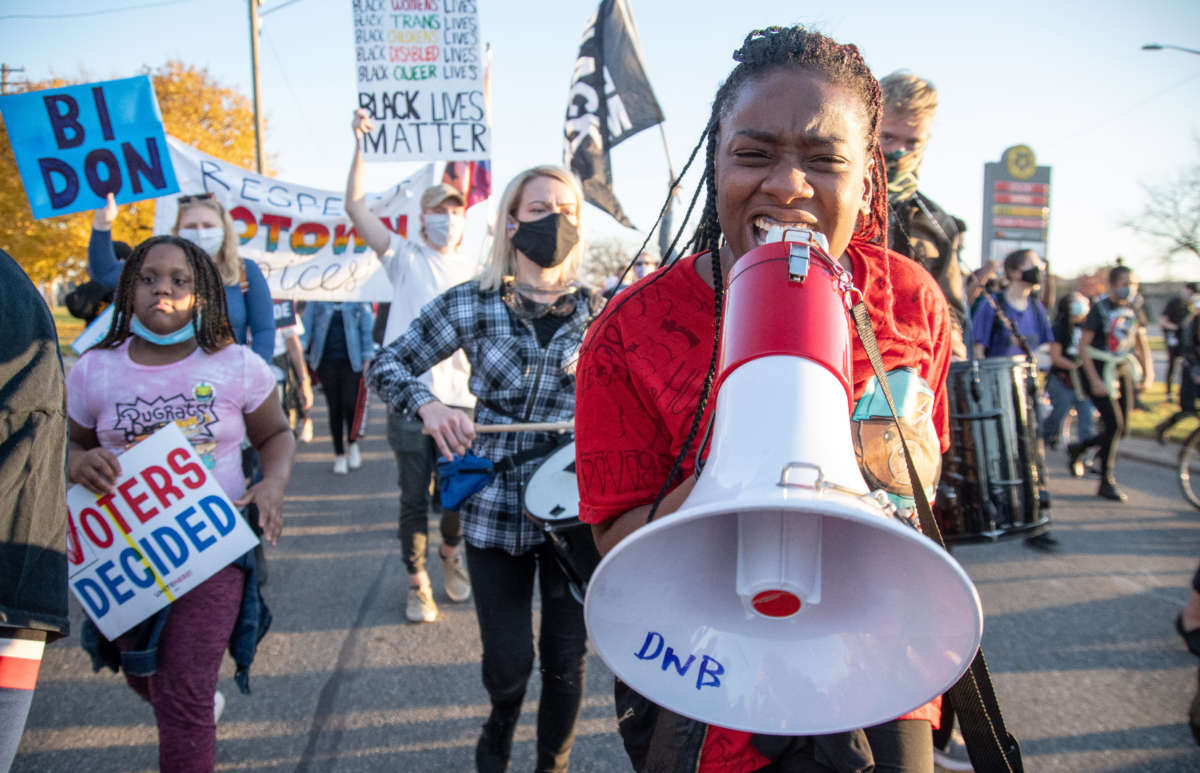

Detroit activists march through the city on November 7, 2020. Adam J. Dewey / NurPhoto via Getty Images

"...In offering voters Biden’s neoliberalism as the only alternative to Trump’s fascistic politics, the election revealed the failure of the Democratic Party to address the economic reality faced by working-class people as a result of the scourge of neoliberalism with its mantra of austerity, privatization and deregulation.

Meanwhile, the Biden campaign is already participating in downplaying the full urgency of the fascist threat that Trump posed to democracy. In his acceptance speech, Biden claimed that there is no red or blue America but a United States of America — a statement that may be strategic in attempting to gain mass support for the democratic transfer of power in January, but that fails to acknowledge that over 70 million people voted to embrace Trump’s fascist politics with enthusiasm.

Biden’s acceptance speech reiterated the well-worn narratives of centrist politics, including the undying embrace of a mythical American dream waiting to resurrect itself again. Imagine how much more powerful this appeal would be if instead of seeking to win public support for his mandate through these Trump-like statements, Biden sought to offer convincing policies that large swaths of the working class could support, especially those elements of the working class hit hardest by the pandemic.

Instead of offering the public a universal health care plan, huge investments in crucial infrastructure, guaranteed basic income, a moratorium on evictions, support for a Green New Deal, or an updated Marshall Plan for creating millions of jobs, Biden and the party regulars have continued to use empty phrases such as “restoring the soul of America.”

In place of such liberal platitudes, what this country needs right now is a robust agenda that addresses a diverse racial and ethnic working class and prioritizes “the upgrading of schools, clinics, roads, mass transit systems, waterworks, and other public services with good-paying jobs,” as Ralph Nader has argued.
 
Regardless of Biden’s win, we still live in a world that appears to have descended into Dante’s version of hell.

Focusing largely on the important goal of bringing the pandemic under control, Biden overlooked the fact that, for many working-class people, being powerless and viewed as disposable was as threatening as the fear of getting sick or dying from the pandemic. Containing the pandemic was a key issue, and working-class people, particularly people of color, are undoubtedly hardest hit by COVID. However, Biden should have also addressed other core issues impacting millions of working-class people whose incomes have been stagnant for 40 years, who have suffered the humiliation of being evicted from their homes, and who have watched as their jobs dried up and their towns turned into landscapes of despair and dashed hopes.

Missing from Biden’s neoliberal script was the scourge of the carceral state, a call for massively reducing the military budget, the horrible consequences of global capitalism, the financialization of the economy, and the toxic effects of deindustrialization.

Trump’s fascist politics, once again, stepped into this void, feeding off the powerlessness felt by so many Americans, all the while stoking their racial fears and offering fantasies that proved far more effective than the Democrats’ empty neoliberal rhetoric. Trump offered their heightened sense of contempt and resentment of the elite with a script that promised what Mark Danner has called a kind of “imaginary revenge.”

The real issue in this election is not simply the story of winners and losers, but the death of the social sphere, evisceration of the welfare state, the broad appeal of right-wing populism, and the destruction of the formative public institutions and civic culture which produced the crucial democratic values of solidarity, trust, compassion, economic equality, and most of all, a sense of ethical and social responsibility. The limitations of what could be hoped for in this election made clear once again the long legacy of the ongoing assault on meaningful politics and its slow death. A long-simmering racist and fascist culture of lies has shredded any hope of the shared values necessary to give meaning to the relationship between truth and social responsibility, citizenship and compassion. In the current election, the legacy of shared fears, falsehoods, racism and lawlessness came home to roost destroying the values and shared standards necessary to distinguish right from wrong, compassion from expedience, economic activity from social costs.

Through its destruction of the economy, environment, education and public health care, neoliberal capitalism has created a petri dish for the virus to wreak havoc and wide-scale destruction.

The United States has become a fortress of militarized ignorance, hate and resentment. The barriers and boarded storefronts that went up before the election may be coming down, but their presence symbolized a deeper reality that will be with the United States for some time to come in the future.

The tsunami of violence, rhetorical and real, now moves beyond the rhetoric of a dictatorial mode of governance into the realm of a heavily polarized country willing “to lock American democracy into an undetermined, perhaps indeterminable, condition.” The current culture of fear began with 9/11, revealed its ugly truth regarding the priority of profits over human needs with the 2008 financial crisis, and the pandemic and current economic crisis made visible the deep-seated racism and white supremacy and white nationalism at the center of power in the United States. Such fears have reached their endpoint in the rise of a fascist politics coupled with those who aid it and those who deny it. While Biden’s win succeeds in ejecting white nationalists like Stephen Miller from the White House, it does not change the fundamental reality that we face: a United States in which overt white supremacy has been emboldened and received mainstream affirmation in chilling new ways. The election did nothing to challenge that. Moreover, it is crucial to acknowledge that Trumpism is vigorously alive in a Republican Party that embraces minority rule and all the toxic policies — voter suppression, packing the Supreme Court, gerrymandering, and other tactical strategies — that both undermine democracy and ensure an embrace of authoritarianism. This is a party for whom only selected voters count (read: white voters) and “the majority can be conjured out of existence.” There is no morality here, only the crude pragmatism of a fascist politics and a large segment of the population along with Trump’s political lackeys who embraced his authoritarianism with zeal.

Regardless of Biden’s win, we still live in a world that appears to have descended into Dante’s version of hell. This is a world marked by horrifying political horizons — a world in which authoritarian and medical pandemics merge in what resembles a dystopian nightmare. In this age of uncertainty, time and space have collapsed into a void of shared apprehensions, relentless anxieties and the possibility of a human rights abyss. The terrors of everyday life manifest themselves in the metrics of rising infections, body counts and the daily risk of contamination, sickness or worse.
Amid this collective terror, the architecture of authoritarianism resurfaced under Trump with a vengeance in the form of a waking nightmare with a cast of horrors. Surveillance technologies proliferated; armed militia defended groups refusing to wear protective masks and intimidated those who did; voter suppression was in full swing; conspiracy theories originated or were legitimated by President Trump; immigrant children were forcibly separated from their parents — sometimes disappearing into internment camps with no hope of reuniting with their families. Echoes of a fascist past surfaced in news accounts in which imprisoned female immigrants were victims of forced sterilization; political rallies emboldened the language of hate and violence; and a steady stream of politicians and reactionary media pundits used vitriolic language against almost anyone who criticized Trump’s destructive and death-dealing policies, including Democratic governors and liberal and progressive members of the press.

The multiple threats produced during the Trump regime have an afterlife and will not disappear with Trump’s defeat.

In this post-election climate, the COVID-19 plague points to more than a medical pandemic and must be understood as part of a more comprehensive narrative. For instance, the disproportionate impact of the virus on poor people of color makes clear that the struggle “for public health, goods, services, social protections, and human rights, with special provisions for the most vulnerable, including the precariat, migrant workers … indigenous peoples” and the elderly cannot be separated from broader struggles for social equality, economic justice and democracy. The horror of the pandemic often overshadows the fact that anti-democratic economic and political forces that have prioritized profits over more urgent human needs have ground away at the social order for the last 50 years. The COVID-19 crisis is deeply rooted in years of neglect by hyper-capitalist governments that denied the importance of public health, the public good and the commons while defunding institutions that made them possible.

At the same time, this crisis cannot be separated from the crisis of massive inequalities in wealth, income and power that grew relentlessly since the 1970s. Nor can it be separated from a crisis of democratic values, critical education and the civic imagination. With respect to the latter, the COVID-19 pandemic is deeply interconnected with the politicization of the social order through the destructive assaults waged by casino capitalism on the welfare state, all manner of social provisions and the ecosystem. Underlying the magnitude of the current pandemic, there is the crucial and demanding question of: What kind of world do we want to live in today and build for in the future?

The pandemic has revealed the ugly and cruel face of an extreme form of capitalism, which has relentlessly attacked the social contract, the public sphere and the common good since the 1970s. I use the term neoliberalism to define this libertarian, market-driven form of capitalism which gained prominence in Chile, under General Pinochet in the 1970s with the help of the University of Chicago Economics Department and Milton Friedman. It was later implemented by U.K. Prime Minister Margaret Thatcher, who infamously stated, “There’s no such thing as society. There are individual men and women and there are families.” Soon afterwards, President Ronald Reagan argued that, “Government is not the solution to our problem, government is the problem.” Of course, these ideas were later embraced with great enthusiasm by Stephen Harper, the former prime minister of Canada. The endpoint here was an attempt to discredit any viable sense of government responsibility.

Implicit in these views is a neoliberal worldview that takes as its central organizing idea the assumption that the market should govern not only the economy, but all aspects of society. In addition, it promotes untrammeled self-interest, indulgent individualism, the concentration of wealth and power in the hands of a financial elite, and removes economic activity from social costs. Neoliberalism views government as the enemy of the market, limits society to the realm of the family and individuals, embraces a fixed hedonism and challenges the very idea of the common good. In this logic, “individual interests are the only reality that matters and those interests are purely monetary.”

In addition, neoliberalism cannot be disconnected from the spectacle of fearmongering, ultra-nationalism, anti-immigrant sentiment and bigotry that has dominated the national zeitgeist in the U.S., Brazil and a number of other countries as a means of promoting shared anxieties rather than shared responsibilities. Through its destruction of the economy, environment, education and public health care, neoliberal capitalism has created a petri dish for the virus to wreak havoc and wide-scale destruction.

There is an urgent need to deal with the larger issue of eliminating a hyper-capitalist system structured in massive racial and economic inequalities.

Under neoliberalism, the language of the public good and community is replaced by the market-driven rhetoric of commodification, privatization, deregulation and commercialization. One consequence is that public goods whither and begin to fail. That is, as Naomi Klein observes the “publicly owned bones of society” — public education, public health systems, roads, bridges, levees, water systems — are underfunded, and in many ways, pushed to the breaking point of disrepair and dysfunctionality. [Naomi Klein, No Is Not Enough: Resisting Trump’s Shock Politics and Winning the World We Need, (Chicago: Haymarket Books, 2017), pp. 152-153] Moreover, the bonds of trust and solidarity are replaced by the bonds of fear and suspicion, and a growing culture of cruelty. Drained of civic values and lacking a commanding vision, the institutions of liberal democracy atrophied, further undermining civic literacy, historical memory and the capacity to discern the truth from falsehoods.

Neoliberalism is not just an economic system, but also an ideological and cultural system that functions as a powerful educational force. Its presence is on display daily in the rise of the corporate-controlled social media that has accelerated a culture of distraction, immediacy and self-absorption. In this overabundance of civic glut, language has succumbed to the aesthetics of vulgarity. What is new about the era in which we live is that the attack on the welfare state and common good is increasingly legitimated and normalized through oppressive forms of education in a variety of sites such as newspapers, social media, magazines and popular culture. This is the space in which willful ignorance, the disdain of science, the repudiation of evidence and conspiracy theories are produced. Moreover, these views are reinforced and reciprocated at the highest levels of government. Far from being objective sources of information or innocent forms of entertainment, these cultural apparatuses have become disinformation and disimagination machines that objectify people of color, promote spectacles of violence and endorse consumerism as the only viable way of life. This emptying out of social relations, democratic values and visions of the good life legitimates a language of exclusion, bigotry and white nationalism.

One result is that the distinction between fact and fiction disappear and “somewhere along the way, the democratization of the flow of information [becomes] the democratization of the flow of disinformation.” Lost here is a critical language capable of producing a narrative that promotes shared values and enables people to develop the sustained connections crucial to a vibrant democracy. All of this was on display in Trump’s campaign of misinformation and lies about both the pandemic and about almost everything else. As a tabloid anti-intellectual who thrives in a culture of spectacle, entertainment and distraction, Trump emptied politics of any substantive meaning given his efforts to both infantilize and depoliticize the public while disdaining any effort at critical analysis, translation or self-reflection. All that was left is what Viktor Frankl in 1965 called “the mask of nihilism.”

In Trump’s hands, ignorance was not innocent and provided a legitimating force from the center of power to fuel a number of extremist groups that use the corporate media and social media to peddle their hatred, lies and self-serving ignorance. Soon after the election, Trump prematurely declared victory, spread lies about the legitimacy of the election, questioned its fairness, and in doing so ran the risk of provoking outrage and sowing potential violence on the part of his more extremist supporters. He claimed that any suggestion he had lost was “a fraud on the American people” and that any further counting of votes after the election should stop. The language of violence, fear and lies has been the preferred political drug of the Trump presidency. In the past he has threatened Adam Schiff and Nancy Pelosi, supported violent right-wing extremists such as the Proud Boys, defended the 17-year-old who fatally shot two protesters in Wisconsin, and demanded that his Attorney General William Barr arrest Joe Biden, Barack Obama and Hillary Clinton.

Trump’s penchant for violence has also asserted itself dangerously in the post-election climate. As Josh Israel observes:

Just two days ago, Trump appeared to egg on his supporters to respond with armed rebellion should states like Pennsylvania attempt to count all the votes. “The Supreme Court decision on voting in Pennsylvania is a VERY dangerous one,” he tweeted. “It will allow rampant and unchecked cheating and will undermine our entire systems of laws. It will also induce violence in the streets. Something must be done!” He was referencing a court ruling allowing the state to count ballots postmarked on time and received within three days of the election in the state. The Washington Post reported on Wednesday that many of his supporters appear to be taking that advice seriously. Dozens of users on a pro-Trump online message board posted messages urging “war” to stop Democrats from “trying to STEAL the election.” One wrote that they are “standing by and keeping my rifle by my side.”

There is more at stake here than Trump’s false claim that he won the election and his unwillingness to accept a peaceful transition of power. There is also a threat this malignant Trump presidency has posed to both American lives and democracy itself given its wantonly destructive and tragic failure to contain the COVID-19 pandemic. The multiple threats produced during the Trump regime have an afterlife and will not disappear with Trump’s defeat...

The U.S. and several other countries are in the midst of a medical, racial, political, economic and educational crisis which touches every aspect of public life. Unfortunately, the crises many countries are experiencing have not been matched by a crisis of ideas — that is, a critical understanding of the conditions that produced the crises in the first place. Within this crisis of ideas, matters of poverty, economic inequality and racial injustices disappear. Missing from this crisis is a recognition that the globe is in a new historical period produced by a hyper-capitalist system that lacks a commanding vision of democracy and is at odds with any just, prudent and equitable notion of the future.

The COVID-19 plague cannot be separated from a broader plague of hyper-capitalism, right-wing populism and the surge of authoritarian politics around the globe. These forces represent the underside of the pandemic and relentlessly subject workers, the elderly, the homeless, the poor, children, people of color and more recently, frontline hospital and emergency workers (and all those others considered at risk) to lives of despair, precarity, massive danger, and in some cases, death. At the roots of this larger pandemic are an unbridled lawlessness and deep-seated disdain for critical thought, meaningful forms of education and any mode of analysis that holds power accountable.

The full-blown pandemic has revealed with laser beam clarity both the irrationality and incapability of a profit-driven capitalism in dealing with a global public health crisis that has been as catastrophic as it has been deadly. The horrors of inequality, compulsory austerity, defunding of public health systems and the collapse of the economy under the rubrics of extreme capitalism are finally being acknowledged as the fundamental plague behind the current pandemic. As Richard D. Wolff has argued, private capitalism cannot “protect and maintain public health and safety,” because it “pursues profits at the expense of more urgent social needs and values…. This pandemic is now bringing that truth home to people.” He has also rightly argued that “both major parties function as cheerleaders for capitalism under all circumstances, when a killer pandemic coincides with a major capitalist crash.”

COVID-19 has produced an age of uncertainty, fragmentation, despair and a dire foreboding about the future. Shared certainties, hopes and dreams have been replaced by shared fears. More troubling is the apprehension that the present crisis has an air of longevity about it, constituting a turning point in history. The stark choice of what the future might look like appears to hang between the forces of despotism and democracy. The pandemic has now revealed in all its ugliness the death-producing mechanisms of systemic inequality, institutional racism, the increasingly dangerous assault on the environment and an anti-intellectual culture that derides any notion of critical education — that is, an education that equips individuals to think critically, engage in thoughtful dialogue, learn the lessons of history and learn how to govern rather than be governed.

Trump’s defeat should not erase the notion that the political, economic and cultural forces that created the conditions for his presidency have disappeared.

The pandemic has torn away the cover of a neoliberal economic system marked by what Thomas Piketty calls “the violence of social inequality.” Inequality is a toxin that destroys lives, democratic institutions, historical consciousness, civic literacy, and is normalized through politicians and a right-wing media culture reduced to sounding boards for the rich and powerful.

The ideological virus-plague has as one of its roots a politics of depoliticization and normalization. It attempts to rob people of their sense of agency all the while making unthinkable the matters of alleged commonsense. Through a variety of market-based assumptions and pedagogical practices, it works to undermine and discredit those ideas, values, modes of identification and desires that enable individuals to become critically engaged actors. As the elevation of profit, greed, and unchecked notions of individualism and self-interests become national ideals, democracy is eviscerated and the habits of citizenship wither.

The pandemic crisis has shattered the myth that each of us are defined exclusively by our self-interest, and as individuals, are solely responsible for the problems we face. Both myths run the risk of breaking down as it becomes obvious that as the pandemic unfolds, shortages in crucial medical equipment, lack of testing, lack of public investments, and failed public health services are largely due to right-wing neoliberal measures such regressive tax policies and bloated military budgets that have drained resources from public health, public goods and other vital social institutions.

COVID-19 has done more than expose the cult of capitalism and its production of social inequities operating on a vast scale in the U.S. and around the globe. It has also revealed the inner workings of an authoritarian politics exemplified by the blundering and dangerous regime of Donald Trump, whose potential reelection the editorial board of The New York Times stated “poses the greatest threat to American democracy since World War II.” According to The Times, Trump degraded the office of the presidency by normalizing the unthinkable, legitimating the inexcusable and defending the indefensible. The administration has been more concerned about the health of the economy than saving lives, especially the lives of those marginalized by color, class, age and preexisting health conditions. For Trump, public relations mattered more than the truth, justice and social responsibility. Trump’s exercise of power was unchecked and untethered to any sense of ethical and political responsibility. Instead, it was used to inflame partisan positions, exploit racial tensions and flagrantly promote a culture of corruption, lawlessness and violence.

Because of Trump’s failure to address the COVID-19 crisis, the United States has been turned into a giant funeral home. Trump lied about the severity of the virus, calling it no more dangerous than the flu, even saying it would just disappear. He admitted to journalist Bob Woodward that the virus was deadly and airborne and that millions of people could get infected, sicken and die. He flouted the advice of experts and put incompetents in positions of power to shape health policies. More recently, White House Chief of Staff Mark Meadows acknowledged that the Trump administration can’t stop the spread and is focusing instead on getting a vaccine. In other words, in spite of the spiraling number of infections and deaths from the virus in the United States, the White House has made the decision to do nothing but wait for a vaccine. There is more at stake here than incompetence and the collapse of moral responsibility made clear by a public admittance that the U.S. cannot control the pandemic; there is also a criminogenic policy, if not an act of domestic terrorism, that will result in unnecessary massive suffering and deaths particularly among the poor, vulnerable and elderly.

Moreover, as the virus spread throughout the country, Trump disregarded the advice of medical and health authorities and held indoor rallies in cities around the United States, impervious to the danger large group gatherings posed to his followers. After downplaying the virus since its inception while modeling behavior that promotes it, going so far as to treat mask-wearing as a weakness while ridiculing his rival Joe Biden for wearing one, Donald and Melania Trump tested positive for COVID-19. For four years, this administration has lied, deceived the public, and undermined the health and safety of the nation. Events have now caught up with Trump’s world of deceit, lies and willful ignorance, and he has to bear the fate of his own hypocrisy and moral failing. What is crucial here is that Trump is not the only the victim of his own inept leadership and the disdain of health experts and the laws of science. More importantly, because of his lack of leadership, the economy tanked, millions lost their jobs, at least 237,000 people have died from COVID-19 and more than 9.5 million are infected. Trump did not deserve this virus, but neither did the people who contracted it because his irresponsible and vicious disregard for the lives of others. Trump has blood on his hands, and his failure to address the pandemic’s reach, severity and danger is no longer an issue he can ignore.

In the aftermath of Biden’s election, there is a need for renewed efforts to put into play policies that raise the minimum wage, support decent and safe work, offer access to affordable housing, provide universal health care, lower prescription drug costs, provide free quality education to everyone, expand infrastructure, defund the police and military, and invest in community services. But such calls do not go far enough, there is also an urgent need to deal with the larger issue of eliminating a hyper-capitalist system structured in massive racial and economic inequalities. The renowned educator David Harvey is right in arguing that the “immediate task is nothing more nor less than the self-conscious construction of a new political framework for approaching the question of inequality [and racism], through a deep and profound critique of our economic and social system.”

...The struggle ahead will be to expose the forces that made Trump possible and to examine how both political parties participated in putting in place the conditions that enabled his coming to power. It is also crucial to think big and create a civic vision that puts in place a notion of democracy that is truly radical in its call for social justice, broad-based political representation and economic equality. This project is not merely a political task but also an educational necessity. Politics has to be reinvented and rethought and it has to be done through social movements working simultaneously at the local levels and federal and international levels.

We need to act en masse to defend public goods and the welfare state, and to bring about the end of neoliberal capitalism. If a new understanding of politics and social and economic justice and equality is to be born, it is crucial to take seriously waging a war of ideas against the normalization of a dying order. And this task cannot be left to young people alone. While there are signs of a social revival in the U.S., social movements must intensify their efforts to unite and embrace educational tools and programs that provide the knowledge and skills necessary for Americans to be critical, engaged and willing to face down the power of the financial elite and right-wing populist movements.

Democracy cannot survive with its current toxic mix of economic inequality, political corruption and institutionalized racism. We need to understand both how dominant power works in all of its manifestations and how to defeat it. This is not simply an economic issue but also a pedagogical consideration — one in which people learn to think hard, work at the frontiers of the imagination, embody a sense of moral courage and civic imagination, and use the tools of persuasion and the power of beliefs to construct public spaces where civic action can be born.

This is a crisis in which the various protests now evolving internationally at the popular level offer the promise of developing invigorated global movements for the struggle for popular sovereignty and economic, racial and social justice. Central to such struggles is the challenge of making good on the ideals and promise of a substantive democratic order. In the current moment, democracy may be under a severe threat and appear frighteningly vulnerable, but with young people and others rising up across the globe — inspired, energized and marching in the streets — the future of a radical democracy is waiting to be reimagined, if not reborn. In order for democracy to breathe again, it needs to resurrect a language of critique and possibility, one that draws from history, rethinks the meaning of politics, and provides the economic, cultural and political conditions to lift the U.S. and other societies out of the present-day sociopolitical malaise so that the public can envision alternatives and build the institutions necessary for democracy to become a reality. Democracy needs a vision rooted in a deep politics of solidarity that enables people to both fight against the forces of authoritarianism and to overcome them. Angela Davis was right in stating, “We cannot go on as usual. We cannot pivot the center. We cannot be moderate. We will have to be willing to stand up and say no with our combined spirits, our collective intellects, and our many bodies.”

The issue is no longer about who won this election, it is about defeating the political, economic and social conditions that have produced a culture of fear, bear the burden of a fascist past, and promise the consequences of something even worse. It is about whether the last glimmer of a failed democracy will be able to breathe until current and future generations can rescue it."
—Henry A. Giroux, "Trump Ousted. The Spirit of Insurgent Democracy Is Rising”, Truthout, November 10, 2020


ABOUT THE AUTHOR:


Henry A. Giroux currently holds the McMaster University Chair for Scholarship in the Public Interest in the English and Cultural Studies Department and is the Paulo Freire Distinguished Scholar in Critical Pedagogy in Toronto, Canada.  Giroux is the acclaimed author of over 25 books. His most recent books include: American Nightmare: Facing the Challenge of Fascism (City Lights, 2018);The Terror of the Unforeseen (Los Angeles Review of books, 2019), On Critical Pedagogy, 2nd edition (Bloomsbury, 2020); Race, Politics, and Pandemic Pedagogy: Education in a Time of Crisis (Bloomsbury 2021); and Pedagogy of Resistance: Against Manufactured Ignorance (Bloomsbury 2022). Giroux is also a member of Truthout’s Board of Directors.


HENRY A. GIROUX SPEAKING 2015-2023

HENRY A. GIROUX
(b. September 18, 1943)


"...Trump’s presence in American politics has made visible a plague of deep seated civic illiteracy, a corrupt political system, and a contempt for reason; it also points to the withering of civic attachments, the collapse of politics into the spectacle of celebrity culture, the decline of public life, the use of violence and fear to numb people into shock, and a willingness to transform politics into a pathology. Trump’s administration will produce a great deal of violence in American society, particularly among the ranks of the most vulnerable: poor children, minorities of color, immigrants, women, climate change advocates, Muslims, and those protesting a Trump presidency. What must be made clear is that Trump’s election and the damage he will do to American society will stay and fester in American society for quite some time because he is only symptomatic of the darker forces that have been smoldering in American politics for the last 40 years. What cannot be exaggerated or easily dismissed is that Trump is the end result of a long standing series of attacks on democracy and that his presence in the American political landscape has put democracy on trial. While mass civil demonstrations have and continue to erupt over Trump’s election, what is more crucial to understand is that something more serious needs to be addressed. We have to acknowledge that at this particular moment in American history the real issue is not simply about resisting Donald Trump’s insidious values and anti-democratic policies but whether a political system can be reclaimed in which a notion of radical democracy can be deepened, strengthened and sustained. Yet, under a Trump presidency, it will be more difficult to sustain, construct, and nurture those public spheres that sustain critique, informed dialogue, and a work to expand the radical imagination. If democracy is to prevail in and through the threat of “dark times,” it is crucial that the avenues of critique and possibility become central to any new understanding of politics. If the authoritarianism of the Trump era is to be challenged, it must begin with a politics that is comprehensive in its attempts to understand the intersectionality of diverse forces of oppression and resistance. That is, on the one hand, it must move towards developing analyses that address the existing state of authoritarianism through a totalizing lens that brings together the diverse registers of oppression and how they are both connected and mutually reinforce each other. On the other hand, such a politics must, as Robin D.G. Kelley has noted, “move beyond stopgap alliances”[22] and work to unite single issue movements into a more comprehensive and broad-based social movement that can make a viable claim to a resistance that is as integrated as it is powerful. For too long progressive cultural workers and activists have adhered to a narrative about domination that relies mostly on remaking economic structures and presenting to the public what might be called a barrage of demystifying facts and an aesthetics of transgression. What they have ignored is that people also internalize oppression and that domination is about not only the crisis of economics, images that deaden the imagination, and the misrepresentation of reality, but also about the crisis of agency, identification, meaning, and desire.

The crisis of economics and politics in the Trump era has not been matched by a crisis of consciousness and agency. The failure to develop a crisis of consciousness is deeply rooted in a society that suffers from a plague of atomization, loneliness, and despair. Neoliberalism has undermined any democratic understanding of freedom limiting its meaning to the dictates of consumerism, hatred of government, and a politics where the personal is the only emotional referent that matters. Freedom has collapsed into the dark abyss of a vapid and unchecked individualism and in doing so has cancelled out that capacious notion of freedom rooted in the bonds of solidarity, compassion, social responsibility, and the bonds of social obligations. The toxic neoliberal combination of unchecked economic growth is a discourse that legitimates plundering the earths’ resources and exhibits a pathological disdain for community and public values that has weakened democratic pressures, values, and social relations and opened the door for the dark side of politics under Donald Trump’s Presidency. The rule of the billionaires and militarists threaten not just democracy but the existence of the planet. The stakes for both justice, if not survival, are more important than ever. There is no room for resignation, internecine squabbles, and despair. Resistance must take on the challenge of creating an informed public, the need to develop new forms of non-violent resistance, and mobilize a collective sense of outrage mixed with a need for disciplined and focus action.

Pressing the claim for social justice and economic equality means working hard to develop alternative modes of consciousness, promote the proliferation of democratic public spheres, create the conditions for modes of mass resistance, and make the development of sustainable social movements central to any viable struggle for economic, political, and social justice. No viable democracy can exist without citizens who value and are willing to work towards the common good. That is as much a pedagogical question as it is a political challenge."

--Henry A. Giroux, "Trump’s Second Gilded Age: Overcoming the Rule of Billionaires and Militarists", Counterpunch, December 9, 2016

"Authoritarian societies do more than censor and subvert the truth, they also punish those who engage in dangerous thinking. The current plague of racism fueling neoliberal fascism is rooted not only in structural and economic forms of domination, but also intellectual and pedagogical forces, making clear that is education central to politics. It also points to the urgency of understanding that white supremacy is first and foremost a struggle over agency, assigned meanings and identity — over whose lives count and whose don’t. This is a politics that often leaves no traces when compared to the endless images of spectacularized violence that fills screen culture with mass shootings, police violence, and racist attacks on Black and Asian Americans in the post-Trump era. In an age when white supremacy is openly defended by both politicians and media celebrities, there is a price to be paid when power is held accountable. When critical ideas come to the surface, right-wing politicians and pundits attack the oppositional press as “an enemy of the American people,” attempt to impose a totalitarian notion of “patriotic education” and censor academics who criticize systemic abuses. In this instance, culture as a site of pedagogical influence has turned oppressive and must be addressed a site of struggle and resistance."

"The U.S.’s slide into a fascist politics demands a revitalized understanding of the historical moment in which we find ourselves, along with a systemic critical analysis of the new political, cultural and pedagogical formations that marks this period. This suggests the need for a more comprehensive understanding of politics. Such connections hint at the educational and cultural power of a neoliberal corporate elite using their mainstream and social media platforms to shape pedagogically the collective consciousness of a nation in the discourse and relations of hate, bigotry, ignorance and conformity. Part of this challenge is to create a new language and social movement to address new and revitalized terrains of education, politics, justice, culture, and power that mark these new systems of racist violence and economic oppression.”

"We live in an era in which the distinction between the truth and misinformation is under attack. Ignorance has become a virtue, and education has become a tool of repression that elevates self-interest and privatization to a central organizing principle of both economics and politics. The socio-historical conditions that enable racism, systemic inequality, anti-intellectualism, mass incarceration, poverty, state violence and the war on youth must be remembered in the fight against that which now parades as ideologically normal. Historical memory and the demands of moral witnessing must become part of a deep grammar of political and pedagogical resistance in the fight against neoliberal capitalism and other forms of authoritarianism.”

"As engaged citizens, it is crucial to examine the anti-democratic and iniquitous political, economic and social forces that have intensified the pandemic while failing to contain it. These are not merely economic and political issues, but also educational considerations. Two of the more obvious questions include: How does a society driven by the accumulation of capital at any cost, with its appropriation of market-based values and regressive notions of freedom and agency, use culture, education and language to produce identities, values and modes of agency? How can any democratic society survive a market-driven notion of freedom in which free will and choice are untouched by any broader notion of constraints and views responsibility as a purely personal phenomenon? Lost here is any sense of the social, the public and the connections that support the common good and the general welfare of society.”

“...Policing in the United States is a force of racist violence that is entangled at the core of the capitalist system. As Robin D.G. Kelley pointed out on Intercepted With Jeremy Scahill, capitalism and racism are not distinct from one another: “If you think of capitalism as racial capitalism, then the outcome is you cannot eliminate capitalism, overthrow it, without the complete destruction of white supremacy, of the racial regime under which it’s built.”

Police in the United States act with impunity in targeted neighborhoods, public schools, college campuses, hospitals, and almost every other public sphere. Not only do the police view protesters, Black and Indigenous people, and undocumented immigrants as antagonists to be controlled, they are also armed with military-grade weapons. This police militarization is a process that dates at least as far back as President Lyndon Johnson when he initiated the 1965 Law Enforcement Assistance Act, which supplied local police forces with weapons used in the Vietnam War. The public is now regarded as dangerous and suspect; moreover, as the police are given more military technologies and weapons of war, a culture of punishment, resentment and racism intensifies as Black people, in particular, are viewed as a threat to law and order. Unfortunately, employing militarized responses to routine police practices has become normalized. One consequence is that the federal government has continued to arm the police through the Defense Logistics Agency’s 1033 Program, which allows the Defense Department to transfer military equipment free of charge to local enforcement agencies.

The scope of the 1033 Program is alarming given that “Since its inception, more than 11,500 domestic law enforcement agencies have taken part in the 1033 Program, receiving more than $7.4 billion in military equipment,” according to CNBC. There is also the federally run 1122 Program which allows the police to purchase military equipment at the same discounted rate as the federal government. In addition, there is the Homeland Security Grant Program, which provides funds for local police departments to buy military-grade armaments and weapons. The military-grade weapons provided through these federal programs include armored vehicles, assault rifles, flashbang grenade launchers, bomb-detonating robots, and night vision items. Arming the police with more powerful weapons reinforced a culture that taught police officers to learn, think and act as soldiers engaged in a war. Moreover, as Ryan Welch and Jack Mewhirter write in The Washington Post, the more militarized and armed the police are, the greater the increase in civilian deaths. As they point out:

Even controlling for other possible factors in police violence (such as household income, overall and black population, violent-crime levels and drug use), more-militarized law enforcement agencies were associated with more civilians killed each year by police. When a county goes from receiving no military equipment to $2,539,767 worth (the largest figure that went to one agency in our data), more than twice as many civilians are likely to die in that county the following year.

This arming and militarizing of the police were intensified after the 9/11 attacks and privileged a police ethos defined by “the use of violent tactics and non-negotiable force over compromise, mediation, and peaceful conflict resolution.” Police brutality is endemic to American history. As Mariame Kaba argues,

There is not a single era in United States history in which the police were not a force of violence against Black people. Policing in the South emerged from the slave patrols in the 1700 and 1800s that caught and returned runaway slaves. In the North, the first municipal police departments in the mid-1800s helped quash labor strikes and riots against the rich. Everywhere, they have suppressed marginalized populations to protect the status quo.

Police brutality cannot be separated from the lethal nature of white supremacy, and in its recent incarnations became “the war on crime.” Under President Nixon and every American president after him, the war on crime continued to expand and intensify into a war on Black communities. The call for “law and order” repeatedly served as a smokescreen for racist and militarized police practices that equated Black behavior with criminality and authorized the use of force against them.

Police in the United States act with impunity in targeted neighborhoods, public schools, college campuses, hospitals, and almost every other public sphere.

As the reach of the culture of punishment expanded, its targets included protesters, immigrants, and those individuals and groups marginalized by class, religion, ethnicity and color as the other — an enemy. This is the organizing principle of a war mentality adopted by the police throughout the United States in which the behavior of Black people and other marginalized communities is criminalized. It comes as no surprise that as one study reports, “Police kill, on average, 2.8 men per day…. Police homicide risk is higher than suggested by official data. Black and Latino men are at higher risk for death than are White men, and these disparities vary markedly across place.”

A militarized culture breeds violence. It wastes money on the security industries and policing, and drains money from the socially necessary programs that could actually prevent violence. Violence is both shocking and part of everyday life, especially for those who are poor, Black, Indigenous, trans, disabled and/or otherwise disenfranchised. In the last few decades, Francesca Mari writes, “the US has had the highest homicide rate of any high-income country, and according to preliminary data released in March by the FBI, it rose by 25 percent in 2020, when an estimated 20,000 people were murdered — more than fifty-six a day.”

Police brutality became code for a more violent expression of racism that emerged with the rise of neoliberalism in the 1980s. This was especially obvious under the Trump administration as the racist adoption of both white supremacy and a wave of police brutality against Black people and undocumented immigrants was presented to the American public as a badge of honor and an act of civic pride.

As the power of the police expanded, along with their unions, social programs were defunded. These included job programs, food stamp programs, health centers, healthcare programs and early childhood education. In many states, more money was spent on prisons than on colleges and universities, as documented by Ruth Gilmore in her book Golden Gulag: Prisons, Surplus, Crisis, and Opposition in Globalizing California. Targeted cities inhabited mostly by poor Black and brown people were now under siege as the war on poverty morphed into the war on crime. Instead of “fighting black youth poverty,” the new crop of white supremacist politicians fought what Elizabeth Hinton called “fighting black youth crime” in her book From the War on Poverty to the War on Crime.

A militarized culture breeds violence. It wastes money on the security industries and policing, and drains money from the socially necessary programs that could actually prevent violence.

As Jim Crow re-emerged in more punitive forms, immigration was criminalized, the war on youth of color intensified, and the culture of punishment began to shape a range of institutions. This was particularly evident as mass incarceration became a defining organizing institution of the narrow racially inspired policies of criminalization in the U.S. and, by default, the prison its most notorious welfare agency. The U.S. has been in the midst of an imprisonment binge since the1960s. As Angela Y. Davis writes in Abolition Democracy:

But even more important, imprisonment is the punitive solution to a whole range of social problems that are not being addressed by those social institutions that might help people lead better, more satisfying lives. This is the logic of what has been called the imprisonment binge: Instead of building housing, throw the homeless in prison. Instead of developing the educational system, throw the illiterate in prison. Throw people in prison who lose jobs as the result of de-industrialization, globalization of capital, and the dismantling of the welfare state. Get rid of all of them. Remove these dispensable populations from society. According to this logic the prison becomes a way of disappearing people in the false hope of disappearing the underlying social problems they represent.

The numbers speak for themselves. Historian Khalil Gibran Muhammad makes this clear in his new preface to The Condemnation of Blackness: Race, Crime, and the Making of Modern Urban America. He writes:

By population, by per capita incarceration rates, and by expenditures, the United States exceeds all other nations in how many of its citizens, asylum seekers, and undocumented immigrants are under some form of criminal justice supervision…. The number of African American and Latinx people in American jails and prisons today exceeds the entire populations of some African, Eastern European, and Caribbean countries.

Michelle Brown has argued persuasively in her book The Culture of Punishment that the rise of police violence, especially against people of color, indicates that increases in the scale of punishment cannot be abstracted from a parallel rise in both power and apparatuses of punishment — extending from the law enforcement, military services, private security forces, immigration detention centers, to intelligence networks and surveillance apparatuses.

Moreover, the culture of punishment increasingly defines both subjects and social problems through the registers of punishment, pain and violence. How else to explain the actions of the South Carolina Gov. Henry McMaster, who in 2021 signed legislation giving people on death row the grotesque choice between a firing squad and electrocution. Frank Knaack, the executive director of South Carolina’s ACLU, stated that capital punishment and the new law “evolved from lynchings and racial terror, and it has failed to separate its modern capital punishment system from this racist history.”


Policing cannot be understood outside of the history of criminogenic culture and a racist punishing state marked by both staggering inequities in wealth, income and power, as well as a collective mindset in which those considered non-white are considered less than human, undeserving of human rights, and viewed as disposable. The journalist Robert C. Koehler rightly argues that underlying both the larger culture and the culture of policing is a deeply ingrained white supremacy marked by a system of growing inequalities in which economic rights do not match political and individual rights. Koehler writes:

it is racism that is the trigger that disproportionately escalates police encounters with people of color. However, even more sadly, it is systemic racism that normalizes it, or legitimates it, making it largely acceptable to white American eyes and consciences. For it is not only the police who have this problem, but our entire society.


As neoliberalism failed to deliver on its promises of upward social and economic mobility, it shifted attention for its broken social experiment to attacks on immigrants, Blacks, and other populations deemed unworthy, inferior and a threat to white people. In doing so, gangster capitalism has become armed, spiraling into a form of authoritarianism that has merged the savagery of market despotism with the rancid ideology of white supremacy. Cornel West is right in arguing that neoliberal capitalism with its emphasis on materialism, racism and cruelty “allows for endemic inequality and a culture of greed and consumerism that [has trampled] on the rights and dignity of poor people and minorities decade after decade.”

Gangster capitalism has become armed, spiraling into a form of authoritarianism that has merged the savagery of market despotism with the rancid ideology of white supremacy.

Sociologist Alex Vitale rightly insists that calls for change regarding policing should not be about producing “better” police through technocratic reforms such as the increased use of body cameras and bias training, but rather with a “larger structure of economic life in America.” In the age of neoliberal austerity, the defunding of the welfare state has given way to a range of social problems — extending from the criminalization of homeless people and the relentless erasure of human rights to the mass proliferation of surveillance and the placing of police in the schools — all of which have contributed to the expansion of police power as a way to control people removed from meaningful involvement in the broader global economy. Turning over every social problem for the police to fix is more than an impossible task; it is a failed, if not diversionary, political decision.

Police violence can be understood as a form of systemic terror instituted intentionally by different levels of government against populations at home in order to realize economic gains and achieve political benefits through practices that range from assassination, extortion, incarceration, violence, and intimidation or coercion of a civilian population. Some of the more notorious racist expressions of such terror include the assassination of Black Panther Party leader Fred Hampton by the Chicago Police Department on December 4, 1969; the MOVE bombing by the Philadelphia Police Department in 1985; the existence of COINTELPRO (an illegal counterintelligence program designed to harass anti-war and Black resistance fighters in the 60s and 70s); the use of extortion by the local police and courts practiced on the largely poor Black residents of Ferguson; and the more publicized killings of Ma’Khia Bryant, Breonna Taylor and George Floyd by the police — to name just a few instances of acute state violence.

The American nightmare that has descended upon the United States points to a crisis of power, agency, community, education and hope. The effects of neoliberalism’s death-dealing-machinery are everywhere, and police abuse is only one thread of this criminogenic social formation.

Rather than fade into the past or disappear beneath the propaganda techniques of right- wing disimagination machines, widespread poverty, racially segregated schools, rampant homelessness, ecological destruction, large-scale rootlessness, fearmongering, social atomization, voter suppression, and the politics of disposability are alive and well. It is now unabashedly reproduced and defended by a Republican Party that has become the overt symbol of white supremacy, economic ruthlessness and manufactured ignorance.

Widespread corruption is now matched by a climate of fear and a willingness on the part of Trump’s political allies to inflict violence on undesirable members of the public along with anyone voicing criticism or dissent. The scaffold of resistance now faces a malignant fascist politics growing across the globe. Fascist politics, especially in the United States, has been on steroids, especially true both during Trump’s reign in office and after his defeat, with the rule of the Republican Party in Congress and among a majority of state legislatures. If the systemic violence and lawlessness that denies Black communities a claim to human rights, citizenship and dignity are to be challenged, it is crucial to understand how neoliberal fascism becomes a machinery of dread, tearing the social fabric, while cancelling the future. As a regime of ideology, neoliberal fascism wages a political and pedagogical war against the conditions that make thinking, agency, the search for truth and informed judgment possible.

The effects of neoliberalism’s death-dealing-machinery are everywhere, and police abuse is only one thread of this criminogenic social formation.

The heart of American violence does not reside merely in the culture and practice of policing in the U.S., or for that matter, in its prison-industrial complex. Its center of gravity is more comprehensive and is part of a broader crisis that extends from the threat of nuclear war and ecological devastation to the rise of authoritarian states and the human suffering caused by the staggering concentrations of wealth in the hands of a global financial elite. The roots of these multilayered and intersecting crises lie elsewhere in a new political and social formation that constitutes a racialized criminal economy that has embraced greed, violence, disposability, denial and racial cleansing as governing principles of the entire social order. This is the rule of neoliberal fascism on steroids. It is also an extermination machine rooted in a vapid nihilism that fuels the celebration of materialism and social atomization with a belief in unshakable loyalty, purification through violence and a cult of heroism.

"The call for a socialist democracy demands the creation of those ideals, institutions, social relations and pedagogies of resistance that enable the public to imagine a life beyond a social order in which racial, class- and gender-based violence produce endless assaults on the environment, systemic police violence, a culture of ignorance and cruelty. This is also an assault on the public and civic imagination, mediated through the elevation of war, militarization, violent masculinity and the politics of disposability to the highest levels of power. Any viable pedagogy of resistance needs to create the educational and pedagogical tools to produce a radical shift in consciousness, capable of both recognizing the scorched-earth policies of neoliberal capitalism, and the twisted ideologies that support it.”


"A pedagogy of resistance must be on the side of hope and civic courage in order to fight indifference, grave social injustices and mind-deadening attacks on the public imagination. At stake here is the struggle for a new world based on the notion that capitalism and democracy are not the same, and that we need to understand the world and how it functions in order to change it. In the spirit of Martin Luther King Jr.’s call for a more comprehensive view of oppression and political struggle, it is crucial to connect his call to a radical restructuring of consciousness, values and society itself. King and other theorists such as Saskia Sassen call for a language “that functions as an ideological rupture that changes the nature of the debate.” This suggests more than simply a rhetorical challenge to the economic conditions that fuel neoliberal capitalism. There is also the need to move beyond abstract notions of structural violence and identify the visceral elements of violence that bear down on and “constrain agency through the hard surfaces of [everyday] life....This challenge demands the courage to develop an anti-capitalist consciousness as the basis for a call to action. Resistance is no longer an option; it has become the lifeline for democracy to be able to breathe again.”

"Violence in the United States has become a form of domestic terrorism; it is omnipresent and works through complex systems of symbolic and institutional control. As the famed artist Isaac Cordal observes, “We live in societies … that use fear in order to make people submissive…. Fear bends us [and makes us] vulnerable to its desires…. Our societies have been built on violence, and that heritage, that colonial hangover which is capitalism today still remains.” Under capitalism in its neoliberal fascistic form, the poverty of the civic and political imagination is taking its last breath.”


ABOUT THE AUTHOR/SPEAKER:


Henry A. Giroux currently holds the McMaster University Chair for Scholarship in the Public Interest in the English and Cultural Studies Department in Toronto, Canada and is the Paulo Freire Distinguished Scholar in Critical Pedagogy. Giroux is the acclaimed author of over 25 books. His most recent books include: American Nightmare: Facing the Challenge of Fascism (City Lights, 2018);The Terror of the Unforeseen (Los Angeles Review of books, 2019), On Critical Pedagogy, 2nd edition (Bloomsbury, 2020); Race, Politics, and Pandemic Pedagogy: Education in a Time of Crisis (Bloomsbury 2021); and Pedagogy of Resistance: Against Manufactured Ignorance (Bloomsbury 2022). Giroux is also a member of Truthout’s Board of Directors.


Sunday, December 31, 2023

Henry A. Giroux and Hasan Minhaj on the White Supremacist Roots and Intellectual, Ideological, Cultural, and Political Content and Historical Identity of Education in the United States

Affirmative Action | Patriot Act with Hasan Minhaj | Netflix Netflix Is A Joke

All,


This brilliant and bitterly HILARIOUS statement by Hasan Minaj is--and has always been-- one of the most profound, HONEST, ACCURATE AND ABSOLUTELY TRUE ANALYSES OF THE ACTUAL REALITY OF WHAT AFFIRMATIVE ACTION IS AND MEANS---AND WHAT IT ALWAYS WAS IN THE LARGER CONTEXT OF THE ENTIRE WARPED HISTORY OF THIS VIRULENTLY WHITE SUPREMACIST NATION .


SO THANK YOU HASAN. I laughed outloud in 2018 when you first aired this brilliant fucking TAKEDOWN of the massive racist FRAUD the "critical discourse" surrounding AA is and has always been and I'm laughing even harder at your deeply incisive and right on target exegesis through extremely bitter fucking tears five years later.


SHARE THIS BEAUTIFUL VIDEO WITH EVERYONE YOU KNOW...or just tell yourself and others a million more racist delusional LIES about what Affirmative Action actually is and means…


Kofi


"What's Past is Prologue..."


Affirmative Action | Patriot Act with Hasan Minhaj | Netflix

Netflix Is A Joke

October 28, 2018 


#HasanMinhaj #PatriotAct #Netflix


Hasan Minhaj breaks down the history of affirmative action, its impact on his experience with the modern education system, and how a recent lawsuit against Harvard that could go to the Supreme Court could change it forever.


VIDEO: 


"It is certain in any case that Ignorance, allied with power, is the most ferocious enemy justice can have." 
--James Baldwin 
 
DEFEAT FASCISM BEFORE FASCISM DEFEATS YOU

https://www.laprogressive.com/election.../apartheid-pedagogy
 
Home
Elections and Campaigns

DeSantis’s Apartheid Pedagogy in the Age of Fascist Politics

It is hard to understand how African Americans who were raped, tortured, whipped, and subject to unimaginable acts of dehumanization somehow benefited from the horrors of slavery.

by Henry A. Giroux
July 23, 2023
LAProgressive

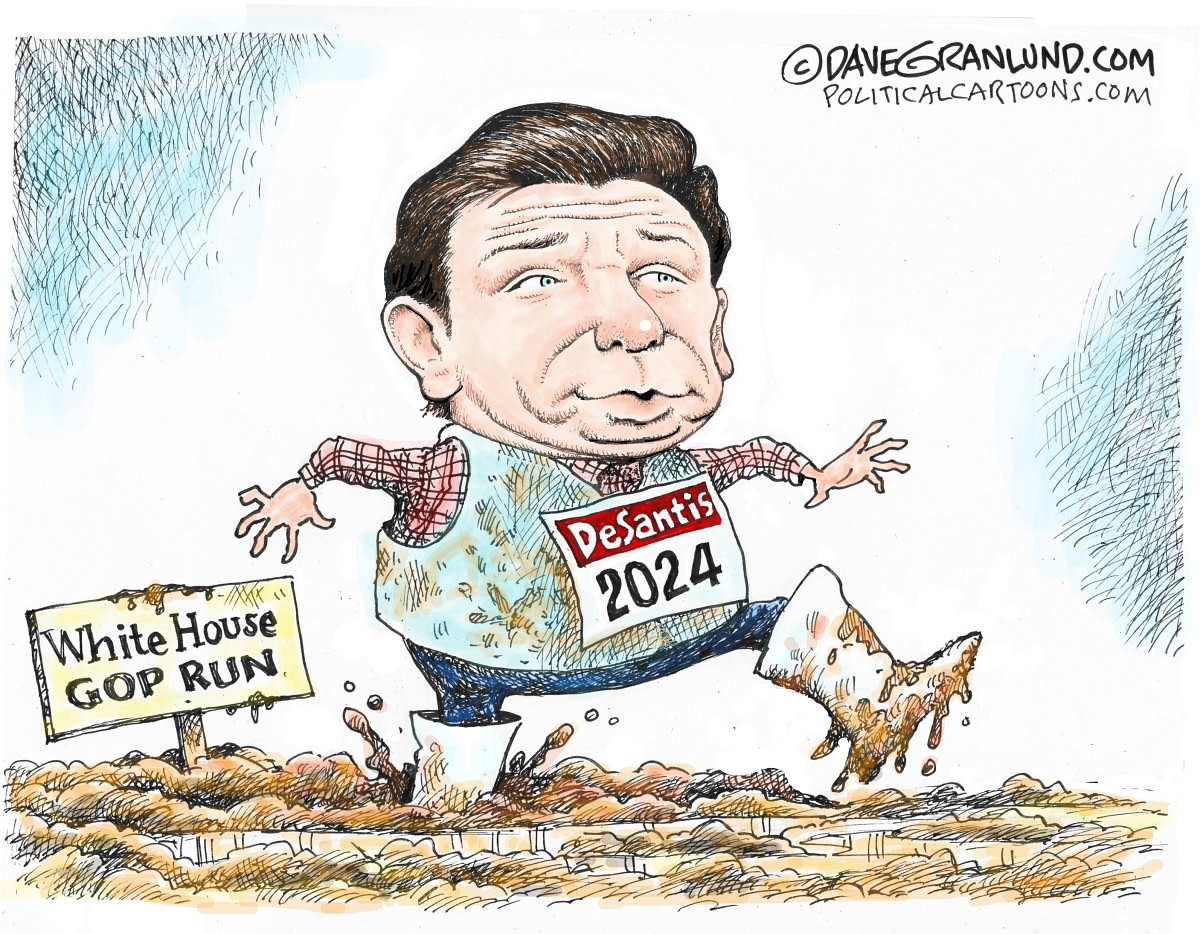
IMAGE: Cagle Cartoon: Dave Granlund


The cult of manufactured ignorance now works through disimagination machines engaged in a politics of falsehoods and erasure. Matters of justice, ethics, equality, and historical memory now vanish from the classrooms of public and higher education and from powerful cultural apparatuses and social media platforms that have become the new teaching machines.

In the current era of white supremacy, the most obvious version of apartheid pedagogy is present in attempts by Republican Party politicians to rewrite the narrative regarding who counts as an American, especially in the whitening of American history. This whitening of collective identity is largely reproduced by right-wing attacks on diversity and race sensitivity training, critical race programs in government, and social justice and racial issues in the schools. These bogus assaults are all too familiar and include widespread and coordinated ideological and pedagogical attacks against both historical memory and critical forms of education.

The fight to censor critical, truth-telling versions of American history and the current persistence of systemic racism is part of a larger conservative project to prevent teachers, students, journalists, and others from speaking openly about crucial social issues that undermine a viable democracy. Such attacks are increasingly waged by conservative foundations, anti-public intellectuals, politicians, and media outlets. These include right-wing think tanks such as Heritage Foundation and Manhattan Institute, conservative scholars such as Thomas Sowell, right-wing politicians such as Mitch McConnell, and far-right media outlets such as City Journal, The Daily Caller, Federalist, and Fox News. The threat of teaching children about the history and systemic nature of racism appears particularly dangerous to politicians such as Florida Gov. Ron DeSantis, who claim that critical race theory and other “anti-racist” programs constitute forms of indoctrination that threatens to undermine the alleged foundations of Western Civilization.

In doing so, they attempt to undermine and discredit the critical faculties necessary for students and others to examine history as a resource in order to “investigate the core conflict between a nation founded on radical notions of liberty, freedom, and equality, and a nation built on slavery, exploitation, and exclusion.”[1]

White ignorance is crucial to upholding the poison of white supremacy.

White ignorance is crucial to upholding the poison of white supremacy. Apartheid pedagogy is about denial and disappearance—a manufactured ignorance that attempts to whitewash history and rewrite the narrative of American exceptionalism as it might have been framed in in the 1920s and 30s when members of a resurgent Ku Klux Klan shaped the policies of some school boards. Apartheid pedagogy uses education as a disimagination machine to convince students and others that racism does not exist, that teaching about racial justice is a form of indoctrination, and that understanding history is more an exercise in blind reverence than critical analysis. Apartheid pedagogy aims to reproduce current systems of racism rather than end them. Apartheid pedagogy most ardent proponent is Florida Gov. Ron DeSantis who has become America's most prominent white supremacist. Nowhere is his version of apartheid pedagogy most obvious than in the new African American history standards adopted in 2023 by the Florida Board of Education. Under the new standards, middle-school students are told that slaves benefited from slavery by “developing new skills which…could be applied to their personal benefit.”

It is hard to understand how African Americans who were raped, tortured, whipped, and subject to unimaginable acts of dehumanization somehow benefited from the horrors of slavery. This is white supremacy on steroids. Under this form of apartheid pedagogy, students are also instructed that the acts of violence committed against African-Americans [as in] the “1905 Atlanta race riot, 1919 Washington, D.C. Race Riot, 1920 Ocoee Massacre, 1921 Tulsa Massacre and the 1923 Rosewood Massacre” were perpetrated not only by whites but also by African Americans.[2] White supremacy is once again rewriting history by stating that mass violence and massacres committed by white racist mobs were sparked by violence from Blacks. In fact, in all of these massacres, whites entered Black communities and destroyed homes, businesses, and murdered Blacks. Two examples will suffice.

In the November 2, 1920, the Ocoee massacre took place. As Isis Davis-Marks observes, a white mob “of around 250 burned 22 homes, 2 churches and a fraternal lodge. The number of black residents killed in the attack remains unknown, with estimates ranging from 3 to 60. Several contemporary observers placed the death toll at between 30 and 35.” [3]

During the Tulsa Race Massacre, which took place on May 30, 1921. whites committed numerous acts of violence against Black people. The Red Cross later estimated that “some 1,256 houses were burned; 215 others were looted but not torched. Two newspapers, a school, a library, a hospital, churches, hotels, stores and many other Black-owned businesses were among the buildings destroyed or damaged by fire.”[4] 36 Black people were murdered.

DeSantis’ attempt to rewrite history and engage in a form of apartheid pedagogy is an attempt to both cover up this violence and strip away a history of structural racism. It is also an attempt to eliminate those historical narratives that instruct us to see what is wrong in our history so it cannot be repeated. This type of racist pedagogy is aimed at both whitewashing history and erasing the hard-fought struggles by African Americans to expand and protect their fundamental rights. Under such circumstances, history becomes a petri dish of lies designed to shift the country into a time when white oppression was legitimated and normalized. In addition, DeSantis’ attempt to distort the authoritarian ideology, menacing tactics, and violence aimed at those groups considered excess, a threat, and disposable is part of a larger attempt to erase how his own politics are closely aligned with fascist ideologies and practices rooted in the past.[5]

This is a form of “patriotic education” being put in place by a resurgence of those who support Jim Crow power relations and want to impose pedagogies of repression on students in the classroom. This type of retribution is a part of a longstanding politics of fear, censorship and academic repression that has been waged by conservatives since the student revolts of the 1960s.[6]

The public imagination is now in crisis. Radical uncertainty has turned lethal. In the current historical moment, tyranny, fear, and hatred have become defining modes of governance and education. Right-wing politicians bolstered by the power of corporate controlled media now construct ways of thinking and feeling that prey on the anxieties of the isolated, disenfranchised, and powerless. to substitute disillusionment and incoherence for a sense of comforting ignorance, the thrill of hyper-masculinity, and the security that comes with the militarized unity of the accommodating masses waging a war on democracy. The public imagination is formed through habits of daily life, but only for the better when such experiences are filtered through the ideals and promises of a democracy. This is no longer true. Under neoliberal fascism, the concentration of power in the hands of a ruling elite has ensured that any notion of change regarding equality and justice is now tainted, if not destroyed, as a result of what Theodor Adorno called a retreat into apocalyptic bombast marked by “an organized flight of ideas.”[7]

America’s slide into a fascist politics demands a revitalized understanding of the historical moment in which we find ourselves

America’s slide into a fascist politics demands a revitalized understanding of the historical moment in which we find ourselves, along with a systemic critical analysis of the new political formations that mark this period. Part of this challenge is to create a new language and mass social movement to address and construct empowering terrains of education, politics, justice, culture, and power that challenge existing systems of racist violence and economic oppression.

Any viable pedagogy of resistance needs to create the educational and pedagogical tools to produce a radical shift in consciousness, capable of both recognizing the scorched earth policies of neoliberal capitalism, and the twisted ideologies that support it. This shift in consciousness cannot take place without pedagogical interventions that speak to people in ways in which they can recognize themselves, identify with the issues being addressed, and place the privatization of their troubles in a broader systemic context.[8] Niko Block gets it right in arguing for a “radical recasting of the leftist imagination,” in which the concrete needs of people are addressed and elevated to the forefront of public discussion in order to address and get ahead of the crises of our times. He writes:

"The crises of the twenty-first century call for a radical recasting of the leftist imagination. This process involves building bridges between the real and the imaginary, so that the path to achieving political goals is plain to see. Accordingly, the articulation of leftist goals must resonate with people in concrete ways, so that it becomes obvious how the achievement of those goals would improve their day-to-day lives. The left, in this sense, must appeal to people’s existing identities and not condescend the general public as victims of “false consciousness.” All this means building movements of continual improvement and refusing to ask already-vulnerable people for short-term losses on the abstract promise of long-term gains. This project also demands that we understand precisely why right-wing ideology retains a popular appeal in so many spaces.[9]

A pedagogy of resistance must be on the side of hope and civic courage in order to fight against a paralyzing indifference, grave social injustices, and mind deadening attacks on the public imagination. At stake here is the struggle for a new world based on the notion that capitalism and democracy are not the same, and that we need to understand the world, how we think about it and how it functions, in order to change it. In the spirit of Martin Luther King, Jr’s call for a more comprehensive view of oppression and political struggle, it is crucial to address his call to radically interrelate and restructure consciousness, values, and society itself. In this instance, King and other theorists such as Saskia Sassen call for a language that ideologically ruptures and changes the nature of the debate about democracy, education, politics, hope, and social justice. We live in an era in which the distinction between the truth and misinformation is under attack. Ignorance has become a virtue, and education has become a tool of repression that elevates self-interest and privatization to central organizing principles of both economics and politics. The socio-historical conditions that enable racism, systemic inequality, anti-intellectualism, mass incarceration, the war on youth, poverty, state violence, and domestic terrorism must be remembered in the fight against that which now parades as ideologically normal. Historical memory and the demands of moral witnessing must become part of a deep grammar of political and pedagogical resistance in the fight against neoliberal capitalism and its updated forms of fascism.

Central to any viable notion of pedagogical resistance is the courage to think about what kind of world we want—what kind of future we want to build for our children. These are questions that can only be addressed when address politics and capitalism as part of a general crisis of democracy. This challenge demands the willingness to develop an anti-capitalist consciousness as the basis for a call to action, one willing to dismantle the present structure of neoliberal capitalism. Chantal Mouffe is right in arguing that “before being able to radicalize democracy, it is first necessary to recover it,” which means first rejecting the commonsense assumptions that capitalism and democracy are synonymous.[10]


[11] There is ample evidence of such solidarity in the policies advocated by the progressive Black Lives Matter protest, the call for green socialism, movements for health as a global right, growing resistance against police violence, emerging ecological movements such as the youth-based Sunrise movement, the Poor People’s Campaign, the massive ongoing strikes waged by students and teachers against the defunding and corporatizing of public education, and the call for resistance from women across the globe fighting for reproductive rights.

What must be resisted at all costs, is an “apartheid pedagogy,” rooted in the notion that a particular mode of oppression, and those who bear its weight, offers political guarantees.[12] Identifying different modes of oppression is important, but it is only the first step in moving from addressing the history and existing mechanisms that produce such trauma to developing and embracing a politics that unites different identities, individuals, and social movements under the larger banner of democratic socialism. This is a politics that refuses the easy appeals of ideological silos which “limits access to the world of ideas and contracts the range of tools available to would-be activists.”[13]

The urgency of the historical moment demands new visions of social change, an inspired and energized sense of social hope, and the necessity for diverse social movements to unite under the collective struggle for democratic socialism. The debilitating political pessimism of neoliberal gangster capitalism must be challenged as a starting point for believing that rather than being exhausted, the future along with history is open and now is the time to act. It is time to make possible what has for tool long been declared as impossible.

NOTES:

[1] George Sanchez and Beth English, “OAH Statement on White House Conference on American History,” Organization of American History (September 2020). Online.
[2] Antonio Planas. “New Florida standards teach students that some Black people benefited from slavery because it taught useful skills,” NBC News (July 20, 2023). Online:
[3] Isis Davis-Marks, “The Little-Known Story of America’s Deadliest Election Day Massacre,” Smithsonian Magazine (November 13, 2020). Online:
[4] History.com editors, “Tulsa Race Massacre,” History (May 31, 2023).
[5] This issue is taken up brilliantly by Federico Finchelstein, A Brief History of Fascist Lies (Oakland: University of California Press, 2020).
[6] Michelle Goldberg, “The Campaign to Cancel Wokeness,” New York Times. (February 26, 2021).
[7] Volker Weiss, “afterword,” in Theodor W. Adorno, Aspects of the New Right-Wing Extremism (London: Polity, 2020), p. 61.
[8] See Robert Latham, A. T. Kingsmith, Julian von Bargen and Niko Block, eds Challenging the Right, Augmenting the Left—Recasting Leftist Imagination (Winnipeg, Canada: Fernwood Publishing, 2020).
[9] Nico Block, “Augmenting the Left: Challenging the Right, Reimagining Transformation,” Socialist Project: the Bullet (August 31, 2020).
[10] Chantal Mouffe, For a Left Populism, [London: Verso, 2018], p. 37.
[11] Institute for Critical Social Analysis, “A Window of Opportunity for Leftist Politics?” Socialist Project: the Bullet (August 3, 2020).
[12] I have taken the notion of “apartheid pedagogy” from Adam Shatz, “Palestinianism” London Review of Books (43:9 (May 6, 2021), p. 28.
[13] Robin D.G. Kelley, “Black Study, Black Struggle – final response,” Boston Review, (March 7, 2016).
The opinions expressed here are solely the author's and do not reflect the opinions or beliefs of the LA Progressive.


TAGS: RacismfascismRonDesantiswhitesupremacydesantis


ABOUT THE AUTHOR:


Henry A. Giroux currently holds the McMaster University Chair for Scholarship in the Public Interest in the English and Cultural Studies Department and is the Paulo Freire Distinguished Scholar in Critical Pedagogy. His most recent books include: The Terror of the Unforeseen (Los Angeles Review of books, 2019), On Critical Pedagogy, 2nd edition (Bloomsbury, 2020); Neoliberalism’s War on Higher Education, 2nd edition (Haymarket Books 2020); and Race, Politics, and Pandemic Pedagogy: Education in a Time of Crisis (Bloomsbury 2021), Pedagogy of Resistance: Against Manufactured Ignorance (Bloomsbury 2022). His latest book is Insurrections: Education in the Age of Counter-revolutionary politics (Bloomsbury in 2023). His website is www.henryagiroux.com


IMAGE: Cagle Cartoon: Dave Granlund

The Horrific Death Toll in Gaza Has Been Enormous and Has Now Reached Unprecedented Levels with No End in Sight. Over 20,000 Gazans Are Dead, including over 8,000 Children


Gaza Deaths Surpass Any Arab Loss in Wars With Israel in Past 40 Years

The death toll reported in Gaza has surpassed 20,000, according to officials in the territory, the heaviest loss on the Arab side in any war with Israel since the 1982 Lebanon invasion.

 
by Liam Stack
December 21, 2023
New York Times

People gather around a row of white body bags outside of a building.
PHOTO:  Palestinians bidding farewell to relatives killed in the war at Nasser hospital in Khan Younis this month. Credit: Yousef Masoud for The New York Times

The number of Gaza residents reported killed during Israel’s 10-week-old war in the territory has already surpassed the toll for any other Arab conflict with Israel in more than 40 years and perhaps any since Israel’s founding in 1948.

The Gaza Health Ministry said on Thursday that the death toll had exceeded 20,000 for the first time, putting it just above one of the most authoritative estimates of those killed in Lebanon by Israel’s 1982 invasion.

And though Gaza officials have said counting the dead has become increasingly challenging, most experts say the figure is likely an undercount and express shock at the enormity of the loss. Some military experts said more people had been killed more quickly in this war than during the deadliest stages of the U.S.-led wars in Afghanistan or Iraq.

Azmi Keshawi, the Gaza analyst for the International Crisis Group think tank, said this war was “more horrifying” than any he had experienced before. He said he and his family had fled his home in northern Gaza and moved six times so far. They now live in a tent near a U.N. shelter in the southern city of Rafah.

The Gaza Health Ministry has said that about 70 percent of those killed in the war are believed to be women and children. Credit:  Yousef Masoud for The New York Times

The Israeli military has engaged in an intense air and ground campaign to eliminate Hamas, the armed Palestinian group that rules Gaza and led the Oct. 7 attack that officials say killed about 1,200 people in Israel — the majority of them civilians but also including hundreds of soldiers. The assailants still hold scores of hostages.

The high death toll reflects how Israel has chosen to wage the war, using thousands of airstrikes, heavy bombs and artillery in a small territory densely packed with civilians who cannot escape. Israel has said Hamas built an extensive tunnel network underground to shield its fighters and weapons, putting civilian infrastructure and people on the ground in the line of fire.

The Gaza war was already thought to be the deadliest conflict for Palestinians in the 75 years since Israel was established. According to the Palestinian Central Bureau of Statistics, an estimated 15,000 Palestinians were killed during the war surrounding Israel’s creation in 1948.

The deaths in the current conflict, if the figures from Gaza are accurate, have also exceeded the most widely cited estimate of the toll for the initial three months of the 1982 invasion of Lebanon. But as in Gaza today, researchers say the number killed in Lebanon may never be known with confidence because of the fog of war, even four decades later.

Palestinian women looking for the bodies of relatives in the Sabra refugee camp in West Beirut in 1982. Credit: Bettmann, via Getty Images

That estimate comes from an analysis of police and hospital records compiled in 1982 by the newspaper An Nahar, which at the time was among the Arab world’s most respected. It put the death toll at 17,825. But the paper said that tally was most likely an undercount, and in 1982, The Times reported that “numbering the dead correctly is virtually impossible” in Lebanon.

In the 1967 Middle East war, nearly 19,000 Egyptians, Syrians and others were estimated to have been killed fighting Israel, while a similar number — mostly Syrians and Egyptians — died in the 1973 war, according to The Associated Press. As in the Gaza and Lebanon wars, the exact tolls for these wars are also not known, but most of the dead were believed to be combatants.

In contrast, the Gaza Health Ministry, which is part of the Hamas-run government there, has said that about 70 percent of those killed are women and children. On Thursday, the ministry said the death toll had reached 20,057 but the Gaza authorities never give breakdowns for how many of those killed are combatants.

Israel claims it has killed some 7,000 Hamas fighters, but has not explained how it arrived at that number.

The toll in Gaza is expected to rise significantly when Palestinians are able to dig out of the vast destruction that the war has wrought. A Gazan government spokesman said Wednesday that in addition to the dead, 6,700 people are missing. Many are believed to still be buried in the rubble.

“The likelihood is that many people who are missing under the rubble will be determined to have been killed,” said Omar Shakir, the Israel and Palestine director for Human Rights Watch. For that reason, the death toll is “likely to increase even if the bombing were to stop today,” he added.


Gaza officials say thousands of people are still missing and presumed dead, believed to be buried under the rubble amid the vast destruction across Gaza. Credit: Yousef Masoud for The New York Times


No independent organizations have been able to verify the Gaza death toll because of the difficulties of operating in the territory. And as the conflict has ground on, the casualty numbers have become more difficult to collect.


The Gaza Health Ministry compiles death toll data from the records of local hospitals and morgues, officials in the territory have said. But in recent weeks, the government media office said it had stepped in to help gather the figures after the Health Ministry’s facilities were bombed and 27 of the 36 hospitals in Gaza were rendered unusable by airstrikes amid an Israeli siege that has tightly restricted food, water, fuel and medicine from entering.

Frequent disruptions in communications caused by Israeli attacks on telecommunication towers, Israeli control of the enclave’s communication lines and fuel shortages have also made gathering information very difficult.

Mahmoud al-Farra, a spokesman for the government media office, said the people collecting the data had to make the most of the “available possibilities” amid the fighting. “It’s hard to count them because the number of martyrs is large,” he added.


An estimated 85 percent of Gaza’s population of more than 2 million have left their homes in an attempt to flee Israel’s airstrikes and ground invasion. Credit:  Samar Abu Elouf for The New York Times

Throughout the war, the Gaza Health Ministry has released updated death tolls that have been called broadly reliable by the U.N., humanitarian groups and a study published this month in The Lancet, a British medical journal.

This month, when the ministry said the death toll had passed 15,000, some Israeli officials said they believed that figure to be roughly accurate. However, the Israeli military has also said the death toll reported in Gaza could not be trusted because the territory is run by Hamas.

On Oct. 26, the ministry released a list of the names and ID numbers of 6,747 people it said had been killed up to that point by Israeli bombing — an accounting that enhanced the credibility of its numbers.

The ministry’s staff includes many civil servants that predate the Hamas takeover of Gaza in 2007, and humanitarian groups have defended its record. They say it has a history of good faith reporting and has provided reliable information.

But the ministry came under criticism after an Oct. 17 explosion at Al-Ahli Arab Hospital in Gaza City, when the government almost instantaneously released casualty figures that ranged from 500 to 833 dead. Days later, it announced a final count of 471.

After the explosion, John F. Kirby, a White House spokesman, called the ministry “a front for Hamas,” and President Biden told reporters he had “no notion that the Palestinians are telling the truth about how many people are killed.”

Mr. Biden then added: “I’m sure innocents have been killed, and it’s the price of waging a war.”


Palestinians buried 111 bodies in a mass grave at a cemetery in Khan Younis, in southern Gaza, in November. The bodies were brought to Khan Younis from northern Gaza. Credit:  Yousef Masoud for The New York Times

The war has posed myriad other complications for compiling accurate casualty counts.

An estimated 85 percent of Gaza’s population of more than two million have fled their homes, after Israel ordered the evacuation of much of the territory, to try to escape Israel’s airstrikes and ground invasion. Its largest population center, Gaza City, has been reduced to rubble. Thousands sleep on the street, and others live in overcrowded shelters that teem with disease.

There has been virtually no electricity for more than two months. Food and clean water are scarce. The U.N. says half the population is at risk of starvation, and 90 percent regularly go without food for a whole day.


Palestinians from the Abu Namous family searched for the freshly dug graves of their relatives who were killed and buried in the Deir al-Balah cemetery in November. Credit:  Samar Abu Elouf for The New York Times
 

Ahmed Fouad Alkhatib, a vocal critic of Hamas who grew up in Gaza but now lives in California, said Israeli airstrikes have so far killed more than 30 members of his family, including people in their 70s and cousins between the ages of 3 months and 9 years old.


Early in the war, he said, his childhood home was bombed, killing one young cousin. And last week, his aunt and uncle’s home was bombed, killing at least 31 people. Sitting in California, he watched video of their destroyed home on his phone. None of the people there were affiliated with Hamas, he said.

“It was a family home,” he said.

Iyad Abuheweila, Adam Sella and Isabel Kershner contributed reporting.


ABOUT THE AUTHOR:


Liam Stack is a Times reporter who covers the culture and politics of the New York City region. More about Liam Stack

 
A version of this article appears in print on Dec. 22, 2023, Section A, Page 8 of the New York edition with the headline: Gaza Deaths Surpass Any Arab War Losses in 40 Years. Order Reprints | Today’s Paper
"Absolutely Unimaginable": Children in Gaza Face Amputations Without Anesthesia, Death & Disease


Democracy Now!

December 28, 2023

 
VIDEO: 

Israel has killed more than 8,200 children in Gaza, which the U.N. now calls the most dangerous place in the world to be a child.

We speak with Steve Sosebee of the Palestine Children's Relief Fund, which provides medical and humanitarian aid to Palestinian children in Gaza and the West Bank, about how at least six Palestinians the organization had brought to the United States for free medical care have now been killed in Gaza. Sosebee shares the stories of Izzeddin Nawasra and Mohammed Al-Ajouri, two young men who were shot by Israeli snipers during the Great March of Return protests in 2018 and received medical care in the U.S. from PCRF. Both were killed alongside their families by Israeli airstrikes on and after Christmas Day. Sosebee also describes the state of medical care in Gaza, where patients are being forced to undergo amputations without anesthesia and forgo life-saving medications amid Israel's ongoing blockade.


Latest Shows