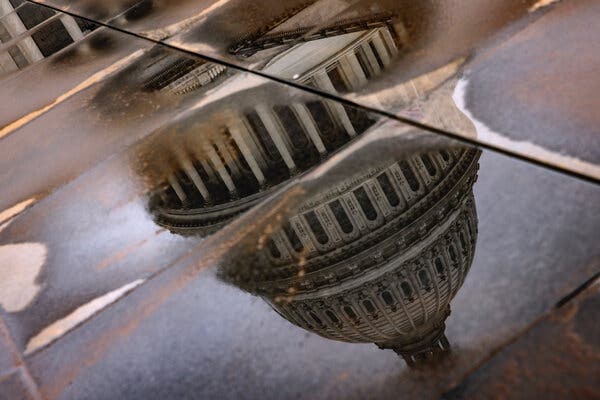
How Immigration Became a Lightning Rod in American Politics
Anti-immigrant think tanks and advocacy groups operated on the margins until Trump became president. Now they have molded not only the GOP but also Democrats in their image.
by Gaby Del Valle
September 25, 2024
The Nation
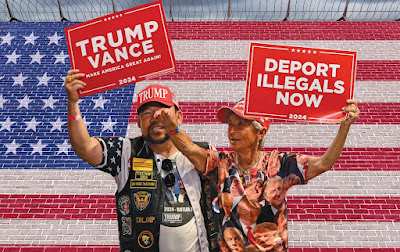
Photomontage by The Nation. This article appears in the October 2024 issue, with the headline “How Immigration Became a Lightning Rod in American Politics.”
On one of his few lucid moments during the only debate of the 2024 election cycle between Donald Trump and Joe Biden, the sitting president suggested he would be tougher on the border than his predecessor, blaming the former president for the demise of a “bipartisan border deal” that would have boosted the Border Patrol’s funding and significantly reduced access to asylum. Biden and top congressional Democrats had spent months negotiating its provisions, granting more and more concessions to conservatives in the hopes that they’d stop claiming that Biden had lost control of the southern border. But “when we had that deal done,” Biden said, Trump “called his Republican colleagues and said, ‘Don’t do it. It’s going to hurt me politically.’” The far right had refused to grant Biden a “win” on immigration, even if it meant forgoing exactly what they claimed they wanted.
This was a very different Biden than the one who had gone up against Trump four years earlier. When the two shared a debate stage in 2020, Biden accused Trump of presiding over unimaginable cruelty toward migrants: babies torn from their mothers’ arms at the border, some never to be reunited; undocumented workers rounded up on the job; asylum seekers shunted back to Mexico without a hearing. But there Biden was, a little over three months ago, saying in effect that he’d tried to finish the job Trump had begun, only to be stymied by Trump himself.
Biden’s pronouncements would soon take a backseat to the flurry of concern over his pitiful debate performance and his visibly declining health. He soon dropped out of the race, passing the torch to Vice President Kamala Harris, whom he’d once tasked with addressing the “root causes” of migration from Central America. But Biden’s pivot in the debate and the months preceding it symbolized a rightward lurch on immigration that may have been initiated by the GOP but has since become the dominant position of the Democratic Party. Meanwhile, in his campaign to get back to the White House, Trump has tacked even further to the right. Immigrants, Trump has said, are “poisoning the blood of our country.” If elected, he’s declared to thunderous applause, he’ll begin “mass deportations” on day one. “Send them back!” the crowd chanted when “illegal aliens” were mentioned at the Republican National Convention in Milwaukee, holding signs that read “Mass Deportation Now!”
This shift came stunningly fast. Just three election cycles ago, in the aftermath of Mitt Romney’s loss in the 2012 election, a postmortem by the Republican National Committee (RNC) attributed Romney’s defeat to his poor performance among Latino voters and recommended that the party should become more inclusive, perhaps softer on immigration. Even Trump—at the time an outspoken businessman with no public political ambitions—said that Romney’s stance on immigration was ridiculous. “He had a crazy policy of self-deportation, which was maniacal,” Trump said in 2012. “It sounded as bad as it was, and he lost all of the Latino vote. He lost the Asian vote. He lost everybody who is inspired to come into this country.” Three years later, announcing his own run for president, Trump descended a gilded escalator at Trump Tower on Fifth Avenue and promised to build an impenetrable border wall. Throughout his 2016 campaign, Trump ignored the RNC’s recommendations and embraced the ethos of the Tea Party, channeling incoherent populist rage into a nativist platform.
The promises of mass deportations and a “big, beautiful wall” were all Trump, but a policy wonk he was not. Trump’s immigration policy was devised by the alumni and allies of a single ecosystem of intertwined think tanks, nonprofits, and advocacy groups—one that once operated largely on the margins but that, beginning with Trump’s ascension to the presidency, has set the tone of the national immigration debate. Few of Trump’s immigration policies survived legal challenge, and even fewer are still in place today. Congress didn’t pass a single immigration bill during Trump’s term, nor has it under Biden. But immigration restriction is now dogma among Republicans and Democrats alike. The choice is no longer between a party that wants to turn away migrants and one that claims to welcome them, but rather between opposing sides that, despite their broader differences, disagree only on the best way to “secure” the border at any cost.
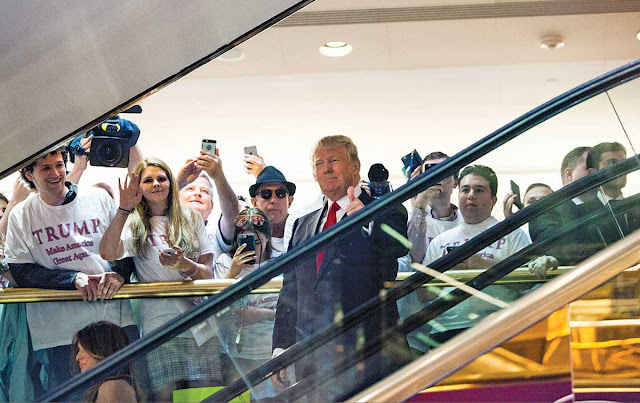 Turning point: Launching his 2016 presidential run, Trump pledged to “build a great wall” between the US and Mexico, signaling his dramatic shift on immigration.(Christopher Gregory / Getty Image)
It’s not an overstatement to say that the modern immigration restriction movement owes its existence to one man: a charismatic eye doctor from rural Michigan named John Tanton. Once described by a former ally as “the most influential unknown man in America,” Tanton spent decades building a network of anti-immigration groups from the ground up, transforming post–World War II nativism from a fringe view held by a small group of white supremacists into a mainstream political movement. Tanton, a veteran of the mid-century conservationist and population control movements, saw population growth as a major hurdle to long-term sustainability. Trying to convince his fellow nature lovers of the connection between international migration and environmental ruin, Tanton founded the Federation for American Immigration Reform, or FAIR, in 1979, dedicating himself to reversing the demographic changes that had taken hold in America in his lifetime. Over the next three decades, Tanton would found and help provide funding for a constellation of anti-immigration advocacy groups, including the Center for Immigration Studies (CIS), U.S. English, and NumbersUSA.
Tanton was born in Detroit in 1934, a decade after the Immigration Act of 1924 put the first permanent numerical limits on immigration in US history. The legislation capped immigration from Europe and allocated slots using a quota based on the composition of Americans’ national origins as of the 1890 census. The effect was an immediate and drastic reduction in immigration from Southern and Eastern Europe: More than a million European immigrants arrived in the United States in 1907; in 1925, that figure was just over 160,000. As a result of the act, Southern and Eastern Europe were no longer the main source of immigrants to the US. (African and Asian migration were effectively banned; no restrictions were implemented on migration from Latin America.)
The 1924 law kept America overwhelmingly white and Western European through Tanton’s young adulthood. But in 1965, a year after he graduated medical school, the country changed forever. The Immigration Act of 1965, also known as the Hart-Celler Act, overturned the national-origins quota system, replacing it with one that prioritized family reunification. The new law more than doubled the number of immigrant visas issued each year and didn’t count the immediate relatives of US citizens against these quotas. At the same time, Hart-Celler imposed numerical limits on Latin American and Caribbean migration for the first time in US history, unwittingly creating the conditions for a rise in unauthorized migration decades later. The law led to new patterns of immigration that slowly shifted America’s racial composition. The descendants of the Southern and Eastern European immigrants who had been considered unassimilable decades earlier were, after a rocky start, incorporated into the American melting pot; the newcomers, meanwhile, were regarded with hostility, accused of being inferior to the generation of immigrants who had come before them.
As was the case at the turn of the 20th century, the wave of immigrants who arrived after 1965 were met with hostility. In 1977, David Duke, the grand wizard of the Ku Klux Klan, said that he and his followers would be patrolling the US-Mexico border in search of migrants. Two years later, Klan members descended on a Texas fishing village that had recently become home to Vietnamese refugees.
Tanton and his wife were mostly insulated from these changes in Petoskey, the tiny northern Michigan town where he found work as an ophthalmologist. A decade earlier, at the end of the 1960s, Tanton had read The Population Bomb, the biologist Paul Ehrlich’s polemic on overpopulation. For Tanton, each refugee who resettled in America meant another drain on resources, another blight on the environment. He conceived of FAIR as a liberal anti-immigration group, and its early talking points were about how unfettered immigration hurt working-class people of color at home and contributed to a brain drain abroad, not to mention its effects on population growth.
All these decades later, it’s hard to grasp how out of step this was. After Hart-Celler and before FAIR’s emergence as a major political player, immigration restriction was the domain of Klansmen and white separatists. It wasn’t, as Tanton wrote in his 1978 funding request to Cordelia Scaife May—the reclusive Mellon heiress who would go on to bankroll his movement—“a legitimate position for thinking people.”
The first test arrived quickly. Months after FAIR’s founding, Congress began working on the Refugee Act of 1980, an effort to streamline the ad hoc system that allowed people fleeing their countries to find protection in the United States. FAIR hired a lobbyist to push for a provision that would cap the number of refugees admitted each year at 50,000. Instead, the bill that President Jimmy Carter signed into law allowed the sitting president to choose the annual limit in consultation with Congress. That year, more than 207,000 refugees were resettled in the United States. Six years later, FAIR once again got caught up in—and lost—a legislative battle, this time over the 1986 Immigration Reform and Control Act, which provided a path to citizenship for nearly 3 million undocumented immigrants living in the US. The bill passed with bipartisan consensus, and President Ronald Reagan signed it into law. Few in Congress were swayed by FAIR’s arguments for deporting unauthorized immigrants. “We didn’t convince anybody,” founding member Otis Graham told The New York Times in 2011. FAIR had built a membership base of 4,000 by 1982, but it wasn’t enough for Tanton, who, according to notes taken during a board meeting that year, believed it was “time to change our methods.” Tanton was realizing that environmental issues didn’t appeal to most Americans; what did was watching their communities change and feeling powerless to stop it. In a 1986 memo, Tanton wrote that FAIR had been too reliant on large donors and too focused on lobbying members of Congress, with little to show for it. Instead, he outlined a “long-range project” to “infiltrate” congressional immigration committees. “Think how much different our prospects would be if someone espousing our ideas had the chairmanship!” he wrote. Until then, it would be difficult to influence national politics. Tanton decided to start small.
On one of his few lucid moments during the only debate of the 2024 election cycle between Donald Trump and Joe Biden, the sitting president suggested he would be tougher on the border than his predecessor, blaming the former president for the demise of a “bipartisan border deal” that would have boosted the Border Patrol’s funding and significantly reduced access to asylum. Biden and top congressional Democrats had spent months negotiating its provisions, granting more and more concessions to conservatives in the hopes that they’d stop claiming that Biden had lost control of the southern border. But “when we had that deal done,” Biden said, Trump “called his Republican colleagues and said, ‘Don’t do it. It’s going to hurt me politically.’” The far right had refused to grant Biden a “win” on immigration, even if it meant forgoing exactly what they claimed they wanted.
This was a very different Biden than the one who had gone up against Trump four years earlier. When the two shared a debate stage in 2020, Biden accused Trump of presiding over unimaginable cruelty toward migrants: babies torn from their mothers’ arms at the border, some never to be reunited; undocumented workers rounded up on the job; asylum seekers shunted back to Mexico without a hearing. But there Biden was, a little over three months ago, saying in effect that he’d tried to finish the job Trump had begun, only to be stymied by Trump himself.
Biden’s pronouncements would soon take a backseat to the flurry of concern over his pitiful debate performance and his visibly declining health. He soon dropped out of the race, passing the torch to Vice President Kamala Harris, whom he’d once tasked with addressing the “root causes” of migration from Central America. But Biden’s pivot in the debate and the months preceding it symbolized a rightward lurch on immigration that may have been initiated by the GOP but has since become the dominant position of the Democratic Party. Meanwhile, in his campaign to get back to the White House, Trump has tacked even further to the right. Immigrants, Trump has said, are “poisoning the blood of our country.” If elected, he’s declared to thunderous applause, he’ll begin “mass deportations” on day one. “Send them back!” the crowd chanted when “illegal aliens” were mentioned at the Republican National Convention in Milwaukee, holding signs that read “Mass Deportation Now!”
This shift came stunningly fast. Just three election cycles ago, in the aftermath of Mitt Romney’s loss in the 2012 election, a postmortem by the Republican National Committee (RNC) attributed Romney’s defeat to his poor performance among Latino voters and recommended that the party should become more inclusive, perhaps softer on immigration. Even Trump—at the time an outspoken businessman with no public political ambitions—said that Romney’s stance on immigration was ridiculous. “He had a crazy policy of self-deportation, which was maniacal,” Trump said in 2012. “It sounded as bad as it was, and he lost all of the Latino vote. He lost the Asian vote. He lost everybody who is inspired to come into this country.” Three years later, announcing his own run for president, Trump descended a gilded escalator at Trump Tower on Fifth Avenue and promised to build an impenetrable border wall. Throughout his 2016 campaign, Trump ignored the RNC’s recommendations and embraced the ethos of the Tea Party, channeling incoherent populist rage into a nativist platform.
The promises of mass deportations and a “big, beautiful wall” were all Trump, but a policy wonk he was not. Trump’s immigration policy was devised by the alumni and allies of a single ecosystem of intertwined think tanks, nonprofits, and advocacy groups—one that once operated largely on the margins but that, beginning with Trump’s ascension to the presidency, has set the tone of the national immigration debate. Few of Trump’s immigration policies survived legal challenge, and even fewer are still in place today. Congress didn’t pass a single immigration bill during Trump’s term, nor has it under Biden. But immigration restriction is now dogma among Republicans and Democrats alike. The choice is no longer between a party that wants to turn away migrants and one that claims to welcome them, but rather between opposing sides that, despite their broader differences, disagree only on the best way to “secure” the border at any cost.
Turning point: Launching his 2016 presidential run, Trump pledged to “build a great wall” between the US and Mexico, signaling his dramatic shift on immigration.(Christopher Gregory / Getty Image)It’s not an overstatement to say that the modern immigration restriction movement owes its existence to one man: a charismatic eye doctor from rural Michigan named John Tanton. Once described by a former ally as “the most influential unknown man in America,” Tanton spent decades building a network of anti-immigration groups from the ground up, transforming post–World War II nativism from a fringe view held by a small group of white supremacists into a mainstream political movement. Tanton, a veteran of the mid-century conservationist and population control movements, saw population growth as a major hurdle to long-term sustainability. Trying to convince his fellow nature lovers of the connection between international migration and environmental ruin, Tanton founded the Federation for American Immigration Reform, or FAIR, in 1979, dedicating himself to reversing the demographic changes that had taken hold in America in his lifetime. Over the next three decades, Tanton would found and help provide funding for a constellation of anti-immigration advocacy groups, including the Center for Immigration Studies (CIS), U.S. English, and NumbersUSA.
Tanton was born in Detroit in 1934, a decade after the Immigration Act of 1924 put the first permanent numerical limits on immigration in US history. The legislation capped immigration from Europe and allocated slots using a quota based on the composition of Americans’ national origins as of the 1890 census. The effect was an immediate and drastic reduction in immigration from Southern and Eastern Europe: More than a million European immigrants arrived in the United States in 1907; in 1925, that figure was just over 160,000. As a result of the act, Southern and Eastern Europe were no longer the main source of immigrants to the US. (African and Asian migration were effectively banned; no restrictions were implemented on migration from Latin America.)
The 1924 law kept America overwhelmingly white and Western European through Tanton’s young adulthood. But in 1965, a year after he graduated medical school, the country changed forever. The Immigration Act of 1965, also known as the Hart-Celler Act, overturned the national-origins quota system, replacing it with one that prioritized family reunification. The new law more than doubled the number of immigrant visas issued each year and didn’t count the immediate relatives of US citizens against these quotas. At the same time, Hart-Celler imposed numerical limits on Latin American and Caribbean migration for the first time in US history, unwittingly creating the conditions for a rise in unauthorized migration decades later. The law led to new patterns of immigration that slowly shifted America’s racial composition. The descendants of the Southern and Eastern European immigrants who had been considered unassimilable decades earlier were, after a rocky start, incorporated into the American melting pot; the newcomers, meanwhile, were regarded with hostility, accused of being inferior to the generation of immigrants who had come before them.
As was the case at the turn of the 20th century, the wave of immigrants who arrived after 1965 were met with hostility. In 1977, David Duke, the grand wizard of the Ku Klux Klan, said that he and his followers would be patrolling the US-Mexico border in search of migrants. Two years later, Klan members descended on a Texas fishing village that had recently become home to Vietnamese refugees.
Tanton and his wife were mostly insulated from these changes in Petoskey, the tiny northern Michigan town where he found work as an ophthalmologist. A decade earlier, at the end of the 1960s, Tanton had read The Population Bomb, the biologist Paul Ehrlich’s polemic on overpopulation. For Tanton, each refugee who resettled in America meant another drain on resources, another blight on the environment. He conceived of FAIR as a liberal anti-immigration group, and its early talking points were about how unfettered immigration hurt working-class people of color at home and contributed to a brain drain abroad, not to mention its effects on population growth.
All these decades later, it’s hard to grasp how out of step this was. After Hart-Celler and before FAIR’s emergence as a major political player, immigration restriction was the domain of Klansmen and white separatists. It wasn’t, as Tanton wrote in his 1978 funding request to Cordelia Scaife May—the reclusive Mellon heiress who would go on to bankroll his movement—“a legitimate position for thinking people.”
The first test arrived quickly. Months after FAIR’s founding, Congress began working on the Refugee Act of 1980, an effort to streamline the ad hoc system that allowed people fleeing their countries to find protection in the United States. FAIR hired a lobbyist to push for a provision that would cap the number of refugees admitted each year at 50,000. Instead, the bill that President Jimmy Carter signed into law allowed the sitting president to choose the annual limit in consultation with Congress. That year, more than 207,000 refugees were resettled in the United States. Six years later, FAIR once again got caught up in—and lost—a legislative battle, this time over the 1986 Immigration Reform and Control Act, which provided a path to citizenship for nearly 3 million undocumented immigrants living in the US. The bill passed with bipartisan consensus, and President Ronald Reagan signed it into law. Few in Congress were swayed by FAIR’s arguments for deporting unauthorized immigrants. “We didn’t convince anybody,” founding member Otis Graham told The New York Times in 2011. FAIR had built a membership base of 4,000 by 1982, but it wasn’t enough for Tanton, who, according to notes taken during a board meeting that year, believed it was “time to change our methods.” Tanton was realizing that environmental issues didn’t appeal to most Americans; what did was watching their communities change and feeling powerless to stop it. In a 1986 memo, Tanton wrote that FAIR had been too reliant on large donors and too focused on lobbying members of Congress, with little to show for it. Instead, he outlined a “long-range project” to “infiltrate” congressional immigration committees. “Think how much different our prospects would be if someone espousing our ideas had the chairmanship!” he wrote. Until then, it would be difficult to influence national politics. Tanton decided to start small.
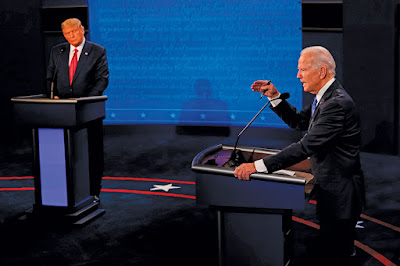
About face: In the 2020 presidential debates, Joe Biden decried Trump’s immigration policies. By 2024, that had changed.(Morry Gash / AP)
Tanton got his first chance to test his new theory of the power of a grassroots immigration restriction movement in 1988, when another organization he’d founded earlier that decade, U.S. English, placed the question of language on the ballot. Tanton had created U.S. English to help organize campaigns to make English the official language of several states, some of which had large and steadily growing Latino populations. The crusade began in California, where U.S. English bankrolled a local group’s efforts in support of an English-only ballot initiative. After the California measure succeeded, U.S. English led similar campaigns in a far-flung mix of states, including Arkansas, Mississippi, North Carolina, North Dakota, and South Dakota in 1987, and Arizona, Colorado, and Florida the following year. Some were states where the demographics were shifting, while others, like North Dakota, were trying to preempt these changes. In all, however, the question was about more than language; it was about who belonged in America—and to whom it should belong in the future.
The English-only campaigns were marred by allegations of racism from the outset. Opponents criticized Tanton’s groups for taking money from the Pioneer Fund, a New York–based eugenicist organization. But it wasn’t until someone leaked a memo from Tanton written two years earlier that the Arizona campaign seemed doomed. “Can homo contraceptivus compete with homo progenitiva if borders aren’t controlled?” he mused in the 1986 memo, which was distributed to attendees of the annual anti-immigration retreat he had begun hosting a year earlier. “Or is advice to limit one’s family simply advice to move over and let someone else with greater reproductive powers occupy the space?” He posed other troubling questions in the memo: Will Latino Catholics be able to assimilate to American culture? Will they bring their customs of bribery, violence, and disregard for authority to the United States? And why do they have so many kids in the first place?
The people who attended Tanton’s retreat—including Jared Taylor, the publisher of the white nationalist journal American Renaissance—must have welcomed these questions, but the public didn’t. Despite U.S. English’s bipartisan background and high-profile endorsements—its first director was former Reagan aide and prominent Latina activist Linda Chavez, and Walter Cronkite was on the board—it could no longer claim plausible deniability regarding allegations of racism. Chavez resigned after the memo leaked and disavowed the organization; Cronkite, too, bailed. But with the help of a last-minute canvassing push funded by May, U.S. English eked out a victory, with 50.5 percent of Arizona voters supporting the measure. The elections weren’t as close elsewhere in the country: More than 60 percent of Colorado’s voters supported the amendment, as did 84 percent of Florida’s.
There was a setback: A federal judge later blocked Arizona’s English-only measure. Even so, grassroots activism, Tanton came to understand, was the key to enacting policies that curtail immigration. All Tanton had to do was help people realize what they already knew in their hearts to be true: America was a nation of immigrants, yes, but the newcomers were unlike those who came before. “I think there is such a thing as an American culture, however difficult it may be to define,” Tanton said in a 1989 oral history of his advocacy. Some could argue that “hyphenated Americans” belong to this culture just as much as people whose forebears date back to the colonial period, Tanton said, but that was “an incorrect view.” In a 1986 interview with The New York Times, FAIR’s first executive director, Roger Conner, a former environmental lawyer, described previous waves of immigrants as “entrepreneurial,” while more recent arrivals had little interest in working or assimilating. “For some reason,” Conner said, “Mexican immigrants are not succeeding as well as other groups.”
By 1990, FAIR claimed to have 50,000 members, and the organization was finding other state-level initiatives to support. In 1994, the group backed Proposition 187, a ballot initiative in California that banned undocumented immigrants from using any government services in the state, including public schools and non-emergency healthcare. In 1986, Tanton had written that California’s system could do this, “but the political will is lacking to implement it.” To build that will, Tanton created and funded groups like Americans for Border Control through his umbrella organization, U.S. Inc. Proposition 187’s supporters claimed that not only were the undocumented overburdening public services and contributing to overcrowding in the state, but their presence in California would lead to long-term gains in political power for Hispanic Americans.
Nearly 60 percent of Californians voted for Proposition 187, but a federal judge blocked the initiative from going into effect. Still, as with Arizona’s English-only measure, the defeat of Proposition 187 provided a valuable lesson for FAIR: Change happens when ordinary people decide they’re fed up with something and come together to do something about it. If the groups that allow people to do that don’t exist, why not create them?
Everywhere they passed, anti-immigrant ordinances like Proposition 187 and the English-only measures granted a degree of legitimacy to long-held racial animus. In Colorado, someone posted a sign reading “No Ingles, No Travato“—an attempted translation of “No English, No Job”—at the entrance to a construction site. “We checked. Because of the English-only bill, we know it’s legal,” a superintendent at the site told the Los Angeles Times. In California, Proposition 187 proved to be just as effective a recruitment tool as it would have been had it been implemented. Tanton’s journal, The Social Contract, has published dozens of articles about Proposition 187 in the decades since the referendum passed. “When thousands of [people] marched to protest” the measure, an article from The Social Contract’s 1996 issue on so-called “anchor babies” declared, “they carried the flag of Mexico, not the Stars and Stripes.”
Tanton’s organizations not only activated dormant anti-immigrant feeling; they actively fomented it, often using the news media to launder their talking points. FAIR, the Center for Immigration Studies, and NumbersUSA—the latter founded in 1996 by Tanton’s acolyte Roy Beck—became reporters’ go-to sources for all things related to immigration restriction, largely because there were few other groups to quote. Representatives of the three organizations blamed nearly every problem, from littering in public parks to gridlock on the highways, on immigration. At the height of the tough-on-crime ’90s, immigration was being portrayed as a gangs and quality-of-life issue; after the September 11 attacks, the permeability of the border became a national security threat.
FAIR and its allies were succeeding in changing public sentiment on immigration. Soon FAIR, through its legal arm, the Immigration Law Reform Institute, began offering its legal services to local governments. In 2006, when the city of Hazleton, Pennsylvania, passed a law fining landlords for renting apartments to undocumented immigrants and employers for using them as workers, it hired Kris Kobach, who would become one of the foremost attorneys pushing immigration restriction. Not long after, the town council of Valley Park, Missouri, unanimously voted to implement a similar policy. Kobach defended Valley Park after a landlord sued over the measure, then went on to draft legislation for other cities—and defended the cities when those policies were challenged in court. The measures faced years of lawsuits, and the cities had to pay Kobach hundreds of thousands of dollars in legal fees. “It was a sham,” the mayor of Farmers Branch, a Texas city that hired Kobach in 2007, told ProPublica, which reported that Kobach earned at least $800,000 for his legal and advocacy work over a 13-year period. Ineffective and expensive as they were, the ordinances helped cement Kobach’s status as the go-to lawyer for local and state governments that wanted to take a hard line on immigration. In 2010, Kobach drafted Arizona’s infamous SB 1070, colloquially referred to as the “Show Me Your Papers” law. An Arizona state senator later described it as “model legislation” for dissemination through the American Legislative Exchange Council, a right-wing “bill mill.” Copycat bills were soon introduced around the country. By 2012, Kobach was informally advising the Romney campaign on immigration.
Most of the bills that Kobach drafted or defended were blocked by the courts, never implemented, or watered down to the point of meaninglessness. But every city that passed or even debated an anti-immigrant ordinance helped Tanton’s groups send a message to Congress: Americans aren’t interested in immigration reform or amnesty for the undocumented; they want those people out. “God forbid he ever gets hit by a Mack truck or something,” the Immigration Law Reform Institute’s general counsel said in 2012 of Kobach, who by that point was working for the group on the side while serving as Kansas’s secretary of state. “It would change the course of history.”
Tanton’s “long-range project” to affect national politics by starting at the local level was working. The organizations under the umbrella of FAIR and U.S. Inc. had built a grassroots army and won over small-town mayors. And some of those mayors were now entering national politics. After three failed bids for a seat in Congress, Lou Barletta, the Hazleton mayor who hired Kobach to defend the city’s anti-immigrant ordinance, was elected to the House of Representatives in 2010. Among Tanton’s other supporters were Colorado Representative Tom Tancredo, who kicked off his first term in 1999 by founding the Congressional Immigration Reform Caucus; Iowa Senator Chuck Grassley; and Jeff Sessions, the soft-spoken Alabama senator whose diminutive presence belied his virulent racism. In 2000, FAIR and its sister organizations helped defeat the Latino and Immigrant Fairness Act, which would have provided a path to citizenship for qualifying undocumented immigrants. The following year, in the immediate aftermath of 9/11, the Congressional Immigration Reform Caucus’s membership nearly doubled overnight, from 16 to 30 members.
FAIR would face its biggest tests yet beginning in 2006, when Congress appeared poised to pass a bill granting green cards to more than 6 million undocumented immigrants. The legislation failed, but in 2007 a group of senators once again attempted to persuade their colleagues—and the nation—to support immigration reform. The bill sponsored by the “Gang of 12,” including Lindsey Graham and John McCain, had bipartisan support and was backed by President George W. Bush. Its opponents had something stronger: a grassroots army, hundreds of thousands strong, who threatened to withhold their votes from politicians who put “illegals” ahead of Americans.
Most Americans, in fact, were in favor of granting citizenship to undocumented immigrants who met certain conditions—but they, too, were swayed by the campaign against the bill. Polls found that many voters who agreed with the 2007 bill’s provisions opposed the idea of “amnesty” and the bill specifically. The discrepancy between what people said they wanted and what they actually supported was the result of a coordinated effort by FAIR, CIS, and NumbersUSA. Every day, as part of a campaign led by NumbersUSA, lawmakers received thousands of calls, letters, and faxes urging them to vote against the bill. “The fax machines would run out of paper,” a Republican House staffer recalled years later. Most of the messages came from a familiar group of people—“frequent fliers,” the staffer called them—but the volume of calls swayed those who were undecided. The callers “lit up the switchboard for weeks,” Senator Mitch McConnell, who voted against the bill, said in 2011, when immigration reform was back on the table. “And to every one of them I say today: Your voice was heard.”
The 2011 bill failed as well and was reintroduced in 2014, this time by a “Gang of Eight”—a sign of waning support in Congress. “The longer it stays in the sun, the more it smells, as they say about the mackerel,” Sessions said of the reform bill in 2014. Certain that it would pass in the Senate, Sessions—at the time still a fringe member of his party—set his sights on tanking the bill in the House. To ensure that the legislation failed, he enlisted his young aide, a 29-year-old from California named Stephen Miller.
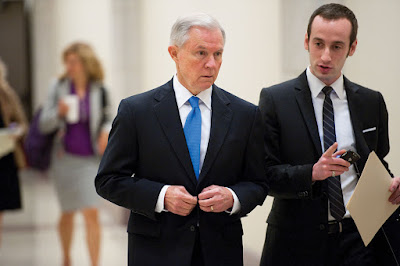
Sowing seeds: Jeff Sessions, left, one of the most prominent anti-immigration voices in the Senate, with his aide Stephen Miller.(CQ Roll Call via AP)
Miller—the son of Santa Monica liberals who would introduce himself to college classmates by saying, “My name is Stephen Miller, I’m from Los Angeles, and I like guns”—started his career as a press secretary for Minnesota Representative Michelle Bachmann. After he took a job with Sessions, Miller became close with researchers at CIS; he used the group’s data to convince other Republicans of the harms that immigrants posed. Sessions had long been close with FAIR and CIS, but with Miller’s help, he became a leader of the anti-immigration-reform movement within Congress and was instrumental in defeating the bill in 2014. “The whole point was to taint the bill in the eyes of Republicans in the House,” CIS president Mark Krikorian told Miller’s biographer. “Sessions, with Miller’s help, really did succeed in preventing that bill from passing.”
Miller, too, was influenced by Tanton, sometimes in obscure ways. In 1983, Tanton persuaded May, his billionaire patron, to cover the costs of reprinting and distributing The Camp of the Saints, a French novel that depicts a dystopian future in which Europe and the US are besieged by hordes of dark-skinned migrants. The book didn’t receive much acclaim outside white supremacist circles when it was first published in 1973. But Tanton acquired the rights and arranged for it to be published through the Social Contract Press. It’s unclear when Miller read the novel, but in September 2015, he persuaded Breitbart to run a story about it, according to e-mails obtained by the Southern Poverty Law Center. “I think it was growing up in California, he saw the role that mass migration played in turning a red state blue,” a former Senate colleague of Miller’s told Politico. “He was fearful that would happen to the rest of the country.”
After Trump announced his candidacy in 2015 by calling Mexican immigrants “rapists,” Miller persuaded Sessions to become the first sitting senator to endorse him. Miller offered his services as an informal adviser to the campaign and then, after a few months, demanded a job. Trump shared Miller’s instincts; in 2014, he’d cautioned Republican legislators against supporting immigration reform by implying that the beneficiaries of amnesty would vote for Democrats. Miller wrote Trump’s speeches and helped turn his xenophobic promises—a border wall, a Muslim ban—into policy proposals. And when Trump took office, Miller and Sessions were rewarded: Sessions was named attorney general, and Miller became a senior policy adviser for Trump. With Miller’s help, Trump stocked his agencies with alumni of the anti-immigration think tank ecosystem. Trump appointed Francis Cissna, a former employee of FAIR ally Chuck Grassley, to head US Citizenship and Immigration Services, the agency that oversees legal migration. Julie Kirchner, the executive director of FAIR from 2007 to 2015, was hired to advise the acting director of Customs and Border Protection in April 2017, before moving to USCIS a month later. During his first few months in office, Trump implemented dozens of policies—including expanding immigrant detention, reviving partnerships between Immigration and Customs Enforcement and local law enforcement agencies, and expediting certain deportation proceedings—that seemed to have been lifted from a 2016 wish list that CIS had published before Trump secured the nomination. In 2017, for the first time, CIS was invited to ICE’s semiannual stakeholder meeting. Representatives from FAIR and NumbersUSA also attended.
But Trump’s Department of Homeland Security was tumultuous. Staffers resigned with an alarming frequency, often after Miller pressured them to implement increasingly hard-line policies. Miller and a key ally, Gene Hamilton, senior counsel for Trump’s first DHS secretary, spent months pushing for a family separation policy at the US-Mexico border. Elaine Duke, Trump’s second DHS secretary, balked; Kirstjen Nielsen, her successor, eventually gave in to the pressure. It didn’t fare well for her: After mass protests and calls for congressional inquiries, Trump ended the family separation policy and Nielsen handed in her resignation.
Miller’s position as an adviser to the president gave him wide latitude in the White House. “The process for making decisions didn’t exist when we came in,” an immigration official in the Biden administration recently told The New Yorker. “It was calls with Stephen Miller in which he yelled at the career officials, and they went off to do what he said, or to try.”
For a brief moment in the wake of Biden’s 2020 victory against Trump, immigrant advocacy groups felt relief. The nation had voted against separating migrant families and banning Muslims. This optimism was cut short by Republicans, who started to spout immigrants-are-invading rhetoric almost as soon as Biden took office. Two months into Biden’s term, the Heritage Foundation accused him of causing a “crisis” at the southern border. Miller and his crew seized the narrative early, pushing the Biden administration into a defensive posture. Biden’s team quickly abandoned the promises they had made during the 2020 campaign to undo the harms that had been perpetrated by Trump’s DHS and to build a new, humane immigration system in its place. While Biden has rolled back some of Trump’s harshest policies at the border and created pathways for migrants from certain countries to lawfully enter and work in the United States on a temporary basis, these are half-measures at best.
Public sentiment on immigration has shifted significantly since Biden took office—and now, with Kamala Harris as the nominee, the Democrats are sending a far different message than they did in 2020. One of Harris’s first campaign ads touts her experience as a “border state prosecutor” who “took on drug cartels and jailed gang members” and reminds voters that as vice president, she backed the “toughest border control bill in decades.” Harris’s warning to would-be migrants in 2021—“Do not come”—is now the kind of thing a growing number of Democratic voters seems eager to hear. In February, a Gallup poll found that immigration was the most important issue for voters. And in July, a poll found that 55 percent of American adults want to see immigration to the United States go down—the first time in more than 20 years that a majority of voters have said they want fewer immigrants in the country.
Having convinced the public that illegal immigration is out of control, the nativist right is now shifting its efforts toward limiting legal migration. The Heritage Foundation’s Project 2025 to remake the federal government under a Trump presidency includes a chapter on the DHS that recommends reducing or outright eliminating visas issued to foreign students “from enemy nations”; reimplementing USCIS’s denaturalization unit to strip certain naturalized citizens of their status; retraining USCIS officers to focus on “fraud detection”; eliminating the diversity visa lottery; ending so-called “chain migration”; and creating a “merit-based system that rewards high-skilled aliens instead of the current system that favors extended family-based and luck-of-the-draw immigration.”
John Tanton, more than anyone else, understood the power of harnessing the public’s fears and anxieties in the service of a broader political project. FAIR, CIS, and NumbersUSA’s public campaigns may have focused on illegal immigration, but the organizations were founded to undo the harms that Tanton believed stemmed from the legal immigration facilitated by the Immigration Act of 1965. Project 2025, if it comes to fruition, may be what he and his disciples have long been waiting for. The indefatigable Tanton, who died in 2019 after a long battle with Parkinson’s, did not live to see the very Democrats who once chanted “Immigrants are welcome here” embrace policies of restriction. If he had, it’s hard to imagine that he would’ve been surprised. In the 1989 oral history, Tanton said that those who “deal in the world of ideas” come to expect a common trajectory: “The first response of many people is to say, ‘I never heard of it before.’ And the second response after they thought about it for a bit was to say, ‘It’s anti-God.’ And the third response after they’d realized the idea was right was to come around and say, ‘I knew it all along.’”
ABOUT THE AUTHOR:
Gaby Del Valle is a freelance immigration reporter who is based in Brooklyn.
Miller—the son of Santa Monica liberals who would introduce himself to college classmates by saying, “My name is Stephen Miller, I’m from Los Angeles, and I like guns”—started his career as a press secretary for Minnesota Representative Michelle Bachmann. After he took a job with Sessions, Miller became close with researchers at CIS; he used the group’s data to convince other Republicans of the harms that immigrants posed. Sessions had long been close with FAIR and CIS, but with Miller’s help, he became a leader of the anti-immigration-reform movement within Congress and was instrumental in defeating the bill in 2014. “The whole point was to taint the bill in the eyes of Republicans in the House,” CIS president Mark Krikorian told Miller’s biographer. “Sessions, with Miller’s help, really did succeed in preventing that bill from passing.”
Miller, too, was influenced by Tanton, sometimes in obscure ways. In 1983, Tanton persuaded May, his billionaire patron, to cover the costs of reprinting and distributing The Camp of the Saints, a French novel that depicts a dystopian future in which Europe and the US are besieged by hordes of dark-skinned migrants. The book didn’t receive much acclaim outside white supremacist circles when it was first published in 1973. But Tanton acquired the rights and arranged for it to be published through the Social Contract Press. It’s unclear when Miller read the novel, but in September 2015, he persuaded Breitbart to run a story about it, according to e-mails obtained by the Southern Poverty Law Center. “I think it was growing up in California, he saw the role that mass migration played in turning a red state blue,” a former Senate colleague of Miller’s told Politico. “He was fearful that would happen to the rest of the country.”
After Trump announced his candidacy in 2015 by calling Mexican immigrants “rapists,” Miller persuaded Sessions to become the first sitting senator to endorse him. Miller offered his services as an informal adviser to the campaign and then, after a few months, demanded a job. Trump shared Miller’s instincts; in 2014, he’d cautioned Republican legislators against supporting immigration reform by implying that the beneficiaries of amnesty would vote for Democrats. Miller wrote Trump’s speeches and helped turn his xenophobic promises—a border wall, a Muslim ban—into policy proposals. And when Trump took office, Miller and Sessions were rewarded: Sessions was named attorney general, and Miller became a senior policy adviser for Trump. With Miller’s help, Trump stocked his agencies with alumni of the anti-immigration think tank ecosystem. Trump appointed Francis Cissna, a former employee of FAIR ally Chuck Grassley, to head US Citizenship and Immigration Services, the agency that oversees legal migration. Julie Kirchner, the executive director of FAIR from 2007 to 2015, was hired to advise the acting director of Customs and Border Protection in April 2017, before moving to USCIS a month later. During his first few months in office, Trump implemented dozens of policies—including expanding immigrant detention, reviving partnerships between Immigration and Customs Enforcement and local law enforcement agencies, and expediting certain deportation proceedings—that seemed to have been lifted from a 2016 wish list that CIS had published before Trump secured the nomination. In 2017, for the first time, CIS was invited to ICE’s semiannual stakeholder meeting. Representatives from FAIR and NumbersUSA also attended.
But Trump’s Department of Homeland Security was tumultuous. Staffers resigned with an alarming frequency, often after Miller pressured them to implement increasingly hard-line policies. Miller and a key ally, Gene Hamilton, senior counsel for Trump’s first DHS secretary, spent months pushing for a family separation policy at the US-Mexico border. Elaine Duke, Trump’s second DHS secretary, balked; Kirstjen Nielsen, her successor, eventually gave in to the pressure. It didn’t fare well for her: After mass protests and calls for congressional inquiries, Trump ended the family separation policy and Nielsen handed in her resignation.
Miller’s position as an adviser to the president gave him wide latitude in the White House. “The process for making decisions didn’t exist when we came in,” an immigration official in the Biden administration recently told The New Yorker. “It was calls with Stephen Miller in which he yelled at the career officials, and they went off to do what he said, or to try.”
For a brief moment in the wake of Biden’s 2020 victory against Trump, immigrant advocacy groups felt relief. The nation had voted against separating migrant families and banning Muslims. This optimism was cut short by Republicans, who started to spout immigrants-are-invading rhetoric almost as soon as Biden took office. Two months into Biden’s term, the Heritage Foundation accused him of causing a “crisis” at the southern border. Miller and his crew seized the narrative early, pushing the Biden administration into a defensive posture. Biden’s team quickly abandoned the promises they had made during the 2020 campaign to undo the harms that had been perpetrated by Trump’s DHS and to build a new, humane immigration system in its place. While Biden has rolled back some of Trump’s harshest policies at the border and created pathways for migrants from certain countries to lawfully enter and work in the United States on a temporary basis, these are half-measures at best.
Public sentiment on immigration has shifted significantly since Biden took office—and now, with Kamala Harris as the nominee, the Democrats are sending a far different message than they did in 2020. One of Harris’s first campaign ads touts her experience as a “border state prosecutor” who “took on drug cartels and jailed gang members” and reminds voters that as vice president, she backed the “toughest border control bill in decades.” Harris’s warning to would-be migrants in 2021—“Do not come”—is now the kind of thing a growing number of Democratic voters seems eager to hear. In February, a Gallup poll found that immigration was the most important issue for voters. And in July, a poll found that 55 percent of American adults want to see immigration to the United States go down—the first time in more than 20 years that a majority of voters have said they want fewer immigrants in the country.
Having convinced the public that illegal immigration is out of control, the nativist right is now shifting its efforts toward limiting legal migration. The Heritage Foundation’s Project 2025 to remake the federal government under a Trump presidency includes a chapter on the DHS that recommends reducing or outright eliminating visas issued to foreign students “from enemy nations”; reimplementing USCIS’s denaturalization unit to strip certain naturalized citizens of their status; retraining USCIS officers to focus on “fraud detection”; eliminating the diversity visa lottery; ending so-called “chain migration”; and creating a “merit-based system that rewards high-skilled aliens instead of the current system that favors extended family-based and luck-of-the-draw immigration.”
John Tanton, more than anyone else, understood the power of harnessing the public’s fears and anxieties in the service of a broader political project. FAIR, CIS, and NumbersUSA’s public campaigns may have focused on illegal immigration, but the organizations were founded to undo the harms that Tanton believed stemmed from the legal immigration facilitated by the Immigration Act of 1965. Project 2025, if it comes to fruition, may be what he and his disciples have long been waiting for. The indefatigable Tanton, who died in 2019 after a long battle with Parkinson’s, did not live to see the very Democrats who once chanted “Immigrants are welcome here” embrace policies of restriction. If he had, it’s hard to imagine that he would’ve been surprised. In the 1989 oral history, Tanton said that those who “deal in the world of ideas” come to expect a common trajectory: “The first response of many people is to say, ‘I never heard of it before.’ And the second response after they thought about it for a bit was to say, ‘It’s anti-God.’ And the third response after they’d realized the idea was right was to come around and say, ‘I knew it all along.’”
ABOUT THE AUTHOR:
Gaby Del Valle is a freelance immigration reporter who is based in Brooklyn.