Wednesday, February 12, 2025

Leading Journalist, Activist, Attorney, Social Critic, Legal Theorist, Public Intellectual, and Author Elie Mystal On The Clear and Present Danger of Trump Remaking and Expanding the Fascist Authority and Power of the Supreme Court and the Absolute Terror That His Utterly Corrupt, Tyrannical, and Oppressive Political, Legal, and Ideological Regime Is Certain To Inflict On This Society and the World If We Don't Stop This Looming Catastrophe

How Trump Could Remake the Supreme Court for a Generation

Donald Trump is poised to become the first president since FDR to have appointed the majority of high-court justices. His potential picks are terrifying
 
by Elie Mystal
February 11, 2025
The Nation
 

Illustration by Brian Stauffer. 

This article appears in the March 2025 issue

with the headline “The Supreme Trump Court.”


Donald Trump’s first term as president gave the republicans control over the most dangerous body of the most dangerous branch of government: the Supreme Court. With the help of Senate majority leader Mitch McConnell, along with timely retirements and untimely deaths, Trump was able to secure a 6–3 hard-right majority on the court and use it to make the Republicans’ least-popular policy dreams come true. In the brief years since, the court has undermined labor rights, stripped back voting rights, and reduced pregnant people to the status of second-class citizens whose bodies can be controlled by Republican state legislatures eager to use them for labor without compensation.

The Democrats might have used Joe Biden’s four-year interregnum to begin to claw back the Supreme Court from the Republicans’ grip. Particularly during the first two years, with the Democrats in control of the White House and both chambers of Congress, they could have added additional justices to the court. Had they done so, abortion rights could have been saved, voting rights could have been protected, and Trump may have been ruled ineligible to ever run for office again.

Instead, the Democrats did nothing. As the Supreme Court revealed its full moral turpitude to a disgusted public, Congress failed to impose even minimal ethical standards on the justices or cut the court’s funding, while Biden sent court expansion to die in a useless commission.

Now we will experience a time of consequences. Vulnerable communities will pay the price for the Democrats’ inaction—and as bad as the court’s rulings have been in recent years, they are likely to get worse. When the justices are inevitably asked to weigh in on whether Trump can actually revoke birthright citizenship, don’t expect them to stop the guy they literally helped get elected from violating the Constitution. When they hear a lawsuit on whether Elon Musk and his apartheid-adjacent DOGE bros can resegregate the workforce, don’t expect them to honor the 14th Amendment and the Civil Rights Act. As for writing trans kids out of existence while citing the writings of J.K. Rowling as precedent, well, this court has already signaled it’s eager to do that.
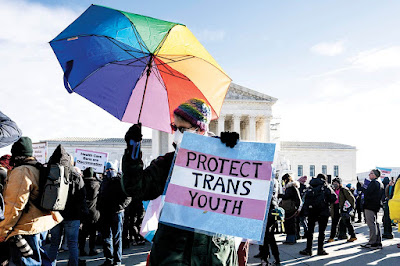

In the balance: People demonstrate in support of trans youth as the current court debates a law banning puberty blockers and hormone therapy for trans teens.(Michael Brochstein / SiPA via AP Images)

Still, all of this represents just the opening salvo in a GOP reign of terror that could outlive Trump and most of the people reading this, because Trump’s reelection gives the Republicans a chance to do something even more extreme with the Supreme Court: to make their judicial control permanent. Backed by a healthy majority in the Senate, the Republicans can swap out their oldest justices for younger blood, entrenching their dystopian view that the Constitution confers unlimited rights to gun owners and nobody else. And if the feckless gods decree that one of the Democratic justices should succumb to the ultimate law of nature during the next four years, the Republicans will be able to appoint their replacement as well, giving them a 7–2 majority.

In the case of either of these events, the Supreme Court will not just have a Republican majority by 2029, when Trump leaves office; it will likely have a Trump majority. Trump is now poised to become the first president since Franklin Delano Roosevelt to have appointed a majority of the justices on the Supreme Court. His justices will outlive him, and their impact on law and policy will outlast whatever temporary tragedies Trump brings forth through his executive orders.


Current Issue


March 2025 Issue


To have that kind of decades-long impact, Trump will require some help from the current Republican justices who are past their sell-by date. Clarence Thomas is 76. Sam Alito is 74. John Roberts just turned 70, and while he is unlikely to retire, life starts to get a bit less certain when you hit your eighth decade. Republican lawmakers and Trump himself will actively pressure these Republican justices to retire and offer them golden parachutes or whatever else their corrupt little hearts desire.

The one most likely to leave voluntarily is Alito. While he enjoys the power of being a Supreme Court justice, Alito is also partisan to his very core and is fully capable of reading the room and an actuary table. By retiring while Trump is in the White House and Republicans control the Senate, he could help out his beloved Republican Party, and that is Alito’s greatest mission in life. Alito (and his wife) are rumored to hate Washington, DC. When Trump gives him the opportunity to be replaced by one of his former law clerks, I reckon he’ll take it.
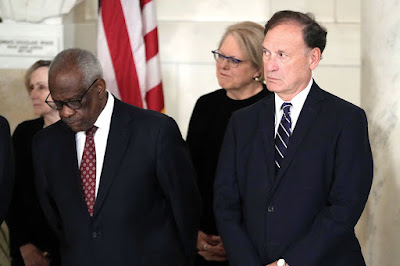
 

Practicing for retirement? Supreme Court Justice Clarence Thomas and Justice Samuel Alito attend a private event together.(Jacquelyn Martin / Getty Images)

Clarence Thomas, by contrast, will take some convincing. If his health holds, he’s on track to break William O. Douglas’s record as the longest-serving Supreme Court justice—a milestone he’ll reach sometime in 2028. Thomas will never get a spot in the Museum of African American History (unless it opens up a “Sometimes It Be Your Own People” wing), but breaking Douglas’s record is a legacy in itself. And Thomas (and his wife), unlike Alito (and his wife), is believed to really enjoy DC—to say nothing of the many perks that come with being a Supreme Court justice on real estate baron Harlan Crow’s payroll.

Thomas is also an iconoclast, which means that while the pleas for him to retire will get very loud in Republican circles, especially as we approach the 2028 presidential election, he might well resist them. I’ve always thought that, of all the justices on the court, Thomas is the one most likely to die at his desk while doing what he loves, which is taking away rights from Black people and women. Still, I think the raw power of his partisan allegiances will win out in the end—assuming, that is, that Republicans find a university or think tank willing to write Thomas a blank check for the rest of his life.

If Trump does get the opportunity to replace some Supreme Court justices, it’s unclear who will mastermind the actual appointments. Last time, conservative archvillain Leonard Leo called the shots, albeit through his sock puppet, then–White House counsel Don McGahn. Trump’s picks of Neil Gorsuch, alleged attempted rapist Brett Kavanaugh, and Amy Coney Barrett were straight out of Federalist Society central casting.

This time, we don’t know if Leo and his ilk will hold the same kind of power over Trump. Trump’s cabinet appointments show that he values loyal sycophants over competent officials, and there’s every reason to think he’ll try to fill the Supreme Court with people loyal to himself, not Leo. There’s also a new voice in Trump’s ear that wasn’t there the last time: that of shadow president Elon Musk. We don’t know whom he wants to see on the court, but given the amount of litigation that Musk and his businesses are involved in, one expects he’ll have his opinions on Supreme Court appointments, and those opinions will carry weight.

The fluid power dynamics among Trump, Musk, Leo, and the Senate confirmation process—ostensibly under the control of the new Senate majority leader, John Thune—mean that there’s more uncertainty about Trump’s likely Supreme Court nominees than for any incoming president in my lifetime. Indeed, the only thing I can be 100 percent sure of is that whoever Trump picks (and the Senate confirms) will be a deplorable jurist, dedicated to a far-right political agenda masquerading as law, and determined to inject more bigotry, discrimination, and sexism into the Constitution.

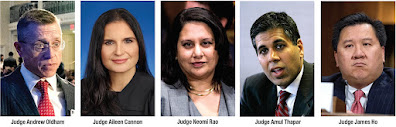
Still, in the cauldron of contenders for the nation’s highest court, there are a few names that keep bubbling to the top. Let’s discuss the five most likely people Trump could nominate to entrench one-party Republican rule on the court.
This time, we don’t know if Leo and his ilk will hold the same kind of power over Trump. Trump’s cabinet appointments show that he values loyal sycophants over competent officials, and there’s every reason to think he’ll try to fill the Supreme Court with people loyal to himself, not Leo. There’s also a new voice in Trump’s ear that wasn’t there the last time: that of shadow president Elon Musk. We don’t know whom he wants to see on the court, but given the amount of litigation that Musk and his businesses are involved in, one expects he’ll have his opinions on Supreme Court appointments, and those opinions will carry weight.

The fluid power dynamics among Trump, Musk, Leo, and the Senate confirmation process—ostensibly under the control of the new Senate majority leader, John Thune—mean that there’s more uncertainty about Trump’s likely Supreme Court nominees than for any incoming president in my lifetime. Indeed, the only thing I can be 100 percent sure of is that whoever Trump picks (and the Senate confirms) will be a deplorable jurist, dedicated to a far-right political agenda masquerading as law, and determined to inject more bigotry, discrimination, and sexism into the Constitution.

Still, in the cauldron of contenders for the nation’s highest court, there are a few names that keep bubbling to the top. Let’s discuss the five most likely people Trump could nominate to entrench one-party Republican rule on the court.


(left to right: Shuran Huang / The Washington Post via Getty Images; CC 4.0: Bill Clark / CQ Roll Call; Ed Reinke / AP; Tom Williams / CQ Roll Call)

ANDREW OLDHAM
fifth circuit court of appeals

Most people were concerned that Texas’s litigious and nefarious attorney general, Ken Paxton, would be given some kind of federal appointment in the new Trump administration. But the real threat coming from the Lone Star State is Andy Oldham, a circuit court judge who was appointed to his post by, yes, Donald Trump.

Oldham began making his bones as Texas Governor Greg Abbott’s right-hand lawman. As deputy solicitor general of Texas, he served as what the Alliance for Justice called the “architect” of Texas’s strategy to block Barack Obama’s Deferred Action for Childhood Arrivals (DACA) order. He also took strong stances against environmental protections and reproductive rights—and in favor of gun access. He did so well as deputy SG that Abbott elevated him to serve as his chief legal counsel in 2018.

Oldham didn’t stay in that position very long, however. A few weeks in, Trump nominated him to the Court of Appeals for the Fifth Circuit. There, Oldham has done what Trump expected him to do: He has issued opinions overturning the federal ban on ghost guns and defending Texas’s draconian immigration laws and, in one particularly curious ruling, appeared to support vigilante justice. He has also been an outspoken opponent of what the white wing now calls “DEI.”

But none of that is what makes Oldham stand out, as white male judges who like guns and hate women and Mexicans are a dime a dozen these days. The most interesting thing about Oldham is how poorly written his opinions are. He front-loads his overlong musings with enough amateur-historian babble to make Dan Brown blush, then sermonizes with the kind of conservative zeal that recalls John Lithgow’s character in the movie Footloose. The law, if discussed at all, is relegated to afterthoughts and footnotes.

That doesn’t seem to be a problem for people in Trump world, particularly since Oldham has other qualities they like, among them being against the counting of all eligible ballots—and in favor of presidents being free to commit crimes without prosecution. In October 2024, Oldham wrote an opinion in a case about whether Mississippi could count absentee ballots received after Election Day. He argued that federal law preempted the state from counting such ballots—which was a key part of Trump’s strategy to steal the election should he have lost it—but he did grant that the court shouldn’t block Mississippi from counting those ballots unless they were dispositive.

Of course, Trump won the election fairly, and in November, a week after the election, Oldham headlined a Federalist Society event to crow about it. In his speech, Oldham said that we need to make sure that no one is ever charged “on the basis of their politics” (which, again, is the false narrative Trump has been pushing to explain his multiple felony indictments), and also that the judiciary must be protected from “reprisals” from the legislative branch. According to Oldham, those reprisals include commonsense reforms like court expansion and ethics laws.

While Oldham checks all of Trump’s boxes, it’s unclear whether he can count on the support of the shadow president, Musk. Oldham joined the unanimous opinion in NetChoice v. Paxton, a case that explored whether Texas could regulate social media platforms when they censor content. The opinion rejects “the idea that corporations have a freewheeling First Amendment right to censor what people say.” That opinion was later reversed by the Supreme Court, 9–0.

We know Elon Musk likes to pretend that he’s in favor of free speech and against censorship. We also know that Musk likes to reserve the right to throttle content and shadow-ban people who are not tweeting out pro-Republican messages. Oldham’s minority viewpoint on the right of states to regulate these platforms might well be a strike against him.

Still, Oldham has one final ace up his sleeve: He’s a former clerk for and protégé of Samuel Alito. The last two justices who retired voluntarily (Anthony Kennedy and Stephen Breyer) were replaced by their former clerks (Brett Kavanaugh and Ketanji Brown Jackson, respectively). Promising to replace a justice with somebody they mentored is a mighty big carrot that can be used to entice a justice to leave the bench.

Oldham is only 46 years old. If elevated to the Supreme Court, he could wield power for 30 years or more. Replacing Samuel Alito with a Samuel Alito clone who writes worse, and then forcing us to suffer under his legal yoke indefinitely, sounds like the kind of torment the gods might have debated for Sisyphus before ultimately going with the rock.
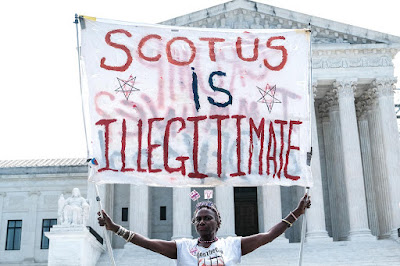
 

The honest truth: A woman demonstrates outside the Supreme Court on the day it ruled in favor of a former police officer who participated in the January 6 coup attempt.(Michael A. McCoy / Getty Images)

JAMES HO
fifth circuit court of appeals

As I said, it can always get worse. James C. Ho is a former clerk for Clarence Thomas and, as with Oldham for Alito, is being mentioned as a potential enticement for Thomas to retire and pass the torch to the next generation.

Ho is from Taiwan (he was naturalized as a US citizen at the age of 9) and, if elevated, would become the first Asian American justice on the Supreme Court. For all of the Republicans’ bluster and vitriol about DEI, they are happy to play identity politics when it suits them. Amy Coney Barrett, for instance, is on the court in part because Trump promised to appoint a woman (who would overturn Roe v. Wade) to replace Ruth Bader Ginsburg. Replacing the second Black justice, who happens to hate Black people, with an immigrant justice who happens to hate immigrants sounds exactly like Republican thinking to me.

Ho is well qualified to perform what Republicans call jurisprudence these days. After law school at the University of Chicago, he was part of the Bush v. Gore team and helped to get George W. Bush appointed president by the court. Ho was rewarded for these efforts with various positions in the Bush Department of Justice. He then served as chief legal counsel for Senator John Cornyn on the Senate Judiciary Committee before clerking for Thomas. After his clerkship, Ho was appointed to be the solicitor general of Texas in 2008, succeeding Senator Ted Cruz in that job. Trump nominated Ho to the Fifth Circuit in 2017, and after he was confirmed, he was sworn in to his seat by Thomas in Harlan Crow’s library. If you designed the career trajectory of a Republican Supreme Court justice in a laboratory, it would look a lot like the path Ho has traveled.

On the Fifth Circuit, Ho has been involved in nearly all of the hot-button culture war issues that have come before his court, and he has staked out extremist positions with unnecessary concurrences almost every time. He’s concurred in numerous gun cases, always arguing that the Second Amendment essentially prevents any restriction or regulation on gun ownership. He concurred in the case that attempted to ban the abortion pill, mifepristone, and gave the wildest justification on record for why the plaintiffs deserved to have standing in the case: He argued that people like dentists have the right to sue abortion-pill makers because they like seeing pregnant women in the wild.

Ho’s father was an ob-gyn, by the way. Reading his opinions is like going to a wildlife reserve with the Trump children instead of David Attenborough: Everything exists for his personal amusement and enjoyment; any natural beauty and tranquility is pierced by insufferable pseudo-scientific chatter; and something is probably going to get shot.

Ho’s opinions are risible, and some commentators have pointed out that this has had the unintentional effect of making him more powerful and popular in Republican circles. In their world, where “owning the libs” is the most valuable currency, Ho is wealthy. Ian Millhiser has written that “if you could breathe life into 4chan” and give that life form the powers and privileges of a federal judge with a lifetime appointment, “you would have created Judge James Ho.”

If Ho were a man of consistent beliefs, that would be one thing, but he’s really just a guy willing to say anything to get his next job. That’s been on full display since Trump’s election. One of Ho’s longest-standing legal opinions is that birthright citizenship is sacrosanct in the Constitution and cannot be undone absent a constitutional amendment. He’s been on record with that belief for nearly 20 years—until it became apparent that Trump was interested in revoking the right. At that point, Ho changed his tune. In an interview he gave a week after Trump’s election, he said, “No one to my knowledge has ever argued that the children of invading aliens are entitled to birthright citizenship…. And I can’t imagine what the legal argument for that would be.”

James Ho is only 51, and he’s not about to let one bedrock constitutional principle get in the way of his next gig. He has already measured the windows in Thomas’s office, and Harlan Crow is ready to buy him new drapes. If Thomas gets struck by a bolt of lightning in the next four years, it will just mean that Ho has learned how to control the weather.
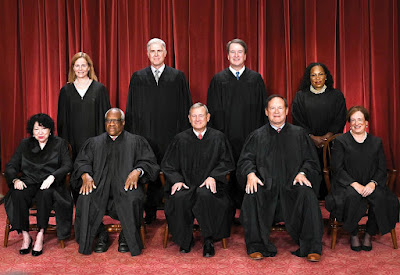

The proto-Trump court: The nine justices of the current Supreme Court; six were appointed by Republican presidents, including three by Trump during his first term.(Olivier Douliery / AFP via Getty Images)

AILEEN MERCEDES CANNON
us district court for the southern district of florida


Aileen Cannon is a mediocrity in the world of judges. She is common, banal. If you threw a dart into any Federalist Society luncheon at any of the top 15 law schools in the country, you’d most likely end up hitting Aileen Cannon or someone just like her. She has no business being on any list of potential Supreme Court nominees, but she likely will be, for one simple reason: Trump likes surrounding himself with mediocrities who owe their careers and status to him.

Cannon was born in Colombia but grew up in Miami. Her mother is Cuban—she left after the revolution—while her father hails from Indiana. After prep school in Miami, Cannon got her undergraduate degree from Duke University. She was a member of the Tri Delta sorority and wrote for Miami’s Spanish-language newspaper, El Nuevo Herald.

From there, Cannon took a bog-standard path to becoming a federal judge on the Republican side. She went to the University of Michigan Law School, where she joined the Federalist Society, but according to a New York Times profile, “she was not an especially visible presence.” She graduated in 2007, and in 2008 she clerked for Judge Steven Colloton, a George W. Bush appointee, on the Court of Appeals for the Eighth Circuit, out in Iowa.

Rather than getting a Supreme Court clerkship, which is what the alleged bright lights in the Federalist Society firmament usually do, Cannon opted for private practice. She went to the law firm Gibson, Dunn & Crutcher, which has a reputation for being an intellectually safe space for conservative-aligned corporate lawyers. She spent three years making money, and then in 2013 she moved to the US Attorney’s Office for the Southern District of Florida, as an assistant United States attorney.

It is, again, not uncommon for AUSAs to make the jump to becoming a federal judge in the district they serve in, and that’s what Cannon did. In 2019, she was contacted by Florida Senator (and fellow member of the conservative Cuban diaspora) Marco Rubio about a potential elevation to the federal bench. After a series of interviews, she was nominated by Trump to the district court in May 2020, at the age of just 39.

Cannon was confirmed to her post on November 12, 2020, during the lame-duck session of Congress after Trump lost the election but before his forces attacked the Capitol. Her confirmation vote was 56–21, so in addition to inexplicably gaining some Democratic support, she also benefited from the Democrats, once again, just not taking judicial appointments all that seriously.

Nobody outside of a few trial lawyers in Miami would know who Cannon is save for the fact that she was randomly assigned the Trump v. United States case after FBI agents raided Mar-a-Lago and found Trump in possession of stolen classified material. Over the course of that litigation, Cannon took Trump’s side at nearly every turn, issuing bizarre rulings that were criticized as wrong and craven readings of the law by other Federalist Society lawyers—and, in some cases, were overturned by the 11th Circuit on appeal. Nonetheless, Cannon dutifully helped Trump delay the prosecution of the case until he was once again the presumptive Republican nominee for president. Then, in July, she dismissed the case outright.

The stolen-documents case was, in many ways, the greatest threat to Trump’s physical freedom, but Cannon made his problems essentially go away. She did not merely slip Trump a bobby pin so he could unlock his handcuffs; she did him one better and effectively hid him in her house so the state could never put the manacles on him in the first place. An AI judge programmed by Musk and Don Jr. to help Trump wouldn’t be as obvious about its intentions as Cannon.

That’s the only reason Cannon is on this list. There are literally hundreds of conservative judges, lawyers, and law professors with more impressive résumés who have proven track records supporting reactionary conservative causes. There are more rabid Trump judges (such as Andy Oldham and Amarillo District Court Judge Matthew Kacsmaryk) who can be relied on to take away the rights of women, gay and trans people, and any non-white person who dares to ask for equal justice in America. But none of those judges have so openly debased themselves to keep Trump out of prison. Cannon’s sole Supreme Court credential is her willingness to read the law in whichever way helps Trump the most.

Trump could reward her for her service without putting her all the way on the Supreme Court. She is, after all, only a district court judge, and so the next logical step in her career would be an appointment to the Court of Appeals for the 11th Circuit (which oversees Alabama, Florida, and Georgia). Giving Cannon a vote on how federal election laws are applied in Florida and Georgia should be enough of a reward for bootlicking. She’s only 43, and so she has more than enough time to use the 11th Circuit to prove that she belongs on the Supreme Court.

But these are not normal times. Fast-tracking Cannon to the Supreme Court would send a shock wave through the conservative legal establishment and tell every career-minded Federalist Society judge that there’s a new sheriff in town—and that loyalty to Trump is even more important than loyalty to Leonard Leo.

 

Close call: Healthcare workers protest outside the Supreme Court during oral argments for a case challenging a law requiring hospitals to perform emergency abortions. The court ultimately punted.(Bill Clark / CQ Roll Call via Getty Images)

NEOMI RAO
dc circuit court of appeals


To paraphrase the character bane as he famously explains in The Dark Knight Rises that Batman is not hard-core enough to defeat him: Aileen Cannon merely adopted the dark; Neomi Rao was born in it and molded by it. Rao has been my pick for the most dangerous person who could be appointed to the Supreme Court for eight years running, and I see no objective reason to demote her in my nightmares.

Rao has expressed vile beliefs since she was very young. While in college at Yale, she wrote in The Yale Herald: “Unless someone made her drinks undetectably strong or forced them down her throat, a woman, like a man, decides when and how much to drink. And if she drinks to the point where she can no longer choose, well, getting to that point was part of her choice.” That statement alone should be disqualifying for a person entrusted with the lifetime power of judging other people’s actions.

Of course, Rao’s statements on rape have not been considered disqualifying by the Republicans. In 2018, she was nominated by Trump to the Court of Appeals for the DC Circuit to fill the seat vacated by (wait for it) alleged attempted rapist Brett Kavanaugh. During her confirmation hearing, when she was questioned about her college writings, Rao said that some of them made her “cringe” and that there were “certainly some sentences and phrases” that she “wouldn’t use today”—and that was enough for the Republicans. She was confirmed 53–46, with every single Republican senator voting for her.

Putting the rape stuff aside (which is apparently a grace we’re required to extend to Republicans in our society), Rao has a long record. After graduating from the University of Chicago Law School in 1999, she clerked for Clarence Thomas and then worked in the George W. Bush administration as an associate White House counsel. In 2006, she became a law professor at George Mason University, which has become a kind of breeding ground for conservative judicial groupthink. She was instrumental in getting the law school’s name changed to the Antonin Scalia School of Law (or “ASSlaw,” as I dubbed it, until they again changed the name to the Antonin Scalia Law School to avoid my acronym). There, she staked out strong positions against Roe v. Wade and the administrative state and in favor of the practice of dwarf-tossing for money. She briefly served in the Trump administration’s Office of Information and Regulatory Affairs before he elevated her to the bench.

Since she’s been on the DC Circuit, Rao has been Trump’s most stalwart defender, often writing as the lone dissenter on panels that go 2–1 against him. She was the only one to dissent in three separate cases involving whether the government could subpoena Trump’s records and financial documents. In a fourth case, Rao argued that special prosecutor Jack Smith should not have been able to subpoena records from Twitter involving Trump’s deleted tweets during the January 6 riot. Rao’s rulings should make Shadow President Musk very happy.

When she’s not busy defending Trump, Rao is busy defending his cronies. She voted to dismiss the case that charged former national security adviser Michael Flynn with being an unregistered foreign agent. She was again in dissent, and Flynn eventually pleaded guilty, which led to Trump pardoning him. But, hey, at least she tried.

Perhaps most troubling of all, Rao has a real love for executions. In the last half of Trump’s first term, his administration ramped up the killing of people on death row. When lawsuits trying to stem the tide of death ended up in front of Rao, she consistently ruled on the side of the executioner.

So when I say Rao is dangerous, I mean it literally. We’re talking about a judge who wants to give everybody from Trump to Robert F. Kennedy Jr. to the common hangman a new set of boots.

As they’re both 51-year-old nonwhite former Clarence Thomas clerks, one could view Rao and Ho as competing for the same seat, should it open up. They have certainly been vying over the past few years to see who can produce the most ludicrous opinions. I’d say Ho has just barely “won” this infernal race, but that’s only because Rao hasn’t had an opportunity to write anything about rape or abortion, where she can truly let her freak flag fly. Rao also seems a little gun-shy when talking to the press, perhaps because of the rough confirmation battle over her college articles, while the most dangerous place in Dallas is between James Ho and a camera.

At 51, Rao is young enough that she doesn’t need to be picked for the first seat that becomes available. But should anything happen to one of the three liberal women justices, then I imagine that under the Republicans’ DEI logic, Rao’s gender would make her an appealing replacement for any of them. Indeed, Rao has done every single thing a conservative woman would do if she wanted to be nominated to the Supreme Court by a misogynistic sexual predator like Donald Trump. That’s what makes her terrifying.
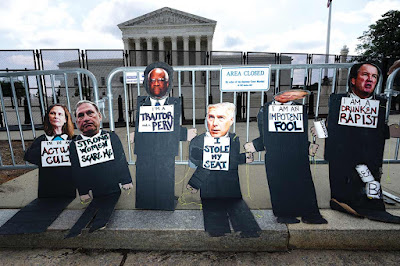
 

Gang of six: Cardboard cutouts of the conservative justices lean aganst a wall in front of the Supreme Court.(Bill Clark / CQ Roll Call via Getty Images)

AMUL ROGER THAPAR
sixth circuit court of appeals


Amul Thapar’s appointment to the Court of Appeals for the Sixth Circuit in 2017 was Trump’s second judicial nomination, following right behind that of Supreme Court Justice Neil Gorsuch. What that should tell you is that Thapar had someone powerful looking out for him—and that person was former Senate majority leader Mitch McConnell.

McConnell plucked Thapar from his role as US attorney for the Eastern District of Kentucky back in 2008 and got him appointed as a district court judge under President George W. Bush. Almost a decade later, McConnell pushed for Thapar to make the jump straight from the district court to the Supreme Court for the seat that eventually went to Gorsuch; Thapar’s appointment to the Sixth Circuit was his consolation prize. McConnell again pushed for Thapar when Justice Anthony Kennedy resigned, but that seat ultimately went to Brett Kavanaugh.

Given that McConnell couldn’t get Thapar onto the Supreme Court from his perch as Senate majority leader, I doubt that he can get Thapar there now, given that McConnell is no longer all-powerful and needs to be rebooted halfway through most of his speeches. There must be something between Thapar and Trump that just doesn’t vibe. My (uninformed) guess as to Thapar’s problem is that he’s smart, hardworking, not openly corrupt, and not as intellectually bankrupt as some of the other potential Supreme Court nominees. These are not qualities that Trump values.

So why is he on this list? Because in any normal Republican administration, Amul Thapar would be the first person nominated to the Supreme Court. Ho and Rao are toxic legal lunatics; Oldham can barely pretend to be concerned about “the law”; and Cannon is a golf caddy dressed in ill-fitting judicial garb. Thapar, by contrast, is just a normal extremist Republican interested in doing normal evil Republican things.

Thapar has gotten to the cusp of supreme lifetime power the long way. Born in Michigan to immigrant parents from India and raised in Ohio, Thapar drove a truck for his father’s HVAC business while in high school. He went to Boston College for his undergraduate years and eventually made his way to Berkeley for law school. But he didn’t get a Supreme Court clerkship and instead worked his way into elite legal circles through private practice, a few adjunct professor gigs, and eventually the US attorney’s office. Along the way, he got married and converted from Hinduism to Catholicism.

Compare Thapar’s backstory with those of the men who beat him out for the Supreme Court job. Both Gorsuch and Kavanaugh are scions of wealth and privilege. They both attended the same elite DC prep school; both went on to Ivy League colleges followed by Ivy League law schools; and both spent time working for the Bush administration. They’re pretty much the same guy, and their petty (fascist)-nerd-versus-(attempted-rapist)-jock squabbles belie the fact that they’re experientially indistinguishable.

If it sounds as though I almost like Thapar, don’t get it twisted. Despite his more humble beginnings, Thapar has spent his career trying to make the world safe for privileged white men. On the Sixth Circuit, he’s been a ruthless defender of white patriarchy, with all of the usual Republican outbursts against women’s rights, LGBTQ rights, immigration, diversity, and the poor.

Thapar’s most notable cases involved Covid. He dissented from a ruling that allowed President Biden’s vaccination mandates to proceed. He joined an opinion saying that the Centers for Disease Control and Prevention had no power to impose an eviction moratorium to protect renters during the pandemic. And he wrote a majority opinion denying the fast-tracking of Covid relief funds to women and minority restaurant owners, saying that the law in question unconstitutionally discriminated against white people.

The Republican legal brain trust loves him because Thapar acts like originalism is the one true gospel. He lectures incessantly about originalism; argues that people should withhold funding from law schools that don’t teach it (notwithstanding the fact that every law school makes you read Antonin Scalia’s opinions and forces you to pretend they’re reasonable); and even wrote a sycophantic book praising Clarence Thomas that I won’t read until I’m consigned to Hell. Thapar (along with Gorsuch) is particularly in favor of the “nondelegation doctrine,” which is a thing conservatives made up to essentially argue that executive agencies don’t have a right to exist because James Madison told them so when they asked him with their Ouija board.

Still, for all his best efforts, Thapar is unlikely to get the job. He’s 55, and when Trump didn’t swap him in for Kavanaugh when the attempted-rape allegations dropped (which is what any normal, non-predator president would have done), that was probably his last, best shot at a Supreme Court gig.

But don’t worry too much about him. With bird flu on the rise, Thapar will likely have many more opportunities to make sure that people suffer and die.
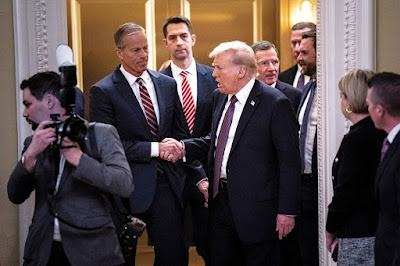

An “evolving” relationship: Donald Trump shakes hands with John Thune, who has replaced Mitch McConnell as Senate majority leader.(Jabin Botsford / The Washington Post via Getty Images)

There are a host of other judges who could be in competition for Supreme Court seats as they open up, but if Alito or Thomas should retire tomorrow, these are the people who I believe will get a first look from the Trump administration. The astute reader will note that on this list of potential nominees, four of the five contestants are not white; four are either immigrants or the children of immigrants; and two are women. The conservative legal bench is deep with immigrant and first-generation jurists who are eager to yank away the ladder that their own families used to pull themselves up, and replete with women who are happy to stand in the way of progress for women’s rights.

For all of that, you’ll notice that the basic, standard, Harvard-educated white guy, Andy Oldham, remains at the top of the list and is by far the most likely person to get the first Supreme Court appointment that becomes available. Some of the others might have a shot should Thomas get raptured or otherwise relinquish his “Black job,” but if Alito retires first, it’s going to be a like-for-like switch.

For my part, I hope Aileen Cannon gets nominated. Yes, I’m serious. Of the poisons arrayed before me, I’ll choose the mediocre partisan hack over the experienced and well-trained evildoer.

I learned this lesson the hard way, back in 2005, when George W. Bush nominated one of his longtime friends, Harriet Miers, to the Supreme Court. The elite legal-industrial complex, including both Senate Republicans and Democrats and expensively educated lawyers like me, were appalled. Miers lacked the august qualifications of traditional Supreme Court justices and was nominated only because she was a Bush crony. Movement Republicans threw a hissy fit, and Bush withdrew Miers’s nomination and then replaced her with… Samuel Alito.

What I’ve learned in the intervening years is that there are far more malign and monstrous things lurking in the bowels of the Federalist Society than mediocre partisan hacks. Cannon would be an awful Supreme Court justice, but she’d be awful in simple, predictable ways. Yes, she’d do whatever democracy-destroying thing Trump wants her to do, but in case you haven’t realized it yet, Trump has already won. The damage he’ll do cannot be mitigated by nine law dorks in robes. If the Supreme Court doesn’t rubber-stamp whatever it is that Trump wants to do, he will do it anyway. The battle for the 2020s has been fought, and the bad guys won.

What matters now are the battles of the 2030s and ’40s, when we will (with any luck) be struggling to undo the damage of the white ethnocentric Trump era. The judges and justices Trump picks this term will be the people we have to overcome in that future. I think my children will be better off trying to overturn some Trump-serving gobbledygook penned by Cannon than trying to de-Klan entire doctrines of racist insanity laid down by Oldham or Ho or Rao.

Whomever Trump picks, though, we are in for hard times. The five people on this list are what Americans voted for when they voted for Trump. People will get what they asked for, and they’ll keep getting it until they learn not to want it anymore.

So if you’re looking for hope over these next terrible years, please do not look to the Supreme Court. Please understand that it has been fully captured by MAGA forces. Even if the court blocks one or two of Trump’s policies, there will be countless others it allows to stand. Trump cannot be fought through the courts, because he has already won the courts.

My hope is that Democrats someday realize that the Supreme Court is their enemy. My hope is that the legacy of the Trump court finally and forever weans the Democrats off their nostalgic memories of the Warren court. My hope is that, should the Democrats ever be allowed to take power again, they will reform and disempower the Supreme Court on Day 1, because that will be the first step toward undoing the damage caused by the Trump era, should any of us survive to see the other side of this nightmare.


ABOUT THE AUTHOR:


Elie Mystal


Elie Mystal is The Nation’s justice correspondent and the host of its legal podcast, Contempt of Court. He is also an Alfred Knobler Fellow at the Type Media Center. His first book is the New York Times bestseller Allow Me to Retort: A Black Guy’s Guide to the Constitution, published by The New Press. Elie can be followed @ElieNYC.



Tuesday, February 11, 2025

APARTHEID ON STEROIDS: White Supremacy at Home and Abroad Under the Hegemonic Fascist Control and Domination of the United States, White South Africa, and Deadly Global Oligarch Elon Musk--VIDEO

https://truthout.org/video/trump-cuts-off-aid-to-south-africa-to-maintain-status-quo-for-white-landowners/

Interview
Politics & Elections

Trump Cuts Off South Africa Aid in Push to Further Interests of White Landowners

White South Africans make up about 7 percent of the population but own more than 70 percent of the farmland.

by Amy Goodman

DemocracyNow!

February 10, 2025

President Trump has ordered a freeze on all foreign aid to South Africa in an executive order he signed Friday, claiming that a new land reform law amounts to “government-sponsored race-based discrimination.” The country’s white minority still owns the vast majority of farmland decades after the end of apartheid rule. Trump also criticized South Africa’s genocide case against Israel at the ICJ and said the United States would accept white South Africans as refugees facing what he characterized as persecution. The cuts to aid are already causing widespread suffering in South Africa, where “after 30 years of democracy, not much has changed in terms of wealth ownership” and a white population with colonial roots is “using politics, ideology, misinformation and propaganda … to maintain the status quo,” says South African activist Trevor Ngwane.


In Bid to Help White Landowners, Trump Cuts Off Aid to South Africa, Threatening Millions of Lives


Democracy Now!

February 10, 2025

President Trump has ordered a freeze on all foreign aid to South Africa in an executive order he signed Friday, claiming that a new land reform law amounts to "government-sponsored race-based discrimination." The country's white minority still owns the vast majority of farmland decades after the end of apartheid rule. Trump also criticized South Africa's genocide case against Israel at the ICJ and said the United States would accept white South Africans as refugees facing what he characterized as persecution. The cuts to aid are already causing widespread suffering in South Africa, where "after 30 years of democracy, not much has changed in terms of wealth ownership" and a white population with colonial roots is "using politics, ideology, misinformation and propaganda … to maintain the status quo," says South African activist Trevor Ngwane.

Latest Shows


VIDEO:  
 

https://www.democracynow.org/embed/story/2025/2/10/trump_south_africa"

TRANSCRIPT:

AMY GOODMAN:

This is Democracy Now!, democracynow.org, The War and Peace Report. I’m Amy Goodman.

President Trump ordered a freeze on all foreign aid to South Africa in an executive order Friday, claiming South Africa’s white population is facing, quote, “government-sponsored race-based discrimination.” Trump has repeatedly criticized the new land reform law in South Africa, where the country’s white minority still owns the vast majority of farmland 30 years after the end of apartheid rule. Trump wrote on his Truth Social account Sunday, “South Africa is confiscating land, and treating certain classes of people VERY BADLY,” unquote. Trump has made the claim before. The South African government says it’s part of a, quote, “campaign of misinformation and propaganda,” unquote. His order also claims South African leaders have, quote, “taken aggressive positions” toward the U.S. and its allies, citing its pursuit of genocide claims against Israel before the International Court of Justice.

South Africans responded to the freeze of an estimated $440 million in U.S. aid. This is a woman seeking her regular treatment for HIV/AIDS when she realized the clinic was closed. She spoke with Sky News Africa correspondent Yousra Elbagir.


YOUSRA ELBAGIR: Are you trying to go to the clinic?

PATIENT: Yeah.

YOUSRA ELBAGIR: It’s closed.

PATIENT: What happened?

YOUSRA ELBAGIR: I mean, the USAID funding has been frozen, so they’re closing down clinics. Do you have alternatives?

PATIENT: I don’t know. I’m going to ask next door. Hopefully they’ll be able to assist me. If they can’t, I don’t know. I don’t know what to do. Serious. What will I do? There’s nothing.

AMY GOODMAN: Trump’s order also offered refugee status in the United States to white South Africans, Afrikaners, who are, quote, “victims of unjust racial discrimination.” But many in the right-wing white lobby groups say they want to stay and focus on ending Black majority rule.

All of this comes as the South African-born billionaire, the richest man in the world, Elon Musk, now a leader in Trump’s administration, has said white South Africans have been the victims of, quote, “racist ownership laws,” and accused the post-apartheid government of anti-white racism. Last week, Musk’s 78-year-old father Errol Musk said an adviser to South African President Cyril Ramaphosa asked him to help.

ERROL MUSK: I was asked if I can arrange a quick talk between Ramaphosa and Elon, last night. So, I said, “All right.” So I did. And then they spoke a few minutes later. And it’s on my phone. … I can only imagine that Elon would have said, “Look, we want to help you, but you have to quit this — this war on white people in South Africa.”

AMY GOODMAN: Errol Musk is Elon Musk’s father. Elon Musk, the richest man in the world, has increasingly embraced far-right leaders and conspiracy theories that some have linked to his roots in apartheid-era South Africa.

In a minute, we’ll also look at how Musk is part of the “PayPal mafia” of libertarian billionaires with roots in South Africa under white rule, who now hold powerful positions in the tech industry and politics and surround the White House. But we begin in Johannesburg with Trevor Ngwane, Soweto-based activist and chair of the United Front, umbrella body of community and labor organizations.

Welcome back, Trevor, to Democracy Now! Talk about the effects of this immediate cutting off of all U.S. aid to South Africa, your country.

TREVOR NGWANE: Thank you, Amy.

Yeah, it’s terrible, because remember that there’s a lot of programs here which rely on American funding, primarily the HIV program, PEPFAR. Seventeen percent of the programs are funded by money from America. And with one stroke, all those services were stopped, because no money came through. And millions of people are suffering, including other community, social and health programs. So this is very bad for the people here in South Africa.

AMY GOODMAN: I mean, it’s very interesting you mentioned PEPFAR. Let’s remember that it was established by the former Republican President of the United States George W. Bush, what many call perhaps the most important achievement of his presidency. The significance, when you talk, Trevor, looking back at the end of apartheid in ’94, white South Africans, who make up, what, 7% of the population, owning farms that make up about half of South Africa? What are your thoughts on the information or misinformation we’re getting in the United States about land seizures from Donald Trump and from the South African-born Elon Musk?

TREVOR NGWANE: Well, white people, you know, are sitting pretty. They manage to hang onto most of their wealth. Due to global and local economic processes, the rich continue to get richer, and the poor get poorer. Most of the white — of the farmland, more than 70% of it is owned by white farmers. So, basically, they are sitting pretty. You know, they’ve got nothing to complain about. Perhaps, Amy — you know, there’s a saying, “The guilty are afraid.” Perhaps they know that this unjust situation, where a tiny minority enjoys most of the country’s wealth and resources, is not tenable, and sooner or later, it will have to end.

AMY GOODMAN: And finally, Trevor, President Trump welcoming Afrikaner refugees into the United States as flight after flight takes immigrants from the United States, for example, to Guantánamo?

TREVOR NGWANE: Yeah, well, the white people here are not interested in going to the U.S.A. because they’re having a good life here. The only thing that is bothering them is what I can call white fears in the face of Black aspirations, indeed Black frustrations, because after 30 years of democracy, not much has changed in terms of, you know, where’s ownership, in terms of basic improvement in the everyday lives of the people. White people, they are human beings. They can see that the suffering continues. They’re just guilty. And they know that they should part give away some of their wealth, but they are not prepared, so they are using politics, ideology, misinformation and propaganda, some of them, you know, to maintain the status quo.

AMY GOODMAN: Trevor Ngwane is joining us from Johannesburg, South Africa.


ABOUT THE PRODUCER/HOST:


Amy Goodman


Amy Goodman is the host and executive producer of Democracy Now!, a national, daily, independent, award-winning news program airing on more than 1,100 public television and radio stations worldwide. Time Magazine named Democracy Now! its “Pick of the Podcasts,” along with NBC’s “Meet the Press.”


Public Intellectual, Political Theorist, Historian, Activist, Teacher, and Social Critic Clarence Lusane On The Hegemonic Doctrine and Practice of White Supremacy in the New Fascist Government of Donald J. Trump

AMERICA IS A FASCIST STATE

Fascism is a far-right, authoritarian, and ultranationalist political ideology and movement, characterized by a dictatorial leader, centralized autocracy, militarism, forcible suppression of opposition, belief in a natural social hierarchy, subordination of individual interests for the perceived good of the nation or race, and strong regimentation of society and the economy.

Opposed to anarchism, democracy, pluralism, egalitarianism, liberalism, socialism, and Marxism fascism is at the far right wing of the traditional left–right spectrum.


AMERICA IS A ROGUE STATE

A nation or state regarded as breaking international law and posing a threat to the security of other nations. 


The White Nationalist in Chief’s Return to Power

No president in the post-civil-rights era has been as racially aggressive as the now-47th president.

by Clarence Lusane
February 7, 2025

The Nation


President Donald Trump in the Roosevelt Room of the White House in Washington, DC, on January 21, 2025.(Aaron Schwartz / Sipa / Bloomberg) This article appears in the March 2025 issue, with the headline “White Nationalist in Chief.”

There is a straight line from the 2017 “unite the right” rallies in Charlottesville to the far-right-led “Stop the Steal” movement to lies about Haitians eating cats and dogs to Donald Trump’s first day in office upon his return to power. No president in the post-civil-rights era has been as racially aggressive as the now-47th president. Nearly every day since he squeaked his way back into the White House, operating under what can properly be called Trump’s White Nationalist Manifesto, his effort to prevent immigrants of color from entering the country and to roll back the rights of people of color already here has been evident. With the white nationalist ideologue Stephen Miller by his side, Trump is acting to address “anti-white feeling,” i.e., a far-right narrative with no basis in fact, but one that excites his MAGA base.

In just one week, the autocrat’s playbook of threats, lawlessness, dishonesty, and disregard for democratic norms wreaked havoc across the nation and around the world. As always, authoritarian politics in the United States are tethered to white nationalism. At this moment, Trump is the white nationalist in chief.

Ten Days That Screwed the World
Chris Lehmann

Trump’s recent presidential actions have sent a clear message to his supporters that he has never left the side of the “very fine people” that back him. Beyond his pardons and commutations for over 1,500 January 6 insurrectionists, he returned a portrait of Andrew Jackson, removed by President Joe Biden, to a prominent place in the Oval Office. Jackson, a hero to Trump, led and personally participated in massacres of Native Americans, as well as profited from selling and enslaving Black people.

Trump pledged to re-rename military bases after segregationists, enslavers, and traitorous Confederate generals—an intention that newly installed Defense Secretary Pete Hegseth seems likely to support. Hegseth has called for restoring North Carolina’s Fort Liberty to its original name of Fort Bragg, named after Confederate General Braxton Bragg, a slaveholder who is considered “one of the worst generals” in US history. And Trump issued an executive order (EO) directing the secretary of the interior to re-rename Denali, the highest peak in the United States, Mount McKinley to honor President William McKinley, another president with a dishonorable record on race, most notably ignoring the vigorous pleas of Black leaders like the journalist Ida B. Wells as the lynchings of African Americans and racist terrorism grew at the end of the 19th century.

In just a few days, Trump has positioned himself as the greatest defender of whiteness in the nation.

Beyond such symbolic acts, Trump signed a number of EOs that will dramatically change people’s lives for the worse, such as ending birthright citizenship. This is textbook “great replacement” theory: Trump and his MAGA base want to slow or stop the expanding population of Black, Latino, and Asian people in the United States. And that extends to his deportation blitz, which makes no pretense of being nonracial or objective. The raids to capture undocumented Black and Brown people have become spectacles of humiliation not dissimilar to events in The Hunger Games or other dystopian fiction.

Trump’s executive order to end all DEI (diversity, equity, and inclusion) programs and initiatives is a direct attack on the civil rights, human rights, and social justice gains that were won by immense sacrifice over two centuries by communities of color and other marginalized groups. In a cruel and calculated move, Trump has destined thousands of federal DEI employees who care deeply about justice and fairness to lose their jobs and careers.


February 2025 Issue
 

Of course, Trump is not doing all this on his own. He has had near-total backing from Republicans in the Capitol, and fearing retribution, these elected officials have abandoned any responsibility to hold him accountable for his actions. It is also no accident that, like every business or endeavor that Trump has run, his administration is overwhelmingly white and male.

As for Trump’s supporters who do not fit that profile, they are awakening to the real Trump, not the faux Christian or fictional “successful” businessman that swayed many. Unable to run for office again, he no longer needs to pretend he cares about the Black community—or any community that isn’t white, wealthy, or far-right MAGA—or its votes.

The second coming of Trump will be one long slog through the bowels of racial animus and juvenile reprisals. Permanent resistance is the way forward.


ABOUT THE AUTHOR:


Clarence Lusane
 

Clarence Lusane is a political science professor and interim political science department chair at Howard University, and independent expert to the European Commission Against Racism and Intolerance. His latest book is Twenty Dollars and Change: Harriet Tubman and the Ongoing Fight for Racial Justice and Democracy (City Lights).

DEFEATING FASCISM: Frederick Douglass, James Baldwin, and Malcolm X in Solidarity from One Century to the Next


Saturday, February 8, 2025

Combatting Fascism in the United States in All Its Dimensions Requires A Fundamental Knowledge of and Coherent Focused Analysis On What It Is and How It Functions in A Social, Civic, and Ideological Context As Well As On a Structural, Economic, and Political Level: Various Scholars, Journalists, and Activists Weigh In On These and Other Important and Related Questions

AMERICA IS A FASCIST STATE

Fascism is a far-right, authoritarian, and ultranationalist political ideology and movement, characterized by a dictatorial leader, centralized autocracy, militarism, forcible suppression of opposition, belief in a natural social hierarchy, subordination of individual interests for the perceived good of the nation or race, and strong regimentation of society and the economy.

Opposed to anarchism, democracy, pluralism, egalitarianism, liberalism, socialism, and Marxism fascism is at the far right wing of the traditional left–right spectrum.


AMERICA IS A ROGUE STATE

A nation or state regarded as breaking international law and posing a threat to the security of other nations.  

 
https://www.nytimes.com/2025/02/07/opinion/trump-musk-christian-nationalism.html


Now Will We Believe What Is Happening Right in Front of Us?


Credit: Will Matsuda for The New York Times


Listen to this article · 11:42 min Learn more

by Katherine Stewart
February 7, 2025
New York Times


They told us they would smash the institutions that safeguard our democracy. And that is exactly what they are doing.

Many Americans chose not to believe what they were saying. Will we now believe what we are seeing?

To be clear, “they” are not just Donald Trump and his billionaire co-pilot. Over the past half-century, an anti-democratic movement has coalesced in the United States. It draws on super-wealthy funders, ideologues of the new right, purveyors of disinformation and Christian nationalist activists. Though it pretends to revere the founders and the Constitution, it fundamentally rejects the idea of America as a modern pluralistic democracy.

The natural tendency in a functioning democracy is to look for ways to “work across the aisle” and “agree to disagree.” But appeasement now would be a mistake. This anti-democratic movement has no interest in compromise. Any concessions will help consolidate the powers of a lawless presidency and entrench a new, kleptocratic, authoritarian form of government in the United States.

It is also bad politics. The Trump administration has charted a course for eventual catastrophic failure. Those who attempt to work with it will go down with it. We must work instead to safeguard our democratic institutions, communicate the threat to the many sectors of the American public that have yet to understand it and prepare for a major cleanup operation in years to come.

Democracy isn’t just about the results of the most recent election. Without a system of justice that applies equally to all citizens, you’re voting for the next elected despot. That is why the leaders of the anti-democratic movement made clear well before the election — in documents such as the Heritage Foundation’s Project 2025, which sought to provide Trump with an aggressive right-wing agenda he could just pick up and run with — that they intend to demolish the system of justice as we know it and replace it with a form of policing in service of the ruling party and its chosen leaders.

In its first two and a half weeks, the Trump administration has delivered on that promise. The stream of transparently lawless executive orders — to make it easier to fire federal officials, to freeze spending that the president cannot freeze, to take away a right to citizenship that is written into the Constitution, to name just three — tell us in no uncertain terms that this administration has no intention of respecting the law or the Constitution. (And if you are comforting yourself with the idea that the administration will respect injunctions from judges, which it has in the past, I invite you to consider Mr. Trump’s recent behavior in court.)

The decapitation at the F.B.I., the sidelining of individuals at the Department of Justice and the de facto shuttering of the foreign aid agency U.S.A.I.D. all serve the same purpose. It means that Mr. Trump and his favorites of the moment will find it much easier to operate with the kind of immunity that the Supreme Court has already granted the president.

Tellingly, the most galling indicator of the administration’s lawless intentions actually came early: the blanket pardon for the Jan. 6 rioters who stormed the Capitol, even those who attacked Capitol Police officers, which provides Mr. Trump with a powerful recruiting tool for elements that might wish to support him with political violence.

Democracy relies equally on a professional government, staffed with individuals who are subject to ethics constraints and act on the basis of reason and evidence in accordance with the law. That is why the leaders of the anti-democratic movement declared war long ago on what they jeeringly call the “administrative state.” Project 2025 promised a brutal assault on what it maintains is a “weaponized” and “woke” civil service bent on persecuting conservatives, and proposed purges.

Russell Vought, a leading figure behind Project 2025 and now Mr. Trump’s director of the Office of Management and Budget for the second time, promised to put government employees “in trauma.” The new-right intellectuals behind the anti-democratic movement draw heavily on crackpot writers like Curtis Yarvin, who condemns “the cathedral” — his term for the people and institutions that sustain a functioning modern state — and openly champions monarchical rule.

In its first weeks, the Trump administration has delivered on that promise. The probably illegal firing of inspectors general throughout the federal government; the tawdry “buyout” offer for federal employees; the commandeering of highly sensitive government data by Elon Musk’s DOGE minions; and the ongoing dismantling, firings and deletions of data at multiple federal agencies — these are not ways of making the government accountable to the voters in the last election, as partisans falsely suggest. They are about making sure that the people can never hold the president and his cronies to account. They also have nothing to do with “efficiency.” We are about to witness administrative dysfunction on a grand scale.

Democracy also depends on a corporate sector and a media sector that work independently of the government in power. That is why the leaders of the anti-democratic movement essentially opened a storefront in advance of the inauguration and began inviting corporations and wealthy individuals to prove their loyalty to the ruling party with inaugural fund contributions. Then came the meme coins that allow anyone to enrich the president and his wife, at least in theory, by purchasing digital tokens with no intrinsic purpose or value.

This proved to be one of the easiest parts of the process. The leaders of Meta, Amazon, JP Morgan, Google, OpenAI and a long list of other corporate titans seem to be making it clear that if protecting their profits means appeasing a corrupt autocratic regime, then that is what they will do.

Democracy relies on something softer, too, namely a sense of unity and shared purpose that allows people to work with one another despite their differences. That is why Rule No. 1 of the authoritarian playbook is to divide the populace. Mr. Trump, of course, is a renowned expert in that department. It is hard to think of another American president who would have taken advantage of an airplane tragedy to push hateful rhetoric about D.E.I. To be sure, reforming policies on diversity is not inherently unreasonable. But the administration’s total war on anti-discrimination law has nothing to do with “merit” and everything to do with stoking division.

Similarly, immigration policy is and ought to be debated. But in the past weeks, the administration has made clear that it will use its powers not to solve the many real immigration issues but instead to perform stunts intended mainly to reinforce the myths that helped get Mr. Trump elected (like the myth that immigrants commit crimes at higher rates than native-born Americans or the myth that the previous administration encouraged bands of these immigrant-criminals to roam free).

Why are they so desperate to weaken or even destroy democracy? Mainly, because they know that our system of justice, a functioning government, an independent economic sector and a united people stand in the way of unearned wealth and privilege. But it is important to understand that the anti-democratic movement is not monolithic. In fact, it isn’t even coherent.

One part of the program answers to the oligarchs — that is, the leaders of tech oligopolies and the most narrow-minded of our nation’s billionaires. These people are betting that the deconstruction of the administrative state means no pesky government oversight on their economic activities, plus tax cuts as well as privileged contracts. They may fatten their pocketbooks in the short term, but the idea that wreaking havoc on our democracy will enhance their wealth is tragically mistaken.

Another part of the program is the work of fanatics. I do not use the term loosely. If you take the trouble to read the writings of the thought leaders of the new right, who form a good portion of the brain trust of the anti-democratic movement, you will discover a group of men who really hate women, admire Nazi political theorists such as Carl Schmitt and believe in the existence of an insidious, all-controlling monster called “the woke,” which apparently works out of diversity, equity and inclusion offices in the back of “the cathedral.” They are acting out their fantasies now, taking revenge on imaginary enemies, and the American republic will be the principal victim.

The Christian nationalist ideologues who supply much of the rest of the ideology of the movement are no less extreme. Just listen to Doug Wilson, the powerful pastor from Moscow, Idaho, whom Pete Hegseth, the defense secretary, has praised. Mr. Wilson is among the growing contingent who say that women should not have a right to vote. Or Lucas Miles, senior director of Turning Point USA Faith and the author of “Woke Jesus: The False Messiah Destroying Christianity,” who has called progressive Christianity “heretical.” In a promotional video at December’s AmericaFest, an annual convention sponsored by Turning Point USA, Mr. Miles said, “I want to see woke church defunded.”

The left, “recognized early on,” Mr. Miles added, “that they knew they needed a vehicle to carry this progressive ideology, this Marxist agenda, and the best vehicle is the church. … It’s been going on since the 1700s that progressive thought has been creeping in.”

Still another part of the movement, which usually gets the most attention even though it has the least power, is the mass of voters who remain faithful to Mr. Trump. They come in many different varieties. No doubt some saw a vote for him as a vote against “Biden-flation” and the sharp rise in the cost of living. Some may really believe that the 2020 election was stolen or that public schools are indoctrination camps forcing gender change on students. Some did not understand the threats to democracy, others did not take them seriously and some simply don’t value democracy.

What is to be done? Let’s start with that dread word: messaging. In the coming months and years, the anti-democratic movement will cause many people to suffer real harm. We need to make sure these people know who did this to them — and who will fight for them.

As people lose their jobs or have to pay more as a consequence of needless tariffs, as they lose out on the benefits they earned and government services they deserve, as the Trump administration prioritizes buffoonish stunts over sound policy, as our most trusted allies abandon us, as women find more of their rights at risk, as people who don’t fit the regime mold find their careers faltering, and as the oligarchs behave ever more outrageously, we need to say, over and over: They did this.

But there is much more we can do. Now is not the time to curl up in despair. We have institutions to protect, pro-democracy organizations to support, and elections in less than two years. We have lawsuits to pursue, corruption to expose. In normal times, it is the duty of democratic citizens to help a newly elected president succeed. In the present circumstances, it is our duty to protect our democratic republic from a lawless president and the profoundly anti-American movement he leads.

More on the first weeks of Trump’s second term:


Opinion | Jamelle Bouie
There Is No Going Back
Feb. 5, 2025


Opinion | Thomas B. Edsall
‘Trump’s Thomas Cromwell’ Is Waiting in the Wings
Feb. 4, 2025


Opinion | Michelle Goldberg
The Familiar Arrogance of Musk’s Young Apparatchiks
Feb. 3, 2025


Opinion | The Editorial Board
Trump’s Test of the Constitution
Feb. 1, 2025

Opinion | David French
How a German Thinker Explains MAGA Morality
Jan. 26, 2025


ABOUT THE AUTHOR:

Katherine Stewart (@kathsstewart) is the author of “Money, Lies, and God: Inside the Movement to Destroy American Democracy” and “The Power Worshippers: Inside the Dangerous Rise of Religious Nationalism.”


https://www.newyorker.com/news/letter-from-trumps-washington/elon-musks-revolutionary-terror


Letter from Trump’s Washington
 
Elon Musk’s Revolutionary Terror

The evisceration of U.S.A.I.D. isn’t a policy fight—it’s an execution designed to strike fear in our own government.

by Susan B. Glasser
February 6, 2025
The New Yorker


Source photograph by Amanda Perobelli / Reuters

Nearly twenty years ago, the Washington Post’s Rajiv Chandrasekaran wrote a classic account of the shambolic American takeover of the Iraqi government, “Imperial Life in the Emerald City.” Most memorably, he described what a Times reviewer called “the lethal combination of official arrogance and ineptitude” that plagued the foreign occupiers from Washington who, after the 2003 U.S. invasion, moved into the Green Zone—the walled-off compound that had once belonged to Saddam Hussein. Young conservatives were favored, heedless of experience. Some job seekers were asked their views of Roe v. Wade. Others were hired after sending their résumés to the right-wing Heritage Foundation back in D.C. While Baghdad spiralled into out-of-control violence, the G.O.P. ideologues who reported for duty in the desert worked to privatize Iraqi government agencies, revamp the tax code, and launch an anti-smoking campaign. A clueless twenty-four-year-old found himself in charge of opening an Iraqi stock exchange. It didn’t work out well.

I was reminded of this gloomy chapter in American history while reading accounts this week of Elon Musk and his small army of anonymous intern-hackers, who have been deployed on Donald Trump’s behalf inside an array of agencies to take control of computer payment systems and government H.R. functions. A nineteen-year-old high school graduate who now has access to sensitive government information is known online as “Big Balls.” A former intern at Musk’s SpaceX, who dropped out of the University of Nebraska, is now working out of the General Services Administration. Scenes of low comedy and spy-movie drama have been reported throughout the federal government—an unclassified e-mail listing all recent C.I.A. employees was sent to the White House to comply with a Musk decree; workers at NASA were ordered to “drop everything” in order to scrub the space program’s Web sites of offending references to banned phrases such as “diversity,” “Indigenous People,” and “women in leadership.” Musk and his command team at the Department of Government Efficiency, a made-up agency with no legal power that Trump established by executive order on his first day back in office, have been sleeping at the Office of Personnel Management.

In its short existence, Musk’s small occupying force has gained access to the entire U.S. Treasury federal payments system—to what end, no one yet knows—and has seemingly orchestrated the dismantling of U.S.A.I.D., the decades-old federal agency in charge of distributing American foreign aid around the world. Upcoming targets reportedly include everything from the Department of Education to the government weather-forecasting service and the U.S. aviation system. Federal employees were given a deadline of Thursday at midnight to accept Musk’s offer of a government-wide deferred-resignation “buyout.” A federal judge has delayed the move, which was expected to yield more than forty thousand takers—well short of the five per cent or more of the federal workforce that Musk hoped to purge, but still an enormous upheaval whose repercussions will echo for years.

In a series of posts on X, the social-media site that Musk owns, the world’s wealthiest man bragged of feeding U.S.A.I.D. to “the wood chipper,” claimed the agency was a “criminal” enterprise, and crowed about “dismantling the radical-left shadow government.” This seemed like a far cry from his initial mandate of serving as an “outside volunteer” to advise Trump on possible budget cuts. Let the record show that, at 3:59 A.M. on day sixteen of the Trump restoration, as Democrats sputtered ineffectually about an unelected billionaire’s illegal power grab, Musk openly proclaimed his project as nothing less than “the revolution of the people.”

A day later, I spoke with a Republican who worked closely with the architects of America’s botched Iraq invasion. I asked whether he had been surprised by anything so far in a Trump Administration designed to shock. Yes, he replied—Musk’s sneaky takeover of the apparatus of the vast U.S. executive branch was something entirely new in the annals of global coups. “Elon figured out that the personnel, information-technology backbone of the government was essentially the twenty-first-century equivalent of the nineteen-fifties television tower in the Third World,” he observed, and “that you could take over the government essentially with a handful of people if you could access all that.” My friend, incidentally, chose to speak on background despite his years of public criticism of Trump, noting that a think tank with which he is affiliated receives government contracts. Fear, in this revolution, as in all revolutions, is perhaps the most effective weapon of all.

Two decades ago, Bush’s Republican Party chose to topple the far-off regime of Saddam Hussein. It’s worth taking a second to reflect that, only a short political lifetime later, the government that Trump’s G.O.P. has chosen to go after is our own.

Trump and Musk have pushed out a steady stream of propaganda and lies to justify their claims for why a revolution wholly outside established laws, procedures, and norms is now necessary. According to a Thursday morning post on Trump’s own Truth Social network, U.S.A.I.D.—which, as far as I can tell, Trump never mentioned on the 2024 campaign trail—is one of several agencies where “BILLIONS OF DOLLARS HAVE BEEN STOLLEN,” including as a “PAYOFF” to the “FAKE NEWS MEDIA” for promoting Democrats. This conspiracy, he warned, might be “THE BIGGEST SCANDAL OF THEM ALL.” In the run-up to the all-out assault on U.S.A.I.D., Trump’s White House press secretary, Karoline Leavitt, spread the absurd tale, via Musk’s team, of fifty million dollars that the agency supposedly earmarked for condoms to be sent to the Gaza Strip. By the time Trump later repeated the story, he had elevated the nonexistent bequest of condoms to a hundred million dollars. Think of this as the information-war equivalent of covering fire from the artillery before the ground assault begins. Days later, the U.S.A.I.D. Web site, with the report proving that there were no condoms for Gaza, had been taken offline. By midweek, that Web site was back up but stripped of all content except a curt message informing readers that “all USAID direct hire personnel” were being placed on “administrative leave globally,” effective at midnight on Friday. In the end, the Trump Administration apparently plans to keep only about two hundred of the agency’s more than ten thousand staff.

We don’t yet know to what extent this brazen ploy will succeed, of course. Congressional Democrats and others have mobilized to defend various embattled agencies; lawsuits have been filed; protests have been convened. But for now, the politics may even be working for Trump and Musk. The Democratic strategist David Axelrod and Rahm Emanuel, the former White House chief of staff for Barack Obama, have both warned that they fear their party is falling into a trap in defending U.S.A.I.D. “My heart is with the people out on the street outside USAID, but my head tells me: ‘Man, Trump will be well satisfied to have this fight,’ ” Axelrod told Politico’s Rachael Bade. “When you talk about cuts, the first thing people say is: Cut foreign aid.”

It’s also true that, if cutting the federal government is what this is all about, then Trump and Musk would not be bothering with tiny U.S.A.I.D., whose estimated budget of some forty billion dollars is less than one per cent of the federal government’s. The point is not a policy fight; it’s an execution. They are killing one agency to terrify a thousand others. Congress should be one of the main aggrieved parties here, given that it passed the laws authorizing U.S.A.I.D. and other departments under attack and appropriating the funding for them, but this is the Republican-controlled Congress in the age of Trump. Speaker Mike Johnson, on Wednesday, dismissed the furor over Musk’s power play as “gross overreaction in the media.” Perhaps the most perfect distillation of where elected Republican officials are at right now came from the North Carolina senator Thom Tillis. Asked about what Musk is doing on Trump’s behalf, he replied, “That runs afoul of the Constitution in the strictest sense.” But, he added, “nobody should bellyache about that.”

The message here is loud and clear: the revolution will not be stopped on Capitol Hill. And indeed, on Tuesday, two of Trump’s most controversial nominees, Robert F. Kennedy, Jr., for Secretary of Health and Human Services, and Tulsi Gabbard for director of National Intelligence, were voted out of Senate committees after key Republican senators abandoned their objections to them. On Thursday evening, despite an all-night Democratic filibuster against the nomination of Russell Vought to be Trump’s director of the Office of Management and Budget, the Senate was expected to go ahead and confirm him. Vought is an intellectual architect of the attack on the federal government who helped write the Heritage Foundation’s Project 2025 agenda for the new Administration, and he has made little secret of the pain he is hoping to inflict. “We want the bureaucrats to be traumatically affected,” he said at a conference in 2023, a tape of which was later obtained by ProPublica. “When they wake up in the morning, we want them to not want to go to work. . . . We want to put them in trauma.”

Earlier this week, I spoke with one of Vought’s millions of targets, a career prosecutor who’s spent decades in the Justice Department’s environment division. The purge of her corner of the bureaucracy hadn’t yet made headlines, but it had arrived nonetheless. “They’ve already come,” she told me. Four of the division’s eight section chiefs had been removed and reassigned to a task force on combatting so-called sanctuary cities. Multiple employees whose roles involved “diversity” had been placed on administrative leave. The division’s “law and policy” section attorneys were told their entire office would be eliminated. And all that was before the incoming Attorney General, Pam Bondi, was confirmed by the Senate. “It’s just basically like we’re in a black hole, where our leadership has been eliminated but no political leadership has come in,” she said.

If trauma is the goal, Trump and his minions have already succeeded. But my source also offered up an eloquent rebuttal to the mindless cutting, an approach that she compared to an elementary-school principal deciding that, rather than trim the budget a few per cent, she’d just go ahead and eliminate the entire third grade. Should we get rid of air-traffic controllers and FEMA and E.P.A. testing for lead in your kids’ water, too? She asked. Frankly, her defense of the federal government was better than just about anything I’ve heard from the beleaguered Democrats. The revolution, however, will get the last laugh: after more than thirty years of public service, she already planned to retire later this year. Congrats, Elon Musk. ♦


ABOUT THE AUTHOR:


Susan B. Glasser, a staff writer at The New Yorker, has a weekly column on life in Washington and is a host of the Political Scene podcast. She is also a co-author of “The Divider: Trump in the White House, 2017-2021.”


Friday, February 7, 2025

IMPORTANT NEW BOOK:

DAVID HAMMONS
October Files 29
edited by Kellie Jones
MIT Press, 2024

[Publication date:  January 28, 2025]


The first anthology of texts on the luminary contemporary artist David Hammons.

David Hammons is a collection of essays on one of the most important living Black artists of our time, David Hammons (b. 1943). Documenting five decades of visual practice from 1982 to the present, the book features contributions from scholars, artists, and cultural workers, and includes numerous images of the artist and his work that are not widely available. Contributions include essays from cultural critics including Guy Trebay and Greg Tate; artists Coco Fusco and Glenn Ligon; and scholars such as Robert Farris Thompson, Alex Alberro, and Manthia Diawara.

A star of the West Coast Black Arts Movement in the 1960s and the winner of a Prix de Rome prize as well as a MacArthur Fellowship, David Hammons rose to fame in Los Angeles with his body prints, in which he used his entire body as a printing plate. His later work engaged with materials that he found in urban environments—from greasy brown paper bags, discarded hair from barber shops, and empty bottles of cheap wine—which he turned into things of wonder while also commenting on a country’s neglect of its citizens. In this volume, a new generation of scholars, Tobias Wofford, Abbe Schriber, and Sampada Aranke, broaden the theoretical mapping of Hammons’s career and its impact, challenging viewers to imagine, in the words of Aranke, “how to see like Hammons.”


ABOUT THE EDITOR:


Kellie Jones is Hans Hofmann Professor of Modern Art in the Departments of Art History & Archaeology and African American & African Diaspora Studies at Columbia University. A member of the American Academy of Arts and Sciences (Boston) and the American Philosophical Society (Philadelphia), she was named a MacArthur Foundation Fellow in 2016.


IMPORTANT NEW BOOKS:

Black in Blues: How a Color Tells the Story of My People
by Imani Perry
‎ Ecco,   2025


[Publication date: January 28, 2025]

NAMED A MOST ANTICIPATED BOOK BY: Time, USA Today, People, AARP, Harper's Bazaar, Today.com, BookRiot, Bustle, LitHub, BookPage, The Millions, Ms., Our Culture, Electric Literature, W, and Vulture

A surprising and beautiful meditation on the color blue—and its fascinating role in Black history and culture—from National Book Award winner Imani Perry

Throughout history, the concept of Blackness has been remarkably intertwined with another color: blue. In daily life, it is evoked in countless ways. Blue skies and blue water offer hope for that which lies beyond the current conditions. But blue is also the color of deep melancholy and heartache, echoing Louis Armstrong’s question, “What did I do to be so Black and blue?” In this book, celebrated author Imani Perry uses the world’s favorite color as a springboard for a riveting emotional, cultural, and spiritual journey—an examination of race and Blackness that transcends politics or ideology.

Perry traces both blue and Blackness from their earliest roots to their many embodiments of contemporary culture, drawing deeply from her own life as well as art and history: The dyed indigo cloths of West Africa that were traded for human life in the 16th century. The mixture of awe and aversion in the old-fashioned characterization of dark-skinned people as “Blue Black.” The fundamentally American art form of blues music, sitting at the crossroads of pain and pleasure. The blue flowers Perry plants to honor a loved one gone too soon.

Poignant, spellbinding, and utterly original, Black in Blues is a brilliant new work that could only have come from the mind of one of our greatest writers and thinkers. Attuned to the harrowing and the sublime aspects of the human experience, it is every bit as vivid, rich, and striking as blue itself.


REVIEWS:

“This prismatic volume finds the National Book Award-winning Princeton professor meditating on skin color and the indigo trade, Louis Armstrong’s music and Toni Morrison’s writing, in short, lyrical chapters.” — New York Times

“An affective investigation into the many roles of blueness in Black life. . . it is full of archival gems – but it is also a lyrical [work]. . . . What unites its disparate contents is a mood, which is just as valuable as an argument. It is a contrapuntal document, musical and moving, and no less rich for its tumbling abundance.” — Washington Post

“As Imani Perry illuminates in a new book that swirls and flicks like an actual marble, [blue is] inextricable from the Black race. . . . Reading Black in Blues is like putting on a pair of those special Kodak 3-D viewfinders that make objects and issues leap suddenly into focus. . . . Its chapters are tide pools: quite short, but deep and teeming. . . . It will have you looking afresh even at your corner mailbox.” — New York Times Book Review

“One of those books that slips the boundaries . . . . ‘Ask the right questions,’ [Perry] insists, ‘and you’ll move toward virtue and truth.’ Words to live by, especially in a nation where a large swatch of the population seems intent on disavowing the better angels of our nature.”
— Los Angeles Times

“Touching on a range of historical, artistic, musical, and literary references—from the color’s significance in Yoruba cosmology to the blue candles used in hoodoo rituals to the ‘tremor’ of the “blue note’—Perry illuminates how the color has been variously associated with mourning, spiritual strength, and forces of freedom and oppression.” — New Yorker, "Briefly Noted"

“It is clear from reading Imani Perry’s Black in Blues: How a Color Tells the Story of My People why she is adept at chronicling the history of the Black diaspora: She weaves stories like a village griot or a grandparent sitting on the porch recalling the past. . . . From Africans dressed in blue as if it were ceremonial garb to a tiny house in Alabama and a cloth of remembrance for a loved one, black and blue are brilliant and so is Black in Blues.” — Christian Science Monitor

“Vast, multifaceted and enchanting. . . . Black in Blues also gave me a renewed sense of direction, a clarity of purpose. Here it is: Hold fast to beauty. It has everything you need. It has everything we need.” — Minnesota Star Tribune

“A meditative and healing introspection on Black history presented through a fresh and innovative lens. . . . Innovative, melancholic, and expansive, Black in Blues achieves its goal to bring Black history to life.” — Atlanta Journal Constitution

“Each impressionistic chapter carries us into a distinctive, colorful world, and together, the sections weave a cultural richness that no traditional history could achieve. While Perry is a renowned Harvard academic who grounds her explorations in scholarship, here, she feels more like our private guide for a vast cultural voyage, her voice beautifully echoing those of her muses Toni Morrison and Zora Neale Hurston. By composing a story that unifies many generations of Black history and is experienced through a single color, Perry herself becomes a master blues artist.” — Oprah Daily

“[Perry] exemplifies the best of interdisciplinary analysis and storytelling, weaving together the threads of history and culture to point out common threads and trends that people may never have noticed otherwise. As a historian, she writes in a conversational tone about the atrocities that are often left out of high school textbooks. As a cultural critic, she’s insightful and artfully intentional about the details she draws readers to.” — The Advocate

“National Book Award winner Perry offers surprising revelations about the connection between the color blue and Black identity as she explores myth and literature, art and music, folklore and film. . . . An innovative cultural history.” — Kirkus Reviews (starred review)

“An impressionistic cultural history of the African diaspora through its connections to the color blue, from the Congo to Haiti, Jamaica, and the American South, in music, dance, folklore, art, and literature. . . . Packed with cultural references to Nina Simone, Zora Neale Hurston, Miles Davis, and Picasso’s African-inspired Blue Period, this is a fascinating and creative work of popular anthropology . . . Original and affecting.” — Booklist (starred review)

“A lyrical meditation on ‘the mystery of blue and its alchemy in the lives of Black folk.’ . . . In direct and intimate prose, Perry synthesizes an impressive range of research into a sinewy, pulsing narrative that positions the past as an active, living force in the present. Readers will be swept up." — Publishers Weekly (starred review)

“Imani Perry's work is brilliant and lyrical as ever! How clearly she assesses the history of Black and Blue, knitting them together with language both precise and haunting. This book is a great gift, in that it allowed me to see the world anew with Perry's clear-eyed insight. How Perry allows me to understand my Blue better, too!” — Jesmyn Ward, author of Let Us Descend and Sing, Unburied, Sing

“Black in Blues is a stunningly original journey in search of the historical origins of the very soul of African American life and culture. Along the way, Perry shows, with telling detail and in engaging prose, how ‘The Blues’ became Black, and how Black people became ‘Blues People.’” — Henry Louis Gates, Jr.

“With Black in Blues,Imani Perry establishes herself as the most important interpreter of Black life in our time. With intellectual skill, an artist’s eye, and the beauty of her pen, she powerfully tells the story of our people through the color blue. This is an extraordinary book.” — Eddie S. Glaude, Jr., author of Begin Again and We Are the Leaders

“Imani Perry's Black in Blues is a masterful convergence of literature, history, and culture—where color itself becomes the field for reflection and revelation. The sheer span of Perry’s thinking, like the sweep of a great sky, stirs the most breathtaking of elusive emotions: awe.” — Evan Osnos, author of Wildland and Age of Ambition

 
ABOUT THE AUTHOR:


Imani Perry is the National Book Award–winning author of South to America, as well as seven other books of nonfiction. She is the Henry A. Morss Jr. and Elisabeth W. Morss Professor of Studies of Women, Gender, and Sexuality and of African and African American Studies at Harvard University, and is a 2023 MacArthur Fellow. Perry lives between Philadelphia and Cambridge with her two sons.


A More Perfect Party: The Night Shirley Chisholm and Diahann Carroll Reshaped Politics
by Juanita Tolliver
Legacy Lit, 2025

[Publication date:  January 14, 2025]


"A beautifully written political-social page turner" (Joy-Ann Reid) about the legendary party hosted by Diahann Carroll for Shirley Chisholm's 1972 presidential campaign, which changed the playing field for Black women in politics.

In 1972, New York Representative Shirley Chisholm broke the ice in American politics when she became the first Black woman to run for president of the United States. Chisholm left behind a coalition-building model personified by a once-in-an-era Hollywood party hosted by legendary actress and singer Diahann Carroll, and attended by the likes of Huey P. Newton, Barbara Lee, Berry Gordy, David Frost, Flip Wilson, Goldie Hawn and others. In A More Perfect Party, MSNBC political analyst Juanita Tolliver presents a path to people-centered politics through the lens of this soiree, with surprising parallels to our current electoral reality.

Chisholm worked the crowd of movie stars, media moguls, music executives and activists gathered at Carroll’s opulent Beverly Hills home, forging relationships with laughter as she urged guests to unify behind her campaign. With the feminist movement on the rise and eighteen- to twenty-year-olds voting for the first time in American history, the Democratic Party and the nation were on the cusp of long-overdue change.

Zooming in on one party attendee per chapter, A More Perfect Party brings this whimsical event out of the margins of history to demonstrate that there is an opportunity for all of us to fight for a better nation and return power to the people.
 
REVIEWS:

“[A More Perfect Party is an] ebullient and trenchant look at a trailblazing campaign for president. Tolliver writes that the fundraiser fueled a sense of optimism among traditionally marginalized groups. A Black woman has yet to be elected president of the United States, but that day may come, thanks in no small part to Shirley Chisholm paving the way.”
―Kirkus

"A More Perfect Party is a must-read. Tolliver’s work is not only a deep dive into a pivotal moment in history but also a call to action for readers to reflect on their own roles in shaping a better nation."―TheGrio

“Juanita Tolliver reveals what might be the most iconic fundraising party of all time. A More Perfect Party is a beautifully written political-social page turner, full of hope, glamour, the triumphs and failures of race and gender allyship, and most of all, the audacity to believe a Black woman could be the president of the United States of America. This is a perfectly timed book.” ―Joy-Ann Reid, host of MSNBC’s The ReidOut and New York Times bestselling author of Medgar and Myrlie

“Juanita Tolliver is an incisive, vibrant, and increasingly prominent voice in today’s politics, and she brings her analytical lens and appreciation for history to A More Perfect Party. Effective campaigns bring people together, and progress usually requires that we see each other as fully human and valuable; Tolliver explores those themes through the 1972 Democratic Party, and one dazzling, historic, literal party — with lessons that echo in today’s debates about liberalism, diversity and of course, winning.”―Ari Melber, host of MSNBC’s The Beat and MSNBC Chief Legal Correspondent

“A More Perfect Party is a detailed, thorough, and inspiring look into the meeting between Congresswoman Shirley Chisholm and Diahann Carroll that brought together two of the most influential Black women of our time—both from very different walks of life, both looking to change the world. I remember that day like it was yesterday. Juanita Tolliver’s gifted storytelling brings this historic encounter back to life in a way that has never been done before. As we celebrate what would have been Congresswoman Chisholm’s 100th birthday, Tolliver's timely book is a reminder that because of Shirley Chisholm, I am. Tolliver’s work emphasizes Chisholm's impact, and beautifully connects it to what we're witnessing in politics today.” ―U.S. Representative Barbara Lee

“Juanita Tolliver artfully weaves together pop culture and history to shed new light on Shirley Chisholm's enduring legacy and lessons from her political career that our nation can, and must, learn. The vivid stories Tolliver presents speak to each of the necessary ingredients for building power and community, offering a roadmap through complex American history, our current reality, and the limitless future of Black women in politics.”―Anna Malaika Tubbs, New York Times bestselling author of The Three Mothers

“Juanita does something beautiful throughout these pages. She captures a story that is unique and universal at the same time—a snapshot of Black women striving to make change. A must read for those in the work of movement and coalition building.”―U.S. Representative Ayanna Pressley

"A More Perfect Party is the story of the historic presidential campaign of Shirley Chisholm, which turns out to be the story of the historic presidential campaign of Kamala Harris, which turns out to be the story of Black women and their historic campaigns to make America great for the first time ever. Black women can help us, if we'd only just let them."―Elie Mystal, New York Times bestselling author of Allow Me to Retort
 

ABOUT THE AUTHOR:


Juanita Tolliver is an MSNBC Political Analyst, an Opinion Contributor for theGrio, and a Contributor for SiriusXM Progress. Previously, she served as the Director of Campaigns at the Center for American Progress. She is a graduate of the Fletcher School of Law and Diplomacy at Tufts University, and the University of North Carolina at Chapel Hill.
 
Perfect Victims: And the Politics of Appeal
by Mohammed El-Kurd
Haymarket Books, 2025

[Publication date:  February 11, 2025] 
 
“Mohammed El-Kurd has written a new Discourse on Colonialism for the twenty-first century.”―Robin D. G. Kelley

Perfect Victims is an urgent affirmation of the Palestinian condition of resistance and refusal―an ode to the steadfastness of a nation.

Palestine is a microcosm of the world: on fire, stubborn, fragmented, dignified. While a settler colonial state continues to inflict devastating violence, fundamental truths are deliberately obscured―the perpetrators are coddled while the victims are blamed and placed on trial.

Why must Palestinians prove their humanity? And what are the implications of such an infuriatingly impossible task? With fearless prose and lyrical precision, Mohammed El-Kurd refuses a life spent in cross-examination. Rather than asking the oppressed to perform a perfect victimhood, El-Kurd asks friends and foes alike to look Palestinians in the eye, forgoing both deference and condemnation.

How we see Palestine reveals how we see each other; how we see everything else. Masterfully combining candid testimony, history, and reportage, Perfect Victims presents a powerfully simple demand: dignity for the Palestinian. 

REVIEWS:

“Great poets are truth-tellers, and the truth hurts. Mohammed El-Kurd’s raw eloquence and razor-sharp clarity will make you hurt and curse and cry and sometimes chuckle. A few will think, only to realize he is also talking about 'us,' the allies, the empathizers, even the comrades whose solidarity unwittingly demands the perfect victim. We are not completely free of Zionist lies; we are not decolonized. Mohammed El-Kurd has written a new Discourse on Colonialism for the twenty-first century. And like Aimé Césaire, he demands that we confront the truth, wipe away our crocodile tears, and take down Goliath once and for all.”
―Robin D. G. Kelley, author of Freedom Dreams: The Black Radical Imagination

“Here's a river of fire. Dive in, if you dare. It will clear the fog.”
―Arundhati Roy, author of The God of Small Things

“In Perfect Victims, Mohammed El-Kurd recenters the Palestinian gaze as compass and metric unit.”
―Noura Erakat, author of Justice for Some

“Mohammed El-Kurd’s voice is unequivocal in a hallucinatory media sphere that portrays the colonized and the occupied as either passive victims of an unnamable crime or the very perpetrators of unspeakable crimes they themselves experience. Perfect Victims is essay and memoir at its best. It portrays children forged by occupation and war and a humble people conditioned by the necessity of resistance for survival in the face of a twenty-first century genocide. Humility, irony, and irreverence are the languages of self-defense, and words are El-Kurd’s weapons.”
―Nick Estes, author of Our History Is the Future


ABOUT THE AUTHOR:


Mohammed El-Kurd is a writer, poet, journalist, and organizer from Jerusalem, occupied Palestine. He is the Nation’s first-ever Palestine Correspondent and editor-at-large at Mondoweiss, the recipient of numerous honors and awards, and the author of the highly-acclaimed poetry collection Rifqa, which has been translated into several languages.