Thursday, February 3, 2011

What Goes Around Comes Around: Egypt, American Imperialism, and the Confirmation of Natambu's Law

http://www.truth-out.org/us-chickens-come-home-roost-egypt67385

All,

NATAMBU'S LAW states: "No matter how bad or fucked up any particular situation is or appears to be, or how much you know or think you know about what it all means, in reality it's always far worse than anything you could possibly imagine"

Kofi


"A former CIA agent observed, "If you want a serious interrogation, you send a prisoner to Jordan. If you want them to be tortured, you send them to Syria. If you want someone to disappear - never to see them again - you send them to Egypt."


US Chickens Come Home to Roost in Egypt
by Marjorie Cohn
Wednesday 02 February 2011
Truthout

Barack Obama, like his predecessors, has supported Egyptian President Hosni Mubarak to the tune of $1.3 billion annually, mostly in military aid. In return, Egypt minds US interests in the Middle East, notably providing a buffer between Israel and the rest of the Arab world. Egypt collaborates with Israel to isolate Gaza with a punishing blockade, to the consternation of Arabs throughout the Middle East. The United States could not have fought its wars in Iraq without Egypt's logistical support.

Now, with a revolution against Mubarak by two million Egyptians, all bets are off about who will replace him and whether the successor government will be friendly to the United States.

Mubarak's "whole system is corrupt," said Hesham Korayem, an Egyptian who taught at City University of New York and provides frequent commentary on Egyptian and Saudi television. He told me there is virtually no middle class in Egypt, only the extremely rich (about 20 to 25 percent of the population) and the extremely poor (75 percent). The parliament has no input into what Mubarak does with the money the United States gives him, $300 million of which comes to the dictator in cash each year.

Torture is commonplace in Egypt, according to Korayem. Indeed, Omar Suleiman, Egypt's intelligence chief whom Mubarak just named vice president, was the lynchpin for Egyptian torture when the Central Intelligence Agency (CIA) sent prisoners to Egypt in its extraordinary rendition program. Stephen Grey noted in his book "Ghost Plane" that "[I]n secret, men like Omar Suleiman, the country's most powerful spy and secret politician, did our work, the sort of work that Western countries have no appetite to do ourselves."

In her chapter in the newly published book, "The United States and Torture: Interrogation, Incarceration, and Abuse," Jane Mayer cites Egypt as the most common destination for suspects rendered by the United States. "The largest recipient of US foreign aid after Israel," Mayer writes, "Egypt was a key strategic ally, and its secret police force, the Mukhabarat, had a reputation for brutality." She describes the rendering of Ibn al-Sheikh al-Libi to Egypt, where he was tortured and made a false confession that Colin Powell cited as he importuned the Security Council to approve the US invasion of Iraq. Al-Libi later recanted his confession.

The State Department's 2002 report on Egypt noted that detainees were "stripped and blindfolded; suspended from a ceiling or doorframe with feet just touching the floor; beaten with fists, metal rods, or other objects; doused with hot or cold water; flogged on the back; burned with cigarettes; and subjected to electrical shocks. Some victims ... [were] forced to strip and threatened with rape."

In 2005, the United Nations Committee Against Torture found that, "Egypt resorted to consistent and widespread use of torture against detainees" and "the risk of such treatment was particularly high in the case of detainees held for political and security reasons."

About a year ago, an Italian judge convicted 22 CIA operatives and a US Air Force colonel of arranging the kidnapping of a Muslim cleric in Milan in 2003 and flying him to Egypt, where he was tortured. Hassan Mustafa Osama Nasr told Human Rights Watch he was "hung up like a slaughtered sheep and given electrical shocks" in Egypt. "I was brutally tortured and I could hear the screams of others who were tortured too," he added.

A former CIA agent observed, "If you want a serious interrogation, you send a prisoner to Jordan. If you want them to be tortured, you send them to Syria. If you want someone to disappear - never to see them again - you send them to Egypt."

So, what will happen next in Egypt?

Suleiman, who is intensely loyal to Mubarak, will not be an acceptable successor to the Egyptian people. Some fear that the Muslim Brotherhood, which supports Hamas, will take power once Mubarak is forced out, but "[t]hough it is the largest opposition group, it by no means enjoys overwhelming support, and its leaders are for the most part moderate and responsible," Scott MacLeod, Time magazine's Middle East correspondent from 1995 to 2010, wrote in The Los Angeles Times. Korayem concurs. He says the Brotherhood, which has formally renounced terrorism and violence, is more educated and peaceful now. The Brotherhood provides social and economic programs that augment public services in Egypt.

Indeed, the Brotherhood supports Mohamed ElBaradei to negotiate with the Egyptian government. ElBaradei, the former UN International Atomic Energy Agency chief and Nobel Peace Prize recipient, recently returned to Egypt to stand with the protesters. He told Fareed Zakaria on CNN that the Brotherhood favors a secular state, and "has nothing to do with the Iranian movement, has nothing to do with extremism as we have seen it in Afghanistan and other places."

The Obama administration has been slow to acknowledge that Mubarak is on his way out. Vice President Joe Biden, still in denial, said on the PBS News Hour, "I would not refer to him as a dictator." ElBaradei criticized Obama for supporting Mubarak in the face of the popular revolt in Egypt. "You are losing credibility by the day," he told CBS News. "On one hand you're talking about democracy, rule of law and human rights, and on the other hand you are lending support to a dictator that continues to oppress his people."

Korayem sees the United States' uncritical support for Israel as key to the problems in Egypt and elsewhere in the Middle East. If the United States acted as an honest broker, even "slightly fair to the Palestinians," that would go a long way to solving the difficulties, he said. But, according to journalist Gareth Porter, "The main function of the U.S. client state relationship with Egypt was to allow Israel to avoid coming to terms with Palestinian demands." Writing in Truthdig, Chris Hedges added that, "The failure of the United States to halt the slow-motion ethnic cleansing of Palestinians by Israel has consequences. The failure to acknowledge the collective humiliation and anger felt by most Arabs because of the presence of U.S. troops on Muslim soil ... has consequences."

We are seeing those consequences in the streets of Egypt and in the likelihood of similar developments in Jordan, Yemen and other Middle Eastern countries. Until the US government stops uncritically supporting tyrants, torturers and oppressors, we can expect the people to rise up and overthrow them.


Published on Truthout (http://www.truth-out.org)

Open Letter To Obama About Egypt and Mubarak

Mubarak's Thugs Use Organized Violence Against Anti-Government Demonstrators As the Egyptian People Fight Back in the Streets of Cairo

http://www.truth-out.org/mubarak-supporters-violently-attack-protesters-tahrir-square-over-100-injured-video67404?utm_source=twitterfeed&utm_medium=twitter

All,

The vicious organized attacks on Egyptian anti-government demonstrators by thousands of thugs and criminals (as well as clearly undercover police and military operatives) bought and paid for by the despicable and tyrannical Mubarak regime is not only an indictment of that venal dictatorship but of President Obama's hopelessly weak, temporizing, and thereby complicit denial of the absolute necessity to publicly denounce and completely repudiate Mubarak's extremely repressive and antidemocratic government and demand his IMMEDIATE OUSTER TODAY (especially following the Egyptian dictator's ominously threatening, stubbornly incoherent, and clearly delusional "speech" on Egyptian television in the very early morning hours yesterday). As I write this four people have already officially been killed and hundreds seriously wounded in the government sponsored massacre that is described in detail below. Needless to say these criminally brutal and lethal actions by Mubarak's hired gangsters and the absurdly "diplomatic" overtures and "suggestions" by Obama's administration and the State Department about the need for the dictator to make an "orderly and peaceful transition to handing over authority now" have combined to make an already highly volatile situation far worse and is directly contributing to the rapid exponential growth of a major crisis with monumental consequences for not only Egypt but the entire Middle East region and the world...Stay tuned...

Kofi


Mubarak Supporters Riding on Horses and Camels Violently Attack Protesters in Tahrir Square, Over 100 Injured (Video)
Wednesday 02 February 2011
by: Amy Goodman | Democracy NOW! | Report

Violent clashes broke out just before our broadcast when supporters of Egyptian President Hosni Mubarak attacked anti-government protesters in Tahrir Square in Cairo. Reports are that more than 100 people have been injured. “The entire square is surrounded by thugs, and apparently there are more coming on the way,” reports Egyptian activist Nazly Hussein. "I have seen people come out injured… I saw people carried into the medical center injured." We get live reports from Hussein and Democracy Now!’s senior producer Sharif Abdel Kouddous, who are both in Cairo. [includes rush transcript]


Guests:

Sharif Abdel Kouddous, Democracy Now! senior producer
Nazly Hussein, Egyptian demonstrator


Amy Goodman: We begin the show in Cairo, where mass protests continue following President Hosni Mubarak’s refusal to immediately step down. The Egyptian army has called for the protests to end, but thousands remain in the streets. Violent clashes have broken out between pro-Mubarak and anti-government protesters in Tahrir Square in Cairo.

We’re going to go right now to Sharif Abdel Kouddous, Democracy Now! senior producer. He’s just come from Tahrir Square. In a moment, he’ll join us in studio, but this is too important to wait for that studio satellite to begin.

Sharif, tell us what’s happening now in Tahrir Square.

Sharif Abdel Kouddous: Amy, I just came back from Tahrir Square. I’m standing, talking to you on a building on top of Kornish Al Nile, which is right on—just a few hundred yards from Tahrir Square near the Nile. I don’t know if you can hear in the background, but there are hundreds, thousands of pro-Mubarak crowds who are streaming towards Tahrir.

In Tahrir, they have actually made it into the square. The army let them in. And now they are facing off. [inaudible] pushing. There’s a lot of cursing. This is mostly coming from the pro-Mubarak forces. If you walk in the street next to them, they’re very in-your-face. It’s a much more aggressive stance than we’ve seen. And we spoke to people in Tahrir who say that they’re basically coming from three different areas. There are Central Security forces who are dressed in civilian clothes, a lot of what we call baltaguia, who are also known as thugs. There’s also reports that the oil minister, Sameh Fahmi, issued orders for employees at oil companies to show up today in Heliopolis, another district in Cairo, and to demonstrate for Mubarak. And many of them are suspected to be government employees and members of the National Democratic Party.

This is an ominous development that’s happened now. They’re trying to take back Tahrir Square. They’re facing off right now. Protesters of the pro-democracy movement have linked arms. They’re holding strong. But the numbers are not what they last night in Tahrir. Many people went home. So it remains to be seen what is going to happen. I don’t know if you can hear in the background right now. The chants are getting louder. They are streaming in. This is a big coordinated effort to come back and take Tahrir. It remains to be seen what’s going to happen.

Many of the protesters in Tahrir said, "We’re going to stay here. We’re going to spend the night. If we get beaten, we get beaten. We will not hit back. But we are not leaving."

Amy Goodman: We are also joined by Nazly Hussein, along with Sharif Abdel Kouddous, in another part of the area around Tahrir Square, an Egyptian woman who’s been taking part in the protests, has been involved in opposition politics in Egypt for several years. Nazly, what do you see right now in Tahrir Square from your vantage point?

Nazly Hussein: I am currently trying to make it into Tahrir Square. I’m not on the square yet. The entire people on the square feel safe and say it’s calm and it’s OK inside the square. I’m trying to make it into the square. But the entire square is surrounded by thugs, and apparently there are more coming on the way. So we’re trying to make it into the square. People on the square are more [inaudible]. There’s a lot of efforts to bring people outside—

Amy Goodman: Have you seen any—Nazly, have you seen any injuries?

Nazly Hussein: I saw injuries. I have not seen the thugs with weapons. I can—you recognize them. After a few days on the street, you recognize them. But I have seen people come out injured. I was standing, two minutes ago, by a—when you first called me—by a medical point, and I saw people carried into the medical center injured. I have not seen anyone use violence. But you recognize them. And it’s really difficult to make it into the square. I have to go to another entry point right now and try to make it into the square.

Amy Goodman: Well, I want to thank you, Nazly Hussein, speaking to us from Tahrir Square. And Sharif will be joining us in a studio momentarily.

Mubarak's Thugs Attack and Try To Destroy the National Revolt Against His Brutal Regime as the Egyptian People Fight Back


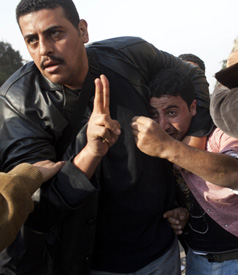
An anti-government protester holds a pro-Mubarak protester in a headlock on the edge of Tahrir Square in Cairo on Wednesday. Hours before the violence erupted in the square, antigovernment protesters had been chanting: “We are not going to go; we are not going to go.” (Photo: Scott Nelson / The New York Times)

http://www.truth-out.org/clashes-erupt-cairo-between-mubaraks-allies-and-foes67391

Clashes Erupt in Cairo Between Mubarak's Allies and Foes 02 February 2011 by Anthony Shadid, David D. Kirkpatrick and Kareem Fahim, The New York Times News Service | Report

An anti-government protester holds a pro-Mubarak protester in a headlock on the edge of Tahrir Square in Cairo on Wednesday. Hours before the violence erupted in the square, antigovernment protesters had been chanting: “We are not going to go; we are not going to go.” (Photo: Scott Nelson / The New York Times)

Cairo - President Obama’s calls for a rapid transition to a new order in Egypt seemed eclipsed on Wednesday as a choreographed surge of thousands of people chanting support for the Egyptian leader, Hosni Mubarak, fought running battles with a larger number of antigovernment protesters in and around Cairo’s Tahrir Square.

Both sides exchanges volleys of Molotov cocktails and rocks, while the military restricted itself mostly to guarding the Egyptian Museum and using water cannons to extinguish the flames.

The mayhem and chaos — with riders on horses and camels thundering through the central square — offered a complete contrast to the scenes only 24 hours earlier when hundreds of thousands of antigovernment protesters turned it into a place of jubilant celebration, believing that they were close to overthrowing a leader who has survived longer than any other in modern Egypt.

Also: Watch live coverage of the situation in Egypt from Al Jazeera.

Such was the nervousness across the Arab world, spreading from its traditional heart in Egypt, that the leader of Yemen offered on Wednesday to step down by 2013 and offered assurances his son would not succeed him — the latest in a series of autocratic leaders bending to the wave of anger engulfing the region.

Late on Tuesday, Mr. Mubarak himself offered to step down in September but that was not enough for the protesters — or for Mr. Obama and the European Union, who both urged speedier change. But those calls were later rebuffed by the Foreign Ministry, which released a statement over state news media saying that calls from “foreign parties” for an immediate political transition had been “rejected and aimed to incite the internal situation in Egypt.”

On Wednesday, the enduring standoff between Mr. Mubarak and his adversaries took an explosive and perilous turn, offreing further proof that Mr. Mubarak had no intention of exiting earlier than he had announced. Hours after a call from Egypt’s powerful military for the president’s opponents to “restore normal life,” thousands of men, some carrying fresh flags and newly printed signs supporting Mr. Mubarak, surged into Tahrir Square.

For several hours in the afternoon, from a base in Talaat Harb Square, northeast of Tahrir Square, pro-Mubarak supporters wielding rebar, knives, pliers, long sticks and even a meat cleaver surged towards the anti-government protesters, under cover of rocks thrown by their confederates in the rear and from a roof of a nearby building.

At regular intervals, men were carried away from the fight bleeding.

A red car and a motorcycle traveled to the front, by the historic Groppi’s cafĂ©, and shuttled the injured men away to a makeshift medical clinic staffed by dozens of doctors. At about 4 p.m., agitated young men started throwing rocks at the windows of residents, without explanation. Men also threw rocks at the offices of an opposition figure, Ayman Nour, that overlooks the square.

A block away, at Champollion Street, a similar battle raged. Several people tried to stop two young men as they hauled a case of empty Pepsi bottles to their car and tore rags, apparently attempting to make Molotov cocktails. The young men brushed those efforts off.

Throughout the afternoon, the president’s supporters emerged in a throng dragging men, presumably from the other side, away. In one case, it was a man in a colorful sweater who was held by a large man who pressed a knife to his captive’s throat. Another time, a mob surrounded a terrified man with a long beard, as soldiers tried to intervene. “God is great!” yelled the man with the beard, as the mob pressed forward.

Some of the Mubarak supporters were working class men who arrived in buses. Some headed to the battle with their sticks or their knives stuffed in their pants. One was a doctor who wore spectacles and held a club wrapped in electrical tape and armored with tacks.

Some were men like Mohamed Hassan, an accountant, who had actually attended Tuesday’s antigovernment demonstration. “Of course we needed a change,” said Mr. Hassan, standing on the Corniche not from the Egyptian Museum. Mr. Mubarak’s speech to the nation had changed his mine. “I think all of our demands were filled. We need change, but step by step.”

Bystanders watched in shock and anger. One pointed to a bearded man calling people to prayer. "He did this to us," the man said. Another man, watching the battle in Talaat Harb, said: "Mubarak lit the world on fire." His friend told him to be quiet.

The pro-Mubarak forces were outnumbered by the protesters, who have spent nine days in the square insisting on his ouster. Clashes erupted close to the Egyptian Museum housing a huge trove of priceless antiquities.

There, the two sides traded volleys of rocks and engaged in hand-to-hand fighting. Many were led or carried away with bleeding head wounds. Antigovernment protesters organized themselves into groups, smashing chunks of concrete into smaller projectiles that they hurled at their adversaries. The violence was the most serious since the antigovernment protesters laid claim to Tahrir, or Liberation, Square days ago as they pursued what seemed to be a largely peaceful campaign for Mr. Mubarak’s ouster.

Hours before the violence erupted in the square, antigovernment protesters had been chanting: “We are not going to go; we are not going to go.”

In counterpoint, demonstrators supporting Mr. Mubarak chorused back: “He’s not going to go; he’s not going to go.” Some protesters reported that they had been approached with offers of 50 Egyptian pounds, about $8.50, to carry pro-Mubarak placards. “Fifty pounds for my country?” one woman said, in apparent disbelief.

But the mood changed as plumes of smoke, apparently from tear gas, rose above the rival crowds surging back and forth as the two sides fought for the upper hand.

“Where’s the Egyptian army?” antigovernment demonstrators chanted.

“They are trying to create chaos,” said Mohamed Ahmed, 30. “This is what Mubarak wants.”

The army took no immediate action as the skirmishes intensified, leaving the competing demonstrators to press toward one another. But troops with bayonets fixed to their AK-47 assault rifles fanned out near the museum as antigovernment protesters sought to build makeshift barricades to keep their foes at bay. And eventually, several tanks maneuvered into position between the two clashing crowds, and soldiers tried to calm both.

Some antigovernment protesters used the shelter of the tanks to launch rocks, and others said they believed their foes were agents of the authorities. At one point, they began calling for the soldiers to fire into the air to disperse their opponents.

Mohamed Gamil, a 30-year-old dentist in the crowd of antigovernment protesters, said their enemies wanted to “take the revolution from us.”

“Never, never, never,” he cried. “We are ready to die for the revolution.”

Pro-government demonstrators, too, vowed a fight to the end.

“With our blood, with our souls, we sacrifice for you, oh Mubarak,” some of the president’s supporters chanted, waving Egyptian flags. Among the pro-government demonstrators, 18 men on horseback and two on camels charged against their adversaries.

Signs that the pro-Mubarak forces were organized and possibly professional were rife. When the melee broke out, a group of them tried to corner a couple of journalists in an alley to halt their reporting. Their assaults on the protesters seemed to come in well timed waves.

A 25-year-old who had just completed his compulsory military duty, Islam Hessomen, denounced the violence. “A few thousand people throwing rocks at each other is destroying the peaceful revolution of millions,” he said. “Mubarak doesn’t deserve to be president anymore.”

Earlier, on state television, a military spokesman had asked the government’s foes: “Can we walk safely down the street? Can we go back to work regularly? Can we go out into the streets with our children to schools and universities? Can we open our stores, factories and clubs?”

“You are the ones able to restore normal life,” he said.

“Your message was received and we know your demands,” the spokesman said. “We are with you and for you.”

The army’s role and its ultimate game plan have remained opaque, with soldiers seeming to fraternize with protesters, without moving against the elite to which its officers belong. While the military has said it will not use force against peaceful protesters, the signs on Wednesday suggested that any gap between it and Mr. Mubarak was narrowing.

The announcement by a military spokesman appeared to be a call for demonstrators, who have turned out in hundreds of thousands in recent days, to leave the streets. It came as high-powered diplomacy between Cairo and Washington unfolded at a blistering pace and reverberations from the protest continue to rumble through the Arab world.

On Tuesday, after a 10-minute television address in which Mr. Mubarak pledged to step down within months, Mr. Obama strongly suggested that Mr. Mubarak’s concession was not enough, declaring that an “orderly transition must be meaningful, it must be peaceful, and it must begin now.”

While the meaning of the last phrase was deliberately vague, it appeared to be a signal that Mr. Mubarak might not be able to delay the shift to a new leadership.

On Wednesday, the White House released a statement saying the United States “deplores and condemns the violence that is taking place in Egypt.”

The statement, from the president’s spokesman, Robert Gibbs, added: “We are deeply concerned about attacks on the media and peaceful demonstrators. We repeat our strong call for restraint.”

In Tahrir Square, some pro-Mubarak supporters appeared genuinely convinced by his speech. At the same time, there were widespread, though uncorroborated, allegations that many of those supporters were paid government plants.

In a separate development, Internet access, denied for days by official restrictions, began to return.

Hundreds of pro-Mubarak protesters converged on a square in the upscale Mohandiseen neighborhood on Wednesday morning, many of them carrying identical signs and banners praising the Egyptian president. Others carried a gold-framed portrait of the president.

Messages sent to Egyptian cellphone users on Wednesday seemed intended to reinforce the official line. “Youth of Egypt beware of the rumors and listen to the voice of reason,” read one message. “Egypt is above all. Preserve it.”

The developments were part of a fast-moving sequence of events that could open a new and unpredictable chapter as Mr. Mubarak seeks to reclaim the initiative after days of protests that have turned the center of the capital into a huge and sometimes festive display of opposition that almost left Washington behind.

In a 30-minute phone call to Mr. Mubarak just before his public remarks late on Tuesday, Mr. Obama was more forceful in insisting on a rapid transition, according to officials familiar with the discussion.

Mr. Mubarak’s speech announcing he would step down came after his support from the powerful Egyptian military began to look uncertain and after American officials urged him not to run again for president.

But Mr. Mubarak’s offer fell short of the protesters’ demands for him to step down immediately and even face trial, and it could well inflame passions in an uprising that has rivaled some of the most epic moments in Egypt’s contemporary history. The protests have captivated a broader Arab world that saw a leader fall in Tunisia last month and growing protests against other American-backed governments.

Mr. Mubarak, 82, said he would remain in office until a presidential election in September and, in emotional terms, declared that he would never leave Egypt.

“The Hosni Mubarak who speaks to you today is proud of his achievements over the years in serving Egypt and its people,” he said, wearing a dark suit and seeming vigorous in the speech broadcast on state television. “This is my country. This is where I lived, I fought and defended its land, sovereignty and interests, and I will die on its soil.”

In Tahrir Square, crowds waved flags as the speech was televised on a screen in the square. “Leave!” they chanted, in what has become a refrain of the demonstrations.

“There is nothing now the president can do except step down and let go of power,” said Mohammed el-Beltagui, a leader of the Muslim Brotherhood, Egypt’s most powerful opposition group, which has entered into the fray with Mr. Mubarak. Those sentiments were echoed by other voices of the opposition, including Mohamed ElBaradei, a Nobel laureate, and Ayman Nour, a longtime dissident.

Reporting was contributed by Liam Stack from Cairo; Nicholas Kulish from Alexandria, Egypt; Alan Cowell from Paris; and David E. Sanger from Washington.

This article "Clashes Erupt in Cairo Between Mubarak’s Allies and Foes" originally appeared at The New York Times.

© 2010 The New York Times Company

Noam Chomsky on Egypt and American Foreign Policy in the Middle East

http://www.democracynow.org/2011/2/2/bloodshed_in_egypt_mubarak_supporters_riding


February 02, 2011
Democracy Now!


All,

The legendary Noam Chomsky (b.1928), a radical paragon of clarity, courage, and commitment and one of the most advanced, profound, LUCID, and formidable political intellectuals and activists in American history, performs a typically exhaustive and critically nuanced analysis of the Egyptian revolt in all of its complex dimensions and its larger implications for the Middle East region as a whole; at the same he lays bare the intricacies, deceptions, and dynamics of U.S. foreign policy machinations in the region and reveals how the Egyptian people's heroic struggle against the violent tyranny of its justly despised dictator Hosni Mubarak has been a tremendous blow not only against national oppression in Egypt but against the depredations of American imperialism as well. Click on the following videolinks below and read the enclosed printed transcript for details. Chomsky's commentary and analysis is as usual both deeply inspiring and tremendously informative. Check it out...

Kofi


Noam Chomsky: “This is the Most Remarkable Regional Uprising that I Can Remember”

In recent weeks, popular uprisings in the Arab world have led to the ouster of Tunisian dictator Zine El Abidine Ben Ali, the imminent end of Egyptian President Hosni Mubarak’s regime, a new Jordanian government, and a pledge by Yemen’s longtime dictator to leave office at the end of his term. We speak to MIT Professor Noam Chomsky about what this means for the future of the Middle East and U.S. foreign policy in the region. When asked about President Obama’s remarks last night on Mubarak, Chomsky said: "Obama very carefully didn’t say anything... He’s doing what U.S. leaders regularly do. As I said, there is a playbook: whenever a favored dictator is in trouble, try to sustain him, hold on; if at some point it becomes impossible, switch sides." We continued the interview with Chomsky for 50 minutes after the live show. [includes rush transcript]


Guest:

Noam Chomsky, author and Institute Professor Emeritus at MIT, where he taught for over half a century. He is the author of dozens of books.

RELATED LINKS

http://www.democracynow.org/tags/egypt
http://www.democracynow.org/blog/2011/2/2/part_2_noam_chomsky_this_is_the_most_remarkable_regional_uprising_that_i_can_remember
(Part 2 of our interview with Noam Chomsky)


RELATED DEMOCRACY NOW! STORIES

Noam Chomsky: "The Center Cannot Hold: Rekindling the Radical Imagination" (5/31/2010)

Noam Chomsky: "The Center Cannot Hold: Rekindling the Radical Imagination" (5/31/2010)
Noam Chomsky on US Expansion of Afghan Occupation, the Uses of NATO, and What Obama Should Do in Israel-Palestine (4/3/2009)

AMY GOODMAN: For analysis of the Egyptian uprising and its implications for the Middle East and beyond, we’re joined now by the world-renowned political dissident and linguist Noam Chomsky, Professor Emeritus at Massachusetts Institute of Technology, author of over a hundred books, including his latest, Hopes and Prospects.

Noam, welcome to Democracy Now! Your analysis of what’s happening now in Egypt and what it means for the Middle East?

NOAM CHOMSKY: Well, first of all, what’s happening is absolutely spectacular. The courage and determination and commitment of the demonstrators is remarkable. And whatever happens, these are moments that won’t be forgotten and are sure to have long-term consequences, as the fact that they overwhelmed the police, took Tahrir Square, are staying there in the face of organized pro-Mubarak mobs, organized by the government to try to either drive them out or to set up a situation in which the army will claim to have to move in to restore order and then to maybe install some kind of military rule, whatever. It’s very hard to predict what’s going to happen. But the events have been truly spectacular. And, of course, it’s all over the Middle East. In Yemen, in Jordan, just about everywhere, there are the major consequences.

The United States, so far, is essentially following the usual playbook. I mean, there have been many times when some favored dictator has lost control or is in danger of losing control. There’s a kind of a standard routine—Marcos, Duvalier, Ceausescu, strongly supported by the United States and Britain, Suharto: keep supporting them as long as possible; then, when it becomes unsustainable—typically, say, if the army shifts sides—switch 180 degrees, claim to have been on the side of the people all along, erase the past, and then make whatever moves are possible to restore the old system under new names. That succeeds or fails depending on the circumstances.

And I presume that’s what’s happening now. They’re waiting to see whether Mubarak can hang on, as it appears he’s intending to do, and as long as he can, say, "Well, we have to support law and order, regular constitutional change," and so on. If he cannot hang on, if the army, say, turns against him, then we’ll see the usual routine played out. Actually, the only leader who has been really forthright and is becoming the most—maybe already is—the most popular figure in the region is the Turkey’s Prime Minister Erdogan, who’s been very straight and outspoken.

AMY GOODMAN: Noam, I wanted to play for you what President Obama had to say yesterday.

PRESIDENT BARACK OBAMA: We have spoken out on behalf of the need for change. After his speech tonight, I spoke directly to President Mubarak. He recognizes that the status quo is not sustainable and that a change must take place. Indeed, all of us who are privileged to serve in positions of political power do so at the will of our people. Through thousands of years, Egypt has known many moments of transformation. The voices of the Egyptian people tell us that this is one of those moments, this is one of those times. Now, it is not the role of any other country to determine Egypt’s leaders. Only the Egyptian people can do that. What is clear, and what I indicated tonight to President Mubarak, is my belief that an orderly transition must be meaningful, it must be peaceful, and it must begin now.

AMY GOODMAN: That was President Obama speaking yesterday in the White House. Noam Chomsky, your response to what President Obama said, the disappointment of many that he didn’t demand that Mubarak leave immediately? More importantly, the role of the United States, why the U.S. would have any say here, when it comes to how much it has supported the regime?

NOAM CHOMSKY: Well, Obama very carefully didn’t say anything. Mubarak would agree that there should be an orderly transition, but to what? A new cabinet, some minor rearrangement of the constitutional order—it’s empty. So he’s doing what U.S. leaders regularly do. As I said, there is a playbook: whenever a favored dictator is in trouble, try to sustain him, hold on; if at some point it becomes impossible, switch sides.

The U.S. has an overwhelmingly powerful role there. Egypt is the second-largest recipient over a long period of U.S. military and economic aid. Israel is first. Obama himself has been highly supportive of Mubarak. It’s worth remembering that on his way to that famous speech in Cairo, which was supposed to be a conciliatory speech towards the Arab world, he was asked by the press—I think it was the BBC—whether he was going to say anything about what they called Mubarak’s authoritarian government. And Obama said, no, he wouldn’t. He said, "I don’t like to use labels for folks. Mubarak is a good man. He has done good things. He has maintained stability. We will continue to support him. He is a friend." And so on. This is one of the most brutal dictators of the region, and how anyone could have taken Obama’s comments about human rights seriously after that is a bit of a mystery. But the support has been very powerful in diplomatic dimensions. Military—the planes flying over Tahrir Square are, of course, U.S. planes. The U.S. is the—has been the strongest, most solid, most important supporter of the regime. It’s not like Tunisia, where the main supporter was France. They’re the primary guilty party there. But in Egypt, it’s clearly the United States, and of course Israel. Israel is—of all the countries in the region, Israel, and I suppose Saudi Arabia, have been the most outspoken and supportive of the Mubarak regime. In fact, Israeli leaders were angry, at least expressed anger, that Obama hadn’t taken a stronger stand in support of their friend Mubarak.

AMY GOODMAN: Talk about what this means for the Middle East, Noam Chomsky. I mean, we’re talking about the massive protests that have taken place in Jordan, to the point where King Abdullah has now dismissed his cabinet, appointed a new prime minister. In Yemen there are major protests. There is a major protest called for Syria. What are the implications of this, the uprising from Tunisia to Egypt now?

NOAM CHOMSKY: Well, this is the most remarkable regional uprising that I can remember. I mean, it’s sometimes compared with Eastern Europe, but that’s not much of a comparison. For one thing, in this case, there’s no counterpart to Gorbachev among the—in the United States or other great powers supporting the dictatorships. That’s a huge difference. Another is that in the case of Eastern Europe, the United States and its allies followed the timeworn principle that democracy is fine, at least up to a point, if it accords with strategic and economic objectives, so therefore acceptable in enemy domains, but not in our own. That’s a well-established principle, and of course that sharply differentiates these two cases. In fact, about the only moderately reasonable comparison would be to Romania, where Ceausescu, the most vicious of the dictators of the region, was very strongly supported by the United States right up ’til the end. And then, when he—the last days, when he was overthrown and killed, the first Bush administration followed the usual rules: postured about being on the side of the people, opposed to dictatorship, tried to arrange for a continuation of close relations.

But this is completely different. Where it’s going to lead, nobody knows. I mean, the problems that the protesters are trying to address are extremely deep-seated, and they’re not going to be solved easily. There is a tremendous poverty, repression, a lack of not just democracy, but serious development. Egypt and other countries of the region have just been through a neoliberal period, which has led to growth on paper, but with the usual consequences: high concentration of extreme wealth and privilege, tremendous impoverishment and dismay for most of the population. And that’s not easily changed. We should also remember that, as far as the United States is concerned, what’s happening is a very old story. As far back as the 1950s, President Eisenhower was—

AMY GOODMAN: Ten seconds in the segment, Noam.

NOAM CHOMSKY: Pardon?

AMY GOODMAN: Ten seconds left in the segment.

NOAM CHOMSKY: Oh.

AMY GOODMAN: Make your point on Eisenhower.

NOAM CHOMSKY: Yeah, shall I go on?

AMY GOODMAN: Five seconds. If you could—we’ll save that for our web exclusive right afterwards. We’ve been speaking with Noam Chomsky. You can go to our website at democracynow.org, and we’ll play more of our interview with him tomorrow on Democracy Now!

February 02, 2011

Noam Chomsky (Part 2): “This Is The Most Remarkable Regional Uprising That I Can Remember”

In recent weeks, popular uprisings in the Arab world have led to the ouster of Tunisian dictator Zine El Abidine Ben Ali, the imminent end of Egyptian President Hosni Mubarak’s regime, a new Jordanian government, and a pledge by Yemen’s longtime dictator to leave office at the end of his term. We spoke to MIT Professor Noam Chomsky on Wednesday’s live program about the situation in Egypt, and then continued the interview for another 50 minutes after the show to further discuss what these popular uprisings mean for the future of the Middle East and U.S. foreign policy in the region, how U.S. fear of the Muslim Brotherhood is really fear of democracy in the Arab world, and what the Egyptian protests mean for people in the United States.

The interview is in six parts below. To watch Noam Chomsky’s interview during the live program, click here.

In Part 1, Chomsky links the U.S. military industrial complex to U.S. foreign policy in the Middle East and it support of the Mubarak government.


In Part 2, Chomsky discusses the decades-long "campaign of hatred" in the Middle East against the United States for blocking democracy and progressive developments.


In Part 3, Chomsky discusses the impact of revelations from WikiLeaks on the uprising in Egypt and the consequences of U.S. support for radical Islamism.


In Part 4, Chomsky says U.S. fear of the Muslim Brotherhood is really a fear of democracy in the Middle East.


In Part 5, Chomsky examines the role of U.S. corporations in a "stable" Egypt in the Middle East.


And in the final part of his interview, in Part 6, Chomsky discusses what the Egyptian protests mean for people in the United States.


AMY GOODMAN: Noam Chomsky, you were just talking about the significance of what’s happening in the Middle East, and you were bringing it back to President Dwight Eisenhower.

NOAM CHOMSKY: Well, in 1958, Eisenhower—this is in internal discussions, since declassified—Eisenhower expressed his concern for what he called the "campaign of hatred against us" in the Arab world, not by the governments, but by the people. Remember, 1958, this was a rather striking moment. Just two years before, Eisenhower had intervened forcefully to compel Israel, Britain and France to withdraw from their invasion of Egyptian territory. And you would have expected enormous enthusiasm and support for the United States at that moment, and there was, briefly, but it didn’t last, because policies returned to the norm. So when he was speaking two years later, there was, as he said, a "campaign of hatred against us." And he was naturally concerned why. Well, the National Security Council, the highest planning body, had in fact just come out with a report on exactly this issue. They concluded that, yes, indeed, there’s a campaign of hatred. They said there’s a perception in the Arab world that the United States supports harsh and brutal dictators and blocks democracy and development, and does so because we’re interested in—we’re concerned to control their energy resources.

AMY GOODMAN: Noam, I wanted to go for a minute to that famous address of the general, of the Republican president, of the president of the United States, Dwight D. Eisenhower.

PRESIDENT DWIGHT D. EISENHOWER: My fellow Americans, this evening I come to you with a message of leave-taking and farewell and to share a few final thoughts with you, my countrymen. We have been compelled to create a permanent armaments industry of vast proportions. Three-and-a-half million men and women are directly engaged in the defense establishment. The total—economic, political, even spiritual—is felt in every city, every state house, every office of the federal government. We recognize the imperative need for this development, yet we must not fail to comprehend its grave implications. In the councils of government, we must guard against the acquisition of unwarranted influence, whether sought or unsought, by the military-industrial complex. The potential for the disastrous rise of misplaced power exists and will persist.

AMY GOODMAN: That was President Dwight D. Eisenhower in his farewell address in 1961. Special thanks to Eugene Jarecki and his film Why We Fight, that brought it to us in the 21st century. Noam Chomsky, with us on the phone from his home near Boston, Noam, continue with the significance of what Eisenhower was saying and what the times were there and what they have to teach us today about this Middle East uprising.

NOAM CHOMSKY: Yeah, the military-industrial complex speech, the famous one, was after what I’ve just been talking about. That was as he was leaving office and a important speech, of course. Needless to say, the situation he described not only persists but indeed has amplified.

It should be mentioned that there’s another element to the military-industrial complex issue, which he didn’t bring up. At that time, in the 1950s, as he certainly knew, the Pentagon was funding what became—a lot of Pentagon funding was going into creating what became the next phase of the high-tech economy at that time: computers, micro-electronics, shortly after, the internet. Much of this developed through a Pentagon subsidy funding procurement, other mechanisms. So it was a kind of a cover for shifting—for a basic theme of contemporary economic development. That is, the public pays the costs and takes the risks, and eventual profit is privatized, in the case of computers and the internet, after decades. So that’s another aspect of the military-industrial complex which is worth keeping in mind.

But Eisenhower was speaking particularly about the military aspect, what’s called "defense," though in fact it’s mostly aggression, intervention, subversion. It doesn’t defend the country; it harms it, most of the time. But that’s separate from the—not, of course, unrelated, but distinct from the Middle East problem. There, what Eisenhower and the National Security Council were describing is a persistent pattern. He was describing—they were describing it in 1950. And I’ll repeat the basic conclusion: the United States does support brutal and harsh dictatorships, blocks democracy and development; the goal is to maintain control over the incomparable energy resources of the region—incidentally, not to use them. The U.S.—one of the things that Eisenhower was doing at exactly the same time was pursuing a program to exhaust U.S. energy reserves, rather than using much cheaper Middle East energy, for the benefit of Texas oil producers. That’s a program that went on from the late '50s for about 15 years. So, at the time, it was not a matter of importing oil from Saudi Arabia, but just ensuring the maintenance of control over the world's major energy resources. And that, as the National Security Council concluded correctly, was leading to the campaign of hatred against us, the support for dictators, for repression, for violence and the blocking of democracy and development.

Now, that was the 1950s. And those words could be written today. You take a look at what’s happening in the Middle East today. There’s a campaign of hatred against the United States, in Tunisia against France, against Britain, for supporting brutal, harsh dictators, repressive, vicious, imposing poverty and suffering in the midst of great wealth, blocking democracy and development, and doing so because of the primary goal, which remains to maintain control over the energy resources of the region. What the National Security Council wrote in 1958 could be restated today in almost the same words.

Right after 9/11, the Wall Street Journal, to its credit, did a—ran a poll in the Muslim world, not of the general population, of the kind of people they are interested in, I think what they called the moneyed Muslims or some phrase like that—professionals, directors of multinational corporations, bankers, people deeply embedded in the whole U.S.-dominated neoliberal project there—so not what’s called anti-American. And it was an interesting poll. In fact, the results were very much like those that were described in 1958. There was tremendous—there wasn’t a campaign of hatred against the U.S. among these people, but there was tremendous antagonism to U.S. policies. And the reasons were pretty much the same: the U.S. is blocking democracy and development; it’s supporting dictators. By that time, there were salient issues that—some of which didn’t exist in 1958. For example, there was a tremendous opposition in these groups to the murderous sanctions in Iraq, which didn’t arouse much attention here, but they certainly did in the region. Hundreds of thousands of people were being killed. The civilian society was being destroyed. The dictator was being strengthened. And that did cause tremendous anger. And, of course, there was great anger about U.S. support for Israeli crimes, atrocities, illegal takeover of occupied territories and so on, settlement programs. Those were other issues, which also, to a limited extent, existed in ’58, but not like 2001.

So that—and in fact, right now, we have direct evidence about attitudes of the Arab population. I think I mentioned this on an earlier broadcast, strikingly not reported, but extremely significant. Now, last August, the Brookings Institute released a major poll of Arab opinion, done by prestigious and respected polling agencies, one of them. They do it regularly. And the results were extremely significant. They reveal that there is again, still, a campaign of hatred against the United States. When asked about threats to the region, the ones that were picked, near unanimously, were Israel and the United States—88 percent Israel, about 77 percent the United States, regarded as the threats to the region. Of course, they asked about Iran. Ten percent of the population thought Iran was a threat. In the list of respected personalities, Erdogan was first. I think there were about 10. Neither Obama or any other Western figure was even mentioned. Saddam Hussein had higher respect.

Now, this is quite striking, especially in the light of the WikiLeaks revelations. The most—the one that won the headlines and that was—led to great enthusiasm and euphoria was the revelation, whether accurate or not—we don’t know—but the claim, at least, by diplomats that the Arab dictators were supporting the U.S. in its confrontation with Iran. And, you know, enthusiastic headlines about how Arab states support—the Arabs support the United States. That’s very revealing. What the commentators and the diplomats were saying is the Arab dictators support us, even though the population is overwhelming opposed, everything’s fine, everything’s under control, it’s quiet, they’re passive, and the dictators support us, so what could be a problem? In fact, Arab opinion was so antagonistic to the United States in this—as revealed in this poll, that a majority of the Arab population, 57 percent, actually thought the region would be better off if Iran had nuclear weapons. Nevertheless, the conclusion here, and in England and the continent, was it’s all wonderful. The dictators support us. We can disregard the population, because they’re quiet. As long as they’re quiet, who cares? People don’t matter. Actually, there’s an analog of that internal to the United States. And it’s of course the same policy elsewhere in the world. All of that reveals a contempt for democracy and for public opinion which is really profound. And one has to listen with jaws dropping when Obama, in the clip you ran, talks about how, of course, governments depend on the people. Our policy is the exact opposite.

AMY GOODMAN: Noam Chomsky, I wanted to read to you what Robert Fisk has written from the streets of Cairo today. Robert Fisk, the well-known reporter from The Independent of London. He said, "One of the blights of history will now involve a U.S. president who held out his hand to the Islamic world and then clenched his fist when it fought a dictatorship and demanded democracy." Noam Chomsky, your response?

NOAM CHOMSKY: Well, Fisk’s reporting, as usual, has been inspiring and phenomenal. And yeah, he’s exactly right. And it is the old pattern. As I say, it goes back 50 years right there in Egypt and the region, and it’s the same elsewhere. As long as the population is passive and obedient, it doesn’t matter if there’s a campaign of hatred against us. It doesn’t matter if they believe that our official enemy can perhaps save them from our attacks. In fact, nothing matters, as long as the dictators support us. That’s the view here.

We should remember there’s an analog here. I mean, it’s not the same, of course, but the population in the United States is angry, frustrated, full of fear and irrational hatreds. And the folks not far from you on Wall Street are just doing fine. They’re the ones who created the current crisis. They’re the ones who were called upon to deal with it. They’re coming out stronger and richer than ever. But everything’s fine, as long as the population is passive. If one-tenth of one percent of the population is gaining a preponderant amount of the wealth that’s produced, while for the rest there 30 years of stagnation, just fine, as long as everyone’s quiet. That’s the scenario that has been unfolding in the Middle East, as well, just as it did in Central America and other domains.

AMY GOODMAN: Noam, I wanted to ask you if you think the revelations from WikiLeaks,—right?—the U.S. diplomatic cables, before that, Iraq and Afghan war logs, this massive trove of documents that have been released, Julian Assange talking about the critical issue of transparency—have played a key role here. I mean, in terms of Tunisia, a young university graduate who ended up, because there were no jobs, just selling vegetables in a market, being harassed by police, immolates himself—that was the spark. But also, the documents that came out on Tunisia confirming the U.S. knowledge, while it supported the Tunisian regime, that it was wholly corrupt, and what this means from one country to another, Yemen, as well. Do you think there is a direct relationship?

NOAM CHOMSKY: Well, actually, the fact of the matter is that WikiLeaks are not really telling us anything dramatically new. They’re providing confirmation, often, of reasonable surmises. Tunisia was a very interesting case. So the ambassador did have a—one of the leaks comes from the ambassador, July 2009, and he describes Tunisia. He says it’s a police state with little freedom of expression or association, serious human rights problems, ruled by a dictator whose family is despised for their corruption, robbery of the population and so on. That’s the assessment of the ambassador. Not long after that, the U.S. singled out Tunisia for an extra shipment of military aid. Not just Tunisia, also two other Arab dictatorships—Egypt and Jordan—and of course Israel—it’s routine—and one other country, namely Colombia, the country with the worst human rights record in the western hemisphere for years and the leading recipient of U.S. military aid for years, two elements that correlate quite closely, it’s been shown.

Well, this tells you what the understanding was about Tunisia—namely, police state, a bitterly hated dictator and so on. But we send them more arms afterwards, because the population is quiet, so everything’s fine. Actually, there was a description by—a very succinct account of all of this by a former high Jordanian official who’s now director of Middle East research for the Carnegie Endowment, Marwan Muasher. He said, "This is the principle." He said, "There is nothing wrong. Everything is under control." Meaning, as long as the population is quiet, acquiescent—maybe fuming with rage, but doing nothing about it—everything’s fine, there’s nothing wrong, it’s all under control. That’s the operative principle.

AMY GOODMAN: He’s a former Jordanian diplomat.

NOAM CHOMSKY: Former Jordanian official, high official.

AMY GOODMAN: What about what’s happening now in Jordan, what you think is going to happen, and also in Saudi Arabia, how much it drives this and what you feel Obama needs to do and what you think he actually is doing?

NOAM CHOMSKY: Well, Jordan, the prime minister was just replaced. He was replaced with an ex-general who seems to be—is claimed to be moderately popular, at least not hated by the population. But essentially nothing changed. There are changes of the Jordanian cabinet frequently, and the basic system remains. Whether the population will accept that, whether the Muasher principle will work—nothing’s wrong, everything’s under control—that, we don’t know.

Saudi Arabia is an interesting case. Saudi Arabia—the king of Saudi Arabia has been, along with Israel, the strongest supporter, most outspoken supporter of Mubarak. And the Saudi Arabian case should remind us of something about the regular commentary on this issue. The standard line and commentary is that, of course, we love democracy, but for pragmatic reasons we must sometimes reluctantly oppose it, in this case because of the threat of radical Islamists, the Muslim Brotherhood. Well, you know, there’s maybe some—whatever one thinks of that. Take a look at Saudi Arabia. That’s the leading center of radical Islamist ideology. That’s been the source of it for years. The United States has—it’s also the support of Islamic terror, the source for Islamic terror or the ideology that supports it. That’s the leading U.S. ally, and has been for a long, long time. The U.S. supported—U.S. relations, close relations, with Israel, incidentally, after the 1967 war, escalated because Israel had struck a serious blow against secular Arab nationalism, the real enemy, Nasser’s Egypt, and in defense of radical Islam, Saudi Arabia. Saudi Arabia and Egypt had been in a proxy war just before that, and there was a major conflict. And that’s quite typical.

Probably the most—going back to WikiLeaks, maybe the most significant revelation has to do with Pakistan. In Pakistan, the WikiLeaks cables show that the ambassador, Ambassador Patterson, is pretty much on top of what’s going on. There’s enormous—the phrase "campaign of hatred against the United States" is an understatement. The population is passionately anti-American, increasingly so, largely, as she points out, as a result of U.S. actions in both Afghanistan and Pakistan, the pressure on the Pakistani military to invade the tribal zones, the drone attacks and so on. And she goes on to say that this may even lead to the—what is in fact the ultimate nightmare, that Pakistan’s enormous nuclear facilities, which incidentally are being increased faster than anywhere else in the world, that these—there might be leakage of fissile materials into the hands of the radical Islamists, who are growing in strength and gaining popular support as a result of—in part, as a result of actions that we’re taking.

Well, this goes back to—this didn’t happen overnight. The major factor behind this is the rule of the dictator Zia-ul-Haq back in the 1980s. He was the one who carried out radical Islamization of Pakistan, with Saudi funding. He set up these extremist madrassas. The young lawyers who were in the streets recently shouting their support for the assassin of the political figure who opposed the blasphemy laws, they’re a product of those madrassas. Who supported him? Ronald Reagan. He was Reagan’s favorite dictator in the region. Well, you know, events have consequences. You support radical Islamization, and there are consequences. But the talk about concern about the Muslim Brotherhood in Egypt, whatever its reality, is a little bit ironic, when you observe that the U.S. and, I should say, Britain, as well, have traditionally supported radical Islam, in part, sometimes as a barrier to secular nationalism.

What’s the real concern is not Islam or radicalism; it’s independence. If the radical Islamists are independent, well, they’re an enemy. If secular nationalists are independent, they are an enemy. In Latin America, for decades, when the Catholic Church, elements of the Catholic Church, were becoming independent, the liberation theology movement, they were an enemy. We carried out a major war against the church. Independence is what’s intolerable, and pretty much for the reasons that the National Security Council described in the case of the Arab world 50 years ago.

AMY GOODMAN: Noam Chomsky, I wanted to read to you what two people are writing. One is Ethan Bronner in the New York Times, saying, "Despite [Mr.] Mubarak’s supportive relations with Israel, many Israelis on both the left and right are sympathetic [to] the Egyptians’ desire to rid themselves of his autocracy and build a democracy. But they fear what will follow if things move too quickly." He quotes a top Israeli official saying, "We know this has to do with the desire for freedom, prosperity and opportunity, and we support people who don’t want to live under tyranny, but who will take advantage of what is happening in its wake?" The official goes on to say, "The prevailing sense here is that you need a certain stability followed by reform. Snap elections are likely to bring a very different outcome," the official said.

And then there’s Richard Cohen, who’s writing in the Washington Post. And Richard Cohen writes—and let me see if I can find this clip. Richard Cohen writes that—let’s see if I can find it—"Things are about to go from bad to worse in the Middle East. An Israeli-Palestinian peace agreement is nowhere in sight."

Noam Chomsky, your response?

NOAM CHOMSKY: The comment of the Israeli official is standard boilerplate. Stalin could have said it. Yes, of course, the people want peace and freedom, democracy; we’re all in favor of that. But not now, please. Because we don’t like what the outcome will be. In fact, it’s worth bearing—in the case—it’s the same with Obama. It’s more or less the same comment. On the other hand, the Israeli officials have been vociferous and outspoken in support of Mubarak and denunciation of the popular movement and the demonstrations. Perhaps only Saudi Arabia has been so outspoken in this regard. And the reason is the same. They very much fear what democracy would bring in Egypt.

After all, they’ve just seen it in Palestine. There has been one free election in the Arab world, exactly one really free election—namely, in Palestine, January 2006, carefully monitored, recognized to be free, fair, open and so on. And right after the election, within days, the United States and Israel announced publicly and implemented policies of harsh attack against the Palestinian people to punish them for running a free election. Why? The wrong people won. Elections are just fine, if they come out the way we want them to.

So, if in, say, Poland under Russian rule, popular movements were calling for freedom, we cheer. On the other hand, if popular movements in Central America are trying to get rid of brutal dictatorships, we send—we arm the military and carry out massive terrorist wars to crush it. We will cheer Václav Havel in Czechoslovakia standing up against the enemy, and at the very same moment, elite forces, fresh from renewed training at Fort Bragg, North Carolina, under command of the military, blow the brains out of six leading Latin American intellectuals, Jesuit priests, in El Salvador. That passes in silence. But those are the—that’s exactly the pattern that we see replicated over and over again.

And it’s even recognized by conservative scholarship. The leading studies of—scholarly studies of what’s called "democracy promotion" happen to be by a good, careful scholar, Thomas Carruthers, who’s a neo-Reaganite. He was in Reagan’s State Department working on programs of democracy promotion, and he thinks it’s a wonderful thing. But he concludes from his studies, ruefully, that the U.S. supports democracy, if and only if it accords with strategic and economic objectives. Now, he regards this as a paradox. And it is a paradox if you believe the rhetoric of leaders. He even says that all American leaders are somehow schizophrenic. But there’s a much simpler analysis: people with power want to retain and maximize their power. So, democracy is fine if it accords with that, and it’s unacceptable if it doesn’t.

AMY GOODMAN: Noam, there’s a sign, a big banner that people are holding in the square, in Tahrir, that says, "Yes, we can, too."

NOAM CHOMSKY: Let’s what? I’m sorry, I didn’t hear.

AMY GOODMAN: The banner says, "Yes, we can, too."

NOAM CHOMSKY: Oh, "Yes, we can, too." Yeah. You know where they got that from. Well, except that they mean it. Whether they can or not, no one knows. I mean, the situation has—we should recognize, has ominous aspects. The dispatch of pro-Mubarak thugs to the square is dangerous and frightening. Mubarak, presumably with U.S. backing, feels that—clearly feels that he can reestablish control. They’ve opened the internet again. The army is sitting by. We don’t know what they’ll do. But they might very well use the conflicts in the streets, caused by the pro-Mubarak gangs that have been sent in, to say, "Well, we have to establish military control," and they’ll be another form of the military dictatorships that have been, you know, the effective power in Egypt for a long time.

Another crucial is how long the demonstrators can sustain themselves, not only against terror and violence, but also just against economic crisis. Within a short time, maybe beginning already, there isn’t going to be bread, water. The economy is collapsing. They have shown absolutely incredible courage and determination, but, you know, there’s a limit to what human flesh can bear. So, amazing as all this is, there’s no guarantee of success.

If the United States, the population of the United States, Europe—if there is substantial vocal, outspoken support, that could make a difference. Now, remember the Muasher principle: as long as everyone’s quiet, everything’s under control, it’s all fine. But when they break those bonds, it’s not fine. You have to do something.

AMY GOODMAN: If you were president today, what would you do right now, president of the United States?

NOAM CHOMSKY: Well, if I were—if I had made it to the presidency, meaning with the kind of constituency and support that’s required to be a president in the United States, I’d probably do what Obama’s doing. But what ought to be done is what Erdogan is doing. Turkey is becoming the most significant country in the region, and it’s recognized. Erdogan is far and away the most popular figure. And they’ve taken a pretty constructive role on many issues. And in this case, he is the one leading public figure, leader, who has been frank, outspoken, clear, and says Mubarak must go now. Now is when we must have change. That’s the right stand. Nothing like that in Europe, and nothing like that here.

AMY GOODMAN: And what do you think of the role of the U.S. corporations? We spoke to Bill Hartung, who wrote this book, Prophets of Power, P-R-O-P-H-E-T-S, about Lockheed Martin. The overwhelming amount of money, the billions, that have gone to Egypt, haven’t really gone to Egypt; they’ve gone to U.S. weapons manufacturers, like General Dynamics, like Lockheed Martin, like Boeing, etc. In fact, Boeing owns Narus, which is the digital technology that’s involved with surveillance of the cell phone, of the internet system there, where they can find dissident voices for the Egyptian regime. And who knows what they will do with those voices, just among others? But these corporations that have made such a killing off the repression, where are they standing right now in terms of U.S. policy?

NOAM CHOMSKY: Well, they don’t issue press releases, so we have to speculate. But it’s pretty obvious that they have a major stake in the dictatorships, not just Egypt. So, for example, a couple of months ago, Obama announced the biggest military sale in history to Saudi Arabia, $60 billion worth of jet planes, helicopters, armored vehicles and so on and so forth. The pretext is that we have to defend Saudi Arabia against Iran. Remember that among the population, if anyone cares about them, 10 percent regard Iran as a threat, and a majority think the region would be better off if Iran had nuclear weapons. But we have to defend them against Iran by sending them military equipment, which would do them absolutely no good in any confrontation with Iran. But it does a lot of good for the American military-industrial complex that Eisenhower was referring to in that clip you ran a while back. So, yes, William Hartung was quite right about this.

In fact, a part of the reason why there is such strong support for Israel in the military lobby, in the military-industrial lobby in the United States, is that the massive arms transfers to Israel, which, whatever they’re called, end up essentially being gifts, they go from the U.S.—the pocket of the U.S. taxpayer into the pocket of military industry. But there’s also a secondary effect, which is well understood. They’re a kind of a teaser. When the U.S. sends, you know, the most advanced jet aircraft, F-35s, to Israel, then Saudi Arabia says, "Well, we want a hundred times as much second-rate equipment," which is a huge bonanza for military industry, and it also recycles petrodollars, which is an important—a necessity for the U.S. economy. So these things are quite closely tied together.

And it’s not just military industry. Construction projects, development, telecommunications—in the case of Israel, high-tech industry. So, Intel Corporation, the major—the world’s major chip producer, has announced a new generation of chips, which they hope will be the next generation of chips, and they’re building their main factory in Israel. Just announced an expansion of it. The relations are very close and intimate all the way through—again, in the Arab world, certainly not among the people, but we have the Muasher principle. As long as they’re quiet, who cares? We can disregard them.

AMY GOODMAN: And the significance of Mubarak in the Israel-Palestine-Egypt axis? I mean, going back to 1979, if you could briefly remind people why he’s so important, as the media keeps saying he has meant peace and stability with Israel, he gives the U.S. access to their air space, he guarantees access to the Suez Canal. Talk about that and what the change would mean.

NOAM CHOMSKY: We should actually go back a little further. In 1971, President Sadat of Egypt offered Israel a full peace treaty in return for withdrawal from the Occupied Territories. He cared about the Sinai, not—but Israel considered it, rejected it. Henry Kissinger, national security adviser, supported the rejection. State Department then supported Sadat. And Israel—it was a fateful decision. That’s the point at which Israel quite explicitly chose expansion over security. They were then expanding into the Sinai, planning to build a city of a million people, Egyptian Sinai, settlements driving farmers out into the desert and so on. Well, that was the background for the 1973 war, which made it clear that Egypt can’t simply be dismissed. Then we move on to the negotiations which led, in 1979, to the U.S. and Israel pretty much accepting Sadat’s offer of 1971: withdrawal from the Sinai in return for a peace treaty. That’s called a great diplomatic triumph. In fact, it was a diplomatic catastrophe. The failure to accept it in 1971 led to a very dangerous war, suffering, brutality and so on. And finally, the U.S. and Israel essentially, more or less, accepted it.

Now, as soon as that settlement was made, 1979, Israeli strategic analysts—the main one was Avner Yaniv, but others, too—recognized right away that now that Egypt is excluded from the confrontation, Israel is free to use force in other areas. And indeed, it very soon after that attacked Lebanon, didn’t have to worry about an Egyptian deterrent. Now, that was gone, so we can attack Lebanon. And that was a brutal, vicious attack, killed 15,000, 20,000 people, led finally to the Sabra-Shatila massacre, destroyed lots of—most of southern Lebanon. And no defensive rationale. In fact, it wasn’t even pretended. It was an effort to—as it was said, it was a war for the West Bank. It was an effort to block embarrassing Palestinian negotiation, diplomatic offers, and move forward on integrating the Occupied Territories. Well, they were free to do that once the Egyptian deterrent was gone. And that continues. Egypt is the major Arab state, the biggest military force by far, and neutralizing Egypt does free Israel—and when I say Israel, I mean the United States and Israel, because they work in tandem—it frees them to carry out the crimes of the occupation, attacks on Lebanon—there have been five invasions already, there might be another one—and Egypt does not interfere.

Furthermore, Egypt cooperates in the crushing of Gaza. That terrible free election in January 2006 not only frightened the U.S. and Israel—they didn’t like the outcome, so turned instantly to punishing the Palestinians—but the same in Egypt. The victor in the election was Hamas, which is an offshoot of the Muslim Brotherhood. That was very much feared by the Egyptian dictatorship, because if they ever allowed anything like a free election, the Muslim Brotherhood would no doubt make out quite well, maybe not a majority, but it would be a substantial political force. And they don’t want that, so therefore they cooperate. Egypt, under Mubarak, cooperates with Israel in crushing [Gaza], built a huge fence on the Egyptian border, with U.S. engineering help, and it sort of monitors the flow of goods in and out of Gaza on the Egyptian side. It essentially completes the siege that the U.S. and Israel have imposed. Well, all of that could erode if there was a democratic movement that gained influence in Egypt, just as it did in Palestine.

I should mention that there’s one other semi-democratic election in the Arab world, regularly. Now, that’s in Lebanon. Lebanon is a complex story. It’s a confessional democracy, so the Shiite population, which is the largest of the sects, is significantly underrepresented under the confessional system. But nevertheless the elections are not just state elections under dictatorships. And they have outcomes, too, which are suppressed here. So, for example, in the last election, the majority, a popular majority, was the Hezbollah-led coalition. They were the popular majority in the last election. I think about 53 percent. Well, that’s not the way it was described here. If you read, say, Thomas Friedman, he wrote an ode about the election about—he was practically shedding tears of joy at free elections, in which Obama won over Ahmadinejad. Well, you know, what he meant is that in the representation under the confessional system, which seriously underrepresents the Shiite population, the pro-U.S. coalition won the most seats. That again reflects the standard contempt for democracy. All we care—we don’t care that the majority of the population went the other way, as long as they’re quiet and passive. And interestingly, Hezbollah quietly accepted the outcome, didn’t protest about it at the time. But since then, their power has increased, and now there’s a serious threat in Lebanon, which we should not overlook.

AMY GOODMAN: Noam, finally, as we wrap up, I’ve asked you a lot about what this means for the Middle East, this rolling revolution, from Tunisia to Egypt, what we’re seeing in Jordan, in Yemen and beyond. But what about what these mass protests mean for people in the United States?

NOAM CHOMSKY: I think they mean a lot, and I’ve been trying to hint about that. The doctrine that everything is fine as long as the population is quiet, that applies in the Middle East, applies in Central America, it applies in the United States. For the last 30 years, we have had state-corporate policies specifically designed—specifically designed, not accidentally—to enrich and empower a tiny sector of the population, one percent—in fact, one-tenth of one percent. That’s the basic source of the extreme inequality. Tax policies, rules of corporate governance, a whole mass of policies, have been very explicitly designed to achieve this end—deregulation and so on. Well, for most of the population, that’s meant pretty much stagnation over a long period. Now, people have been getting by, by sharply increasing the number of work hours, far beyond Europe, by debt, by asset inflation like the recent housing bubble. But those things can’t last.

And as soon as Obama came into office, he came in in the midst of the worst crisis since the Depression. In fact, Ben Bernanke, we know from recent testimony that was released, head of the Fed, said it was even worse than the banking crisis in 1929. So there was a real crisis. Who did he pick to patch up the crisis? The people who had created it, the Robert Rubin gang, Larry Summers, Timothy Geithner, basically the people who were responsible for the policies that led to the crisis. And it’s not surprising. I mean, Obama’s primary constituency was financial institutions. They were the core of the funding for his campaign. They expect to be paid back. And they were. They were paid back by coming out richer and more powerful than they were before the crisis that they created.

Meanwhile, the population, much of the population, is literally in depression. If you look at the unemployment figures, among the top few percent, maybe 10, 20 percent, unemployment is not particularly high. In fact, it’s rather low. When you go down to the bottom of the income ladder, you know, the lower quintiles, unemployment is at Depression levels. In manufacturing industry, it is at Depression levels.

And it’s different from the Depression. In the Depression, which I’m old enough to remember, it was very severe. My own family was mostly unemployed working class. But there was a sense of hopefulness. Something is—we can do something. There’s CIO organizing. There’s sitdown strikes, that compelled New Deal measures, which were helpful and hopeful. And there was a sense that somehow we’ll get out of this, that we’re in it together, we can work together, we can get out of it. That’s not true now. Now there’s a general atmosphere of hopelessness, despair, anger and deep irrationality. That’s a very dangerous mix. Hatred of foreigners, you know, a mix of attitudes which is volatile and dangerous, quite different from the mood in the Depression.

But the same governing principle applies: as long as the population is—accepts what’s going on, is directing their anger against teachers, you know, firemen, policemen, pensions and so on, as long as they’re directing their anger there, and not against us, the rulers, everything’s under control, everything’s fine. Until it erupts. Well, it hasn’t erupted here yet, and if it does erupt, it might not be at a constructive direction, given the nature of what’s happening in the country now. But yes, those Egyptian lessons should be taken to heart. We can see clearly what people can do under conditions of serious duress and repression far beyond anything that we face, but they’re doing it. If we don’t do it, the outcome could be quite ugly.

AMY GOODMAN: Noam Chomsky, I want to thank you very much for being with us. Noam, author, Institute Professor Emeritus at MIT, and most recent book, Hopes and Prospects, has written more than a hundred books.


Noam Chomsky, author and Institute Professor Emeritus at MIT, where he taught for over half a century. He is the author of dozens of books.

Hosni Mubarak, President Obama, American Foreign Policy, and the Fight for Egyptian Self Determination

Doug Mills/The New York Times
President Obama after his remarks on the situation in Egypt on Tuesday. He said that a political transition “must begin now.”
Amr Abdallah Dalsh/Reuters Hundreds of thousands of Egyptians crowded into Tahrir Square in Cairo on Tuesday for the largest demonstration so far in the uprising against President Hosni Mubarak’s government.


http://www.nytimes.com/2011/02/02/world/middleeast/02egypt.html?nl=todaysheadlines&emc=tha2

Obama Urges Faster Shift of Power in Egypt
By ANTHONY SHADID

February 1, 2011

New York Times

CAIRO — President Hosni Mubarak declared Tuesday night that he would step down in September as modern Egypt’s longest-serving leader, but that did not go far enough for the hundreds of thousands who poured into Tahrir Square in a sprawling protest that cut across entrenched lines of piety, class and ideology.

Hours later, President Obama strongly suggested that Mr. Mubarak’s concession was not enough, declaring that an “orderly transition must be meaningful, it must be peaceful, and it must begin now.”

While the meaning of the last phrase was deliberately vague, it appeared to be a signal that Mr. Mubarak might not be able to delay the process or manipulate the results.

In a 30-minute phone call to Mr. Mubarak just before his public remarks, Mr. Obama was more forceful in insisting on a rapid transition, according to officials familiar with the discussion.

The announcement in a 10-minute speech by Mr. Mubarak came after his support from the powerful Egyptian military began to crumble and after American officials urged him not to run again for president.

Mr. Mubarak’s offer, which fell short of the crowd’s demands for him to step down now and even face trial, could well inflame passions in an uprising that has rivaled some of the most epic moments in Egypt’s contemporary history. The protests have captivated a broader Arab world that has already seen a leader fall in Tunisia this month and growing protests against other American-backed governments.

Mr. Mubarak, 82, said he would remain in office until a presidential election in September and, in emotional terms, declared that he would never leave Egypt.

“The Hosni Mubarak who speaks to you today is proud of his achievements over the years in serving Egypt and its people,” he said, wearing a dark suit and seeming vigorous in the speech broadcast on state television. “This is my country. This is where I lived, I fought and defended its land, sovereignty and interests, and I will die on its soil.”

In Tahrir Square, crowds waved flags as the speech was televised on a screen in the square. “Leave!” they chanted, in what has become a refrain of the demonstrations.

“There is nothing now the president can do except step down and let go of power,” said Mohammed el-Beltagui, a leader of the Muslim Brotherhood, Egypt’s most powerful opposition group, which has entered forcefully into the fray with Mr. Mubarak. Those sentiments were echoed by other voices of the opposition, including Mohamed ElBaradei, a Nobel laureate, and Ayman Nour, a longtime dissident.

The speech and the demonstration, whose sheer numbers represented a scene rarely witnessed in the Arab world, illustrated the deep, perhaps unbridgeable, divide that exists between ruler and ruled in Egypt, the most populous Arab country and once the axis on which the Arab world revolved.

The events here have reverberated across a region captivated by an uprising that in some ways has brought a new prestige to Egypt in an Arab world it once dominated culturally and politically. King Abdullah II of Jordan fired his cabinet after protests there on Tuesday, and the Palestinian cabinet in the West Bank said it would hold long-promised municipal elections “as soon as possible.” Organizers in Yemen and Syria, countries with their own authoritarian rulers, have called for protests this week.

In his speech, Mr. Mubarak was pugnacious, accusing protesters of sowing chaos and political forces here of adding “fuel to the fire.” He fell back to the refrain that has underlined his three decades in power — security and stability — and vowed that he would spend his remaining months restoring calm.

“The events of the past few days impose on us, both citizens and leadership, the choice between chaos and stability,” he said. “I am now absolutely determined to finish my work for the nation in a way that ensures its safekeeping.”

American officials were clearly disappointed by Mr. Mubarak’s effort to stay in office for the next eight months, but Mr. Obama, saying, “It is not the role of any other country to determine Egypt’s leaders,” stopped short of demanding that Mr. Mubarak leave office immediately.

But if Mr. Obama pushed Mr. Mubarak, he did not shove him, at least in his public remarks. He commended the Egyptian military for its “professionalism and patriotism” in refusing to use force against the protesters, comments that clearly undercut Mr. Mubarak’s efforts to maintain control. He praised the protesters for their peaceful action, and he reinforced that “the status quo is not sustainable.”

Mr. Obama was clearly hopeful that Mr. Mubarak would decide to leave office sooner. But he warned there would be “difficult days ahead,” a clear signal that he expected the transition period to be lengthy, and messy.

The uprising, though, seems to have brought a new dynamic to political life here, on display in the scenes of jubilation and protest in Tahrir Square. The government suffered what could prove a fatal blow to its credibility as police authority collapsed Saturday and Mr. Mubarak’s officials met the early protests with half-hearted measures. On Monday, the army said it would not fire on protesters, calling their demands legitimate and leaving Mr. Mubarak with few options.

Protesters defied a curfew that has become a joke to residents and overcame attempts by the government to keep them at bay by suspending train service, closing roads and shutting down public transportation to Cairo. Peasants from the south joined Islamists from the Nile Delta, businessmen from wealthy suburbs rubbed shoulders with street-smart youths from gritty Bulaq in a square that served as a vast tapestry of diversity joined in the bluntest of calls: that Mr. Mubarak leave immediately.

“Welcome to a free Egypt,” went one cry.

“No one would have imagined a week before that this would happen in Egypt,” said Basel Ramsis, 37, a film director who returned from Spain for the uprising. “I had to be here. We all have to be here. The Egyptian people can change Egypt now.”

As the uprising has spread, thousands of foreigners have sought to flee the country in chaotic scenes at the Cairo airport. The United States ordered all nonemergency embassy staff members and other American government personnel to leave the country, fearing unrest as the protests build toward Friday, when organizers hope for even bigger crowds in what they portray as a last push.

But most of Cairo slumbered, its streets free of chronic traffic jams and its shops shuttered out of anxiety or respect for a strike called to coincide with the protest. Crowds walked miles to the rendezvous. Others woke up in the square’s muddy patches, where they have slept for days.

Ayman Ahmed ventured alone, carrying a cardboard placard with the lyrics of a song by Abdel Halim Hafez, an Egyptian icon.

“And we won when the army rose and revolted,” it went, a song he knew by heart, “when we ignited a revolution and fire, when we fought corruption, when we liberated the country, when we realized independence, and we won, we won, we won.”

He passed slogans scrawled on bridges, lampposts and the statues of lions before the Kasr al-Nil Bridge. “Mubarak is a thief,” one read. “Mubarak is a coward.”

But, perhaps most poignantly, one declared, “Egypt is mine.”

In the long years of Mr. Mubarak’s rule, Egypt was spared the brutality of Saddam Hussein’s Iraq and the delusions of the Baath Party in Syria. But his brand of despotism produced an authoritarianism that suffocated his people, a bureaucracy that corrupted the most mundane transaction and a malaise that saw Egypt turn inward.

“I’ve always said that my age is 60, but I haven’t lived for 30 years,” said Leila Abu Nasr, walking with her husband, Sharif. “We could have done so much more.”

Tens of thousands of people also took to the streets of Alexandria, Egypt’s second-largest city, and other protests gathered in the Nile Delta, in the south and along the Suez Canal.

In an ominous sign that the unrest had not ended, about 250 pro-Mubarak demonstrators attacked the crowd of several thousand in Alexandria with knives and sticks, witnesses said. A dozen people were injured in the melee that followed, medical officials on the scene said. The army fired warning shots to separate the groups.

The very desire for sweeping change on the part of the protesters may present the greatest challenge in the transition period Mr. Mubarak declared Tuesday night. Mr. Mubarak promised changes, but the Parliament responsible for them is completely dominated by his party.

The opposition may similarly be at a disadvantage. Organized by young people and driven by the poor and dispossessed in the country of 80 million, the uprising has stunned even the most critical of his government. The Muslim Brotherhood has so far stayed in the background, and other opposition leaders, like Mr. ElBaradei and Mr. Nour, have struggled to cultivate support.

Several activists said Mr. Mubarak’s gesture might have been enough had it been made a week ago. But each day in the square, new cries have rung out — a new constitution, the removal of the ruling party and a trial of Mr. Mubarak and his cronies.

“It’s not just about President Mubarak,” said Mustafa Mohammed, 32, a laborer. “Of course, he has to go. But the whole regime has to go with him.”

The accumulated miseries of all his years in power seemed to underline the anger on Tuesday. Naser Muftah, a factory worker, said he had to go by the name Nader because bureaucrats fouled up his identity card, and he could not change it. Walid Kamel, a lawyer, said his clients were treated like dogs anytime they entered a police station.

Each seemed to bathe in the sense of empowerment represented by the square. From those kneeling in the mud for noon prayers and the couples walking by, with no fear of harassment, the message was the same: They would prove to the government that they were better than it had so long portrayed them.

“You see all these people, with no stealing, no girls being bothered, and no violence,” said Omar Saleh. “He’s trying to tell us that without me, without the regime, you will fall into anarchy, but we have all told him, ‘No.’ ”


Reporting was contributed by David D. Kirkpatrick, Kareem Fahim and Liam Stack from Cairo; Nicholas Kulish from Alexandria, Egypt; and David E. Sanger from Washington.