Monday, April 7, 2025

The Vicious and Debilitating All Out Assault On Education, Literacy, Social and Economic Justice, Truth, and Free Speech Under the U.S. Fascist Regime and Political Psychosis of the GOP, MAGA, and the Utterly Tyrannical Scumbag-in-Chief: PART 2

https://www.nytimes.com/2025/04/04/opinion/trump-ice-detentions.html

Opinion

Panelists:  David French, M. Gessen, Lydia Polgreen and Zeynep Tufekci

‘What Is Our Country Becoming?’ Four Columnists Map Out Where Trump Is Taking America.
April 4, 2025
New York Times


Credit:  Illustration by The New York Times; photographs by David Dee Delgado, Andrew Harnik, and HERIKA MARTINEZ/Getty

Listen to this article · 30:59 minutes

Learn more


By David French, M. Gessen, Lydia Polgreen and Zeynep Tufekci

[Mr. French, Mx. Gessen, Ms. Polgreen and Ms. Tufekci are Opinion columnists.]


​Patrick Healy, the deputy Opinion editor, hosted an online conversation with four Times Opinion columnists about how President Trump is changing America.

Patrick Healy: Masha, David, Lydia, Zeynep, I’ll be blunt — I never thought our country would have masked federal agents snatching students off sidewalks seemingly because of newspaper opinion pieces they wrote or protest movements they helped lead. As I was walking on my own sidewalk the other night, I played out the tape and imagined where these detentions and tactics might lead. Would a day come in America when conversations like this one are not permitted by the state? What if my country won’t always be what I think it is? I thought that Donald Trump was likely to win last November, and that a backlash was coming over progressive activism, illegal immigration, free speech and more. But I did not expect — as Masha wrote powerfully in their column this week — the forced deportation of people in the U.S. legally and the growing irrelevance of the law. So play out the tape with me: What is our country becoming?

M. Gessen: I want to try to be precise here. The future is not preordained. We can observe today’s events and the direction in which things are moving, but we cannot predict the future. That said, is it possible that conversations like this one will one day be banned by the state? Yes, it is. Will this happen? It depends. Are we closer to such an outcome than we were three months ago, two weeks ago, yesterday? Without a doubt. How do we know? For one thing, political speech is already becoming impossible for a rapidly growing number of people. This country has always severely restricted the political rights of immigrants, including green-card holders. Now political speech by college professors and students has become risky, regardless of their immigration or citizenship status.

Healy: There’s only one correct side in the eyes of the American government today — President Trump’s side.

Gessen: When universities and individual researchers lose funding because the White House doesn’t like their academic policies or because their grant applications include words like “diversity” (even if it’s “genetic diversity”), we have entered a period when the speech space is rapidly shrinking.

David French: We’re becoming an earlier version of ourselves. Nothing we’re seeing is truly new. Too many people forget the thousands of people prosecuted during the Woodrow Wilson administration for protesting American involvement in World War I, or the internment of Japanese Americans in World War II, much less the experience of Black Americans for centuries. The list of American injustices is long.

Thankfully, we’re not yet facing crises that grave, but America has always been at war with its darker nature, and sometimes that darker nature wins. We are living in a period of profound national regression.

Lydia Polgreen: I had the surreal experience of watching the video of Rumeysa Ozturk being snatched off the streets near Tufts while I was in Damascus, Syria. I was there on a reporting trip for my series on global migration, and my notebook was already filled with stories of arbitrary detention by faceless agents of Bashar al-Assad’s brutal regime. This was an omnipresent fear for millions of Syrians during the Syrian civil war who were suspected of disloyalty by the regime.

So it was striking how small an impression this video made on people I spoke to the next day. It depicted a woman in a hijab, being grabbed by a male agent while on her way to break the Ramadan fast. Of course Syria is in the midst of its own struggle to rebuild after the fall of the Assad regime, but I was struck by how irrelevant, even puny, the United States seemed to Syrians.


Healy: What did you take away from that, Lydia?

Polgreen: It’s useful to see your own country through the eyes of those who have felt the rough end of its power and the chill of its indifference. The question, it seemed, was less what the United States is becoming, than whether Americans realize what it already is.

French: I also think it’s useful to consider what we’d think if we saw this same behavior in a foreign democracy. If a man who instigated an attack on, say, a parliament building to preserve his hold on power was able to hold office again and then immediately not only began pardoning the loyal militia that attacked the government but also denied due process and free speech rights to his political opponents, we’d consider that nation to be in the midst of an autocratic takeover.

Zeynep Tufekci: Rumeysa Ozturk was abducted by people wearing masks who stuffed her into a car. It was such a revelatory moment. There is no credible claim that she broke any laws. It’s a clear example of how lines shift under one’s feet, like quicksand. A year ago, the very people who are now cheering on her treatment might have said newspaper opinion pieces were fine as freedom of speech. Free speech was fine until it wasn’t. Protests were fine until they weren’t.

Healy: Masha, you wrote this week that an American police state has arrived. I want to take the other side of that. America just had a member of the opposition party speak unmolested in the U.S. Senate for more than 25 hours. The liberal candidate won handily in a big state election in Wisconsin. A free press published your column — and has published columns by all of you — challenging Trump and the administration. I am not saying the contours of a police state or authoritarian state are not emerging; I graduated from Tufts, and the video of the Tufts student was like a scene out of a totalitarian state. But isn’t civil society still robust and free in America in most ways? Or is that an illusion, a rationalization?

Gessen: I think it’s a mistake — a very tempting mistake to make — to take stock by looking at what we still have rather than what we have already lost. Two and a half months has not been enough time for Trump to quash every single opposition voice, dismantle the electoral system, successfully intimidate every single judge and bring every single publication to heel. Is that good? Of course. But there is no way he could have done all of that in less than three months. He has successfully destroyed more in two and a half months than even I, ever the catastrophizer, thought possible. He has enabled a secret police force, inflicting terror on millions of people in this country. He is rapidly normalizing disregard for the judiciary. He has brought a leading university and several giant law firms to their knees, and some large media companies have arguably assumed a supplicant position as well. That is a spectacular amount of institutional and societal damage, and I think damage is the more meaningful metric right now.

Healy: Masha, you’re making me think of your recent column on whether to obey or not obey Trump and the way pragmatism factors into that calculus. I think a lot of people — myself included — look more at what we still have than what we’ve lost — partly to avoid sliding into grievance and resentment over those losses. But I see the dangers you describe. As a citizen, our country is becoming less recognizable, especially on matters of “liberty and justice for all.”

Gessen: Patrick, I think one of our best and worst traits as humans is the ability to adapt to what we have. Living under the Putin regime for many years (and observing my friends living there for much longer), I got used to a sort of a shock-and-lull cadence. There would be a terrifying new law or a wave of arrests or the invasion of a neighboring country — and people who were opposed to Vladimir Putin would collectively gasp, talk about how unthinkable this was and how they may need to leave the country. A bit later, we’d breathe out, take stock and think, “Well, I can still do meaningful work, live in community with my friends, look forward to a few things — this is not the end of the world.” And, of course, it’s never the end of the world (until it is), but I think our adaptability plays tricks on us. We don’t notice how, as individuals and a society, we lose more and more freedom to act and think.

Back when I was living in Russia, I would regularly try to leave the country and go to Ukraine or Sweden or the United States, to remind myself what it actually felt like to live in a free society. Maybe we should all develop the habit of taking regular breathers in Canada, the better to take stock of our actual situation.

French: I sometimes think people argue so much over political or legal terms, such as “police state” or “constitutional crisis,” that we distract ourselves from focusing on the terrible facts of the injustice that’s taking place right in front of our face. I think Masha’s arguments about a police state are extremely compelling, but no one has to agree to use that term to unite with Masha in saying that the administration’s actions are utterly appalling, deeply unjust and profoundly dangerous.

The question I ask myself isn’t, “do we have a police state?” but rather, “Is there a line Trump won’t cross?” In other words, is there any self-restraint at all? And if the answer is no (as I think it is), then we have to realize that the only things preventing America from sliding into violent despotism are the courage of Trump’s opponents and the strength of those institutions that are willing to take a stand.

Polgreen: I remember a conversation I had with Masha in the first days of this Trump administration. I invoked the hell Republicans would likely pay in the midterms, and Masha said something to the effect of, if there are midterms. I am on record as being deeply averse to catastrophic thinking, though definitely not immune to panic. And I now feel pretty chastened by my own blithe, if limited, optimism. I just did not have the capacity in those first weeks to imagine how bad it could get.

Healy: And now?

Polgreen: Seeing the broad capitulation of institutions and individuals has left me thinking much more as Masha does here. Every inch given is a permission slip to push a little further next time. Every failure of solidarity is a crack with which to wedge the foes of autocracy a little further apart. Bargaining makes fundamental rights seem negotiable, and negotiations are what Trump wants. Anything less than total refusal feels wholly inadequate.

Healy: David, I want to get your views as a lawyer about the creeping criminalization of free speech. We are seeing it around university campuses and around not only pro-Palestinian action but of pro-Palestinian thought. You had Johns Hopkins tell faculty and staff members not to get in the way of ICE detentions. You have the various agreements being made with Trump by Columbia University and, perhaps, Harvard soon. Secretary of State Marco Rubio has ordered diplomats overseas to scrutinize social media content of some visa applicants for evidence of criticizing America and Israel. As an Opinion colleague mentioned the other day, screening for criticism of the U.S. is chilling — but it’s remarkable to screen for criticism of another country.

French: The atmosphere for free speech in this country is the worst it’s been since the Red Scare. This might sound strange, but I’m actually more alarmed by the capitulation of so many powerful legal and academic institutions than I am by Trump’s unconstitutional demands.

Healy: Say more about that — because I know, as a lawyer, you are concerned about the unconstitutional demands!


French: So, between the 1950s and 1970s, American courts developed a series of very robust legal doctrines designed to protect free speech — partly as a result of the Red Scare, but also because of efforts to suppress the civil rights movement. If NATO is the geopolitical version of saying “never again” to invasion and genocide, then First Amendment jurisprudence is the American version of saying “never again” to the censorship and tyranny of the past.

But to rely on the First Amendment, you have to have the courage to go to court, to sue the administration, to secure court rulings and then make the president defy the Supreme Court if he wants to continue his campaign of censorship. Of course he could do just that, but Paul, Weiss and Skadden, Arps are making Trump’s work easier — and his opponents’ work harder — by throwing in the towel before they even attempt to appeal to a legal system that should be built for exactly this moment.

Tufekci: Notice the many intellectuals and Silicon Valley folks who complained about the stifling of free speech before this year, and note how many of them are now completely silent or even cheering what’s going on with the apparent criminalization of campus speech. There are a few principled people who have spoken out, thankfully, but I find myself constantly shaking my head at so much silence. I also agree with David that the unprincipled capitulation is more important and worrying than any single attack.

Healy: I want to bear down on the belief among some Americans about the growing irrelevance of the law, judges and lawyers. A colleague noted how Trump allies apparently managed to get Andrew Tate out of Romania (and into Florida) — but now they are powerless against the “foreign sovereign” El Salvador to help a man they accidentally deported there. David wrote recently about how Trump has not intimidated the courts so far. But I keep wondering if Americans will still have faith in the rule of law when the Trump administration keeps applying or interpreting it however it likes.

Gessen: That’s such a good point, about Andrew Tate and Romania versus the man deported to El Salvador. For the record, while it’s very important to tell the stories of individuals subjected to injustice, it makes me uncomfortable when we focus on the man who had protected status, or the Venezuelan gay makeup artist, or the young barber, who were on those planes to El Salvador — when in fact every single man who was on those planes was put there without due process and is now confined to a prison, indefinitely. This well-observed contrast between the fates of two different men in foreign prisons points to another way in which Trump is transforming power. By sidelining the courts on the one hand and decimating the federal bureaucracy on the other, Trump is concentrating power in an extreme way.

Putin holds an annual televised hotline during which a person might ask him to fix a leaking roof in a school building or intervene in a salary dispute — trying to totally normalize the idea that one person wields all the power and nothing can function without him.

I think this is how Trump understands power, too. It’s true that Trump has not intimidated the courts so far. But his administration seems to be consistently ignoring court rulings, whether on deportations, or on the trans-people-in-the-military ban, or on funding for Radio Free Europe/Radio Liberty. By word and deed, Trump is showing it’s always up to him.

French: I’m so glad Masha said that. Violations of due process are not unjust only when inflicted on the innocent. The Fifth and 14th Amendment due process protections apply to any “person” in the United States, not just to citizens or certainly not just to the innocent. Indeed, due process is how we try to discern guilt or innocence. Like Masha, I fear that by focusing on the terrible individual injustices, we might (perversely enough) send the message that a due process violation is only a problem when it inflicts harm on the innocent. Due process is a fundamental human right.

Tufekci: Patrick, rule of law isn’t something that happens in a vacuum. Currently, judges are constantly being targeted by name and face as well as through their family members. Elon Musk has posted the name and photo of the daughter of a judge who ruled against something the administration wanted to do, even though it was a temporary injunction to stop them from doing something until higher courts stepped in. And that’s not the only example of a judge or a judge’s family being targeted like that. Institutions are made of people, too. People who keep thinking courts will surely put a stop to the excesses have to remember that courts are run by vulnerable human beings who are also subject to pressure and targeting.

Healy: So, how does everything we’re talking about differ from the architecture of the war on terror? I think a bit of compare-and-contrast would be helpful here. I was a war reporter in Afghanistan, Iraq and elsewhere in the Middle East in the early 2000s, and returned to the United States of the Patriot Act, enhanced interrogation tactics and Guantánamo Bay.


French: When I think of the present moment compared to the early 2000s, it’s as if the Trump administration is experiencing greater political hysteria, with far less cause.

The Trump administration is acting as if America faces a threat to its existence — but from immigrants, Democrats and Canadians, and not from a powerful and heavily armed terrorist group that just inflicted catastrophic damage in the heart of two of America’s great cities.

Also, while there were obvious excesses and outrages in our response to Al Qaeda (or during our invasion of Iraq), the legal issues surrounding our counterinsurgency operations were infinitely more complex than the simple legal norms that Trump is defying today. It is not easy to fight an enemy that deliberately and systematically violates the law of war, and we often faced rather novel legal issues created when an army confronts unlawful, un-uniformed enemy combatants.

But we learned. We improved. During my deployment in Iraq, my unit provided suspected Qaeda insurgents with more humane treatment and due process than the Trump administration is providing to some visa holders who write pro-Palestinian op-eds. It’s a farce.

Gessen: There are always different stories one can tell about any given political moment, but the story that is relevant to me goes back to the American response to 9/11. The police infrastructure that is now deployed against immigrants was created then. But it’s a lot more than that: It’s the story of America that was forged in the wake of 9/11 — the story of a country under siege, cowering and baring its teeth against a hostile world. That was an insane story to tell about the most powerful country in the world, and it is the story that Trump is now telling about all of his policies, from the crackdown on immigrants to tariffs.

Tufekci: Masha is right — some of the machinery for the current erosion of rights came to being after 9/11, and was upheld and even expanded by both Republicans and Democrats. This is why it’s so important to defend fundamental rights on principle. It’s always good for people to imagine a tool in the hands of someone that doesn’t like them before deciding it’s a great tool simply because they happen to like who wields it at the moment.

Healy: Lydia, when you have an opposition effort that comes to life — Cory Booker’s marathon speech, the Bernie Sanders-A.O.C. rallies around the country, the “Hands Off!” protests this weekend, even the plunging stock market, which is its own form of opposition from the business world — what does that tell us? Is that real and consequential opposition, or is it a kind of performance of opposition and resistance that doesn’t have any real impact on Trump and his administration?

Polgreen: There is clearly a hunger to manifest in the physical world the anger and betrayal many Americans are feeling, and I am glad that some Democrats are waking up and showing up to give a venue and bring some focus to that anger. Booker’s speech is a welcome intervention, as is the move to put holds on nominees in the Senate. But I have to wonder — what took so long?

That said, I think the disgust at the Democrats, reflected in abysmal polling, is a bit of a red herring. Just look at the Wisconsin Supreme Court race, which was won in a blowout by the Democrat-aligned candidate. Or the thinning margins in deep red Florida house races. The decision not to put Elise Stefanik’s House seat in a strong Republican district into play tells you a lot about how the White House thinks this is going.

But there is also polling that shows that Trump remains consistently high, at just about 50 percent, on immigration. Of course, much depends on how you ask the question. When asked about specific practices, like the one that sent a gay makeup artist to a gruesome prison in El Salvador with no due process, people naturally say they are against that kind of thing. But revulsion to a sympathetic individual story elides the broader point. Immigration seems to be the place where the greatest cruelty and crudeness is on display, and he has continued to enjoy relatively high support on the issue, which tells you something about where Americans stand.


Healy: Trump talked a lot in his first term about roughing up protesters, “shooting” looters, and allegedly privately asked about shooting protesters in the legs. Will we get there? We already have, at Kent State in 1970, and Nixon then won easily in 1972. But what I’m asking is: are the conditions being laid for violence by the state against its citizens, or is that hyperbolic, alarmist?

Polgreen: I have been deeply worried since Pete Hegseth’s confirmation as secretary of defense about the wanton use of military violence against civilians in the United States. His lobbying on behalf of soldiers convicted or accused of heinous crimes against civilians is pretty chilling, especially because it represents a big shift in his views over time. I don’t find it hard to imagine him sending soldiers to shoot civilians if Trump orders it. Trump has already invoked the Alien Enemies Act, absurdly, against a Venezuelan gang. There is no reason to think Trump would hesitate to use his extraordinary powers to deploy the U.S. military on American soil to put down protests he doesn’t like, and even less reason to think Hegseth would refuse him.

And even before you get to the extreme point of using U.S. troops, you already have agents from ICE willing to engage in what seem to be totally lawless arrests. One might have once taken comfort in the possibility that the police, members of state National Guards and other armed agents would exercise restraint when faced with unarmed protest. Not so much anymore.

Gessen: It’s already happening, and it happened during Trump’s first term. During the Black Lives Matter marches in the summer of 2020, we saw violence, some of it extreme, deployed against protesters. I am thinking, in particular, about Portland, Ore., where, in addition to the physical violence, protesters or people suspected of going to or from a protest were reportedly getting snatched up off the street. Why am I bringing this up now? Because the force deployed in Portland five years ago was the Department of Homeland Security, the militarized outfit that is not subject to the constraints imposed on the military acting domestically. I have argued that the D.H.S. was destined to become our secret police — and now, with ICE raids and detentions, we see exactly how it functions.

The distinction implied in your question, Patrick, is between noncitizens and citizens. But, in just a couple of weeks, we have seen the focus of ICE raids expand from people who are in this country without legal status to legal permanent residents. At this rate, in a couple of weeks naturalized citizens will be seen as a legitimate target (this was already done in the first Trump administration), as will be the children of immigrants (see the executive order repealing birthright citizenship). Other categories of citizens will follow. And, as I noted, D.H.S. has already been deployed against citizens who were protesting.

French: I keep going back to the argument Trump supporters made time and again in 2016. They take him “seriously, not literally.” So when he talked about shooting protesters or immigrants, they interpreted him as saying, “We need law and order and a secure border, and I really mean it.”

But Jan. 6 should have ended that nonsense. He always wanted to be taken seriously and literally, but key members of his first-term administration threw their bodies in front of his worst plans. When they were gone, Trump was unleashed, and now he’s surrounded by sycophants and fanatics. Trump has no line, and neither do the key members of his team.

Polgreen: I’m glad Masha brought up the special role of D.H.S, because it brings us back to 9/11. I remember the first time I heard the name “Department of Homeland Security” it made my skin crawl. It felt like such an un-American name — vague, capacious, full of trouble. The perfect vessel for an authoritarian project.

Tufekci: We should take politicians seriously and literally. If people talk themselves into complacency, we should expect exactly the result that complacency will bring.

Healy: So, what are the danger signs for America that have not happened but that we should be watching for? What are the forms of intimidation that do not involve unmarked vans and arrests and detentions?


Gessen: This may come across as an infuriatingly soft answer, but I believe it’s the most important thing. I think of it as intellectual drift. Consider ideas that seemed beyond the pale to you a few years ago that you may now think twice about questioning in the company of people you don’t know very well. It may be something like the border wall. Remember 2016, when Trump’s incessant “build the wall” served as a sort of shorthand for his belligerent, fear-mongering politics? It seems mild now, not just because he has said many more outrageous things, but also because the need for extreme border security has become a pretty mainstream idea. Now think about things that seem insane now. Invading Canada or Greenland? Taking possession of the Gaza Strip and expelling Palestinians (a pretty mainstream idea in Israel already)? Claiming that trans people don’t exist (but, despite our nonexistence, are very dangerous)?

Healy: Aligning with Putin and saying it’s the president of Ukraine who’s a dictator.

Gessen: Exactly. When you find yourself looking around the room before saying that Russia started a war of aggression against a democratic country, you know we are deep in the territory of autocratic intellectual drift. (I know you asked about forms of intimidation — I think intimidation is at work in this kind of intellectual drift, but it’s the intimidation in the ether rather than in physical form.)

Polgreen: I am examining my own responses to government action very carefully, because what we guard against is a sign of what we allow to come into the realm of possibility. A couple of weeks ago I idly wondered if I should start carrying my passport around with me. My ethnicity is ambiguous, and I thought, well, it would be a big hassle if I was detained by ICE for some reason. And I pretty quickly decided that I would not do this — though I don’t begrudge anyone making a different choice. It felt like a surrender, and seeing powerful institutions surrender one after another, I could not countenance doing the same myself. It is a small thing, but I do think it will be up to individuals and smaller institutions to make these refusals and bear the consequences for the full horror of what is happening to become visible.

Tufekci: I’m an academic so I’m all about reading history books. But when it comes to now, I keep feeling there is too much meta-analysis — what will happen in the future and what exact line could be crossed as a sign of what’s to come — rather than a strong, singular focus on recognizing what’s happening and figuring out what needs to be done, now, this moment, in order to protect fundamental rights from further erosion and crucial institutions from hard-to-reverse destruction.

French: It’s not each new Trump action that alarms me nearly as much as each new capitulation. Each new capitulation hurts America more than each new executive order or unconstitutional mandate. We have the legal and institutional tools to deal with a man like Donald Trump, but it takes courage and will to use those tools.


But for the invertebrates of the American right — including members of the Republican establishment who loathe Trump behind closed doors and rally to his defense on Fox News — Trump would already be gone, impeached and convicted in 2019 and remembered in history as weak and ineffectual man who challenged a constitutional republic, and failed.

Healy: I want to finish with an open-ended question. Is there anything on your mind — or troubling you — that you want to bring up or return to?

Polgreen: Nothing is inevitable, and no process is unstoppable. This goes multiple ways. A failure to imagine how much our system of government relied on what turned out to be extremely soft norms got us to this point. The tools that have preserved and expanded democracy in the past — the courts, elections, the free press, universities — may be weaker than we thought. But failing to imagine that Americans do have the power to resist and obstruct, or to think that because powerful institutions are capitulating that smaller, weaker ones don’t stand a chance is to make a fatal error. Trump and his allies want us to believe that they cannot be stopped, but they are lying.

Tufekci: I will echo Lydia. The future is not set in stone, and a wake-up call should be a call to action. There’s no requirement for people to agree on everything else to come together to defend fundamental rights and liberties — especially free speech, due process and the rule of law — and basic principles like checks and balances. I know the saying about the moral arc of the universe and how it bends toward justice. As nice a quote as that is, it’s not something that just happens. The arc only bends toward justice if people are willing to take risks and work hard to bend it in that direction.

Gessen: Lydia, I’m glad you brought up the failure of the imagination. The things we are experiencing — a profound destabilization of the political and economic order, the introduction of political terror (for this is what a secret police does) — put us in a state of anxiety that’s terrible for the imagination. It’s hard to imagine the worst or the best when it takes all you have to put one foot in front of the other. And yet, to prevent the worst, we have to be able to imagine not only ways to resist Trump but a future for this country that makes this resistance necessary.


French: I often think about the letter John Adams wrote to the Massachusetts Militia in 1798. “Because We have no Government armed with Power capable of contending with human Passions unbridled by morality and Religion,” he wrote, “Avarice, Ambition Revenge or Galantry, would break the strongest Cords of our Constitution as a Whale goes through a Net.”

Another way of putting it is that character is destiny. We can create checks and balances. We can establish constitutional doctrines. But if the people who defend those doctrines abandon their posts, then we are lost.
From the comments section (NYT)
 
R
Ratan
NJ
April 4


Even now, Republicans get some resistance only because the economy is going down. If economy is doing good, no one will bother about human rights violations or the hit on the Constitution itself. In fact, millions of voters would cheer them up.


David French
Opinion Columnist
April 4


@Ratan I think this is one of the central insights of the moment. Sadly, a critical mass of the American people have a very high tolerance for corruption and even oppression so long as their personal circumstances are good. That’s a key reason why arguments about the rule of law or democracy didn’t resonate with so many millions of Americans. They may not exactly like or approve of Jan. 6, but they didn’t feel its impact in their lives. I think we’re learning the extent to which the success of the American experiment has always depended on the honor system — on a political class that wasn’t willing to fully exploit public passion and was willing to voluntarily constrain its worst impulses by (however imperfectly) maintaining basic respect for the truth and the constitutional order.
 

Thursday, April 3, 2025

American Fascism's Attack On American Universities: Three prominent Yale professors depart for Canadian university, citing Trump fears


AMERICA IS A FASCIST STATE

Fascism is a far-right, authoritarian, and ultranationalist political ideology and movement, characterized by a dictatorial leader, centralized autocracy, militarism, forcible suppression of opposition, belief in a natural social hierarchy, subordination of individual interests for the perceived good of the nation or race, and strong regimentation of society and the economy.

Opposed to anarchism, democracy, pluralism, egalitarianism, liberalism, socialism, and Marxism fascism is at the far right wing of the traditional left–right spectrum.

AMERICA IS A ROGUE STATE

A nation or state regarded as breaking international law and posing a threat to the security of other nations.

https://yaledailynews.com/blog/2025/03/27/three-prominent-yale-professors-depart-for-canadian-university-citing-trump-fears/
 
Three prominent Yale professors depart for Canadian university, citing Trump fears


History department power couple Timothy Snyder and Marci Shore and philosophy professor Jason Stanley will begin teaching at the University of Toronto’s renowned Munk School in fall 2025.

by Ariela Lopez & Yolanda Wang
May 27, 2025
Yale Daily News


PHOTOS: (L-R) Timothy Snyder, Marci Rose, and Jason Stanley. Yale Department of History, Yale News and Yale Department of Philosophy

Three prominent critics of President Donald Trump are leaving Yale’s faculty — and the United States — amid attacks on higher education to take up positions at the University of Toronto in fall 2025.

Philosophy professor Jason Stanley announced this week that he will leave Yale, while history professors Timothy Snyder and Marci Shore, who are married, decided to leave around the November elections. The three professors will work at Toronto’s Munk School of Global Affairs and Public Policy.

Stanley wrote to the Daily Nous that his decision to leave was “entirely because of the political climate in the United States.” On Wednesday, he told the Guardian that he chose to move after seeing how Columbia University handled political attacks from Trump.

After the Trump administration threatened to deport two student protesters at Columbia and revoked $400 million in research funding from the school, Columbia agreed on Friday to concede to a series of demands from the Trump administration that included overhauling its protest policies and imposing external oversight on the school’s Middle Eastern studies department.

“When I saw Columbia completely capitulate, and I saw this vocabulary of, well, we’re going to work behind the scenes because we’re not going to get targeted — that whole way of thinking presupposes that some universities will get targeted, and you don’t want to be one of those universities, and that’s just a losing strategy,” Stanley told the Guardian.

“I just became very worried because I didn’t see a strong enough reaction in other universities to side with Columbia,” he added.

Yale has not released a statement addressing the revocation of Columbia’s funding. Yale College Dean Pericles Lewis has told the News that he does not anticipate any changes in Yale’s free expression and protest policies. University President Maurie McInnis previously said that she is prioritizing lobbying for Yale’s interests in Washington over issuing public pronouncements.

Shore wrote that the Munk School had long attempted to recruit her and Snyder and that the couple had seriously considered the offers “for the past two years.” Shore wrote that the couple decided to take the positions after the November 2024 elections. However, a spokesperson for Snyder told Inside Higher Ed that Snyder’s decision was made before the elections, was largely personal and came amid “difficult family matters.” The spokesperson also said that he had “no desire” to leave the United States.

Shore wrote that her and Snyder’s children were factors in the couple’s decision.

Snyder and Shore both specialize in Eastern European history and each has drawn parallels between the fascist regimes they have studied and the current Trump administration. Stanley, a philosopher, has also published books on fascism and propaganda, including the popular book “How Fascism Works.”

In 2021, Stanley and Snyder co-taught a course at Yale titled “Mass Incarceration in the Soviet Union and the United States.” Earlier this week, Stanley and Shore joined nearly 3,000 Jewish faculty across the U.S. to sign a letter denouncing the arrest of a Columbia student protester and urging their respective institutions to resist the Trump administration’s policies targeting colleges.

“I know Jason Stanley very well, he’s been one of my most important interlocutors on political, historical and philosophical questions for the better part of a decade now,” Shore wrote to the News on Wednesday. “I am thrilled that he’ll be joining us in Toronto, but also heartbroken at what’s happened to my own country.”

Paul Franks, the chair of Yale’s philosophy department, described the news of Stanley’s departure as a shock, although he knew that Stanley had been considering leaving Yale “for quite some time.” Franks described Stanley as an irreplaceable “pioneer” in analytic philosophy and as a “rare” American philosophical public intellectual.

Angel Nwadibia ’24, who took several classes with Stanley and worked as a research assistant on his latest book on fascism, lauded Stanley’s commitment to including a diverse canon in his classes’ syllabi, and to relating his courses to relevant current events.

“He has a really neat ability to marry the tools of the discipline with the contemporary crises that we as students, as people in the world, are currently facing,” Nwadibia said.

With Shore and Snyder departing, Yale’s faculty will be short two of its most prominent scholars of Eastern Europe. Although Stanley’s academic work was not focused on the region, the philosophy professor has commented and written on the war in Ukraine and taught a course at the Kyiv School of Economics in Ukraine in the summer of 2024.

Olha Tytarenko, a Ukrainian language professor, shared that Snyder and Shore provided a crucial platform for conversations and events focused on Ukraine.

“The departure of Professors Shore and Snyder leaves behind a profound void,” Tytarenko wrote to the News. “The intellectual and moral leadership they offered in advancing public understanding of Ukrainian history, culture, and politics at Yale is, in many ways, irreplaceable.”

Andrei Kureichik, a Belarusian dissident and research scholar at the MacMillan Center, called the professors’ departure “a big loss” for Yale and American education, but urged the University community to carry forward the pro-Ukraine advocacy Snyder and Shore led on campus.

Molly Brunson, Director of the Russian, East European and Eurasian Studies Program, also emphasized the couple’s “tireless” advocacy for Eastern European scholarship on campus.

When Yevhenii Monastyrskyi GRD ’23 studied European and Russian studies at Yale, Shore advised his thesis and Snyder served as his “spiritual guide,” Monastyrskyi said. He described the two professors as “generous scholars” who made time for their students.

“Professor Snyder is always good with conceptual thinking. He helps to grasp the bigger picture students are trying to pursue,” Monastyrski said. “Professor Shore is a person of ideas and language, so she really helps her students to develop the clearest but also the most beautifully written pieces.”

Asked whether she believes other professors might be encouraged to leave the United States, Shore wrote that she believes many of her colleagues will consider relocating due to the current political climate, which she deemed an “American descent into fascism.”

“I don’t feel confident that American universities will manage to mobilize to protect either their students or their faculty,” Shore said.

Franks wrote that he is not aware of other faculty in the philosophy department who are considering leaving the country for political reasons.

This semester, Shore is on leave from Yale to finish a book manuscript, though she has resided in Toronto since the beginning of the academic year. She will begin teaching at the University of Toronto in the fall as the Munk School’s chair in European intellectual history. Snyder will be the school’s inaugural chair in Modern European History.

The University of Toronto’s Munk School of Global Affairs and Public Policy was founded in 2010.

Yurii Stasiuk contributed reporting.


ABOUT THE AUTHORS:


Ariela Lopez covers Cops and Courts for the City Desk and lays out the weekly print paper as a Production & Design editor. She previously covered City Hall. Ariela is a sophomore in Branford College, originally from New York City.


Yolanda Wang covers Faculty and Academics as well as Endowment, Finances and Donations. Originally from Buffalo, NY, she is a junior in Davenport College majoring in political science.


The Stark and Brutal Reality of Fascism in America Today and How and Why It Is Maniacally Committed To Systematically Destroying the Country in Real Time As We Speak--With No End in Sight--Part 6

AMERICA IS A FASCIST STATE
 
Fascism is a far-right, authoritarian, and ultranationalist political ideology and movement, characterized by a dictatorial leader, centralized autocracy, militarism, forcible suppression of opposition, belief in a natural social hierarchy, subordination of individual interests for the perceived good of the nation or race, and strong regimentation of society and the economy.
Opposed to anarchism, democracy, pluralism, egalitarianism, liberalism, socialism, and Marxism fascism is at the far right wing of the traditional left–right spectrum.

AMERICA IS A ROGUE STATE
 
A nation or state regarded as breaking international law and posing a threat to the security of other nations.

All,


As usual the great Joy Reid formerly of MSNBC’s 'The Reidout' cable news TV program kicks ass and takes names (read and share with others her typically scathing analysis and incisive commentary below). It’s MSNBC’s great loss and as always OUR GAIN. Thank you Joy for doing what the legendary Black Radical Tradition should always be doing: Openly using knowledge, courage, clarity, discipline, and an absolute commitment to one's own self determination to tell the whole damn truth to power no matter what under any and all circumstances. This is finally the ONLY WAY to fight and defeat fascism both NOW and in the “long run” Stay tuned because the ultimate fight for our lives (literally!) is on and no one–most especially ourselves– will be able on any level to “avoid” it…

Kofi


https://www.joyannreid.com/p/the-daily-reid-the-control-alt-delete


The Daily Reid: the Control-Alt-Delete regime
 
By deleting anything uncomfortable or inclusive about the U.S., the Christian nationalists currently running things hope to return us to the 19th century. That's bad news for everyone but billionaires

by Joy-Ann Reid
April 1, 2025
Substack


The Big House at the Whitney Plantation Historic District. The house was used in the movie "Django Unchained." Photo from Wikipedia.

My assistant recently visited one of those old plantations that have been converted into living museums, where actors bring to life the era when the site was active and populated by wealthy planters, their wives and children, and their enslaved captives.
 
When she returned, I asked if she enjoyed the trip. Her answer was that it was hard to, as some of her fellow visitors spent the tour complaining that the actors portraying enslaved folk were making America’s peculiar institution seem too harsh. What these white American tourists had come to the plantation to enjoy was the fantasy of pastoral American goodness; not an accurate re-enactment of American villainy.
 
Make the world go away
 
Eddy Arnold - Make the World Go Away (Official Audio): https://www.youtube.com/watch?v=lq0Ri9e6SY0

My mom used to enjoy watching TV variety shows — like “The Carol Burnett Show,” The Osmonds, and “Sonny and Cher.” And since she controlled The TV in the family room, we grew up watching them, too. When I was a young kid in the 1970s, one of the artists who’d make his way onto those shows was Eddy Arnold. I only know him for one song: “Make the world go away.” It could be a theme for the Trump-Elon regime and their doge gang.
 
When they’re not ripping apart the federal government, driving out as much of the federal workforce as they can, and breaking the federal workers unions, abducting people with beliefs inconvenient to their donors right off of U.S. streets using their ICE secret police and disappearing them … deporting people seemingly pulled at random based on the color of their skin, their accents or their tattoos and shipping them off to a Salvadoran gulag … or plotting the largest tax increase in world history (AKA Trump’s “Liberation Day” tariffs in order to shovel through a $4.7 TRILLION permanent tax cut for the super rich — they are rapidly deleting the recorded memory of any Black, female, indigenous, gay or otherwise non white, male, straight American from the official records of the United States.
 
They’ve done it on the website for Arlington cemetery and the military web writ large … they’ve done it at NASA … they appear to be preparing to sell off the physical manifestations of the history of Black struggles for equality, (they’re now hiding the ball on the fire sale) … women’s, gay people’s and nonwhite Americans’ contributions to the sciences, and indigenous peoples’ and other nonwhite valor during wartime Even if the individual entries are ultimately restored, you can be assured they will be sanitized of any uncomfortable truths about race or gender in America’s past. The whitewashing will neutralize the power of these stories. And that’s the point. As far as this regime is concerned, to the extent that people besides white, straight, Christian conservative and especially wealthy men have existed in America at all, they must only be recalled as silent, smiling window dressing to the main characters in the story of the United States.
This isn’t new.
 
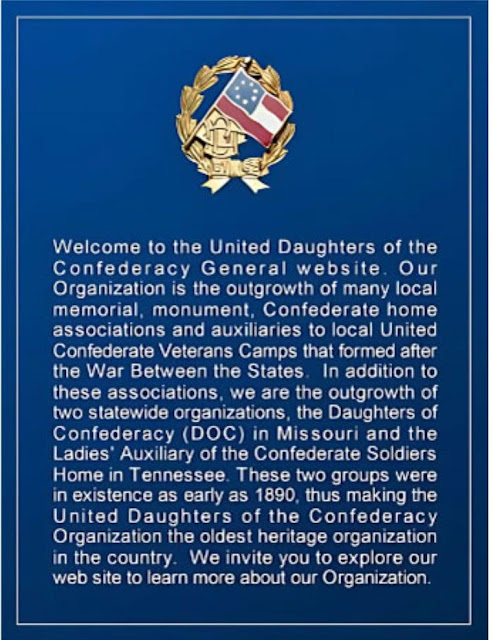
After the civil war, the well-heeled daughters and spouses of traitorous confederate soldiers formed auxiliary groups in Tennessee and Missouri that ultimately coalesced into a powerful national organization called the United Daughters of the Confederacy, Their mission was to rewrite the history of the American South, to make their husbands, brothers, sons and fathers both the victims of an unjust and brutish North, and the valiant generals and war fighters who ought to be deemed America’s real heroes — and the true inheritors of the battles of 1776 to liberate the American colonies from the British Crown.
 
Here’s how the organization — which still exists as a tax-exempt 501C3 — describes itself on their website:

Ah yes, the “war between the states…”
Pause to watch this excellent Vox.com summary of how the losing side in the civil war rewrote themselves into our history books and our physical landscape as the winners:
How Southern socialites rewrote Civil War history:

Vox
 
 
The United Daughters of the Confederacy altered the South's memory of the Civil War.
 
The United Daughters of the confederacy were founded during the Gilded Age, as wealthy women, lacking the right to vote, organized into associations that brought them influence and power despite their lack of electoral authority. Oh, and it was also about preserving the privileges of their race — a mission that continued into the 20th century.
 
At a time when the region was immersed in a new round of racial conflict as African Americans challenged the strictures of segregation, disfranchisement, and the extralegal violence of lynching, the Lost Cause sought a nostalgic elevation of the antebellum South with the effect of minimizing the agency and importance of African Americans. Within this context, the Daughters commemorated the traditional privileges of race, gender, and class by casting them as “natural” parts of the region’s history. The group’s members looked to the region’s past as a means to shape race and gender relations in the New South. The UDC historian-general Mildred Lewis Rutherford, for one, firmly believed that African Americans needed to behave as faithful “servants” if the New South were ever to approximate the Old (and supposedly racially harmonious) South the Daughters sought to venerate.
 
The office of historian-general was created in 1908 in part to review histories and textbooks for material that the UDC deemed “unjust to the South.” Rutherford, a Georgian who served in the position from 1911 to 1916, gave speeches, published pamphlets, and wrote newspaper columns that promulgated the Lost Cause view of the war. In one address, delivered on October 22, 1915, she told her audience that “true history” would erase any further sectional conflict.
 
Toward that end, in the Wrongs of History Righted, a pamphlet published in 1914, Rutherford argued that Africans brought to America had been “savage to the last degree” and “sometimes cannibals,” while under slavery “they were the happiest set of people on the face of the globe.” In Civilization of the Old South (1916), she noted that when faced with the challenges of freedom, African Americans “as a race” had “become disorderly, idle, vicious and diseased.” She then suggested that the South’s large population of Black people helped explain the prevalence of lynching there. S. E. F. Rose, a prominent UDC member from Mississippi, authored The Ku Klux Klan; or Invisible Empire (1914), and with the UDC’s unanimous endorsement described Klan violence as having “delivered the South from a bondage worse than death.”
 
Mildred Rutherford also published A Measuring Rod to Test Text Books, and Reference Books in Schools, Colleges and Libraries (1919), which was updated by Marion Salley during her term as historian-general, from 1928 to 1931. In conjunction with the United Confederate Veterans, the UDC advocated for history of which they approved, seeking changes to or the removal of books that didn’t meet their standards. As the historian Elizabeth Gillespie McRae has pointed out, they benefited from free textbook programs adopted by many states by the end of the 1930s. “While providing the state’s schoolchildren with free [often UDC-approved] textbooks,” she has written, “the programs also recycled the state-owned textbooks from white schools to black ones, eroding black control over the textbooks in their segregated schools.”
 
This insistence on “a correct and impartial history of the Confederate side” continued through the twentieth and into the twenty-first century. While distancing itself from the phrase “white supremacy” and groups such as the Ku Klux Klan, the UDC continued to voice objections to histories it deemed “unjust to the South.” In 2018, for example, the Virginia Division urged its members to write letters to a museum devoted to African American military service asking that it honor Black Confederates alongside those who served in the United States Colored Troops.
Pro tip: there’s no such thing as a “Black confederate…” these men were forced labor.
 
Fast forward to today, and the battle is on again over the story America will tell about itself, through its government-controlled institutions. And the Christian nationalists who run our government see a fitting example of “greatness” in the very era during which the United Daughters of the Confederacy were born.
 
Russ Vought, the Christian nationalist former and current Trump budget director and Project 2025 co-author helpfully spelled out the plan when he spoke at Trump’s infamous MSG pre-election rally, where he declared exactly when America was great:

Ah yes … the late 19th century … otherwise known to the far right as “the good old days,” before women had the right to vote, when Blacks were under the heel of the redemption movement and being terrorized, lynched, bombed and burned out of their homes and communities all around the country by the Klan and by racist mobs … when there were no child labor laws, unions could be busted by brute militaristic force and Gilded Age oligarchs raked in unlimited wealth from their 12 hour a day low paid workforces income tax and regulation free. Good times!
 
Not only to men like Vought openly dream of returning America to that hideous era, he and his fellow white Christian nationalists seem particularly determined to ensure that American children never learn a version of history that fails to hold particularly wealthy white, straight, Christian men in abject reverence; or that gives even a glimpse at villainy on the part of America’s founders and slaveholders.
 
Christian nationalists are the United Sons and Daughters of the Neoconfederacy
 
For these conservatives, The 1619 Project — the brilliant and bombshell historical essay series from Nikole Hannah Jones in the New York Times that seemed to shake the earth’s very foundatons during the heart of the Pandemic and the outcry over the police murder of George Floyd — was so deeply dangerous, its residue must be cleansed from school books, museums, government websites, and from the very minds of Americans, Black and white, just as surely as Medgar Evers, the Tuskegee Airmen and Jackie Robinson must be expunged from military history. Generations from now, true Americans must believe that there has been no honor or national valor among anyone but those designated as “non-DEI” and that to the extent nonwhite people, women, and gays get to exist at all in the American story (trans people get erased entirely) they will return their status as silent, smiling and noble window dressing on the broad and valiant shoulders of America’s uber class, just as they have in the decades when the United Daughters controlled our textbooks and erected our monuments.
 
Control - Alt - Delete
 

The National Museum of African American History. and Culture in Washington D.C.
 
In order to have their way, and re-rewrite the American narrative, new and more accurate tellings of our collective past must be erased. Like the plantation visitor, the neoconfederates want the past told in hazy hagiographies, not cold, hard facts. They plan a national reset that involves hitting “control-alt-delete” like resetting a misbehaving PC … so that what comes back to life is a bland national organism that never questions the greatness of people who look like Donald Trump, Pete Hegseth, RFK Jr. and Elon Musk, and never elevates people who look, sound and think like Medgar Evers, the Tuskegee Airmen, the Navajo Code Talkers or Jackie Robinson.
Enter the Blacksonian — that’s what Black Americans call the National Museum of African-American History and Culture in Washington D.C. It’s an exquisite structure outside and in — with exhibits on the history of Black existence in the Americas that will plunge deep into your soul and stay there for a long time after you’ve visited. Trump last week issued an executive order putting none other than JD Vance, someone who has in my experience has never publicly exhibited any respect whatsoever for any American not named Donald Trump, in charge of radically shifting the focus of its exhibits, along with those of the entire revered collection of museums known as the Smithsonian institution.
 
From the order:
 
President Trump aims to ensure that the Smithsonian is an institution that sparks children’s imagination, celebrates American history and ingenuity, serves as a symbol to the world of American greatness, and makes America proud.
The Order directs the Vice President, who is a member of the Smithsonian Board of Regents, to work to eliminate improper, divisive, or anti-American ideology from the Smithsonian and its museums, education and research centers, and the National Zoo.
 
The Order directs the Administration to work with Congress to ensure that future Smithsonian appropriations: (1) prohibit funding for exhibits or programs that degrade shared American values, divide Americans by race, or promote ideologies inconsistent with Federal law; and (2) celebrate women’s achievements in the American Women’s History Museum and do not recognize men as women.
 
The Vice President will work with congressional leaders to appoint members to the Smithsonian Board of Regents who are committed to advancing the celebration of America’s extraordinary heritage and progress.
The Order also directs the Secretary of the Interior restore Federal parks, monuments, memorials, statues, markers, or similar properties that have been improperly removed or changed in the last five years to perpetuate a false revision of history or improperly minimize or disparage certain historical figures or events.
 
In preparation for the 250th anniversary of the signing of the Declaration of Independence on July 4, 2026, the Order directs the Secretary of the Interior to complete restorations and improvements to Independence Hall by that date.
 
So the UDC’s confederate monuments honoring secessionist traitors and intended to intimidate Black Americans into submission are coming back. But wait, there’s more…
 
The prior administration pushed a divisive ideology that reconstrued America’s promotion of liberty as fundamentally flawed, infecting revered institutions like the Smithsonian and national parks with false narratives.

At Independence National Historical Park in Philadelphia, the Biden Administration sponsored training by an organization that advocates for dismantling “Western foundations” and that taught Park Rangers that their racial identity should dictate how they present history to visitors.

The Smithsonian Institution—once revered throughout the world as a symbol of American excellence—has recently promoted divisive ideology that American and Western values are harmful.
 
The American Art Museum currently features an exhibit that purports to address how “sculpture has been a powerful tool in promoting scientific racism” and claims that the United States has “used race to establish and maintain systems of power, privilege, and disenfranchisement.”

The National Museum of African American History and Culture has proclaimed that “hard work,” “individualism,” and “the nuclear family” are aspects of “White culture.”


The American Women’s History Museum plans to celebrate male athletes participating in women’s sports.
And since James David will be in charge of remaking these revered institutions into ones Trump and his friends can enjoy, free from psychic torment, we should know where he gets his ideas. The answer won’t be comforting. He has claimed that part of his personal philosophy comes from listening to a murky wannabe intellectual named Curtis Yarvin, whom I’ve discussed before in this newsletter. But for a refresher, here’s a flashback to Rachel Maddow’s excellent rundown:


More Yarvin, who beyond being weird, creepy and dismal… is quite popular among the white Christian nationalist podcast crowd…
 

And he also seems to believe that life was better before what he, like old Mildred Rutherford, refers to as “the war between the states.” 
 
I noticed when I was going through your stuff that you make these historical claims, like the one you just made about no genocide in Europe between 1,000 A.D. and the Holocaust, and then I poke around, and it’s like, Huh, is that true? My skepticism comes from what I feel is a pretty strong cherry-picking of historical incidents to support your arguments, and the incidents you’re pointing to are either not factually settled or there’s a different way of looking at them. But I want to ask a couple of questions about stuff that you’ve written about race. Mm.
 
I’ll read you some examples: “This is the trouble with white nationalism. It is strategically barren. It offers no effective political program.” To me, the trouble with white nationalism is that it’s racist, not that it’s strategically unsophisticated. Well —
 
There’s two more. “It is very difficult to argue that the Civil War made anyone’s life more pleasant, including that of freed slaves.” Come on. [Yarvin’s actual quote called it “the War of Secession,” not the Civil War.] The third one: “If you ask me to condemn Anders Breivik” — the Norwegian mass murderer — “but adore Nelson Mandela, perhaps you have a mother you’d like to [expletive].” When you look at Mandela, the reason I said that — most people don’t know this — there was a little contretemps when Mandela was released because he actually had to be taken off the terrorist list.
 
Maybe the more relevant point is that Nelson Mandela was in jail for opposing a viciously racist apartheid regime. The viciously racist apartheid regime, they had him on the terrorist list.
 
What does this have to do with equating Anders Breivik, who shot people on some bizarre, deluded mission to rid Norway of Islam, with Nelson Mandela? Because they’re both terrorists, and they both violated the rules of war in the same way, and they both basically killed innocent people. We valorize terrorism all the time.
 
So Gandhi is your model? Martin Luther King? Nonviolence? It’s more complicated than that.
Is it? I could say things about either, but let’s move on to one of your other examples. I think the best way to grapple with African Americans in the 1860s — just Google slave narratives. Go and read random slave narratives and get their experience of the time. There was a recent historian who published a thing — and I would dispute this, this number is too high — but his estimate was something like a quarter of all the freedmen basically died between 1865 and 1870.
 
I can’t speak to the veracity of that. But you’re saying there are historical examples in slave narratives where the freed slaves expressed regret at having been freed. This to me is another prime example of how you selectively read history, because other slave narratives talk about the horrible brutality. Absolutely.
 
“Difficult to argue that the Civil War made anyone’s life more pleasant, including freed slaves”? OK, first of all, when I said “anyone,” I was talking about a population group rather than individuals.
 
Are you seriously arguing that the era of slavery was somehow better than — If you look at the living conditions for an African American in the South, they are absolutely at their nadir between 1865 and 1875. They are very bad because basically this economic system has been disrupted.
 
I can’t believe I’m arguing this. Brazil abolished slavery in the 1880s without a civil war, so when you look at the cost of the war or the meaning of the war, it visited this huge amount of destruction on all sorts of people, Black and white. All of these evils and all of these goods existed in people at this time, and what I’m fighting against in both of those quotes, also in the way the people respond to Breivik — basically you’re responding in this cartoonish way. What is the difference between a terrorist and a freedom fighter? That’s a really important question in 20th-century history. To say that I’m going to have a strong opinion about this stuff without having an answer to that question, I think is really difficult and wrong.
Sounds like just the person we want influencing the guy who is remaking our national historical memory.
 
Among Yarvin’s apparent defenders is this guy: Doug Wilson, an Idaho based Christian nationalist church leader and content producer who happens to have ties to weekend host-turned Defense Secretary Pete Hegseth. A bit more about Pastor Wilson:
 
Wilson and his allies have a rigid patriarchal belief system and don’t believe in the separation of church and state. They support taking away the right to vote from most women, barring non-Christians from holding office and criminalizing the LGBTQ+ community.
 
Wilson apparently also believes that empathy is a sin and slavery wasn’t always so bad:

So are these the ideas that will guide the new, Trumped out Blacksonian? And will anyone be able to trust the history coming out of any of the once grand museums in Washington D.C.? Will the currently moving and phenomenal exhibits on slavery be reduced to happy talk about slaves singing in the fields and writing plaintive letters during Reconstruction about how much they missed the old plantation life and their kindly “massah?” Will there be exhibits on the red riders and white knights of the Klan, or will those be washed away? Will Reconstruction be rewritten as a crime against the South? Will exhibits inside the Blacksonian be replaced by laudatory exhibits about Clarence Thomas? Will we even recognize the place when James David is done? And what will happen to the other great museums? Will there be any women’s, indigenous or other histories left in Washington?
 
I wish these weren’t real questions.
 
As I said to Steve Schmidt during our live last week on The Warning, it’s not just Black Americans who are losing our history — we happen to be used to America doing that. White Americans who are having their history erased, too. They’re just not used to knowing it’s happening.
 
(Here’s Steve’s essay, written as he and his wife drive across America, including visiting Medgar Evers’ home and National Parks Service site … which is currently in danger of being sold off by doge.)
 
And note that this year, 2025, is a jubilee year — with 60 year anniversaries of not just the Selma to Montgomery March, but also the Voting Rights Act, the murders of Goodman, Schwerner and Cheney, the 70th anniversary of the lynching of Emmett Till, and what would be the 100th birthday of Medgar Evers in June.
 
What a tragedy to have a regime ruling us that respects none of that history.
 
Thanks for reading Joy's House! This post is public so feel free to share it.
 
Joy's House is a reader-supported publication. To receive new posts and support my work, consider becoming a free or paid subscriber.
 
Discussion about this post
 
Edited
 
Thank you, Joy , for this invaluable article!! Keep exposing these atrocities for what they are—ERASING HISTORY!! We must never give up the fight against censorship. I’m so pleased to find you at Substack ❤️
 
Like (22)
Reply
Share
 
I hope artists (visual, writers, actors, etc.) of all cultures increase their documentation of America's real history that should be shown in art galleries and public places throughout the nation. It's time to stand up.
My April 5th protest sign: One side is a painting of the Klan in robes standing around a tree with Uncle Sam (a personification of the American people and government of the USA) hanging from a tree. Standing in front, robed Trump and Musk holding his chainsaw ... with a torn Constitution at their feet. The other side of the sign reads "Trump Destroys America's Well-being"
 

2:43
 
Mar 4
Joy-Ann Reid
3,234
17