Tuesday, July 15, 2025

IMPORTANT NEW BOOKS:

The New Racial Regime: Recalibrations of White Supremacy
by Alana Lentin
Pluto Press, 2025


[Publication date: May 20, 2025]

‘Extraordinary ... The New Racial Regime works from an archival foundation of Black and Indigenous, liberationist and anti-colonialist thinkers, honing analytical tools that make sense of the ongoing racial reconstructionist moment’ Dylan Rodríguez, author of White Reconstruction

‘Accessible, rigorous, and unequivocal, The New Racial Regime is the principled treatise we sorely need’ Charisse Burden-Stelly, author of Black Scare/Red Scare

In the words of Robin D.G. Kelley, ‘anti-wokeness is the perfect example of the functioning of the racial regime.’ Taking the reader beyond the distracting framings of culture wars and moral panics, Alana Lentin shows how the attacks on Black, Indigenous and anticolonial thought and praxis reveal the processes through which racial colonial rule is ideologically resecured.

The often chaotic and contradictory restitching of the racial regime is traced through the attacks on Critical Race Theory; the ‘whitelash’ against the teaching of histories of slavery and colonialism; the counterinsurgent capture and institutionalisation of antiracism, Indigeneity and decoloniality in the interests of Zionism, settler colonialism, and imperialism; and the ways that the state mandated ‘war on antisemitism’ reforms white supremacism in a time of genocide.

While the racial regime undergoes constant recalibration, its inherent instability is the consequence of continual resistance from below. Maintaining and deepening that resistance is vital at a time of rapidly mounting fascism.


REVIEWS: 

'An extraordinary theoretical and methodological engagement with Cedric Robinson's indispensable conceptualization of "racial regimes." Simultaneously an intellectual tribute and expansive explication, The New Racial Regime works from an archival foundation of Black and Indigenous, liberationist and anti-colonialist thinkers, honing analytical tools that make sense of the ongoing racial reconstructionist moment'
--Dylan Rodríguez, author of White Reconstruction: Domestic Warfare and the Logics of Genocide

'A vital and well-written analysis of the regimes of racial capitalism that have reinvented themselves within the past decade. Lentin's analysis of white supremacy's dynamism and durability is incisive and she offers readers terrific suggestions about how to organize for change in a world where evil sometimes feels insurmountable'
--Steven Salaita, author of An Honest Living: A Memoir of Peculiar Itineraries

'Thinking through and with Cedric Robinson's framework of "racial regime", Alana Lentin offers a powerful reminder that, without an emphatic rejection of colonialism and imperialism, white supremacy, Zionism, and antiblack racial oppression will endure in our intellectual and political projects. Accessible, rigorous, and unequivocal, The New Racial Regime is the principled treatise we sorely need in this "time of monsters"'
--Charisse Burden-Stelly, author of Black Scare/Red Scare: Theorizing Capitalist Racism in the United States

'A crucial theorisation of the new "racial regime", where fervent support for genocide, and the rejection of racial equality have become components of a new common sense. From the war on critical race theory, through to the legitimation of genocide through a discourse of "decolonization", Lentin's book offers deep insights into just how deep the new racial regime characterises our new social landscape. Social problems of our time need to be theorized, and Lentin's book provides us with the vital theorization we need in order to fight back'
--Ali Meghji, Associate Professor in Social Inequalities, University of Cambridge

'With intellectual rigor and moral urgency, this book dismantles the myths of liberal progress and reveals the recalibrations of white supremacy in the modern era. Lentin's work is a valuable tool for any policy based on a genuine theory of racism'
--Houria Bouteldja, author of Rednecks and Barbarians: Uniting the White and Racialized Working Class

'What an extraordinarily instructive and timely book! Again and again, The New Racial Regime reveals the internal logics and methods of racial regimes and how they reproduce themselves, and in turn, reproduce the cultural and governing logic of capitalism – one that extracts, exploits and subjugates. By taking up Zionism to further interrogate the racial logic of governing, Lentin demonstrates the ways in which racial regimes are indeed inventive, indispensable to capitalism, and deadly'
--H.L.T. Quan, author of Become Ungovernable: An Abolition Feminist Ethic for Democratic Living
 
 
ABOUT THE AUTHOR:
 

Alana Lentin is a teacher and scholar working on the critical theorisation of race, racism and anti-racism. She is a Professor of Cultural and Social Analysis at Western Sydney University and the author of Why Race Still Matters. She is a Founding Collective member of the Institute for the Critical Study of Zionism. She lives on Gadigal-Wangal land (Sydney, Australia). 
 

Decolonizing Language and Other Revolutionary Ideas
by Ngugi Wa Thiong'o
The New Press,  2025
 
[Publication date:  May 6, 2025]
 
A Literary Hub Most Anticipated Book

Brilliant thoughts on modern African literature and postcolonial literary criticism from one of the giants of contemporary letters

“One of the greatest writers of our time.” —Chimamanda Ngozi Adichie, bestselling author

Ngũgĩ wa Thiong’o was a towering figure in African literature, and his novels A Grain of Wheat; Weep Not, Child; and Petals of Blood are modern classics. Emerging from a literary scene that flourished in the 1950s and ’60s during the last years of colonialism in Africa, he became known not just as a novelist—one who, in the late ’70s, famously stopped writing novels in English and turned to the language he grew up speaking, Gĩkũyũ—but as a major postcolonial theorist.

In Decolonizing Language and Other Revolutionary Ideas, Ngũgĩ gives us a series of essays that build on the revolutionary ideas about language and its constructive role in national culture, history, and identity that he set out in his earlier work—illuminating the intrinsic importance of keeping intact and honoring these native languages throughout time.

Intricate and deeply nuanced, this collection examines the enduring power of African languages in resisting both the psychic and material impacts of colonialism, past and present. These themes are elucidated through chapters on some contemporaries of Ngũgĩ wa Thiong’o, including Chinua Achebe, Mĩcere Gĩthae Mũgo, and Wole Soyinka—each offering a distinct lens on the liberatory potential of language.

A brave call for discourse and immensely relevant to our present moment, Decolonizing Language and Other Revolutionary Ideas works both as a wonderful introduction to the enduring themes of Ngũgĩ’s work as well as a vital addition to the library of the world’s greatest and most provocative writers.

REVIEWS:

Praise for Decolonizing Language and 
Other Revolutionary Ideas:

“Ngũgĩ wa Thiong’o’s incisive analysis unearths the hidden connections between language and power, doling out insights into the fault lines of postcolonial African politics along the way. This will leave readers with much to ponder.”
—Publishers Weekly

“This very personal book by Nobel Prize–nominated novelist and literary scholar Ngũgĩ wa Thiong’o defines ‘decolonization’ as much more than geopolitical freedom and urges African writers to reclaim African languages as a way of decolonizing literature and the mind. This philosophy builds on his earlier book Decolonizing the Mind. . . . Highly recommended for readers seeking a broadened perspective on the value and meaning of native language.”
—Library Journal

“A deeply considered case for reframing how we think about native tongues, Decolonizing Language looks to be an eye-popping argument from one of our most formidable thinkers.”
—Literary Hub, “Most Anticipated Books of 2025”

“The celebrated Kenyan novelist contemplates literature, politics and colonialism in forceful essays covering Kenya’s poverty crisis and past efforts to suppress African languages, while paying tribute to writers such as Chinua Achebe and Mĩcere Mũgo.”
—The New York Times Book Review

“These essays by acclaimed African novelist and post-colonial theorist include pieces on important contemporaries including Chinua Achebe and Wole Soyinka, but also delve into the links between language and identity.”
—Los Angeles Times

“Steeped in rich historical references and Ngũgĩ wa Thiong’o’s own lived experiences, this book brings refreshing focus back to efforts towards decolonization, a term that has perhaps faded from popular discourse but that deserves vigorous resuscitation.”
—Booklist

ABOUT THE AUTHOR:

Ngũgĩ wa Thiong'o (1938–2025) was a leading Kenyan author and academic. He is the author of A Grain of Wheat; Weep Not, Child; and Petals of Blood, as well as Birth of a Dream Weaver, Wrestling with the Devil, Minutes of Glory, and The Perfect Nine (all from The New Press). He was the recipient of twelve honorary doctorates, among other awards, and was nominated for the Man Booker International Prize.


Karl Marx in America
by Andrew Hartman
University of Chicago Press, 2025


[Publication date: May 29, 2025]


The vital and untold story of Karl Marx’s stamp on American life.

To read Karl Marx is to contemplate a world created by capitalism. People have long viewed the United States as the quintessential anti-Marxist nation, but Marx’s ideas have inspired a wide range of people to formulate a more precise sense of the stakes of the American project. Historians have highlighted the imprint made on the United States by Enlightenment thinkers such as Adam Smith, John Locke, and Thomas Paine, but Marx is rarely considered alongside these figures. Yet his ideas are the most relevant today because of capitalism’s centrality to American life.

In Karl Marx in America, historian Andrew Hartman argues that even though Karl Marx never visited America, the country has been infused, shaped, and transformed by him. Since the beginning of the Civil War, Marx has been a specter in the American machine. During the Gilded Age, socialists read Marx as an antidote to the unchecked power of corporations. In the Great Depression, communists turned to Marx in hopes of transcending the destructive capitalist economy. The young activists of the 1960s were inspired by Marx as they gathered to protest an overseas war. Marx’s influence today is evident, too, as Americans have become increasingly attuned to issues of inequality, labor, and power.

After decades of being pushed to the far-left corner of intellectual thought, Marx’s ideologies have crossed over into the mainstream and are more alive than ever. Working-class consciousness is on the rise, and, as Marx argued, the future of a capitalist society rests in the hands of the people who work at the point of production. A valuable resource for anyone interested in Marx’s influence on American political discourse, Karl Marx in America is a thought-provoking account of the past, present, and future of his philosophies in American society.

REVIEWS:
 
"'As long as capitalism persists, Marx cannot be killed.' So writes Andrew Hartman in a capacious, captivating, and learned study that demonstrates why every generation of Americans, on the right as well as left, has been compelled to grapple with and reinterpret Karl Marx and all his works. This is a brilliant, provocative, and highly readable history, essential to an understanding of American capitalism and its critics, past and present." -- Nelson Lichtenstein, author of 'A Fabulous Failure: the Clinton Presidency and the Transformation of American Capitalism'

"From Brussels to London and across the Atlantic, Karl Marx’s revolutionary ideas traversed the borders that once presumed to divide American liberals from conservatives, free market boosters from believers in the welfare state, the left from the right. Given Marx’s enduring influence on American thought, we owe a debt of gratitude to Andrew Hartman for reconstructing this important history and presenting it in compulsively readable prose." -- Jennifer Ratner-Rosenhagen, University of Wisconsin-Madison

"
Karl Marx in America is a fascinating and long overdue book. As Andrew Hartman notes, not only was Marx an active participant in American political debate as a correspondent for the New York Tribune for the crucial decade leading up to the Civil War; he has been a specter haunting American political debate since the Gilded Age. Much American social reform discourse -- from fin de siecle meliorist socialism and Progressivism through postwar industrial and interest-group pluralism, as well as Cold War liberalism, to a neoliberalism experiencing legitimation problems  -- has been shaped in typically unacknowledged debate with, or opposition to, Marx and Marxism. The topic is important, and it is particularly well treated by a deft intellectual historian like Hartman." -- Adolph Reed, Jr., University of Pennsylvania

"Marx was in exile for most of his adult life, so he was a kind of foreign import wherever he got read.  But his studies of the United States, what he called the "most modern form of bourgeois society," reshaped his thinking at a critical moment, and this thinking, Andrew Hartman claims, found a home here.  That sounds unlikely, almost ridiculous, in view of the way Marxism has been treated by American intellectuals and activists from Left to Right—as an exotic essence from the other shore which must be spoon fed to the masses or handled as a deadly contaminant, either way appearing as something counter to American values.  But Hartman proves the point in this comprehensive, convincing, and yes, even entertaining book, 
Karl Marx in America.  It's a brilliant tour de force that might persuade Americans that we are the other shore, inhabitants of the place that Marxism was made for." -- James Livingston, Rutgers University
 
"Hartman sweeps with gusto through over a century and a half of U.S. history, revealing the influence of Marxism on dozens of institutions, individuals, and events, obscure and famous. . . . to show that both liberal critics and right-wing demonizers got his favorite thinker terribly wrong." 
 ―The New Republic
 
"Recent books on Marx have oscillated between presenting him as a singularly nineteenth-century figure or as a timeless savant whose ideas are applicable across all of the spaces and times of capitalist modernity. Hartman’s approach, disaggregating the man from the posthumous deployment of his later ideas, allows him to stand on both sides of that divide. The result is an astute and politically useful book about a vital strand of American intellectual thought." ― Jacobin

"If you’ve never read about Marx’s life, Hartman’s book doubles as a short biography; if you’ve never read The Eighteenth Brumaire of Louis Bonaparte (1852), Hartman’s book is a primer on a variety of Marx’s most cited and important philosophy. If you’ve never read Marx’s interpreters—who are many, from Kenneth Burke to Frantz Fanon and David Harvey—Karl Marx in America is a road map. But the most interesting insight in the book comes from the laundry list of Marx’s haters, and their complete inability to land a good punch on our boy." ― Los Angeles Review of Books
 
"A nimble study that sheds new light on Marx’s thought and enduring influence." 
 ― Kirkus Reviews, starred review

"Students of U.S. history and thought will benefit from this study." ―
Library Journal

"
Karl Marx in America significantly contributes to our understanding of the twists and turns of the periodic Marx booms. Throughout its 500 pages and nine chapters, the text adroitly historicizes a wide range of American readers’ uses of Marx since the mid-19th century." ― Foreign Policy

"
Karl Marx in America is a start in building the narrative of how a generation of American intellectuals are beginning to analyze the history of Marxism in the United States not as a failure but as a continuing tradition, with the present being an historically important moment in its development and to which we can contribute. After all, we have nothing to lose." ― The Baffler
 

ABOUT THE AUTHOR: 


Andrew Hartman is professor of history at Illinois State University. He is the author of A War for the Soul of America: A History of the Culture Wars, published by the University of Chicago Press, and Education and the Cold War: The Battle for the American School. He is also the coeditor of American Labyrinth: Intellectual History for Complicated Times.
 

Murder the Truth: Fear, the First Amendment, and a Secret Campaign to Protect the Powerful
by David Enrich
Mariner Books, 2025


[Publication date: March 11, 2025]

 
New York Times Bestseller

"Authoritarian governments abroad have long used legal threats and lawsuits against journalists to cover up their disinformation, corruption, and violence. Now, as master investigative journalist David Enrich reveals, those tactics have arrived in America.” 
— Ruth Ben-Ghiat, author of Strongmen

David Enrich, the New York Times Business Investigations Editor and the #1 bestselling author of Dark Towers, produces his most consequential and far-reaching investigation yet: an in-depth exposé of the broad campaign—orchestrated by elite Americans—to silence dissent and protect the powerful.

It was a quiet way to announce a revolution: In an obscure 2019 case that the Supreme Court refused to even hear, Justice Clarence Thomas raised the prospect of overturning the legendary New York Times v. Sullivan decision. Though hardly a household name, Sullivan is one of the most consequential free speech decisions, ever. Fundamental to the creation of the modern media as we know it, it has enabled journalists and writers all over the country—from top national publications to revered local newspapers to independent bloggers—to pursue the truth aggressively and hold the wealthy, powerful, and corrupt to account.

Thomas’s words were a warning—the public awakening of an idea that had been fomenting on the conservative fringe for years. Now it is going mainstream. From the Florida statehouse to small town New Hampshire to Donald Trump's White House, this movement today consists of some of the world’s richest and most powerful people and companies, who believe they should be above scrutiny and want to silence or delegitimize voices that challenge their supremacy. Indeed, many of the same businessmen, politicians, lawyers, and activists are already weaponizing the legal system to intimidate and punish journalists and others who dare criticize them.

In this masterwork of investigative reporting, David Enrich, New York Times Business Investigations Editor, traces the roots and reach of this growing threat to our modern democracy. With Trump’s emboldened right-wing coalition committed to demonizing and punishing those who attempt to hold them accountable, Murder the Truth sounds the alarm about the looming war over facts, laying bare the stakes of losing our most sacrosanct rights. The result is a story about power in the age of Trump—the way it’s used by those who have it and the lengths to which they will go to avoid it being questioned.

REVIEWS:

“David Enrich makes a compelling and alarming case in this very important new book.” — Rachel Maddow

“With the new administration already seizing every opportunity to strong-arm the press, and with stiff spines in short supply among leaders of major media organizations, Murder the Truth makes for an unfortunately urgent warning…This is a story not just about political and legal shifts, but about the power of money.” — Washington Post

“David Enrich is a keen observer of the intersection of money, power and politics… [A] granular and disturbing read.”
— The Guardian

“The story Enrich has unearthed is engaging…Enrich takes readers deep into other interesting First Amendment legal battles, showing how each one could chip away at Times v. Sullivan.”
— Boston Globe

“[Murder the Truth] feels especially timely in the current political climate, amid questions of whether owners of newspapers and TV networks will stand up to a president who’s long demonized the media—and whether the conservative-majority Supreme Court could upend libel laws in America.” — Vanity Fair

“Please read this important book while we still have the liberty to publish and enjoy such tomes.” 
— Philadelphia Inquirer

“[This] book reads like a thriller. I read the entire thing in a day because it’s so captivating. It’s the perfect primer on the right wing’s war against free speech. If you’re looking to learn more about free speech and how Trump and the far right are seeking to weaponize our speech laws to silence dissent, this book is a must read.” 
— Taylor Lorenz, User Mag

“A most fascinating and comprehensive chronicle of this new threat to journalism…The ultrawealthy are feeling emboldened to file lawsuits against journalists and their publishers, perhaps inspired by Donald Trump’s giddy disregard for a free press. In his new book, ‘Murder the Truth,’ David Enrich forecasts a dangerous endgame.”
— William D. Cohan, Puck News

“Urgently relevant… Enrich is an indefatigable investigative reporter as well as a gifted storyteller.” 
— Pittsburgh Post-Gazette

“In his tightly reported book, Enrich shows how we got here. The story is not without nuance: not every plaintiff he describes is unsympathetic; not every critic of Sullivan is on the political right (and some who might like to keep the precedent in place are). In the end, though, he paints a clear picture of a right-wing crusade to weaken press protections in order to blunt scrutiny of the rich and powerful—one that is already exerting a devastating financial and emotional toll on American journalists, even as Sullivan remains the law of the land.” 
— Columbia Journalism Review

"Authoritarian governments abroad have long used legal threats and lawsuits against journalists to cover up their disinformation, corruption, and violence. Now, as master investigative journalist David Enrich reveals, those tactics have arrived in America. Murder the Truth is a timely and essential study of how these favored legal tools of repressive regimes are being regularly deployed in the United States to conceal the truth, discredit the press, and benefit anti-democratic forces." 
— Ruth Ben-Ghiat, author of Strongmen

“This important book is about an attempted murder. With readers as witnesses, we see small newspapers killed, and editors and publishers terrorized by legal assaults from public officials who demonize the press as Enemies of the People. Yet as this riveting narrative shows, the ultimate target is the Supreme Court’s landmark New York Times vs Sullivan decision, which erected a First Amendment wall to protect journalists from being silenced by those in power. David Enrich’s engrossing, carefully reported account is vital to help prevent this murder.” — New York Times bestselling author Ken Auletta

“This is the deeply reported, richly narrated story of a war on honest journalism that disturbs the interests of the wealthy and powerful. David Enrich takes us behind the scenes of a concerted right-wing campaign to destroy news organizations financially — but the ultimate goal is to overturn New York Times v. Sullivan, the linchpin of libel protection for reporters who err in good faith. Nothing less than the future of accountability journalism is at stake." — Barton Gellman, New York Times bestselling author and three-time winner of the Pulitzer Prize

“A chilling deep dive . . . an unsettling look at a dire threat to democracy.” — Publishers Weekly (starred review)

“[Enrich] elucidates the complex legal challenges to fact-based journalism brought against long-established media and independent outlets by hungrily litigious politicians and corporate executives...With thousands of publications now defunct, Enrich’s probing analysis brings crucial attention to this endangered tenet of a functioning democracy.” — Booklist (starred review)

"A revealing look at a campaign intended to stifle the First Amendment in favor of those in power." 
— Kirkus Reviews

“Startling and deeply researched”
— Nieman Lab


ABOUT THE AUTHOR:


David Enrich is the Business Investigations Editor at the New York Times and the bestselling author of Dark Towers and Servants of the Damned. The winner of numerous journalism awards, he previously was an editor and reporter at the Wall Street Journal. His first book, The Spider Network: How a Math Genius and Gang of Scheming Bankers Pulled Off One of the Greatest Scams in History, was short-listed for the Financial Times Business Book of the Year award. Enrich grew up in Lexington, Massachusetts, and graduated from Claremont McKenna College in California. He currently lives in New York with his wife and two sons.
 

FASCIST AMERICA 2025: How the Criminally Corrupt, Deeply Unhinged, and Violently Pathological Trump Regime in Collusion With The Equally Fascist Supreme Court Is Systematically Destroying the Country With No End in Sight

AMERICA IS A FASCIST STATE

Fascism is a far-right, authoritarian, and ultranationalist political ideology and movement, characterized by a dictatorial leader, centralized autocracy, militarism, forcible suppression of opposition, belief in a natural social hierarchy, subordination of individual interests for the perceived good of the nation or race, and strong regimentation of society and the economy.

Opposed to anarchism, democracy, pluralism, egalitarianism, liberalism, socialism, and Marxism fascism is at the far right wing of the traditional left–right spectrum.

AMERICA IS A ROGUE STATE

A nation or state regarded as breaking international law and posing a threat to the security of other nations.


https://www.nytimes.com/live/2025/07/14/us/trump-news

Live Updated 
July 14, 2025
New York Times


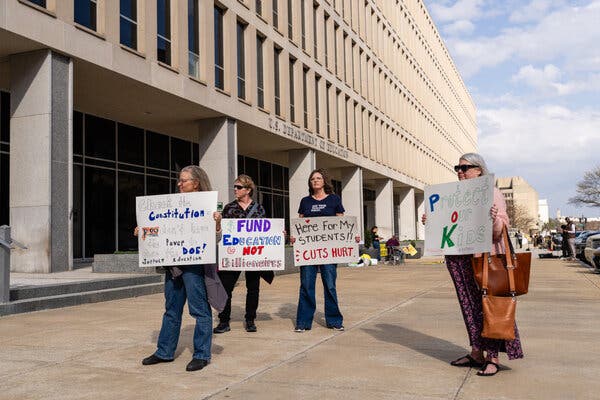
Trump Administration Live Updates: Supreme Court Clears Way for Dismantling of Education Department


Demonstrators in Washington protested in March against the dismantling of the Education Department. Credit: Eric Lee/The New York Times
 
Where Things Stand:

Education Department: In a major victory for the Trump administration, the Supreme Court on Monday let it fire more than a thousand Education Department employees and functionally eliminate the agency. The court’s decision, while technically temporary, lets workers who had been reinstated during the legal battle be fired again. The department manages federal loans for college, tracks student achievement and enforces civil rights laws in schools. Read more ›


New lawsuit: Two dozen states and the District of Columbia are suing the Trump administration over $6.8 billion in education funding it withheld a few weeks before the start of the next school year. The money pays for free or low-cost after-school programs, as well as teacher training and help for children learning English.

July 14, 2025,
by Carl Hulse
Reporting from the Capitol
New York Times
 
The Senate approves the first judge of Trump’s second term.


Whitney D. Hermandorfer during her confirmation hearing before the Senate Judiciary Committee in June. Credit: Nathan Howard/Reuters

The Senate on Monday confirmed the first federal judge of President Trump’s second term, putting the administration on a much slower pace for filling federal court vacancies than in his first term, when a rush to install conservatives on the courts was an overarching priority.

Senators voted 46 to 42 along party lines to confirm Whitney D. Hermandorfer of Tennessee to a seat on the Cincinnati-based U.S. Court of Appeals for the Sixth Circuit. Her approval came more than six weeks later than the first appellate judge confirmed after Mr. Trump took office in 2017. The Senate had also confirmed a new Supreme Court justice by this point in his last term, placing Neil M. Gorsuch on the court.

This time around, Mr. Trump has put more emphasis on other aspects of his administration, aggressively pushing ambassadorial nominations and devoting much of the energy of the Senate to pushing through the sweeping tax and policy legislation enacted this month.

In addition, significantly fewer judicial vacancies exist today compared with 2017, when Mr. Trump inherited more than 100 court openings after Senate Republicans stalled President Barack Obama’s judicial selections when they took Senate control in 2014.

“We’re not facing the number of judicial vacancies this Congress we did during Trump’s first term,” said Senator John Thune, Republican of South Dakota and the majority leader. “There are around 50 vacancies on the federal bench. Our job is to fill those vacancies with more judges who understand the proper role of a judge, and that starts with confirming Ms. Hermandorfer.”

Ms. Hermandorfer served as director of the strategic litigation unit in the Tennessee attorney general’s office, where she has argued high-profile cases, including defending the state’s abortion ban and challenging a Biden administration prohibition on discrimination against transgender students.

She clerked for Justices Samuel A. Alito and Amy Coney Barrett on the Supreme Court and for Justice Brett M. Kavanaugh when he sat on the U.S. Court of Appeals for the District of Columbia Circuit. At age 38, she is part of an effort by both parties to place younger judges on the bench, where they can serve for decades given their lifetime tenure, as opposed to the previous tradition of choosing lawyers with more extensive careers.

Her legal background drew criticism from Democrats.

“She has less than 10 years of legal experience,” Senator Chuck Schumer, Democrat of New York and the minority leader, said on Monday. “She has never served as a chief counsel on any single case. She made a career of going after people’s reproductive rights, transgender rights and anti-discrimination policies.”

Senator Richard J. Durbin of Illinois, the top Democrat on the Judiciary Committee, also suggested that Ms. Hermandorfer had a “shocking” lack of experience for such a powerful appeals court post and noted that she ducked questions on whether Mr. Trump had lost the 2020 election.

“The fact that she’s willing to condone President Trump’s false claims further demonstrates a level of partisanship and deference to this president that is unacceptable for someone seeking a lifetime appointment,” Mr. Durbin said.

Republicans were strongly in support. Senator Charles E. Grassley, the Iowa Republican who is chairman of the Judiciary Committee, called her approval “nothing but net,” in a nod to Ms. Hermandorfer’s stint as a co-captain of the women’s varsity basketball team at Princeton.

“Ms. Hermandorfer understands the powerful role that judges have in our system of government, but even more importantly, she respects the limitations of that power,” Mr. Grassley said.

During his 2016 presidential run, Mr. Trump made his commitment to appointing conservative judges a central theme of his campaign, seeking to allay concerns on the right about his character and political leanings. In a first, he made public lists of those he said he would nominate to the Supreme Court if elected, a promise that was seen as important to his win.

With the eager cooperation of Senator Mitch McConnell, the Kentucky Republican who was then majority leader, Mr. Trump moved quickly to follow through on his judicial pledge. He ultimately placed 234 federal judges on the bench, including three Supreme Court justices after Mr. McConnell held open a vacancy that occurred with almost a year left in Mr. Obama’s tenure while another was pushed through just days before the 2020 election.

During the administration of President Joseph R. Biden Jr., Democrats worked aggressively to counter Trump’s judicial record and ultimately saw the confirmation of 235 federal judges. At this point in the Biden administration, seven judges had been confirmed.

Other judicial nominees are in the pipeline. Mr. Trump has nominated 10 people for U.S. district court seats in Missouri, Florida and Kentucky. He also put forward Emil Bove III, a former Trump defense lawyer and Justice Department official, for a seat on the U.S. Court of Appeals for the Third Circuit, which handles cases from Pennsylvania, New Jersey, Delaware and the Virgin Islands.

Mr. Bove, who could face a committee vote on his confirmation as early as Thursday, has faced accusations from a fired Justice Department colleague that he was willing to ignore court orders in immigration cases, an accusation Mr. Bove has denied.


July 14, 2025
Abbie VanSickle
Reporting from Washington
 
The Supreme Court agrees that the firing of more than 1,000 Education Dept. workers can proceed.


The emergency application to the justices stemmed from efforts by the Trump administration to sharply curtail the federal government’s role in the nation’s schools. Credit: Eric Lee/The New York Times

The Supreme Court agreed on Monday that the Trump administration can proceed with dismantling the Education Department by firing more than a thousand workers.

The order is a significant victory for the administration and could ease President Trump’s efforts to sharply curtail the federal government’s role in the nation’s schools.

The Trump administration has announced plans to fire more than 1,300 workers, a move that would effectively gut the department, which manages federal loans for college, tracks student achievement and enforces civil rights laws in schools.

The Education Department began the year with more than 4,000 employees. The administration also fired some probationary workers and offered employees the ability to resign. Altogether, after the terminations, the Education Department will have a work force of about half the size it did before Mr. Trump returned to office.

The move by the justices represents an expansion of presidential power, allowing Mr. Trump to dismantle the inner workings of a government department created by Congress without legislators’ input. The firings will hobble much of the department’s work, supporters argued in court filings. Particularly hard hit was the department’s Office for Civil Rights, which had seven of its 12 offices shuttered.

It comes after a decision by the justices last week that cleared the way for the Trump administration to move forward with cutting thousands of jobs across a number of federal agencies, including the Departments of Housing and Urban Development, State and Treasury.

The order by the court was unsigned and gave no reasoning, as is typical in such emergency applications. No vote count was given, which is usual for emergency orders, but Justice Sonia Sotomayor wrote a dissent, joined by the court’s other two liberals, Justices Elena Kagan and Ketanji Brown Jackson.

The three argued that Mr. Trump had overstepped his authority with his “unilateral efforts to eliminate a cabinet-level agency established by Congress nearly half a century ago.”

“Only Congress has the power to abolish the department,” Justice Sotomayor wrote in her 19-page dissent.

The court’s decision, she wrote, would have severe consequences for the country’s students by unleashing “untold harm, delaying or denying educational opportunities and leaving students to suffer from discrimination, sexual assault and other civil rights violations without the federal resources Congress intended.”

The order is technically temporary, in effect only while courts continue to consider the legality of Mr. Trump’s move. In practice, fired workers whom a Boston judge had ordered be reinstated are now again subject to removal from their jobs.

Trump administration officials celebrated the court’s decision. Shortly after it was announced, the education secretary, Linda McMahon, said in a statement that the department would press forward with terminating workers.

“We will carry out the reduction in force to promote efficiency and accountability and to ensure resources are directed where they matter most — to students, parents, and teachers,” Ms. McMahon said. She added that the administration would “return education to the states,” but would “continue to perform all statutory duties” while “reducing education bureaucracy.”

The White House also praised the decision. “The Supreme Court once again recognized what radical district court judges refuse to accept — President Trump, as head of the executive branch, has absolute constitutional authority to direct and manage its agencies and officers,” a spokeswoman, Liz Huston, said in a statement.

In a statement, a union representing Education Department workers called the court’s decision “deeply disappointing.”

“This effort from the Trump administration to dismantle the Department of Education is playing with the futures of millions of Americans, and after just four months, the consequences are already evident across our education system,” Sheria Smith, the president of the American Federation of Government Employees Local 252, said in a statement.

Mr. Trump had signed an executive order on March 20 instructing Ms. McMahon to start shutting down the federal agency, which manages federal loans for college, monitors student achievement and supports programs for students with disabilities. Trump administration officials cited low test scores by students as the reason to dismantle the department.

“We’re going to shut it down, and shut it down as quickly as possible,” Mr. Trump said during the ceremony where he signed the executive order.

The move immediately set up a legal fight over the future of the department because it was created by an act of Congress, and legislators had not given approval to eliminate it.

Shortly after, two school districts, the American Federation of Teachers and 21 Democratic state attorneys general filed a legal challenge in federal court in Massachusetts. The challengers asked a judge to block the executive order and to unwind a round of layoffs that gutted the department’s work force by about half.

Lawyers for the challengers argued that the administration’s plans would interfere with the department’s ability to carry out functions required by law.

On May 22, Judge Myong J. Joun of the U.S. District Court for the District of Massachusetts ordered the Trump administration to reinstate the fired employees while the lawsuit was pending. Judge Joun, who was nominated to the bench by President Joseph R. Biden Jr., said he agreed that only Congress could eliminate the department and that the administration’s actions amounted to an illegal shutdown of the agency.

On June 4, a panel of judges in the U.S. Court of Appeals for the First Circuit upheld Judge Joun’s ruling. Two days later, the Trump administration filed an emergency application with the Supreme Court, asking it to intervene and lift the trial judge’s order. In the filing, Solicitor General D. John Sauer argued that Judge Joun had “thwarted the executive branch’s authority to manage the Department of Education.”

In response, lawyers for the challengers argued that the agency’s leaders had “set out to destroy the agency by executive fiat” and without the support of Congress.

In court filings, the challengers asserted that the trial judge had properly determined that the government was likely to lose its argument that it had not eliminated the department. Judge Joun properly recognized that just because “a skeleton crew remains” at the Education Department, that did not mean the Trump administration was “faithfully carrying out Congress’s mission” in what was effectively “tearing the department down to the plywood,” they argued.

The Trump administration replied in court filings that the department had “determined that it can carry out its statutorily mandated functions with a pared-down staff and that many discretionary functions are better left to the states.”

Michael C. Bender contributed reporting.


July 14, 2025
Sarah Mervosh
Education reporter

 
24 states sue Trump over $6.8 billion withheld from education.


About 1.4 million children nationwide attend after-school programs that rely on federal support. Credit...Philip Cheung for The New York Times

A coalition of 24 states and the District of Columbia sued the Trump administration on Monday over $6.8 billion in education funding that the administration has withheld a few weeks before the start of the school year.

The withheld money includes about 14 percent of all federal funding for elementary and secondary education across the country. It helps pay for free or low-cost after-school programs that give students a place to go while their parents work. It also covers training to improve the effectiveness of teachers and help for children learning English.

Attorneys general from 22 states signed onto the lawsuit, along with the governors of Pennsylvania and Kentucky. All are Democrats.

The lawsuit accuses the Trump administration of holding back the money illegally. The U.S. Constitution gives Congress the power of the purse, and the Impoundment Control Act of 1974 says that a president cannot unilaterally refuse to spend money that Congress has appropriated.

The lawsuit asks a federal judge in Rhode Island to order the release of the money, which was supposed to be sent to states on July 1.

The Department of Education notified state education agencies on June 30 that it was holding the money back while it conducted a review. The Trump administration has sought to slash federal spending and align the budget with the president’s political priorities.

A spokesman for the White House Office of Management and Budget said that an initial review found instances of federal education money being “grossly misused to subsidize a radical left-wing agenda.” Among the examples he cited was a seminar on “queer resistance in the arts.”

The White House did not respond immediately to a request for comment about the lawsuit.

The White House has not said when the money might be released. It has proposed eliminating dedicated funding for the programs in its 2026 budget, ending some of the programs outright and collapsing others into a smaller pot of education funding for states.

President Trump and his team have said they believe the Impoundment Control Act is unconstitutional, and have argued that the president should have a greater say over spending in many areas of government.

Mr. Trump has said he also wants to eliminate the Department of Education, arguing that education should be more fully controlled by the states, though only Congress can abolish a cabinet-level agency.

The withholding of $6.8 billion for education has been sharply criticized by a growing chorus of Democrats, as well as by some Republicans.

Rep. Mike Lawler, a Republican who represents suburban areas north of New York City, urged President Trump to release $1.3 billion of the money to be used for after-school and other programs that keep children occupied outside of school hours, including in the summer.

He argued in a statement that the programs fulfill the Trump administration’s goal of giving power over education to the states, because state education agencies manage the money and choose which organizations receive it.

Nationwide, the withheld federal money funds after-school and other services for an estimated 1.4 million children, or nearly 20 percent of all students who participate in after-school programs, according to the Afterschool Alliance, an advocacy group. Most of the students in the programs come from lower-income households, and through after-school, they typically receive academic help, enrichment and a free snack or meal.

“Work doesn’t end at 3 o’clock,” said Christy Gleason, executive director of the Save the Children Action Network, which runs after-school programs at 41 schools, mainly in rural areas.

In many rural areas, the federally funded after-school programs are the only option. Cutting them would leave working parents there with few alternatives for child care, she said.

The withheld money includes $2.1 billion to help train, mentor and retain effective teachers, with a focus on low-income school districts. It also includes $1.4 billion in flexible funding for schools to spend on art, music, mental health services, physical education and technology. Smaller amounts go toward helping children learning English; adult literacy and education; and support for children of migrant farmworkers.

In Monterey County, Calif., about one in eight students qualify for the federal program for children of migrant farmworkers, said Deneen Guss, the county superintendent, who works with 24 local school districts.

The students’ parents move seasonally to harvest crops like strawberries and vegetables, education officials said. Many of them arrive in the county in March and move on again in October, creating academic and emotional challenges for students.

The federal money helps pay for academic support and other needs, like helping children sign up to see a doctor or dentist. The Trump administration has proposed eliminating the program, claiming that it is ineffective and strips taxpayer money from American students.

Most students in the Monterey County program are U.S. citizens or are in the country legally, Dr. Guss said.

Because the money to pay them has been withheld, the county has issued a layoff notice for about 30 employees who work as family specialists, teachers’ aides and in other positions, said Ernesto Vela, an assistant superintendent in the Monterey County Office of Education.

“All of the staff, if the funds do not come in, then essentially their last day of work is Sept. 7,” he said.


Friday, July 4, 2025

"The United States slide into a fascist politics demands a revitalized understanding of the historical moment in which we find ourselves..."--Henry A. Giroux

DEFEAT FASCISM BEFORE FASCISM DEFEATS YOU
All,
The vicious hatred and relentless oppression and exploitation of African Americans in particular is the foundational template for the deadly economic and fiscal policies (known as the "big beautiful bill”) currently being enacted on a national scale by a criminally corrupt, deeply xenophobic, ruthlessly anti-labor, virulently misogynist, and deadly white supremacist Trump administration/regime. Its major aim and objective is to fundamentally eviscerate and eventually destroy the social safety net that enables the poor, working, and middle classes in the United States in general to live even a halfway affordable life in the United States. This is a fascist program of sheer evil and its only going to become much worse very soon. STAY TUNED AND STAY WOKE because at this rate this country will not survive the next six months. 

This is not merely a rhetorical claim but one rooted in a close and careful critical analysis of the facts on the ground as they have metastasized and mushroomed since 2016 (Here then is the major receipt/takeaway of the past eight years: 

The Scumbag-in-Chief Donald J. Trump has received an astonishing alltime record of 214 million votes over the course of three straight presidential elections from 2016-2024 in which 80% of those votes have come from white American voters and in which a robust majority of 60% of those votes came from both white male and female voters. Keep in mind that this national demographic is currently 65% of all voters in the United States). 

My prediction on the given evidence as of today is that the national economy of the United States will completely collapse by early next year (March/April) at the latest...
 
Kofi 

A TRIBUTE TO LEGENDARY CIVIL RIGHTS LEADER AND MISSISSIPPI ACTIVIST MEDGAR EVERS (1925-1963) ON THE 50th ANNIVERSARY OF HIS TRAGIC ASSASSINATION, June 12, 1963

https://panopticonreview.blogspot.com/…/a-tribute-to-legend…

FROM THE PANOPTICON REVIEW ARCHIVES

(Originally posted on June 12, 2013):

Wednesday, June 12, 2013

A TRIBUTE TO LEGENDARY CIVIL RIGHTS LEADER AND MISSISSIPPI ACTIVIST MEDGAR EVERS (1925-1963) ON THE 50th ANNIVERSARY OF HIS TRAGIC ASSASSINATION

MEDGAR EVERS 
(b. July 2, 1925--d. June 12,1963)

All,

Medgar Evers (1925-1963) is one of the central and thus most important figures to emerge in the modern Civil rights movement that began directly after WWII in the United States. A brilliant visionary, shrewd political strategist, and deeply courageous man who had served his country with great honor, distinction, and bravery throughout Europe fighting fascism in the second world war, a 21 year old Medgar returned to the United States as did hundreds of thousands of his fellow African American veteran soldiers in 1945-46 absolutely determined to confront, challenge, and defeat the ruthlessly racist system of Jim Crow segregation that absolutely ruled his home state of Mississippi as well as the entire southern region of the country with an iron fist and the morally bankrupt sanction of the law--and tellingly in most of the rest of the country as well. Arriving back in his hometown of Jackson, it didn't take long for the ambitious and dynamic Evers to take full advantage of the higher educational opportunities provided by the GI bill that financially enabled an entire generation to attend college. Medgar immediately enrolled in and successfully completed a B.A. program in business administration at Alcorn State College, a well regarded historically black college where he met and soon married Myrlie Beasley in 1951. They had three children and raised a strong family together first in Mound Bayou, Missisippi, and later in Jackson, Miss. while Evers worked as a life insurance salesman for an independently successful black insurance company. Evers's boss T.R.M. Howard was a prominent civil rights activist in his own right and was local President of the Regional Council of Negro Leadership (RCNL). Through its auspices Evers played a major role in organizing the RCNL's boycott of filling stations that denied black people use of the stations' restrooms. Over the next couple years from 1952-1954 Evers and his brother Charles were very active representatives and organizers of the RCNL's annual conferences which attracted thousands of local black residents.

In 1954 Evers became an even more high profile figure in the burgeoning--and very dangerous--Mississippi civil rights struggle when a highly qualified Evers in a NAACP sponsored legal test case applied to the then completely segregated University of Mississippi. Predictably his application was rejected but Evers's effort galvanized many other black activists throughout the country who were inspired by Evers's courageous example and emulated his activity in many similar anti-segregation cases in the United States. In late 1954 the NAACP officially named Evers its first field secretary in Mississippi. In this leadership capacity Medgar organized many boycotts and established many local chapters of the NAACP. Medgar was also at the epicenter of the heroic desegregation efforts of James Meredith to successfully enroll at the University of Mississippi in 1962 after major violence by enraged white Mississippi students and many local racist thugs who rioted both on and off campus in protest of Meredith's admission were confronted and disarmed by federal troops that President John Kennedy sent to quell the racist violence.

Evers continued as he always had as a dedicated local civil rights leader and organizer in Mississippi who also worked as an investigator in various civil rights cases and incidents around the issues of voter registration (which like in most of the south was still denied to African American citizens), education, and labor rights. For these and other activities Evers was targeted by the Ku Klux Klan (KKK) and many other racist organizations throughout the region. For his important public investigations into the vile racist murders of 14 year old Emmitt Till in 1955 and his outspoken support for Clyde Kennard an innocent and brilliant black man (and also WWII veteran) who after trying vainly to transfer from the University of Chicago following his junior year after returned to his native Mississippi to aid a sick and infirm family relative and tried to enroll in a prominent and racially segregated all white Mississippi college. After leading an unsuccessful legal and political effort during the late '1950s to enroll in the school Kennard was framed and falsely imprisoned for burglary because he was seen as a local "troublemaker" for trying to enroll in the school. His case was later thrown out of court years later because of false arrest.

From this point in 1960 onward Medgar was a marked man by the Klan and others for his leadership and on May 28, 1963a Molotov cocktail bomb was thrown into the carport of his home and a week later on June 7, 1963 Evers was nearly run down by a car after he emerged from his Jackson, Mississippi NAACP office. Then just five days later only a few minutes past midnight on June 12, 1963 Medgar was assassinated by a well known KKK and white citizens council member and murderer by the name of Byron De La Beckworth. After being acquited in two all white male deadlocked jury trials in 1964 it would be another 30 years before De La Beckworth was finally convicted and sent to prison where he died at the age of 80 in 2001. It was the fiercely dedicated persistence and deep commitment by Medgar Evers's extraordinary wife and widow who was and is also a civil rights leader and organizer in her own right (and later chairperson during the late 1990s of the NAACP) who diligently fought for the successful reopening of his husband's case over a three decade period that led to finally bring Medgar's racist murderer to justice. At age 80 Mrs. Evers-Williams continues her now 50 year old fight to carry on and implement the tremendous legacy of Medgar's astonishing human and civil right activism on behalf of genuine justice, freedom, and equality today.

The following collection of original texts, videos, recordings, photographs and other pertinent archival information about Medgar Evers's inspiring life and work follows. We offer it all in humble recognition and deep appreciation for what Medgar fought for and achieved during his exceptional life and what now remains for all the rest of us to do both in his personal honor and on behalf of our own collective humanity. Long Live Medgar Evers!...

Kofi

http://mshistorynow.mdah.state.ms.us/…/medgar-evers-and-the…
 
Medgar Evers and the Origin of the Civil Rights Movement in Mississippi
by Dernoral Davis
Mississippi Historical Society


Mississippi became a major theatre of struggle during the Civil Rights Movement of the mid-20th century because of its resistance to equal rights for its black citizens. Between 1952 and 1963, Medgar Wiley Evers was one of the state’s most impassioned activist, orator, and visionary for change. He fought for equality and fought against brutality.

Born July 2, 1925, in Decatur, Mississippi, Medgar was one of four children born to James and Jesse Evers. His father worked in a sawmill and his mother was a laundress. Evers’s childhood was typical in many ways of black youths who grew up in the Jim Crow South during the Great Depression of the 1930s and in the years preceding World War II. As a youth, Evers’s parents showered him with love and affection, taught him family values, and routinely disciplined him when needed. The Evers home emphasized education, religion, and hard work.

Among his siblings, Evers spent the most time with Charles, whom he idolized. As Evers’s older brother, Charles protected him, taught him to fish, swim, hunt, box, wrestle, and generally served as a sounding board for many of Medgar’s early experiences. He attended all-black schools in the dual and segregated public educational system of Newton County. Segregated public education meant long walks to school for the Evers children. The schools had few resources and operated with outdated textbooks, few teachers, large classes, and small classrooms without laboratories and supplies for the study of biology, chemistry, and physics.

Besides his under-funded public education, Evers on occasion saw and witnessed acts of raw violence against blacks. On these occasions, Evers’s parents and older brother could not shield him from the realities of a society built on racial discrimination. At about age 14, Evers observed to his horror the dragging of a black man, Willie Tingle, behind a wagon through the streets of Decatur. Tingle was later shot and hanged. A friend of Evers’s father, Tingle was accused of insulting a white woman.

Evers later recalled that Tingle’s bloody clothes remained in the field for months near the tree where he was hanged. Each day on his way to school Evers had to pass this tableau of violence. He never forgot the image.

A World War II soldier

At the end of his sophomore year of high school and several months before his eighteenth birthday, Evers volunteered and was inducted into the United States Army in 1942. The decision to volunteer was prompted by a desire to see the world and to follow Charles, who had enlisted a year earlier. During his tour of duty in World War II, Evers was assigned to and served with a segregated port battalion, first in Great Britain and later in France. Though typical at the time, racial segregation in the military only served to anger Evers. By the end of the war, Evers was among a generation of black veterans committed to answering W.E.B. Dubois’s clarion call of nearly three decades earlier: “to return [home] fighting” for change.

Upon returning home, the initial “fight” for Evers was to register to vote. For Evers voting was an affirmation of citizenship. Accordingly, in the summer of 1946, along with his brother, Charles, and several other black veterans, Evers registered to vote at the Decatur city hall. But on election day, the veterans were prevented by angry whites from casting their ballots. The experience only deepened Evers’s conviction that the status quo in Mississippi had to change.

A college student

Evers spent the next decade preparing to become part of the vanguard for change in Mississippi. He returned to school to complete his education under the military’s GI Bill, which was passed by Congress in 1944 to provide education to people who had served in the armed forces during World War II.

In 1946, he enrolled at Alcorn A&M College in Lorman, Mississippi, where he roomed with his brother Charles. At Alcorn, which had both high school and college courses of study, Evers first completed high school and remained to pursue a college degree with a major in business administration.

While in college, Evers met and courted Myrlie Beasley, an education major from Vicksburg. They were married Christmas Eve 1951. Myrlie remembers her initial impressions of Evers as a well-built, self-assured veteran and athlete. Soon afterward she realized he was a “rebel” at heart. “He was ready,” Myrlie recalls, “to put his beliefs to any test. He [even] saw a much larger world than the one that, for the moment, confined him; but he aspired to be a part of that world.”

During his years at Alcorn, Evers enjoyed reading and worked hard to pass all classes. Participation in extracurricular activities remained Evers’s real passion from his freshman year through his senior year. As a freshman he joined the debate team, the business club, played football, and ran track. As a junior he was elected president of his class and vice president of the student forum. By his senior year he had become editor of the Alcorn Yearbook, the student newspaper, the Alcorn Herald, and was named to Who’s Who Among American College Students.

The decision to attend college afforded Evers critical exposure and experiences that contributed to his development as an emerging activist and eventual leader of the Civil Rights Movement in Mississippi. A crucial experience occurred during his senior year when each month he drove to Jackson to participate in an interracial seminar jointly sponsored by then all-white Millsaps and all-black Tougaloo colleges. It was at one of the interracial seminars that Evers became aware of the National Association for the Advancement of Colored People (NAACP), which he subsequently joined.

An insurance agent

After Evers’s graduation, he and Myrlie moved to the all-black town of Mound Bayou, Mississippi, where he began work as an insurance agent for the Magnolia Mutual Insurance Company, selling life and hospitalization policies to blacks in the Mississippi Delta. The insurance company was owned by Dr. T. R. M. Howard, a black physician in Mound Bayou and a political activist. It was largely because of Howard’s influence that Evers, from 1952 to 1954, not only traveled his Delta route selling insurance, but organized new chapters of the NAACP. The NAACP organizing travels convinced Evers that Jim Crow rendered the state a virtual closed society and that mobilizing at the grassroots level was essential for building a movement for social change. Increasingly, too, Evers saw himself in the vanguard to put an end to Mississippi’s infrastructure of segregation. Other people in the still-young Mississippi Civil Rights Movement also began thinking of Evers as a leader.

The leadership prospects for Evers only increased when he volunteered to become the first black applicant to seek admission to the University of Mississippi. University and state officials reacted to Evers’s January 1954 application for admission to the law school in Oxford with alarm and sought to handle the matter with dispatch. His application was rejected on the “technicality” that it failed to include letters of recommendation from two individuals in the county (Bolivar) where he lived at the time.

NAACP state field secretary

The law school application soon catapulted Evers from relative obscurity to broader name recognition and to serious leadership consideration within the emerging state Civil Rights Movement. E.J. Stringer, president of the NAACP Mississippi State Conference, was so impressed with Evers’s leadership potential that he recommended him for the newly created position of state field secretary of the civil rights organization. The National Office of the NAACP voted in favor of Stringer’s recommendation.

In December 1954, Evers’s appointment as state field secretary was officially announced. The new position required that Evers move from Mound Bayou to Jackson and establish an NAACP field office. Evers negotiated with the NAACP National Office for Myrlie to be appointed as the office’s paid secretary. The Medgar Evers family, which now included two children, Darryl Kenyatta and Reena Denise, came to Jackson in January 1955 – the couple in 1960 had another son, James. Once in Jackson a residence for the family was quickly secured followed by the selection of the new NAACP office in the business hub of the local black community on North Farish Street. Evers relocated the field office ten months later to the Masonic Temple on Lynch Street.

When Evers assumed his position as state field secretary, he began an eight-year career in public life that was both demanding and frustrating. The 1950s proved frustrating and anxiety-laden as some white Mississippians responded with massive resistance to the civil rights activities of the NAACP and to the 1954 Brown v. Board of Education of Topeka decision which declared segregated schools unconstitutional. There was widespread racial violence against blacks and from 1955 to 1960, Evers faced a range of daunting challenges. He investigated nine racial murders and countless numbers of alleged maltreatment cases involving black victims during the period.

And, Evers’s organizing efforts on behalf of the NAACP proved just as demanding. He worked to promote the growth of adult-lead chapters and to encourage involvement of younger activists in local youth councils across the state. The inclusion of youth, Evers believed, was critical to a winning strategy in the crusade against Jim Crow. In several areas of the state – Jackson, Meridian, McComb, and Vicksburg most notably – youth councils emerged and were quite active. Statewide membership in NAACP chapters nearly doubled between 1956 and 1959 from about 8,000 to 15,000 dues-paying activists.

In the 1960s the agitation for civil rights grew more radical and diverse in its protest strategies. The dominant protest strategies became direct action with civil disobedience, such as boycotts against white merchants. Evers had only limited knowledge of these protest strategies but willingly embraced them to advance the struggle.

On the morning of June 12, 1963, around 12:20 a.m., Medgar Evers arrived home from a long meeting at the New Jerusalem Baptist Church located at 2464 Kelley Street. He got out of his car, arms filled with “Jim Crow Must Go” T-shirts, and walked toward the kitchen door when a shot was fired from a high-powered rifle, striking Evers in the back. Myrlie heard the shot, ran outside with the children behind her, and saw Medgar lying face down in the carport. Next-door-neighbor Houston Wells heard the shot and called the police. The police arrived only minutes later and provided an escort as Wells drove Evers to the emergency room of the University of Mississippi Medical Center on North State Street. Evers died shortly after 1:00 a.m. of loss of blood and internal injuries.

In the initial police investigation, a rifle, which was thought to have fired the fatal shot, was discovered in a thicket of honeysuckle approximately 150 feet from Evers’s carport. White leaders publicly expressed shock and regret. Governor Ross Barnett called the shooting a “dastardly act.” On behalf of the city, Mayor Allen Thompson offered a $5,000 reward for the arrest of the shooter and added that he was “dreadfully shocked, humiliated and sick at heart.”

The day after Evers’s death, several demonstrations broke out in the local black community in reaction to the murder. Black ministers and businessmen joined other angry blacks as they surged out into the streets. Jackson police used force to stop the demonstrations.

On June 15, 1963, Evers’s funeral was held at the Masonic Temple, with Charles Jones, Campbell College chaplain, officiating the service. A special permit was obtained from the city in anticipation of a large funeral cortege and march from the site of the services to Collins Funeral Home. The permit prohibited slogans, shouting, and singing during the funeral procession. After the service about 5,000 mourners joined the procession from the Masonic Temple on Lynch Street, east to Pascagoula, then north onto Farish to the funeral home. When the cortege reached the funeral home, approximately 300 young mourners began singing and moving south in mass toward Capitol Street, the main street of the capital city. The police, who had been shadowing the cortege, responded to mourners by using billy clubs and dogs to disperse them. The crowd then began hurling bricks, bottles, and rocks. A potentially deadly incident was averted when several civil rights workers, and John Doar, a U.S. Justice Department lawyer, beseeched the mourners to stop, which they soon did.

The loss of Medgar Evers was a serious blow to the civil rights struggle across the state. Gone were his imposing presence, compelling oratory, and committed leadership. In a mere eight years, Evers had advanced the civil rights struggle in Mississippi from a fledgling organization to a formidable agent for change.

Medgar Evers is buried in Arlington National Cemetery. Despite the loss of Evers’s leadership, the Mississippi Civil Rights Movement forged ahead. The remaining years of the 1960s saw the emergence of the Mississippi Freedom Democratic Party (1964), Freedom Summer (1964), James Meredith’s March Against Fear (1966), and other protests for racial equality.

On June 22, 1963, Byron De La Beckwith, a member of the White Citizens’ Council, was arrested and charged with the slaying of Medgar Evers. Beckwith was tried twice for Evers’s murder, first in February and later in April 1964. Both trials (before all-white male jurors) ended in hung juries. Beckwith was not retried for the Evers murder until 30 years later. In a two-week trial, held in February 1994 before a jury of eight blacks and four whites, Beckwith was found guilty of the murder of Evers, for which he received a life sentence. Beckwith served only seven years of his life sentence at the Central Mississippi Correctional Facility in Rankin County before dying of a heart attack January 21, 2001.

Dernoral Davis, Ph.D., is chairman of the history and philosophy departments, Jackson State University.

Posted October 2003

Bibliography:

Books:


Chafe, William. Civilities and Civil Rights: Greensboro, North Carolina and the Black Struggle for Freedom. New York: Oxford University Press, 1980.

Delaughter, Bobby. Never Too Late: A Prosecutor’s Story of Justice in the Medgar Evers Case. New York: Scribner, 2001.

Dittmer, John. Local People: The Struggle for Civil Rights in Mississippi. Urbana: University of Illinois Press, 1995.

Evers, Charles. Evers. New York: The World Publishing Company, 1971.

Evers, Myrlie (with William Peters). For Us the Living. New York: Doubleday, 1967. Reprint. Jackson: University Press of Mississippi, 1996.

Johnston, Erle. Mississippi’s Defiant Years, 1953-1973. Forest, Mississippi: Lake Haber Publishers, 1990.

Lawson, Steven, and Payne, Charles. Debating the Civil Rights Movement, 1945-1968. New York: Rowman, Littlefield Publishers, Inc., 1998.

McMillen, Neil, ed. Remaking Dixie: The Impact of World War II on the American South. Jackson: University Press of Mississippi, 1997.

Mendelsohn, Jack. The Martyrs: Sixteen Who Gave Their Lives for Racial Justice. New York: Harper and Row, 1966.

Mottley, Constance Baker. Equal Justice Under Law. New York: Farrar, Straus and Giroux, 1998.

Numan, Bartley. The Rise of Massive Resistance: Race and Politics in the South During the 1950s. Baton Rouge: Louisiana State University Press, 1969.

Payne, Charles. I’ve Got the Light of Freedom: The Organizing Tradition and the Mississippi Freedom Struggle. Berkeley: University of California Press, 1995.

Salter, John. Jackson, Mississippi: An American Chronicle of Struggle and Schism. Malabar, Florida: Robert Krueger Publishing Company, 1987.


Articles
 
Crittendon, Denise. “Medgar Evers Killer Finally Convicted.” Crisis, April 8, 1994.

Evers, Medgar. “Why I Live In Mississippi.” Ebony, September, 1963, 44.

Evers, Myrlie. “He said he wouldn’t mind dying if.” Life, June 28, 1963, 35.

Mitchell, Dennis. “Trial for Honor.” Mindscape (Publication of the Mississippi Committee for the Humanities), 1986, 3-5.

Wynn, Linda. “The Dawning of a New Day: The Nashville Sit-Ins, February 13-May 10, 1960.” Tennessee Historical Quarterly, Vol 50 (1991), 42-54.

Pamphlet

National Association for the Advancement of Colored People (NAACP). M is for Mississippi and Murder. New York: NAACP, 1955. This NAACP publication was based on the investigations of Medgar Evers, the newly appointed field secretary for the civil rights organization in Mississippi. The pamphlet provided details on three racial murders in 1955. The three victims were George W. Lee of Belzoni, Lamar Smith of Brookhaven, and Emmett Till, a 14-year-old teenager from Chicago who was visiting his grandfather in Money, Mississippi. At least ten other Black men were racial murder victims during the 1950s in Mississippi.

Mississippi Historical Society © 2000–2013. All rights reserved.


Remembering Medgar Evers: Writing the Long Civil Rights Movement (Mercer University Lamar Memorial Lectures)
by Minrose Gwin
University of Georgia Press, 2013


http://www.democracynow.org/…/medgar_evers_murder_50_years_…

Medgar Evers’ Murder, 50 Years Later: Widow Myrlie Evers-Williams Remembers "A Man for All Time"

WEDNESDAY, JUNE 12, 2013

Medgar Evers’ Murder, 50 Years Later: Widow Myrlie Evers-Williams Remembers "A Man for All Time"

Fifty years ago today — June 12th, 1963 — 37-year-old civil rights organizer Medgar Evers was assassinated in the driveway outside his home in Jackson, Mississippi. In the early 1960s, Evers served as the first NAACP field secretary for Mississippi, where he worked to end segregation, fought for voter rights, struggled to increase black voter registration, led business boycotts, and brought attention to murders and lynchings. We hear from Edgers’ widow, Myrlie Evers-Williams, on how she wants her husband to be remembered "a man for all time, one who was totally dedicated to freedom for everyone — and was willing to pay a price."

TRANSCRIPT:

NERMEEN SHAIKH: We end today’s show remembering the life of African-American civil rights activist Medgar Evers. In the early 1960s, Evers served as the first NAACP field secretary for Mississippi, where he worked to end segregation and fought for voter rights. It was 50 years ago today, June 12th, 1963, when the 37-year-old organizer was assassinated in his driveway.

AMY GOODMAN: I recently caught up with his widow, Myrlie Evers, at an NAACP dinner here in New York and asked her how people should remember her husband, for whom she sought justice for so many years.

MYRLIE EVERS-WILLIAMS: Well, what I would encourage young people to do is to go online and find out as much as they can about him, his contributions, to go, believe it or not, to their libraries and do research, and to say to them that he was a man of all time, one who was totally dedicated to freedom for everyone, and was willing to pay a price. And he knew what that price was going to be, but he was willing to pay it. As he said at one of his last speeches, "I love my wife, and I love my children, and I want to create a better life for them and all women and all children, regardless of race, creed or color." I think that kind of sizes him up. He knew what was going to happen. He didn’t want to die, but he was willing to take the risk.

AMY GOODMAN: Talk about where he was coming from that night that he was killed in your driveway.

MYRLIE EVERS-WILLIAMS: Medgar was coming from a mass rally that we had two or three times a week, actually. And there had been a meeting after that session, and he was on his way home. I know how weary he was, because he got out of his car on the driver’s side, which was next to the road where the assassin was waiting, and we had determined quite some time ago that we should always get out on the other side of the car. And that night, he got out on the driver’s side with an armful of T-shirts that said "Jim Crow must go." And that bullet struck him in his back, ricocheted throughout his chest, and he lasted 30 minutes after that. And the doctors said they didn’t know how he did. But he was determined to live. The good thing, his body is not here, but he still lives. And I’m very happy, proud and pleased to have played a part in making that come true.

AMY GOODMAN: Myrlie Evers, 50 years ago today, June 12th, 1963, her husband, the civil rights leader Medgar Evers, 37 years old, was assassinated in his driveway in Jackson, Mississippi.


Medgar Evers, Mississippi Martyr
by Michael Vinson Williams
University of Arkansas Press, 2011


Myrlie Evers-Williams On Medgar's Assassination:

The widow of Medgar Evers, Mississippi civil rights activist and former chairperson of the NAACP, Myrlie Evers-Williams talks about both the events leading up to her husband's assassination and the tragic incident itself in interview:

http://www.youtube.com/watch?v=ibJFzOBtmag


Myrlie Evers-Williams On Medgar's Accomplishments:

http://www.youtube.com/watch?v=QlunCuiojAs
  
 
The Autobiography of Medgar Evers: A Hero's Life and Legacy Revealed Through His Writings, Letters, and Speeches

Edited by Myrlie Evers-Williams and Manning Marable
Basic Civitas Books 2006