Wednesday, September 15, 2010

Frank Rich on the Necessity for President Obama To Stand Up To the Right and Not Fear Its Opposition

http://www.nytimes.com/2010/09/12/opinion/12rich.html?_r=1&ref=general&src=me&pagewanted=all

Hey Amiri,

I'm in complete agreement with Frank Rich because it's the truth...Read article below...If FDR could decisively stand up to and stare down his opponents Obama can at least do the same and we should all demand that he does...

Kofi


OP-ED COLUMNIST

Time for This Big Dog to Bite Back

By FRANK RICH
September 11, 2010
New York Times

NO, he can’t. President Obama can’t reverse the unemployment numbers by Election Day. He can’t get even a modest new stimulus bill past the Party of No, and even if he could, there would be few jobs to show for it until (maybe) 2011. Nor can he rewrite the history of his administration. Its signal accomplishments to date are an initial stimulus package that was overrun by the calamity at hand and a marathon health care battle as yet better known for its unseemly orgy of backroom wrangling than its concrete results. While that brawl raged, the White House seemed indifferent to the mounting number of Americans being tossed onto the Great Recession scrapheap.

And so the odds that Obama’s party will survive the midterms seem less than Indiana Jones’s in the Temple of Doom — as we are reminded hourly by the Beltway herd flogging the latest polls. The Democrats are facing a “historic” rout, an earthquake, a tidal wave — well, you know the drill. End of story.

Unless it’s not. On Labor Day, the fighting Obama abruptly re-emerged, a far cry from the man whose Oval Office address on Iraq days earlier was about as persuasive as a hostage video. Speaking to workers in Milwaukee, the president finally started giving voice to the anger of America’s battered middle class. And he even let loose with a little anger of his own. The unspecified “powerful interests” aligned against him, he said, “talk about me like a dog.”

That inelegant line — “not in my prepared remarks,” Obama explained — landed because it was true and because he said it with a grin. Americans like their warriors happy, not petulant (cf, “You’re likable enough, Hillary”).

For a guy facing a tidal wave, the president was so ebullient, you had to wonder if he knew something we didn’t. Maybe he simply read the unabridged poll numbers rather than the CliffsNotes summaries of cable news. Those numbers are hardly as monochromatic as advertised. Obama’s approval rating, for months a consistent (not imploding) 45-ish percent, still makes him arguably America’s most popular national politician. The polls also continue to show that, while both political parties are despised, Democrats are slightly less despised than Republicans. In The Wall Street Journal/NBC News poll, for instance, 36 percent of those surveyed rate the Democrats positively, compared with the G.O.P.’s 30 percent. It’s only when the November horse-race matchup is limited to “likely voters” that the tidal wave rolls in, giving the Republicans a roughly 10-point lead.

That spread is the Democrats’ dread “enthusiasm gap.” And since that gap can’t be bridged in two months by new government programs or divine intervention for the nearly one in six Americans who are un- or underemployed, what could give the Democrats even a slender reed of hope? If there’s any plausible answer, it can be drawn from the single poll finding that is most devastating for Obama, the question (as worded by The Washington Post/ABC News) of whether “he understands the problems of people like you.” There his numbers really have imploded. When he arrived in office, 72 percent answered Yes and 24 percent No. As of last week, Yes had fallen to 50 and No had doubled to 48.

That a former community organizer and insurgent presidential candidate from a rocky middle-class background could be branded an out-of-touch elitist is not entirely the fault of his critics. Obama has perhaps never recovered from handing his administration’s plum economic jobs to Robert Rubin protégés with dirty hands from the bubble — Lawrence Summers, a deregulation advocate from the Clinton administration, and Timothy Geithner, an indulgent regulator at the New York Fed. Their presence has helped Obama’s more unscrupulous adversaries get away with the lie that his White House, not President Bush’s, created TARP. Indeed, such is the Obama administration’s identification with the tarnished Wall Street culture that even Michael Bloomberg mistakenly identified Geithner, a longtime public servant who never worked at an investment bank, as a Goldman Sachs alumnus at a public event in New York last month.

The White House’s not-on-C-Span deal-making with the health care industry behemoths only cemented the administration’s corporatist image, as did Obama’s meandering path to what still looks like a loophole-ridden compromise on financial regulatory reform. This is why even many Democrats have become lukewarm in their conviction that their president “understands the problems of people like you.”

For Obama to make Americans believe he does understand their problems and close the enthusiasm gap, he cannot merely make changes of campaign style. Sporadic photo ops in shirtsleeves or factory settings persuade no one; a few terrific speeches can’t always ride to the rescue. Nor would there be much point in firing Summers and Geithner — a political nonstarter anyway, now that it’s been opportunistically proposed by the G.O.P. leader John Boehner (his one good idea). Certainly Obama can add powerful new hands who might actually fight to protect ordinary Americans from the sharks; the star consumer advocate, Elizabeth Warren, should have been front and center, even in a Senate confirmation battle, long ago. But in the short term between now and Election Day, Obama may have the most to gain by sharpening his attack on those “powerful interests” who liken him to a dog. A top dog bites back (with a smile).

In a second forceful speech last week, delivered outside Cleveland, Obama titillated the political press by calling out Boehner by name eight times. But though Boehner is a nice soft target — he belittled the economic meltdown as an “ant” and has staked his political capital on extending tax cuts for America’s wealthiest 3 percent — he’s merely a front-man. Obama must also call out the powerful interests who are pulling the G.O.P.’s strings (and filling its coffers), whether on Wall Street or in Big Oil or any other sector where special interests are aligned against reform in the public interest.

If Obama can speak lucidly about a subject as thorny as race, he can surely do a far more specific job of telling the story of how we got to this economic impasse. He must join the many who are talking about why the top 1 percent of American earners now take home nearly a quarter of Americans’ total income — perhaps the single most revealing indicator of how three decades of greed and free-market absolutism have eviscerated America’s fundamental ideals of fairness. It can’t all be reduced to the shorthand of “George W. Bush.”

Obama might be so rude as to point out how these top earners are whining all the way to the bank even as the G.O.P. opposes extending more benefits to the unemployed and new tax cuts to small business. In June, the Business Roundtable chairman and Verizon chief executive Ivan Seidenberg gave a speech so rank with self-victimization — he claimed that government was “reaching into virtually every sector of economic life” — that the normally polite Washington Post business columnist Steven Pearlstein reviled him as “a corporate hack” peddling “much-discredited country-club nonsense.”

Seidenberg was soon topped by a multibillionaire Republican contributor, Stephen Schwarzman, who likened Obama’s modest financial regulatory package to “when Hitler invaded Poland in 1939.” Among the clients of Schwarzman’s private equity company, Blackstone, is Goodyear, which signed on in 2004 to get advice on “optimal business configuration” and announced it was shipping more jobs to Asia the following year. That narrative, one of countless like it, might have come in handy last week when Obama was speaking in Ohio, just 30 miles from Goodyear’s headquarters.

As many have noted, the obvious political model for Obama this year is Franklin Roosevelt, who at his legendary 1936 Madison Square Garden rally declared that he welcomed the “hatred” of his enemies in the realms of “business and financial monopoly, speculation, reckless banking, class antagonism, sectionalism, war profiteering.” As the historian David Kennedy writes in his definitive book on the period, “Freedom from Fear,” Roosevelt “had little to lose by alienating the right,” including those in the corporate elite, with such invective; they already detested him as vehemently as the Business Roundtable crowd does Obama.

Though F.D.R. was predictably accused of “class warfare,” his antibusiness “radicalism,” was, in Kennedy’s words, “a carefully staged political performance, an attack not on the capitalist system itself but on a few high-profile capitalists.” Roosevelt was trying to co-opt the populist rage of his economically despondent era, some of it uncannily Tea Party-esque in its hysteria, before it threatened that system, let alone his presidency. Only the crazy right confused F.D.R. with communists for taking on capitalism’s greediest players, and since our crazy right has portrayed Obama as a communist, socialist and Nazi for months, he’s already paid that political price without gaining any of the benefits of bringing on this fight in earnest.

F.D.R. presided over a landslide in 1936. The best the Democrats can hope for in 2010 is smaller-than-expected losses. To achieve even that, Obama will have to give an F.D.R.-size performance — which he can do credibly and forcibly only if he really means it. So far, his administration’s seeming coziness with some of the same powerful interests now vilifying him has left middle-class voters, including Democrats suffering that enthusiasm gap, confused as to which side he is on. If ever there was a time for him to clear up the ambiguity, this is it.


My Response To Amiri Baraka's Letter

"So that it is distressing to read nominally intelligent black commentators lending their yowl to the hounds. Kofi Natambu’s characterization of President Obama as “gutless” is neither accurate nor does it add to the call for an anti –racist, anti monopoly united front. A call for the progressive democratic coalition that elected Obama to re-group and fight the right. We may, we have to, criticize Obama for his shortcomings, but our main fight is against the resurgent right wing...."

From: "Why are you all different from the Tea Parties?" by Amiri Baraka--September 7, 2010

Amiri,

I don't want to put my personal response to your remarks in the silly solipsistic category of merely "defending myself" since I think overall that you and I are mutually clear and in general agreement about who and what President Obama is and is not (despite your rather myopic out-of-context characterization of my remarks about Obama in your comments above). For the record however: As I've been saying since 2007 and have said repeatedly whenever I am either praising or criticizing him (or more likely BOTH): I will support the man and his agenda when necessary, I will openly criticize the man and his agenda when necessary, and I WILL ALWAYS FIGHT AND CALL FOR MORE THAN WHAT'S OFFERED IN THE MEANTIME. I bear no personal ill-will toward the President at all. In fact I have a great deal of respect for him and his situation--even if I don't always agree with or endorse what he says or does! My critical assessment of Obama thus remains in the much fuller and broader context of what I perceive the man and his administration to be doing and/or saying at any given time. As a result I have said what I thought when what he was doing was correct or courageous or important and when he has done the right thing and I also said what I thought needs to be said when he has not done so and at those moments I have attacked him accordingly. The simple truth of the matter is that from time to time (and especially in the last year or so) Barack HAS been "gutless" in his approach to certain issues and circumstances--which I have gone to great lengths in my writing for the Panopticon Review and other outlets to say clearly and fairly (i.e. within the proper and correct larger context). This does NOT mean however that I have forsaken in any irresponsible or dismissive way the ongoing need, desire, and commitment to seriously engaging this President and his program FROM THE LEFT and to at the same time not just throw up my hands in despair or frustration every time he does something that I know is wrong/incorrect/inadequate/ and-- yes!-- even "gutless." I don't see anything wrong with this nor do I think I am willfully supporting our enemies in making any necessary criticisms of the President's actions. I have made it very clear many, many times in my writing over the past two years that our greatest responsibility on the Left is to create, maintain, and expand a broad-based coalition of an "anti-racist anti monopoly united front" --as you put it-- in every single piece in which I've also criticized the President. In the same spirit and for many of the exact same reasons I have also consistently engaged in self criticism of the Left for not doing nearly enough to fight the right and that is and must always remain our major primary focus (for printed evidence of this fact please consult the following pieces in The Panopticon Review--see article and essay references below)...

So I wouldn't be too stressed or distressed about what I have said or what it means if I were you. My feeling is that intellectual honesty and integrity is still a very important aspect of what we all must do politically and ideologically and it is in that context that I make my remarks about Obama or anyone else. The bottomline however is that WE AGREE on where the movement among all of us should be going--whether we're openly criticizing Obama or not (which as you and I both point out MUST occur when necessary without losing sight or focus on the paramount necessity of fighting and defeating the right). So please RELAX brother (smile/grimace). We are still on the same page and will generally remain so for the forseeable future--again no matter what Obama himself does or doesn't do in the interim. The fact is that I vigorously campaigned for the man and his program--from the Left!--during his campaign against Hillary and fought very hard with many doubting friends and colleagues to convince them to do the same. I wanted Obama to win the national election and would gladly and openly campaign again for the man if necessary in 2012 in order to fight and defeat the loony dangerous right in this country. His election was indeed a provisional People's victory and should be embraced in those terms. NOBODY IN THEIR RIGHT MIND WANTS OR WANTED the far right lunatics like McCain or Palin or any of their friends, associates, and acolytes to run the government and we still don't. By the same token that doesn't mean however that everything the President and the Democratic Party does is golden or can be lazily overlooked. We are NOT "aiding and abetting his/our enemies" when we criticize or even attack them when necessary. As you well know there must be a semblance of ideological and political clarity and commitment even under the most trying and demanding circumstances and my/our assessments of the President must, and should always remain, in that larger mature context in order for those of us on the Left to effectively impact the direction of the the general society and culture. It is in that light, and that light alone, that I make any comments--pro or con--about the Obama Administration and Barack himself...

I sincerely hope you can appreciate and understand where I'm coming from in that regard...

Peace & Struggle,

Kofi


Here are the copies of the Panopticon Review articles I was referring to above (Please click on the following links):


http://panopticonreview.blogspot.com/search/label/American%20left


http://panopticonreview.blogspot.com/search/label/President%20Obama


Open letter From Amiri Baraka on President Obama, the Far Right, and What the Left Must Do Now

Marvin & Kofi: Why are you all different from the Tea Parties?

It is easy to pop Charlie Rangel up side his head ($6000 shoes & all) than to effectively attack the real enemy. I said about Rangel that the reason he is being attacked is that with his die hard support of Hilary, he had separated himself from his constituency, So his (and our) enemies pounced..

During the campaign I had written once when he was in his “death ground” support of Hilary Clinton, “Strangle Rangel”! Well, now somebody Has or is trying. And for the reasons I gave. Our enemies saw that he had gotten too far removed from his constituency. That isolation bid the attack!

The “sidestepping” Rangel did is very common among that congressional crowd, but we are not them nor represented by them, and we must demand integrity from those who represent us, they are so few, and our expectations of them so high. But, predictably, the response to Rangel’s doing is very different. Is it coincidence that it was Rangel who unseated the most famous Black congressman, Adam Clayton Powell, just as the House slave catchers expelled him from the House. Just as Rangel was chair of the powerful Ways & Means committee, till the ethics committee’s actions against him, so Powell was the First Afro American elected to congress to represent Harlem. He also became chairman of the powerful Education & Labor committee. He too was charged with ethics violations and expelled by the 90th congress.

The fact that, indeed, , there is a double standard in relationship to everything in America should not be news. One standard for the rulers, the corporations , the banks who are racist thieves and their synchophants. And another for everybody else. (Even for President Obama!) And the fact that both Rangel and Powell had reached power stations that are guarded jealously by the historic legacy of white supremacy. Certainly, Obama as President of the United States has set off the “GET HIM!” alarm throughout racist America. You can hear and see and read slave catchers blood hounds over all US communications systems.

So that it is distressing to read nominally intelligent black commentators lending their yowl to the hounds. Kofi Natambu’s characterization of President Obama as “gutless” is neither accurate nor does it add to the call for an anti –racist, anti monopoly united front. A call for the progressive democratic coalition that elected Obama to re-group and fight the right. We may, we have to, criticize Obama for his shortcomings, but our main fight is against the resurgent right wing.

Whenever there is reform or victory for the people, the reaction, the back lash, will be sharp. The slaves thought they were “free” after the Emancipation Proclamation. The Ku Klux Klan and Black Codes were the reaction to that assumption of equal rights and democracy for the ex-slave. The destruction of Reconstruction itself was the result of this reaction. By 1915 Blacks could not vote anywhere in the south!

We are in the same situation today. Obama’s victory was a people’s victory. Are you saying that one year later it was a fraud and that we would be better off with McCain (who is now attacking the immigrants in Arizona , remember he is a successor to Barry Goldwater in the state that opposed celebration of Dr. King’s birthday)? Instead of calling for the restoration of the Progressive Democratic coalition that elected Obama to close ranks to the fight the Right, in Unity & Struggle Marvin X calls Obama “a neo-colonial nigguh”. How are you, with such attitudes, different from the House Party retards?

Political Visionary of Note

In The sixties

George Romero warned us

About the Tea Parties to come

With his Night of the Living Dead

They, along with, Murdoch’s right wing Zionist slanted propaganda weapons( News Corporation NY Mirror, Wall St. Journal, Fox, channel 9, 11, HUNDREDS OF LOCAL CHANNELS, bombard us hourly with anti-Obma fusilades. Anointed imbeciles like the O’Reilly, Glenn Beck, Limbaugh, Sarah Palin who backed Schlesinger with the N word as 1st amendment denial. The courts told me I had no first amendment rights for Questioning Israel in the poem—Somebody Blew Up America – Apparently Palin’s handlers just want her to be a propagandist of the far, obviously any idea of running for president she has tongue -whipped into submission.

It is the vicious retards of Monopoly Capitalism who should be the main focus of our resistance. Of course we must criticize Obama but in the spirit of Unity Criticism Unity, We must demand that he lead the fight against our enemies. That struggle is always between Private Ownership and Public Development. Even after the Freedman’s bureau dispensed land to the ex-slaves after the Civil War. Lincoln and his generals had to fight private enterprise from seizing this land. Even today whether it is the Health Care struggle, Regulation of the banks and financial operations, or even opposition to the wars, it is always private ownership , super profiteers, that are our main enemies and these the Corporations, Banks, their lobbyists and running dogs who are our main enemies. Not Obama who should not be expected to overthrow the principal instruments of imperialism –monopoly capitalism just a year after becoming President. It is an infantile leftist bitter idealism that must be analyzed and discarded. No matter how frustrated we are with what it seems Obama is not doing, We must remember that even the microscopic reforms that he has made are actually monumental if we remember what we faced just a year and a half ago.

We must Fight The Right. That is Principal!! We should not let our frustration add to the chorus of would be super profiteers, corporate vampires, and right wing pseudo populists like the billionaire supported tea parties and the right wing Zionist media lord, Murdoch. We should remember the Weimar Republic , Germany’s last democratic government, which allowed Hitler to rise to power, while the “Left”, the Social Democrats, The Communists, The Progressives were arguing whether they had a socialist government or not! Unity Struggle Unity among the People’s Forces. Not an Inch to Reaction! Fight the Right. Death to Fascism!

Amiri Baraka
9/7/10

Friday, September 10, 2010

Jean-Michel Basquiat: The Radiant Child--A New Film Directed by Tamra Davis


Horn Players (1983)
by Jean-Michel-Basquiat

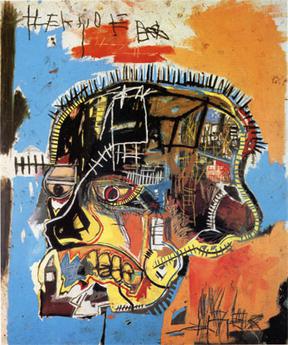
Untitled [Skull] acrylic and mixed media on canvas by Jean-Michel Basquiat, 1981


FILM REVIEW


A Critique of Jean-Michel Basquiat: The Radiant Child

By Chuleenan Svetvilas

Jean-Michel Basquiat: The Radiant Child is an insightful, humorous, and poignant tribute to a gifted artist who created a remarkable body of work before he died of a drug overdose in 1988 at the age of 27. Through numerous interviews as well as director Tamra Davis’s own footage of the artist, the documentary reveals a complex, enormously talented man who was misunderstood by many and rejected by the art cognoscenti during his lifetime. It’s the first film about Basquiat to provide a nuanced picture of the charismatic artist and to explore the challenges he faced as a black man in the white art world. It is a response to Basquiat, Julian Schnabel’s disappointing 1996 fiction feature film, which did not have the estate’s permission to use Basquiat’s paintings and thus used fake paintings, and to Phoebe Hoban’s infamous 1999 book, Basquiat: A Quick Killing in Art, which is more of a hit piece loaded with scurrilous gossip than a biography.

Davis was a film student in Los Angeles when she became friends with Basquiat during the last years of his life. During that time, she shot a fascinating interview with the artist as well as riveting scenes of the artist working in his California studio. Clips from her footage appear throughout the documentary alongside archival film and video, interviews with art dealers, collectors and critics as well as friends, former girl friends, artists and musicians, and of course, many images of Basquiat’s arresting artwork.

The documentary opens with the words of Langston Hughes’s famous poem “Genius Child”—white text appears on a stark black background. The poem’s refrain is a theme of the film: “Nobody loves a genius child.” Davis deliberately underlines the words “genius child,” telling viewers to pay attention to those words.

The film then offers a tantalizing glimpse of the interview with text explaining that it was filmed two years before his death and that the footage “has not been seen for over twenty years.” A sequence tightly edited to Dizzy Gillespie’s energetic bebop tune “Salt Peanuts” immediately follows: Basquiat dancing, painting, being playful, intercut with clips showing various paintings and the text for the opening credits, each quick cut punctuated by the blare of a horn or syncopated drumbeat. Basquiat’s favorite music was bebop. Words and images and music combine to create a collage portrait, an apt approach for an artist who frequently used words in his paintings and incorporated jazz artists in his work.

Music plays an integral part in the film. Davis chose music evocative of Basquiat’s personality, of his life during a particular period or of the year she was covering, for example, Grandmaster Flash and the Furious Five’s seminal song, “The Message,” takes you immediately back to 1982, the year it was released; John Lee Hooker singing the blues offers a soulful backdrop to a section showing Basquiat’s depiction of black people in his paintings, such as “The Irony of Negro Policeman” and “Jim Crow.”

The film follows a loose chronological structure, beginning in 1978, the year a teenage Basquiat ran away from his Brooklyn home for the final time and escaped to Manhattan, specifically downtown, where artists and musicians flourished and lived hand to mouth. Besides covering the growth of his career as an artist, starting with his early beginnings as the enigmatic graffiti artist SAMO the film also tries to give context to his work and its place in art history.

Davis makes it clear that Basquiat was well aware of the racism in the art world and the media, dismissing his work or portraying him as some sort of “wild child,” “primitive artist” or a “black Picasso” whose work was created by instinct. A startling clip shows the reactionary art critic Hilton Kramer condescendingly claiming that Basquiat’s “contribution to art is so miniscule as to be practically nil.”

Fortunately, Davis has footage of the artist that reveals his thoughts. “Most of my reviews have been more about me as a personality instead of my work,” says Basquiat in one interview. Then he’s asked, “How do you feel about that?” “It’s racist,” he replies. When he’s asked about the claim that he was locked in a basement to paint, Basquiat states, “I was never locked anywhere. If I was white, they would have said ‘artist in residence.’” Clealy, he was no naïf.

Swiss gallery owner Bruno Bishchofberger recalls a conversation with Basquiat in which the artist told him, “These look very sloppy but everything is done for a reason. It has to look like this. Nothing is by chance.”

A delightful sequence cleverly shows the vast range of influences on Basquiat’s work—showing a painting juxtaposed to the object or image that inspired the work: Batman and Robin; a photo of saxophonist Charlie Parker; the mask of Tezcatlipoca from the Aztec period, a sculpture from 19th century Zaire.

The documentary also explores Basquiat’s unique friendship with Andy Warhol, showing photos and footage of the pair together that reveal a genuinely warm and caring relationship. Unfortunately, they had a falling out after their collaboration on a series of paintings was panned by critics who dismissed Basquiat as a mere accessory to Warhol. Then Warhol died, which devastated Basquiat.

The film’s last part takes on a sober tone as people discuss his drug use and his difficulties working on what would be his last exhibit. Here the music shifts to somber classical music as people describe the work in that show, one painting repeatedly says “Man dies” all over the canvas, another one depicts a man riding a skeleton. Text on screen informs that Basquiat left more than 1,000 paintings and 1,000 drawings, and that his paintings have been auctioned at Sotheby’s for millions of dollars. These cold facts are meant to prove his significance as an artist but they are unnecessary. His work speaks for itself. The documentary closes with Fab 5 Freddy, a longtime friend of Basquiat, reciting the Langston Hughes poem introduced at the beginning of the film-- and which he initially read as a eulogy tribute at Basquiat's funeral in 1988 -- a moving ending to a compelling film.


Synopsis:

Jean-Michel Basquiat: The Radiant Child explores the rise and fall of the gifted artist who created more than 1,000 paintings and 1,000 drawings before he died of a drug overdose at the age of 27. This documentary uses music, interviews with friends, former girl friends, artists, musicians, art critics, collectors and gallery owners, archival footage, and images of the artist’s work to craft an intriguing and nuanced portrait.


Chuleenan Svetvilas is a writer and editor based in Berkeley, California.

Wednesday, September 8, 2010

The American Ruling Class, the Koch Brothers, the Tea Party, and the Right Wing War On Obama and the Rest of Us


David H. Koch in 1996. He and his brother Charles are lifelong libertarians and have quietly given more than a hundred million dollars to right-wing causes.


http://www.newyorker.com/reporting/2010/08/30/100830fa_fact_mayer?currentPage=all

All,

In a brilliant and exhaustively researched article the widely acclaimed investigative political journalist Jane Mayer-- who wrote the definitive book on the pervasive criminality, pathological lies, and massive corruption of the Bush Administration's heinous foreign policy agenda and its most venal and deadly architect Vice President Dick Cheney (The Dark Side: How the War on Terror Turned Into A War on American Ideals, Doubleday, 2008)-- has done it again with a scathing, fascinating, and extremely informative report on, and analysis of, the deeply disturbing role of two major reactionary members of the American Ruling Class in the public formation of domestic and foreign policy in the United States, Charles and David Koch, two billionaire brothers who also happen to be on the shortlist of the wealthiest people on the planet. What Mayer makes so painstakingly clear in this groundbreaking piece on the brothers Koch is just how truly insidious and dangerous this kind of highly centralized political and economic power is and how intricately connected the utterly symbiotic and welded-at-the-hip the twin doctrines of global monopoly capitalism and white supremacy actually are in the 21st century. Further this article goes a long way in demonstrating just how systematically well funded and ideologically aligned and controlled are the institutional webs of national right wing policy think tanks and their various reactionary intellectuals and theorists, "grassroots" social activists, and an endless number of seasoned political operatives, consultants, lobbyists, and "advisors" are fed by a huge network of foundations, "charities", and far right wing yet "mainstream" propaganda cultural and economic fronts like the Americans for Prosperity and the general Tea Party movement. In exposing just how integral and manipulative the well organized political, media, and ideological "war on Obama" really is and what it portends for both the immediate and long range future of American politics, society, and culture Mayer shows us precisely why and how the racist rightwing diabolical attack on the current Presidency is so deeply important to us all far beyond what happens to the "career" of an individual politician like Obama or the institutional fate of the Democratic Party or any other 'liberal' or even 'leftist' formation. What's truly at stake in the current attack led by the elitist wealthy corporate right (and their many clueless and overwhelmingly white American followers from the middle, working class, and poor sectors of the larger society) is nothing less than the very survival of any notion of mass "democracy" or "citizenship" in a very divided country openly flirting with the establishment of a highly vernacular version of U.S. fascism. The Koch brothers and their corporate and financial colleagues, ideological partners, and political acolytes are at the very epicenter of this development and contrary to often highly misinformed public opinion it is a very serious and horrific reality with real consequences for us all.

So Be Afraid. Be Very Afraid. But we must not be so afraid that we can't or won't fight back. That not only goes for the President and his administration-- however weak, inept, and misdirected it obviously is. But we can't and shouldn't lay it all off on them alone even if we lazily want to. Most importantly this goes for the rest of us as general citizens; after all we are and will remain the central target of this deadly war on Democracy in all of its manifestations--both foreign and domestic...Just ask the Koch Brothers...

Kofi


A REPORTER AT LARGE

COVERT OPERATIONS

The billionaire brothers who are waging a war against Obama.

by Jane Mayer
AUGUST 30, 2010
The New Yorker

On May 17th, a black-tie audience at the Metropolitan Opera House applauded as a tall, jovial-looking billionaire took the stage. It was the seventieth annual spring gala of American Ballet Theatre, and David H. Koch was being celebrated for his generosity as a member of the board of trustees; he had recently donated $2.5 million toward the company’s upcoming season, and had given many millions before that. Koch received an award while flanked by two of the gala’s co-chairs, Blaine Trump, in a peach-colored gown, and Caroline Kennedy Schlossberg, in emerald green. Kennedy’s mother, Jacqueline Kennedy Onassis, had been a patron of the ballet and, coincidentally, the previous owner of a Fifth Avenue apartment that Koch had bought, in 1995, and then sold, eleven years later, for thirty-two million dollars, having found it too small.

The gala marked the social ascent of Koch, who, at the age of seventy, has become one of the city’s most prominent philanthropists. In 2008, he donated a hundred million dollars to modernize Lincoln Center’s New York State Theatre building, which now bears his name. He has given twenty million to the American Museum of Natural History, whose dinosaur wing is named for him. This spring, after noticing the decrepit state of the fountains outside the Metropolitan Museum of Art, Koch pledged at least ten million dollars for their renovation. He is a trustee of the museum, perhaps the most coveted social prize in the city, and serves on the board of Memorial Sloan-Kettering Cancer Center, where, after he donated more than forty million dollars, an endowed chair and a research center were named for him.

One dignitary was conspicuously absent from the gala: the event’s third honorary co-chair, Michelle Obama. Her office said that a scheduling conflict had prevented her from attending. Yet had the First Lady shared the stage with Koch it might have created an awkward tableau. In Washington, Koch is best known as part of a family that has repeatedly funded stealth attacks on the federal government, and on the Obama Administration in particular.

With his brother Charles, who is seventy-four, David Koch owns virtually all of Koch Industries, a conglomerate, headquartered in Wichita, Kansas, whose annual revenues are estimated to be a hundred billion dollars. The company has grown spectacularly since their father, Fred, died, in 1967, and the brothers took charge. The Kochs operate oil refineries in Alaska, Texas, and Minnesota, and control some four thousand miles of pipeline. Koch Industries owns Brawny paper towels, Dixie cups, Georgia-Pacific lumber, Stainmaster carpet, and Lycra, among other products. Forbes ranks it as the second-largest private company in the country, after Cargill, and its consistent profitability has made David and Charles Koch—who, years ago, bought out two other brothers—among the richest men in America. Their combined fortune of thirty-five billion dollars is exceeded only by those of Bill Gates and Warren Buffett.

The Kochs are longtime libertarians who believe in drastically lower personal and corporate taxes, minimal social services for the needy, and much less oversight of industry—especially environmental regulation. These views dovetail with the brothers’ corporate interests. In a study released this spring, the University of Massachusetts at Amherst’s Political Economy Research Institute named Koch Industries one of the top ten air polluters in the United States. And Greenpeace issued a report identifying the company as a “kingpin of climate science denial.” The report showed that, from 2005 to 2008, the Kochs vastly outdid ExxonMobil in giving money to organizations fighting legislation related to climate change, underwriting a huge network of foundations, think tanks, and political front groups. Indeed, the brothers have funded opposition campaigns against so many Obama Administration policies—from health-care reform to the economic-stimulus program—that, in political circles, their ideological network is known as the Kochtopus.

In a statement, Koch Industries said that the Greenpeace report “distorts the environmental record of our companies.” And David Koch, in a recent, admiring article about him in New York, protested that the “radical press” had turned his family into “whipping boys,” and had exaggerated its influence on American politics. But Charles Lewis, the founder of the Center for Public Integrity, a nonpartisan watchdog group, said, “The Kochs are on a whole different level. There’s no one else who has spent this much money. The sheer dimension of it is what sets them apart. They have a pattern of lawbreaking, political manipulation, and obfuscation. I’ve been in Washington since Watergate, and I’ve never seen anything like it. They are the Standard Oil of our times.”

A few weeks after the Lincoln Center gala, the advocacy wing of the Americans for Prosperity Foundation—an organization that David Koch started, in 2004—held a different kind of gathering. Over the July 4th weekend, a summit called Texas Defending the American Dream took place in a chilly hotel ballroom in Austin. Though Koch freely promotes his philanthropic ventures, he did not attend the summit, and his name was not in evidence. And on this occasion the audience was roused not by a dance performance but by a series of speakers denouncing President Barack Obama. Peggy Venable, the organizer of the summit, warned that Administration officials “have a socialist vision for this country.”

Five hundred people attended the summit, which served, in part, as a training session for Tea Party activists in Texas. An advertisement cast the event as a populist uprising against vested corporate power. “Today, the voices of average Americans are being drowned out by lobbyists and special interests,” it said. “But you can do something about it.” The pitch made no mention of its corporate funders. The White House has expressed frustration that such sponsors have largely eluded public notice. David Axelrod, Obama’s senior adviser, said, “What they don’t say is that, in part, this is a grassroots citizens’ movement brought to you by a bunch of oil billionaires.”

In April, 2009, Melissa Cohlmia, a company spokesperson, denied that the Kochs had direct links to the Tea Party, saying that Americans for Prosperity is “an independent organization and Koch companies do not in any way direct their activities.” Later, she issued a statement: “No funding has been provided by Koch companies, the Koch foundations, or Charles Koch or David Koch specifically to support the tea parties.” David Koch told New York, “I’ve never been to a tea-party event. No one representing the tea party has ever even approached me.”

At the lectern in Austin, however, Venable—a longtime political operative who draws a salary from Americans for Prosperity, and who has worked for Koch-funded political groups since 1994—spoke less warily. “We love what the Tea Parties are doing, because that’s how we’re going to take back America!” she declared, as the crowd cheered. In a subsequent interview, she described herself as an early member of the movement, joking, “I was part of the Tea Party before it was cool!” She explained that the role of Americans for Prosperity was to help “educate” Tea Party activists on policy details, and to give them “next-step training” after their rallies, so that their political energy could be channelled “more effectively.” And she noted that Americans for Prosperity had provided Tea Party activists with lists of elected officials to target. She said of the Kochs, “They’re certainly our people. David’s the chairman of our board. I’ve certainly met with them, and I’m very appreciative of what they do.”

Venable honored several Tea Party “citizen leaders” at the summit. The Texas branch of Americans for Prosperity gave its Blogger of the Year Award to a young woman named Sibyl West. On June 14th, West, writing on her site, described Obama as the “cokehead in chief.” In an online thread, West speculated that the President was exhibiting symptoms of “demonic possession (aka schizophrenia, etc.).” The summit featured several paid speakers, including Janine Turner, the actress best known for her role on the television series “Northern Exposure.” She declared, “They don’t want our children to know about their rights. They don’t want our children to know about a God!”

During a catered lunch, Venable introduced Ted Cruz, a former solicitor general of Texas, who told the crowd that Obama was “the most radical President ever to occupy the Oval Office,” and had hidden from voters a secret agenda—“the government taking over our economy and our lives.” Countering Obama, Cruz proclaimed, was “the epic fight of our generation!” As the crowd rose to its feet and cheered, he quoted the defiant words of a Texan at the Alamo: “Victory, or death!”

Americans for Prosperity has worked closely with the Tea Party since the movement’s inception. In the weeks before the first Tax Day protests, in April, 2009, Americans for Prosperity hosted a Web site offering supporters “Tea Party Talking Points.” The Arizona branch urged people to send tea bags to Obama; the Missouri branch urged members to sign up for “Taxpayer Tea Party Registration” and provided directions to nine protests. The group continues to stoke the rebellion. The North Carolina branch recently launched a “Tea Party Finder” Web site, advertised as “a hub for all the Tea Parties in North Carolina.”

The anti-government fervor infusing the 2010 elections represents a political triumph for the Kochs. By giving money to “educate,” fund, and organize Tea Party protesters, they have helped turn their private agenda into a mass movement. Bruce Bartlett, a conservative economist and a historian, who once worked at the National Center for Policy Analysis, a Dallas-based think tank that the Kochs fund, said, “The problem with the whole libertarian movement is that it’s been all chiefs and no Indians. There haven’t been any actual people, like voters, who give a crap about it. So the problem for the Kochs has been trying to create a movement.” With the emergence of the Tea Party, he said, “everyone suddenly sees that for the first time there are Indians out there—people who can provide real ideological power.” The Kochs, he said, are “trying to shape and control and channel the populist uprising into their own policies.”

A Republican campaign consultant who has done research on behalf of Charles and David Koch said of the Tea Party, “The Koch brothers gave the money that founded it. It’s like they put the seeds in the ground. Then the rainstorm comes, and the frogs come out of the mud—and they’re our candidates!”

The Kochs and their political operatives declined requests for interviews. Instead, a prominent New York public-relations executive who is close with the Kochs put forward two friends: George Pataki, the former governor of New York, and Mortimer Zuckerman, the publisher and real-estate magnate. Pataki, a Republican who received campaign donations from David Koch, called him “a patriot who cares deeply about his country.” Zuckerman praised David’s “gentle decency” and the “range of his public interests.”

The Republican campaign consultant said of the family’s political activities, “To call them under the radar is an understatement. They are underground!” Another former Koch adviser said, “They’re smart. This right-wing, redneck stuff works for them. They see this as a way to get things done without getting dirty themselves.” Rob Stein, a Democratic political strategist who has studied the conservative movement’s finances, said that the Kochs are “at the epicenter of the anti-Obama movement. But it’s not just about Obama. They would have done the same to Hillary Clinton. They did the same with Bill Clinton. They are out to destroy progressivism.”

Oddly enough, the fiercely capitalist Koch family owes part of its fortune to Joseph Stalin. Fred Koch was the son of a Dutch printer who settled in Texas and ran a weekly newspaper. Fred attended M.I.T., where he earned a degree in chemical engineering. In 1927, he invented a more efficient process for converting oil into gasoline, but, according to family lore, America’s major oil companies regarded him as a threat and shut him out of the industry. Unable to succeed at home, Koch found work in the Soviet Union. In the nineteen-thirties, his company trained Bolshevik engineers and helped Stalin’s regime set up fifteen modern oil refineries. Over time, however, Stalin brutally purged several of Koch’s Soviet colleagues. Koch was deeply affected by the experience, and regretted his collaboration. He returned to the U.S. In the headquarters of his company, Rock Island Oil & Refining, in Wichita, he kept photographs aimed at proving that some of those Soviet refineries had been destroyed in the Second World War. Gus diZerega, a former friend of Charles Koch, recalled, “As the Soviets became a stronger military power, Fred felt a certain amount of guilt at having helped build them up. I think it bothered him a lot.”

In 1958, Fred Koch became one of the original members of the John Birch Society, the arch-conservative group known, in part, for a highly skeptical view of governance and for spreading fears of a Communist takeover. Members considered President Dwight D. Eisenhower to be a Communist agent. In a self-published broadside, Koch claimed that “the Communists have infiltrated both the Democrat and Republican Parties.” He wrote admiringly of Benito Mussolini’s suppression of Communists in Italy, and disparagingly of the American civil-rights movement. “The colored man looms large in the Communist plan to take over America,” he warned. Welfare was a secret plot to attract rural blacks to cities, where they would foment “a vicious race war.” In a 1963 speech that prefigures the Tea Party’s talk of a secret socialist plot, Koch predicted that Communists would “infiltrate the highest offices of government in the U.S. until the President is a Communist, unknown to the rest of us.”

Koch married Mary Robinson, the daughter of a Missouri physician, and they had four sons: Freddie, Charles, and twins, David and William. John Damgard, the president of the Futures Industry Association, was David’s schoolmate and friend. He recalled that Fred Koch was “a real John Wayne type.” Koch emphasized rugged pursuits, taking his sons big-game hunting in Africa, and requiring them to do farm labor at the family ranch. The Kochs lived in a stone mansion on a large compound across from Wichita’s country club; in the summer, the boys could hear their friends splashing in the pool, but they were not allowed to join them. “By instilling a work ethic in me at an early age, my father did me a big favor, although it didn’t seem like a favor back then,” Charles has written. “By the time I was eight, he made sure work occupied most of my spare time.” David Koch recalled that his father also indoctrinated the boys politically. “He was constantly speaking to us children about what was wrong with government,” he told Brian Doherty, an editor of the libertarian magazine Reason, and the author of “Radicals for Capitalism,” a 2007 history of the libertarian movement. “It’s something I grew up with—a fundamental point of view that big government was bad, and imposition of government controls on our lives and economic fortunes was not good.”

David attended Deerfield Academy, in Massachusetts, and Charles was sent to military school. Charles, David, and William all earned engineering degrees at their father’s alma mater, M.I.T., and later joined the family company. Charles eventually assumed control, with David as his deputy; William’s career at the company was less successful. Freddie went to Harvard and studied playwriting at the Yale School of Drama. His father reportedly disapproved of him, and punished him financially. (Freddie, through a spokesperson, denied this.)

In 1967, after Fred Koch died, of a heart attack, Charles renamed the business Koch Industries, in honor of his father. Fred Koch’s will made his sons extraordinarily wealthy. David Koch joked about his good fortune in a 2003 speech to alumni at Deerfield, where, after pledging twenty-five million dollars, he was made the school’s sole “lifetime trustee.” He said, “You might ask: How does David Koch happen to have the wealth to be so generous? Well, let me tell you a story. It all started when I was a little boy. One day, my father gave me an apple. I soon sold it for five dollars and bought two apples and sold them for ten. Then I bought four apples and sold them for twenty. Well, this went on day after day, week after week, month after month, year after year, until my father died and left me three hundred million dollars!”

David and Charles had absorbed their father’s conservative politics, but they did not share all his views, according to diZerega, who befriended Charles in the mid-sixties, after meeting him while browsing in a John Birch Society bookstore in Wichita. Charles eventually invited him to the Kochs’ mansion, to participate in an informal political-discussion group. “It was pretty clear that Charles thought some of the Birch Society was bullshit,” diZerega recalled.

DiZerega, who has lost touch with Charles, eventually abandoned right-wing views, and became a political-science professor. He credits Charles with opening his mind to political philosophy, which set him on the path to academia; Charles is one of three people to whom he dedicated his first book. But diZerega believes that the Koch brothers have followed a wayward intellectual trajectory, transferring their father’s paranoia about Soviet Communism to a distrust of the U.S. government, and seeing its expansion, beginning with the New Deal, as a tyrannical threat to freedom. In an essay, posted on Beliefnet, diZerega writes, “As state socialism failed . . . the target for many within these organizations shifted to any kind of regulation at all. ‘Socialism’ kept being defined downwards.”

Members of the John Birch Society developed an interest in a school of Austrian economists who promoted free-market ideals. Charles and David Koch were particularly influenced by the work of Friedrich von Hayek, the author of “The Road to Serfdom” (1944), which argued that centralized government planning led, inexorably, to totalitarianism. Hayek’s belief in unfettered capitalism has proved inspirational to many conservatives, and to anti-Soviet dissidents; lately, Tea Party supporters have championed his work. In June, the talk-radio host Glenn Beck, who has supported the Tea Party rebellion, promoted “The Road to Serfdom” on his show; the paperback soon became a No. 1 best-seller on Amazon. (Beck appears to be a fan of the Kochs; in the midst of a recent on-air parody of Al Gore, Beck said, without explanation, “I want to thank Charles Koch for this information.” Beck declined to elaborate on the relationship.)

Charles and David also became devotees of a more radical thinker, Robert LeFevre, who favored the abolition of the state but didn’t like the label “anarchist”; he called himself an “autarchist.” LeFevre liked to say that “government is a disease masquerading as its own cure.” In 1956, he opened an institution called the Freedom School, in Colorado Springs. Brian Doherty, of Reason, told me that “LeFevre was an anarchist figure who won Charles’s heart,” and that the school was “a tiny world of people who thought the New Deal was a horrible mistake.” According to diZerega, Charles supported the school financially, and even gave him money to take classes there.

Throughout the seventies, Charles and David continued to build Koch Industries. In 1980, William, with assistance from Freddie, attempted to take over the company from Charles, who, they felt, had assumed autocratic control. In retaliation, the company’s board, which answered to Charles, fired William. (“Charles runs it all with an iron hand,” Bruce Bartlett, the economist, told me.) Lawsuits were filed, with William and Freddie on one side and Charles and David on the other. In 1983, Charles and David bought out their brothers’ share in the company for nearly a billion dollars. But the antagonism remained, and litigation continued for seventeen more years, with the brothers hiring rival private investigators; in 1990, they walked past one another with stony expressions at their mother’s funeral. Eventually, Freddie moved to Monaco, which has no income tax. He bought historic estates in France, Austria, and elsewhere, filling them with art, antiques, opera scores, and literary manuscripts. William founded his own energy company, Oxbow, and turned to yachting; he spent an estimated sixty-five million dollars to win the America’s Cup, in 1992.

With Charles as the undisputed chairman and C.E.O., Koch Industries expanded rapidly. Roger Altman, who heads the investment-banking firm Evercore, told me that the company’s performance has been “beyond phenomenal.” Charles remained in Wichita, with his wife and two children, guarding his privacy while supporting community charities. David moved to New York City, where he is an executive vice-president of the company and the C.E.O. of its Chemical Technology Group. A financial expert who knows Koch Industries well told me, “Charles is the company. Charles runs it.” David, described by associates as “affable” and “a bit of a lunk,” enjoyed for years the life of a wealthy bachelor. He rented a yacht in the South of France and bought a waterfront home in Southampton, where he threw parties that the Web site New York Social Diary likened to an “East Coast version of Hugh Hefner’s soirées.” In 1996, he married Julia Flesher, a fashion assistant. They live in a nine-thousand-square-foot duplex at 740 Park Avenue, with their three children. Though David’s manner is more cosmopolitan, and more genial, than that of Charles, Brian Doherty, who has interviewed both brothers, couldn’t think of a single issue on which the brothers disagreed.

As their fortunes grew, Charles and David Koch became the primary underwriters of hard-line libertarian politics in America. Charles’s goal, as Doherty described it, was to tear the government “out at the root.” The brothers’ first major public step came in 1979, when Charles persuaded David, then thirty-nine, to run for public office. They had become supporters of the Libertarian Party, and were backing its Presidential candidate, Ed Clark, who was running against Ronald Reagan from the right. Frustrated by the legal limits on campaign donations, they contrived to place David on the ticket, in the Vice-Presidential slot; upon becoming a candidate, he could lavish as much of his personal fortune as he wished on the campaign. The ticket’s slogan was “The Libertarian Party has only one source of funds: You.” In fact, its primary source of funds was David Koch, who spent more than two million dollars on the effort.

Many of the ideas propounded in the 1980 campaign presaged the Tea Party movement. Ed Clark told The Nation that libertarians were getting ready to stage “a very big tea party,” because people were “sick to death” of taxes. The Libertarian Party platform called for the abolition of the F.B.I. and the C.I.A., as well as of federal regulatory agencies, such as the Securities and Exchange Commission and the Department of Energy. The Party wanted to end Social Security, minimum-wage laws, gun control, and all personal and corporate income taxes; it proposed the legalization of prostitution, recreational drugs, and suicide. Government should be reduced to only one function: the protection of individual rights. William F. Buckley, Jr., a more traditional conservative, called the movement “Anarcho-Totalitarianism.”

That November, the Libertarian ticket received only one per cent of the vote. The brothers realized that their brand of politics didn’t sell at the ballot box. Charles Koch became openly scornful of conventional politics. “It tends to be a nasty, corrupting business,” he told a reporter at the time. “I’m interested in advancing libertarian ideas.” According to Doherty’s book, the Kochs came to regard elected politicians as merely “actors playing out a script.” A longtime confidant of the Kochs told Doherty that the brothers wanted to “supply the themes and words for the scripts.” In order to alter the direction of America, they had to “influence the areas where policy ideas percolate from: academia and think tanks.”

After the 1980 election, Charles and David Koch receded from the public arena. But they poured more than a hundred million dollars into dozens of seemingly independent organizations. Tax records indicate that in 2008 the three main Koch family foundations gave money to thirty-four political and policy organizations, three of which they founded, and several of which they direct. The Kochs and their company have given additional millions to political campaigns, advocacy groups, and lobbyists. The family’s subterranean financial role has fuelled suspicion on the left; Lee Fang, of the liberal blog ThinkProgress, has called the Kochs “the billionaires behind the hate.”

Only the Kochs know precisely how much they have spent on politics. Public tax records show that between 1998 and 2008 the Charles G. Koch Charitable Foundation spent more than forty-eight million dollars. The Claude R. Lambe Charitable Foundation, which is controlled by Charles Koch and his wife, along with two company employees and an accountant, spent more than twenty-eight million. The David H. Koch Charitable Foundation spent more than a hundred and twenty million. Meanwhile, since 1998 Koch Industries has spent more than fifty million dollars on lobbying. Separately, the company’s political-action committee, KochPAC, has donated some eight million dollars to political campaigns, more than eighty per cent of it to Republicans. So far in 2010, Koch Industries leads all other energy companies in political contributions, as it has since 2006. In addition, during the past dozen years the Kochs and other family members have personally spent more than two million dollars on political contributions. In the second quarter of 2010, David Koch was the biggest individual contributor to the Republican Governors Association, with a million-dollar donation. Other gifts by the Kochs may be untraceable; federal tax law permits anonymous personal donations to politically active nonprofit groups.

In recent decades, members of several industrial dynasties have spent parts of their fortunes on a conservative agenda. In the nineteen-eighties, the Olin family, which owns a chemicals-and-manufacturing conglomerate, became known for funding right-leaning thinking in academia, particularly in law schools. And during the nineties Richard Mellon Scaife, a descendant of Andrew Mellon, spent millions attempting to discredit President Bill Clinton. Ari Rabin-Havt, a vice-president at the Democratic-leaning Web site Media Matters, said that the Kochs’ effort is unusual, in its marshalling of corporate and personal funds: “Their role, in terms of financial commitments, is staggering.”

Of course, Democrats give money, too. Their most prominent donor, the financier George Soros, runs a foundation, the Open Society Institute, that has spent as much as a hundred million dollars a year in America. Soros has also made generous private contributions to various Democratic campaigns, including Obama’s. But Michael Vachon, his spokesman, argued that Soros’s giving is transparent, and that “none of his contributions are in the service of his own economic interests.” The Kochs have given millions of dollars to nonprofit groups that criticize environmental regulation and support lower taxes for industry. Gus diZerega, the former friend, suggested that the Kochs’ youthful idealism about libertarianism had largely devolved into a rationale for corporate self-interest. He said of Charles, “Perhaps he has confused making money with freedom.”

Some critics have suggested that the Kochs’ approach has subverted the purpose of tax-exempt giving. By law, charitable foundations must conduct exclusively nonpartisan activities that promote the public welfare. A 2004 report by the National Committee for Responsive Philanthropy, a watchdog group, described the Kochs’ foundations as being self-serving, concluding, “These foundations give money to nonprofit organizations that do research and advocacy on issues that impact the profit margin of Koch Industries.”

The Kochs have gone well beyond their immediate self-interest, however, funding organizations that aim to push the country in a libertarian direction. Among the institutions that they have subsidized are the Institute for Justice, which files lawsuits opposing state and federal regulations; the Institute for Humane Studies, which underwrites libertarian academics; and the Bill of Rights Institute, which promotes a conservative slant on the Constitution. Many of the organizations funded by the Kochs employ specialists who write position papers that are subsequently quoted by politicians and pundits. David Koch has acknowledged that the family exerts tight ideological control. “If we’re going to give a lot of money, we’ll make darn sure they spend it in a way that goes along with our intent,” he told Doherty. “And if they make a wrong turn and start doing things we don’t agree with, we withdraw funding.”

The Kochs’ subsidization of a pro-corporate movement fulfills, in many ways, the vision laid out in a secret 1971 memo that Lewis Powell, then a Virginia attorney, wrote two months before he was nominated to the Supreme Court. The antiwar movement had turned its anger on defense contractors, such as Dow Chemical, and Ralph Nader was leading a public-interest crusade against corporations. Powell, writing a report for the U.S. Chamber of Commerce, urged American companies to fight back. The greatest threat to free enterprise, he warned, was not Communism or the New Left but, rather, “respectable elements of society”—intellectuals, journalists, and scientists. To defeat them, he wrote, business leaders needed to wage a long-term, unified campaign to change public opinion.

Charles Koch seems to have approached both business and politics with the deliberation of an engineer. “To bring about social change,” he told Doherty, requires “a strategy” that is “vertically and horizontally integrated,” spanning “from idea creation to policy development to education to grassroots organizations to lobbying to litigation to political action.” The project, he admitted, was extremely ambitious. “We have a radical philosophy,” he said.

In 1977, the Kochs provided the funds to launch the nation’s first libertarian think tank, the Cato Institute. According to the Center for Public Integrity, between 1986 and 1993 the Koch family gave eleven million dollars to the institute. Today, Cato has more than a hundred full-time employees, and its experts and policy papers are widely quoted and respected by the mainstream media. It describes itself as nonpartisan, and its scholars have at times been critical of both parties. But it has consistently pushed for corporate tax cuts, reductions in social services, and laissez-faire environmental policies.

When President Obama, in a 2008 speech, described the science on global warming as “beyond dispute,” the Cato Institute took out a full-page ad in the Times to contradict him. Cato’s resident scholars have relentlessly criticized political attempts to stop global warming as expensive, ineffective, and unnecessary. Ed Crane, the Cato Institute’s founder and president, told me that “global-warming theories give the government more control of the economy.”

Cato scholars have been particularly energetic in promoting the Climategate scandal. Last year, private e-mails of climate scientists at the University of East Anglia, in England, were mysteriously leaked, and their exchanges appeared to suggest a willingness to falsify data in order to buttress the idea that global warming is real. In the two weeks after the e-mails went public, one Cato scholar gave more than twenty media interviews trumpeting the alleged scandal. But five independent inquiries have since exonerated the researchers, and nothing was found in their e-mails or data to discredit the scientific consensus on global warming.

Nevertheless, the controversy succeeded in spreading skepticism about climate change. Even though the National Oceanic and Atmospheric Administration recently issued a report concluding that the evidence for global warming is unequivocal, more Americans are convinced than at any time since 1997 that scientists have exaggerated the seriousness of global warming. The Kochs promote this statistic on their company’s Web site but do not mention the role that their funding has played in fostering such doubt.

In a 2002 memo, the Republican political consultant Frank Luntz wrote that so long as “voters believe there is no consensus about global warming within the scientific community” the status quo would prevail. The key for opponents of environmental reform, he said, was to question the science—a public-relations strategy that the tobacco industry used effectively for years to forestall regulation. The Kochs have funded many sources of environmental skepticism, such as the Heritage Foundation, which has argued that “scientific facts gathered in the past 10 years do not support the notion of catastrophic human-made warming.” The brothers have given money to more obscure groups, too, such as the Independent Women’s Forum, which opposes the presentation of global warming as a scientific fact in American public schools. Until 2008, the group was run by Nancy Pfotenhauer, a former lobbyist for Koch Industries. Mary Beth Jarvis, a vice-president of a Koch subsidiary, is on the group’s board.

Naomi Oreskes, a professor of history and science studies at the University of California, San Diego, is the co-author of “Merchants of Doubt,” a new book that chronicles various attempts by American industry to manipulate public opinion on science. She noted that the Kochs, as the heads of “a company with refineries and pipelines,” have “a lot at stake.” She added, “If the answer is to phase out fossil fuels, a different group of people are going to be making money, so we shouldn’t be surprised that they’re fighting tooth and nail.”

David Koch told New York that he was unconvinced that global warming has been caused by human activity. Even if it has been, he said, the heating of the planet will be beneficial, resulting in longer growing seasons in the Northern Hemisphere. “The Earth will be able to support enormously more people because far greater land area will be available to produce food,” he said.
In the mid-eighties, the Kochs provided millions of dollars to George Mason University, in Arlington, Virginia, to set up another think tank. Now known as the Mercatus Center, it promotes itself as “the world’s premier university source for market-oriented ideas—bridging the gap between academic ideas and real-world problems.” Financial records show that the Koch family foundations have contributed more than thirty million dollars to George Mason, much of which has gone to the Mercatus Center, a nonprofit organization. “It’s ground zero for deregulation policy in Washington,” Rob Stein, the Democratic strategist, said. It is an unusual arrangement. “George Mason is a public university, and receives public funds,” Stein noted. “Virginia is hosting an institution that the Kochs practically control.”

The founder of the Mercatus Center is Richard Fink, formerly an economist. Fink heads Koch Industries’ lobbying operation in Washington. In addition, he is the president of the Charles G. Koch Charitable Foundation, the president of the Claude R. Lambe Charitable Foundation, a director of the Fred C. and Mary R. Koch Foundation, and a director and co-founder, with David Koch, of the Americans for Prosperity Foundation.

Fink, with his many titles, has become the central nervous system of the Kochtopus. He appears to have supplanted Ed Crane, the head of the Cato Institute, as the brothers’ main political lieutenant. Though David remains on the board at Cato, Charles Koch has fallen out with Crane. Associates suggested to me that Crane had been insufficiently respectful of Charles’s management philosophy, which he distilled into a book called “The Science of Success,” and trademarked under the name Market-Based Management, or M.B.M. In the book, Charles recommends instilling a company’s corporate culture with the competitiveness of the marketplace. Koch describes M.B.M. as a “holistic system” containing “five dimensions: vision, virtue and talents, knowledge processes, decision rights and incentives.” A top Cato Institute official told me that Charles “thinks he’s a genius. He’s the emperor, and he’s convinced he’s wearing clothes.” Fink, by contrast, has been far more embracing of Charles’s ideas. (Fink, like the Kochs, declined to be interviewed.)

At a 1995 conference for philanthropists, Fink adopted the language of economics when speaking about the Mercatus Center’s purpose. He said that grant-makers should use think tanks and political-action groups to convert intellectual raw materials into policy “products.”

The Wall Street Journal has called the Mercatus Center “the most important think tank you’ve never heard of,” and noted that fourteen of the twenty-three regulations that President George W. Bush placed on a “hit list” had been suggested first by Mercatus scholars. Fink told the paper that the Kochs have “other means of fighting [their] battles,” and that the Mercatus Center does not actively promote the company’s private interests. But Thomas McGarity, a law professor at the University of Texas, who specializes in environmental issues, told me that “Koch has been constantly in trouble with the E.P.A., and Mercatus has constantly hammered on the agency.” An environmental lawyer who has clashed with the Mercatus Center called it “a means of laundering economic aims.” The lawyer explained the strategy: “You take corporate money and give it to a neutral-sounding think tank,” which “hires people with pedigrees and academic degrees who put out credible-seeming studies. But they all coincide perfectly with the economic interests of their funders.”

In 1997, for instance, the E.P.A. moved to reduce surface ozone, a form of pollution caused, in part, by emissions from oil refineries. Susan Dudley, an economist who became a top official at the Mercatus Center, criticized the proposed rule. The E.P.A., she argued, had not taken into account that smog-free skies would result in more cases of skin cancer. She projected that if pollution were controlled it would cause up to eleven thousand additional cases of skin cancer each year.

In 1999, the District of Columbia Circuit Court took up Dudley’s smog argument. Evaluating the E.P.A. rule, the court found that the E.P.A. had “explicitly disregarded” the “possible health benefits of ozone.” In another part of the opinion, the court ruled, 2-1, that the E.P.A. had overstepped its authority in calibrating standards for ozone emissions. As the Constitutional Accountability Center, a think tank, revealed, the judges in the majority had previously attended legal junkets, on a Montana ranch, that were arranged by the Foundation for Research on Economics and the Environment—a group funded by Koch family foundations. The judges have claimed that the ruling was unaffected by their attendance.
“Ideas don’t happen on their own,” Matt Kibbe, the president of FreedomWorks, a Tea Party advocacy group, told me. “Throughout history, ideas need patrons.” The Koch brothers, after helping to create Cato and Mercatus, concluded that think tanks alone were not enough to effect change. They needed a mechanism to deliver those ideas to the street, and to attract the public’s support. In 1984, David Koch and Richard Fink created yet another organization, and Kibbe joined them. The group, Citizens for a Sound Economy, seemed like a grassroots movement, but according to the Center for Public Integrity it was sponsored principally by the Kochs, who provided $7.9 million between 1986 and 1993. Its mission, Kibbe said, “was to take these heavy ideas and translate them for mass America. . . . We read the same literature Obama did about nonviolent revolutions—Saul Alinsky, Gandhi, Martin Luther King. We studied the idea of the Boston Tea Party as an example of nonviolent social change. We learned we needed boots on the ground to sell ideas, not candidates.” Within a few years, the group had mobilized fifty paid field workers, in twenty-six states, to rally voters behind the Kochs’ agenda. David and Charles, according to one participant, were “very controlling, very top down. You can’t build an organization with them. They run it.”
Around this time, the brothers faced a political crisis. In 1989, the Senate Select Committee on Indian Affairs investigated their business and released a scathing report accusing Koch Oil of “a widespread and sophisticated scheme to steal crude oil from Indians and others through fraudulent mismeasuring.” The Kochs admitted that they had improperly taken thirty-one million dollars’ worth of crude oil, but said that it had been accidental. Charles Koch told committee investigators that oil measurement is “a very uncertain art.”
To defend its reputation, Koch Industries hired Robert Strauss, then a premier Washington lobbyist; the company soon opened an office in the city. A grand jury was convened to investigate the allegations, but it eventually disbanded, without issuing criminal charges. According to the Senate report, after the committee hearings Koch operatives delved into the personal lives of committee staffers, even questioning an ex-wife. Senate investigators were upset by the Kochs’ tactics. Kenneth Ballen, the counsel to the Senate committee, said, “These people have amassed such unaccountable power!”

By 1993, when Bill Clinton became President, Citizens for a Sound Economy had become a prototype for the kind of corporate-backed opposition campaigns that have proliferated during the Obama era. The group waged a successful assault on Clinton’s proposed B.T.U. tax on energy, for instance, running advertisements, staging media events, and targeting opponents. And it mobilized anti-tax rallies outside the Capitol—rallies that NPR described as “designed to strike fear into the hearts of wavering Democrats.” Dan Glickman, a former Democratic congressman from Wichita, who supported the B.T.U. tax, recalled, “I’d been in Congress eighteen years. The Kochs actually engaged against me and funded my opponent. They used a lot of resources and effort—their employees, too.” Glickman suffered a surprise defeat. “I can’t prove it, but I think I was probably their victim,” he said.

The Kochs continued to disperse their money, creating slippery organizations with generic-sounding names, and this made it difficult to ascertain the extent of their influence in Washington. In 1990, Citizens for a Sound Economy created a spinoff group, Citizens for the Environment, which called acid rain and other environmental problems “myths.” When the Pittsburgh Post-Gazette investigated the matter, it discovered that the spinoff group had “no citizen membership of its own.”

In 1997, another Senate investigation began looking into what a minority report called “an audacious plan to pour millions of dollars in contributions into Republican campaigns nationwide without disclosing the amount or source,” in order to evade campaign-finance laws. A shell corporation, Triad Management, had paid more than three million dollars for attack ads in twenty-six House races and three Senate races. More than half of the advertising money came from an obscure nonprofit group, the Economic Education Trust. The Senate committee’s minority report suggested that “the trust was financed in whole or in part by Charles and David Koch of Wichita, Kansas.” The brothers were suspected of having secretly paid for the attack ads, most of which aired in states where Koch Industries did business. In Kansas, where Triad Management was especially active, the funds may have played a decisive role in four of six federal races. The Kochs, when asked by reporters if they had given the money, refused to comment. In 1998, however, the Wall Street Journal confirmed that a consultant on the Kochs’ payroll had been involved in the scheme. Charles Lewis, of the Center for Public Integrity, described the scandal as “historic. Triad was the first time a major corporation used a cutout”—a front operation—“in a threatening way. Koch Industries was the poster child of a company run amok.”

During the Clinton Administration, the energy industry faced increased scrutiny and regulation. In the mid-nineties, the Justice Department filed two lawsuits against Koch Industries, claiming that it was responsible for more than three hundred oil spills, which had released an estimated three million gallons of oil into lakes and rivers. The penalty was potentially as high as two hundred and fourteen million dollars. In a settlement, Koch Industries paid a record thirty-million-dollar civil fine, and agreed to spend five million dollars on environmental projects.

In 1999, a jury found Koch Industries guilty of negligence and malice in the deaths of two Texas teen-agers in an explosion that resulted from a leaky underground butane pipeline. (In 2001, the company paid an undisclosed settlement.) And in the final months of the Clinton Presidency the Justice Department levelled a ninety-seven-count indictment against the company, for covering up the discharge of ninety-one tons of benzene, a carcinogen, from its refinery in Corpus Christi, Texas. The company was liable for three hundred and fifty million dollars in fines, and four Koch employees faced up to thirty-five years in prison. The Koch Petroleum Group eventually pleaded guilty to one criminal charge of covering up environmental violations, including the falsification of documents, and paid a twenty-million-dollar fine. David Uhlmann, a career prosecutor who, at the time, headed the environmental-crimes section at the Justice Department, described the suit as “one of the most significant cases ever brought under the Clean Air Act.” He added, “Environmental crimes are almost always motivated by economics and arrogance, and in the Koch case there was a healthy dose of both.”

During the 2000 election campaign, Koch Industries spent some nine hundred thousand dollars to support the candidacies of George W. Bush and other Republicans. During the Bush years, Koch Industries and other fossil-fuel companies enjoyed remarkable prosperity. The 2005 energy bill, which Hillary Clinton dubbed the Dick Cheney Lobbyist Energy Bill, offered enormous subsidies and tax breaks for energy companies. The Kochs have cast themselves as deficit hawks, but, according to a study by Media Matters, their companies have benefitted from nearly a hundred million dollars in government contracts since 2000.

In 2004, Citizens for a Sound Economy was accused of illegitimately throwing its weight behind Bush’s reëlection. The group’s Oregon branch had attempted to get Ralph Nader on the Presidential ballot, in order to dilute Democratic support for John Kerry. Critics argued that it was illegal for a tax-exempt nonprofit organization to donate its services for partisan political purposes. (A complaint was filed with the Federal Election Commission; it was dismissed.)

That year, internal rivalries at Citizens for a Sound Economy caused the organization to split apart. David Koch and Fink started a new group, Americans for Prosperity, and they hired Tim Phillips to run it. Phillips was a political veteran who had worked with Ralph Reed, the evangelical leader and Republican activist, co-founding Century Strategies, a campaign-consulting company that became notorious for its ties to the disgraced lobbyist Jack Abramoff. Phillips’s online biography describes him as an expert in “grasstops” and “grassroots” political organizing. The Kochs’ choice of Phillips signalled an even greater toughness. The conservative operative Grover Norquist, who is known for praising “throat slitters” in politics, called Phillips “a grownup who can make things happen.”

Last year, Phillips told the Financial Times that Americans for Prosperity had only eight thousand registered members. Currently, its Web site claims that the group has “1.2 million activists.” Whatever its size, the Kochs’ political involvement has been intense; a former employee of the Cato Institute told me that Americans for Prosperity “was micromanaged by the Kochs.” And the brothers’ investment may well have paid off: Americans for Prosperity, in concert with the family’s other organizations, has been instrumental in disrupting the Obama Presidency.

In January, 2008, Charles Koch wrote in his company newsletter that America could be on the verge of “the greatest loss of liberty and prosperity since the 1930s.” That October, Americans for Prosperity held a conference of conservative operatives at a Marriott hotel outside Washington. Erick Erickson, the editor-in-chief of the conservative blog RedState.com, took the lectern, thanked David Koch, and vowed to “unite and fight . . . the armies of the left!” Soon after Obama assumed office, Americans for Prosperity launched “Porkulus” rallies against Obama’s stimulus-spending measures. Then the Mercatus Center released a report claiming that stimulus funds had been directed disproportionately toward Democratic districts; eventually, the author was forced to correct the report, but not before Rush Limbaugh, citing the paper, had labelled Obama’s program “a slush fund,” and Fox News and other conservative outlets had echoed the sentiment. (Phil Kerpen, the vice-president for policy at Americans for Prosperity, is a contributor to the Fox News Web site. Another officer at Americans for Prosperity, Walter Williams, often guest-hosts for Limbaugh.)

Americans for Prosperity also created an offshoot, Patients United Now, which organized what Phillips has estimated to be more than three hundred rallies against health-care reform. At one rally, an effigy of a Democratic congressman was hung; at another, protesters unfurled a banner depicting corpses from Dachau. The group also helped organize the “Kill the Bill” protests outside the Capitol, in March, where Democratic supporters of health-care reform alleged that they were spat on and cursed at. Phillips was a featured speaker.

Americans for Prosperity has held at least eighty events targeting cap-and-trade legislation, which is aimed at making industries pay for the air pollution that they create. Speakers for the group claimed, with exaggeration, that even back-yard barbecues and kitchen stoves would be taxed. The group was also involved in the attacks on Obama’s “green jobs” czar, Van Jones, and waged a crusade against international climate talks. Casting his group as a champion of ordinary workers who would be hurt by environmentalists, Phillips went to Copenhagen last year and staged a protest outside the United Nations conference on climate change, declaring, “We’re a grassroots organization. . . . I think it’s unfortunate when wealthy children of wealthy families . . . want to send unemployment rates in the United States up to twenty per cent.”

Grover Norquist, who holds a weekly meeting for conservative leaders in Washington, including representatives from Americans for Prosperity, told me that last summer’s raucous rallies were pivotal in undermining Obama’s agenda. The Republican leadership in Congress, he said, “couldn’t have done it without August, when people went out on the streets. It discouraged deal-makers”—Republicans who might otherwise have worked constructively with Obama. Moreover, the appearance of growing public opposition to Obama affected corporate donors on K Street. “K Street is a three-billion-dollar weathervane,” Norquist said. “When Obama was strong, the Chamber of Commerce said, ‘We can work with the Obama Administration.’ But that changed when thousands of people went into the street and ‘terrorized’ congressmen. August is what changed it. Now that Obama is weak, people are getting tough.”

As the first anniversary of Obama’s election approached, David Koch came to the Washington area to attend a triumphant Americans for Prosperity gathering. Obama’s poll numbers were falling fast. Not a single Republican senator was working with the Administration on health care, or much else. Pundits were writing about Obama’s political ineptitude, and Tea Party groups were accusing the President of initiating “a government takeover.” In a speech, Koch said, “Days like today bring to reality the vision of our board of directors when we started this organization, five years ago.” He went on, “We envisioned a mass movement, a state-based one, but national in scope, of hundreds of thousands of American citizens from all walks of life standing up and fighting for the economic freedoms that made our nation the most prosperous society in history. . . . Thankfully, the stirrings from California to Virginia, and from Texas to Michigan, show that more and more of our fellow-citizens are beginning to see the same truths as we do.”

While Koch didn’t explicitly embrace the Tea Party movement that day, more recently he has come close to doing so, praising it for demonstrating the “powerful visceral hostility in the body politic against the massive increase in government power, the massive efforts to socialize this country.” Charles Koch, in a newsletter sent to his seventy thousand employees, compared the Obama Administration to the regime of the Venezuelan strongman Hugo Chávez. The Kochs’ sense of imperilment is somewhat puzzling. Income inequality in America is greater than it has been since the nineteen-twenties, and since the seventies the tax rates of the wealthiest have fallen more than those of the middle class. Yet the brothers’ message has evidently resonated with voters: a recent poll found that fifty-five per cent of Americans agreed that Obama is a socialist.

Americans for Prosperity, meanwhile, has announced that it will spend an additional forty-five million dollars before the midterm elections, in November. Although the group is legally prohibited from directly endorsing candidates, it nonetheless plans to target some fifty House races and half a dozen Senate races, staging rallies, organizing door-to-door canvassing, and running ads aimed at “educating voters about where candidates stand.”

Though the Kochs have slowed Obama’s momentum, their larger political battle is far from won. Richard Fink, interviewed by FrumForum.com this spring, said, “If you look at where we’ve gone from the year 2000 to now, with the expansion of government spending and a debt burden that threatens to bankrupt the country, it doesn’t look very good at all.” He went on, “It looks like the infrastructure that was built and nurtured has not carried the day.” He suggested that the Kochs needed “to get more into the practical, day-to-day issues of governing.”

In 1991, David Koch was badly injured in a plane crash in Los Angeles. He was the sole passenger in first class to survive. As he was recovering, a routine physical exam led to the discovery of prostate cancer. Koch received treatment, settled down, started a family, and reconsidered his life. As he told Portfolio, “When you’re the only one who survived in the front of the plane and everyone else died—yeah, you think, ‘My God, the good Lord spared me for some greater purpose.’ My joke is that I’ve been busy ever since, doing all the good work I can think of, so He can have confidence in me.”

Koch began giving spectacularly large donations to the arts and sciences. And he became a patron of cancer research, focussing on prostate cancer. In addition to his gifts to Sloan-Kettering, he gave fifteen million dollars to New York-Presbyterian Hospital, a hundred and twenty-five million to M.I.T. for cancer research, twenty million to Johns Hopkins University, and twenty-five million to the M. D. Anderson Cancer Center, in Houston. In response to his generosity, Sloan-Kettering gave Koch its Excellence in Corporate Leadership Award. In 2004, President Bush named him to the National Cancer Advisory Board, which guides the National Cancer Institute.

Koch’s corporate and political roles, however, may pose conflicts of interest. For example, at the same time that David Koch has been casting himself as a champion in the fight against cancer, Koch Industries has been lobbying to prevent the E.P.A. from classifying formaldehyde, which the company produces in great quantities, as a “known carcinogen” in humans.

Scientists have long known that formaldehyde causes cancer in rats, and several major scientific studies have concluded that formaldehyde causes cancer in human beings—including one published last year by the National Cancer Institute, on whose advisory board Koch sits. The study tracked twenty-five thousand patients for an average of forty years; subjects exposed to higher amounts of formaldehyde had significantly higher rates of leukemia. These results helped lead an expert panel within the National Institutes of Health to conclude that formaldehyde should be categorized as a known carcinogen, and be strictly controlled by the government. Corporations have resisted regulations on formaldehyde for decades, however, and Koch Industries has been a large funder of members of Congress who have stymied the E.P.A., requiring it to defer new regulations until more studies are completed.

Koch Industries became a major producer of the chemical in 2005, after it bought Georgia-Pacific, the paper and wood-products company, for twenty-one billion dollars. Georgia-Pacific manufactures formaldehyde in its chemical division, and uses it to produce various wood products, such as plywood and laminates. Its annual production capacity for formaldehyde is 2.2 billion pounds. Last December, Traylor Champion, Georgia-Pacific’s vice-president of environmental affairs, sent a formal letter of protest to federal health authorities. He wrote that the company “strongly disagrees” with the N.I.H. panel’s conclusion that formaldehyde should be treated as a known human carcinogen. David Koch did not recuse himself from the National Cancer Advisory Board, or divest himself of company stock, while his company was directly lobbying the government to keep formaldehyde on the market. (A board spokesperson said that the issue of formaldehyde had not come up.)

James Huff, an associate director at the National Institute for Environmental Health Sciences, a division of the N.I.H., told me that it was “disgusting” for Koch to be serving on the National Cancer Advisory Board: “It’s just not good for public health. Vested interests should not be on the board.” He went on, “Those boards are very important. They’re very influential as to whether N.C.I. goes into formaldehyde or not. Billions of dollars are involved in formaldehyde.”

Harold Varmus, the director of the National Cancer Institute, knows David Koch from Memorial Sloan-Kettering, which he used to run. He said that, at Sloan-Kettering, “a lot of people who gave to us had large business interests. The one thing we wouldn’t tolerate in our board members is tobacco.” When told of Koch Industries’ stance on formaldehyde, Varmus said that he was “surprised.”

The David H. Koch Hall of Human Origins, at the Smithsonian’s National Museum of Natural History, is a multimedia exploration of the theory that mankind evolved in response to climate change. At the main entrance, viewers are confronted with a giant graph charting the Earth’s temperature over the past ten million years, which notes that it is far cooler now than it was ten thousand years ago. Overhead, the text reads, “HUMANS EVOLVED IN RESPONSE TO A CHANGING WORLD.” The message, as amplified by the exhibit’s Web site, is that “key human adaptations evolved in response to environmental instability.” Only at the end of the exhibit, under the headline “OUR SURVIVAL CHALLENGE,” is it noted that levels of carbon dioxide are higher now than they have ever been, and that they are projected to increase dramatically in the next century. No cause is given for this development; no mention is made of any possible role played by fossil fuels. The exhibit makes it seem part of a natural continuum. The accompanying text says, “During the period in which humans evolved, Earth’s temperature and the amount of carbon dioxide in the atmosphere fluctuated together.” An interactive game in the exhibit suggests that humans will continue to adapt to climate change in the future. People may build “underground cities,” developing “short, compact bodies” or “curved spines,” so that “moving around in tight spaces will be no problem.”

Such ideas uncannily echo the Koch message. The company’s January newsletter to employees, for instance, argues that “fluctuations in the earth’s climate predate humanity,” and concludes, “Since we can’t control Mother Nature, let’s figure out how to get along with her changes.” Joseph Romm, a physicist who runs the Web site ClimateProgress.org, is infuriated by the Smithsonian’s presentation. “The whole exhibit whitewashes the modern climate issue,” he said. “I think the Kochs wanted to be seen as some sort of high-minded company, associated with the greatest natural-history and science museum in the country. But the truth is, the exhibit is underwritten by big-time polluters, who are underground funders of action to stop efforts to deal with this threat to humanity. I think the Smithsonian should have drawn the line.”

Cristián Samper, the museum’s director, said that the exhibit is not about climate change, and described Koch as “one of the best donors we’ve had, in my tenure here, because he’s very interested in the content, but completely hands off.” He noted, “I don’t know all the details of his involvement in other issues.”

The Kochs have long depended on the public’s not knowing all the details about them. They have been content to operate what David Koch has called “the largest company that you’ve never heard of.” But with the growing prominence of the Tea Party, and with increased awareness of the Kochs’ ties to the movement, the brothers may find it harder to deflect scrutiny. Recently, President Obama took aim at the Kochs’ political network. Speaking at a Democratic National Committee fund-raiser, in Austin, he warned supporters that the Supreme Court’s recent ruling in the Citizens United case—which struck down laws prohibiting direct corporate spending on campaigns—had made it even easier for big companies to hide behind “groups with harmless-sounding names like Americans for Prosperity.” Obama said, “They don’t have to say who, exactly, Americans for Prosperity are. You don’t know if it’s a foreign-controlled corporation”—or even, he added, “a big oil company.” ♦
