Wednesday, January 10, 2024

Lara Elborno and Double Down News On the Genocidal Assault On Gaza and What Needs To Be Done About It On A Global Scale

The World's Most Documented Genocide in History

International law is officially dead 

Support and read more from Lara Elborno ► https://gazangirl.substack.com 

Support the Palestine Pod ►   / palestinepod   

Subscribe to the Palestine Pod ►    / thepalestinepod   

Follow Lara on Instagram ►   / gazangirl   

Join the Future of Journalism ►   / doubledownnews  

The Hearing on Provisional Measures will take place in the Hague on January 11-12, 2024

by LARA ELBORNO
January 10, 2023

If you have been following along, then you know that Israel is committing a genocide in Gaza according to the consensus of scholars of genocide and state crime. I covered this in a previous article and I just released, along with Double Down News, a viral video summarizing the argument that Israel is committing genocide. 


Efforts to stop this genocide and hold those responsible liable whether before the International Criminal Court or United Nations have been frozen, sabotaged by the US, or largely inefficient at changing the reality on the ground, allowing Israel to continue its genocidal campaign through uninterrupted bombardment day in and day out for over 90 days now, as all of Gaza continues to be starved, dehydrated, displaced, and lacking the most basic supplies or services as a matter of intentional Israeli policy, not an inadvertant byproduct of conflict. 


Enter South Africa. 


On December 28, South Africa filed suit before the International Court of Justice arguing that Israel, through its actions in Gaza, is acting in violation of its obligations under the Genocide Convention. In particular, South Africa argues that “[t]he acts and omissions by Israel complained of by South Africa are genocidal in character because they are intended to bring about the destruction of a substantial part of the Palestinian national, racial and ethnic group, that being the part of the Palestinian group in the Gaza Strip.” It’s an 84 page application. I read it so you don’t have to but I really encourage you do. Either way, allow me to address some of the key points made by South Africa before getting into Israel’s reaction and the implications of this move. 


Key takeaways


  • Historical context: The request contains descriptions of the Nakba critically noting that “80% of Palestinians in Gaza are refugees — and their descendants — from towns and villages in what is now the State of Israel, expelled or forced to flee during the mass displacement of over 750,000 Palestinians or ‘Nakba’ during the establishment of the State of Israel. The Nakba and the mass displacement associated with it therefore features prominently in the history and consciousness of Palestinians in Gaza, as it does for the wider Palestinian people.” (p. 12)


  • Gaza is occupied: The request affirms that “Gaza is still considered by the international community to be under belligerent occupation by Israel” despite the latter’s “disengagement” in 2005 because of continued Israeli control over the Gazan airspace, territorial waters, land crossings, water, electricity, electromagnetic sphere and civilian infrastructure as well as key governmental functions, such as the management of the Palestinian population registry for Gaza. (p. 14)


  • Features of Israel’s 16 year siege of Gaza: The request details the devastating consequences of Israel’s blockade imposed in response to Hamas’ electoral victory since 2006, including restrictions on freedom of movement fragmenting Palestinians in Gaza from Palestinians in the occupied West Bank, the restriction of food imports into Gaza “in accordance with calories consumed per person, to limit the transfers of food to a ‘humanitarian minimum’, without causing hunger or malnutrition” a practice Norman Finkelstein has referred to as Israel’s “starvation+” diet for Palestinians in Gaza (p. 25). The request further recalls that the 16 year Israeli siege of Gaza also included the implementation of a buffer zone restricting access to 24% of Gaza’s agricultural land for farming and the prevention of fishing beyond a certain distance from the shore of Gaza (p. 15). The request provides additional invaluable context on the situation in Gaza pre-October 7, 2023. For example, UNCTAD infamously warned in 2015 that “the restrictive measures imposed by Israel risked making Gaza uninhabitable by 2020”. Further, the request notes that the United Nations Special Rapporteur on the situation of human rights in the Palestinian territories occupied since 1967 described Gaza in 2020 as ‘an impoverished ghetto with a decimated economy and a collapsing social service system” and in 2022 as having undergone “a multi-decade process of development, deindustrialization, resulting in a 45% unemployment rate and a 60% poverty rate, with 80% of the population dependent on some form of international assistance” with Palestinians in Gaza having “endured four highly assymetrical wars with Israel over the past 13 years, with enormous loss of civilian life and immense property destruction.” (p. 16)


  • Pattern of Israeli impunity re crimes against Palestinian civilians in Gaza: South Africa builds a strong case of Israel as a pariah that has consistently targeted Gazan civilians, their infrastructure, and land in an “excessive” manner (pp. 17-18) which is undoing foundational principles of international law like distinction and proportionality (p. 19). 


    • The request cites a UN report from 2009 reminding that with respect to Operation Cast Lead “statements by political and military leaders prior to and during the military operations in Gaza leave little doubt that disproportionate destruction and violence against civilians were part of a deliberate policy…” and further concluding that “the plan [was] directed, at least in part, at a different target: the people of Gaza as a whole…” “to make the daily process of living, and dignified living, more difficult for the civilian population…” (p. 20). The request notes that the same 2009 report “excluded” the possibility that hospitals were being used by Palestinian armed groups (p. 19) and confirmed instead Israel’s practice of “using Palestinians as human shields” which is prohibited under international humanitarian law (p. 19). Side note: I wish to point out that while Israel continues to hurl accusations, in this current moment, of Hamas operating from hospitals and using Palestinians as “human shields” it fails to mention that these accusations were investigated previously by the UN and proven to be false (with even the Israeli Supreme Court finding in 2005 that it is Israel which has unlawfully used Palestinians as human shields — every accusation is an admission vibes). 


    • Similarly, a fact finding commission established pursuant to the Human Rights Council report dealing with Operation Protective Edge in 2014 found that “the [IOF] carried out destructions that were not required by military necessity” and “the vast scale of destruction may have been adopted as tactics of war” (pp. 22-23). 


    • Finally, a UN report from 2020 cited to in the request noted that “the actions of Israel towards the protected population of Gaza amount to collective punishment under international law. The two million Palestinians of Gaza are not responsible for the deeds of Hamas and other militant groups, yet they have endured a substantial share of the punishment, intentionally so.” (p. 23)


  • Palestinians in the occupied West Bank suffer repeated systemic human rights violations living under Israel’s apartheid regime:South Africa paints a similarly dark picture of life in the occupied West Bank for 2.7 million Palestinians who suffer from “discriminatory laws, policies, and practices” constituting an “apartheid regime”. There’s reference to, inter alia, the (i) segregating Wall (which the ICJ is well aware of, having already decided in its advisory opinion in 2004 that such wall was illegal, ordering its dismantlement, an order blatantly ignored by Israel), (ii) discriminatory land zoning and planning polices, (iii) punitive and administrative house demolitions, (iv) violent Israeli army incursions into Palestinian homes, (v) arbitrary arrests and indefinitely renewable administrative detention (a.k.a. kidnapping Palestinian civilians including children without charge or trial) and (vi) a dual legal system subjecting Palestinians to military law and Jewish Israelis to civil law for the same crime. The request notes that this apartheid reality is also exacerbated by settler violence “overtly supported by Israeli politicians”. The result is that 2023 was the deadliest year on record for Palestinians since 2005 including for Palestinian children in the West Bank with at least 38 Palestinian children having been killed prior to October 7 and an additional 77 Palestinian children having been killed since October 7. On the matter of arbitrary arrests, the request notes that since October 7, Israel “detained more than 3,000 Palestinians from the West Bank and East Jerusalem, including for social media posts relating to the situation in Gaza” and “significantly increased the number of Palestinians held in administrative detention, without charge or trial, to 2070.” While all eyes were on the attacks against Gaza’s healthcare system, the request reminds that since October 7, Israel has carried out 236 attacks on healthcare in the occupied West Bank. (pp. 27-28)


  • Israel oversees an apartheid regime: While Israel’s apartheid regime has existed since the inception of the state, the analysis has gained mainstream acceptance in the human rights community with the publication of reports by Btselem, Human Rights Watch, and Amnesty International in 2021 and 2022 thoroughly describing this apartheid system. That being said, Israel has not yet been held accountable for subjecting Palestinians to an apartheid regime despite the fact that apartheid is a crime against humanity under international law. South Africa’s request does not mince words when it notes that this genocide is being carried out “in the broader context of Israel’s conduct towards Palestinians during its 75-year-long apartheid, its 56-year long belligerent occupation of Palestinian territory and its 16-year-long blockade of Gaza, including the serious and ongoing violations of international law associated therewith, including grave breaches of the Fourth Geneva Convention, and other war crimes and crimes against humanity”. (p. 2)


  • Facts and law: The request contains robust factual and legal analysis of violations of the Genocide Convention by Israel since October 7, 2023 including committing genocide and failing to prevent or punish: genocide, direct and public incitement to genocide, conspiracy to commit genocide, and complicity in genocide.


    • The detailed factual account of Israel’s actions in Gaza since October 7 is based in “significant part on statements and reports by United Nations chiefs and bodies and [NGOs], as well as eye-witneess accounts from Gaza — including from Palestinian journalists on the ground — in circumstances where Israel continues to restrict access to Gaza by international journalists, investigators and fact-finding teams.” (p. 4) 


    • As for the law, the request points to three of the five genocidal acts under the Genocide Convention, i.e. (i) killing Palestinians in Gaza (including children), (ii) causing serious bodily and mental harm to Palestinians in Gaza, and (iii) inflicting conditions of life intended to bring about their destruction as a group. As to the two remaining legal bases for genocide under the Genocide Convention, the request does not mention “forcibly transferring children of the group to another group” although there have been reports of Palestinian children being kidnapped by Israeli soldiers from Gaza and taken to Israel (a post on this is forthcoming). The request does mention the taking of measures to prevent Palestinian birth but not as a own standalone legal basis. Rather, it is discussed as evidence of the third legal basis for genocide — inflicting conditions of life intended to bring about their destruction as a group — along with four other policies applied by Israel to Palestinians in Gaza in this moment, i.e. (a) expulsions from homes and mass displacement, alongside the large-scale destruction of homes and residential areas; (b) deprivation of access to adequate food and water; (c) deprivation of access to adequate medical care; (d) deprivation of access to adequate shelter, clothes, hygiene and sanitation; and (d) the destruction of the life of the Palestinian people in Gaza. It is important to note that only one of the five actions is needed to make a showing of genocide in addition to genocidal intent. Here, according to South Africa, there are three genocidal actions taking place. 


  • Provisional measures and other urgent relief: In addition to asking for an expedited hearing to hear its request for the indication of provisional measures, South Africa has asked, pursuant to Article 74(4) of the Rules of the Court, for the President of the Court to call upon Israel to immediately halt all military attacks that constitute or give rise to violations of the Genocide Convention pending the holding of such hearing on provisional measures (p. 3). The court has not yet responded to this request, but the hearing on provisional measures is scheduled for January 11-12 in the Hague. It will be broadcast live on UN TV or the website of the Court and I will be tuning in and live tweeting on X (under @thegazangirl) and Instagram (under @gazangirl). Its request for provisional measures seeks, inter alia, an order that (1) Israel immediately suspend its military operations in and against Gaza; (2) Israel ensure that any military or irregular armed units which may be directed, supported or influenced by it, as well as any organisations and persons which may be subject to its control, direction or influence, take no steps in furtherance of the military operations referred to point (1) above; (3) South Africa and Israel each, in accordance with their obligations under Genocide Convention, in relation to the Palestinian people in Gaza, take all reasonable measures within their power to prevent genocide; and (4) Israel in accordance with its obligations Genocide Convention, in relation to the Palestinian people as a group, protected by the Genocide Convention, desist from the commission of any acts of killing, causing serious bodily or mental harm, inflicting on the group conditions of life calculated to bring about its physical destruction in whole or in part and measures intended to prevent births within the group. It also asks for Israel to be required to desist from and rescind relevant orders or restrictions relating to the (i) expulsion and forced displacement; (ii) deprivation of access to adequate food and water; (iii) deprivation of access to humanitarian assistance like adequate fuel, shelter, clothes, hygiene and sanitation; '(iv) deprivation of access to medical supplies and assistance; and (v) the destruction of Palestinian life in Gaza. South Africa also calls on the Court to require Israel to take steps to preserve evidence. 


  • Genocidal intent: South Africa refers to statements of Israeli State officials’ specific intent to commit and persist in genocidal acts or fail to prevent them as “significant and overt since October 2023” and clearly explains that “[t]hose statements of intent — when combined with the level of killing, maiming, displacement and destruction on the ground, together with the siege — evidence an unfolding and continuing genocide”. (p. 59) In particular, South Africa cites to over 60 statements of genocidal intent, including those statements expressed at the highest levels of government (pp. 59-67). It is notable that the true scope of genocidal statements made in Israeli government, military, media, and society at large is so much more than what is even in this request (which already seems like quite a lot). Law 4 Palestine has developed a database tracking over 500 statements of genocidal intent made by Israeli officials, media, and more since October 7, 2023. It is also noteworthy that since the filing of this request, statements evidencing genocidal intent continue to be made by Israeli officials and public figures, like for example this former Israeli foreign ministry official arguing for the “immediate destruction” of UNRWA on January 4, 2024.


  • Duty to prevent Genocide: One of the key features of the Genocide Convention is that its focus is not only on seeking accountability for Genocide once it has happened, but the Convention actually imposes on signatories an obligation to prevent Genocide before it happens. Therefore, a signatory to the Convention can violate it obligations not only by committing genocide, acts of complicity in genocide and incitement to genocide but also by failing to take steps to prevent genocide. It is on this basis that South Africa brought this petition, i.e. by arguing that it has a positive obligation to take steps to prevent genocide under the Convention. 


  • South Africa’s comments on the International Criminal Court: Despite confirming that the Office of the Prosecutor at the International Criminal Court “has an ongoing investigation with jurisdiction over Palestine” including over “current events in Gaza and also current events in the West Bank”, South Africa pointed out that “the Prosecutor has not given any more recent indication as to the state of any investigation in relation to the Situation in the State of Palestine, including in response to the request of the 17 November 2023 by South Africa and other States that the ICC investigate inter alia the crime of genocide”. (p. 24) While I would have liked South Africa to make a stronger statement against the ICC’s failure in this moment, it chose to restrain itself.


Monday, January 8, 2024

The Major Deadly Legacy of January 6, 2021: The Overwhelmingly Clear and Present Danger Of Fascism On Every Level of American Life, Culture and Political Economy


"What's Past is Prologue…”

Op-Ed
Politics & Elections

Downplaying Trumpism Is Dangerous
by Henry A. Giroux
January 15, 2021
Truthout


[Part of the Series: The Public Intellectual]

PHOTO: Trump supporters storm the U.S. Capitol following a rally with President Trump on January 6, 2021, in Washington, D.C.Samuel Corum / Getty Images


Ten Republicans within the House of Representatives helped bestow on Trump the ignoble distinction this week of being the first president to be impeached twice, charging him with “incitement of insurrection.”

But the vast majority of Republicans in the House either remained silent or produced further falsifications diverting attention away from Trump and their own role in inciting the violent insurrection. For instance, Rep. Andy Biggs (R-Arizona) claimed that impeaching Trump will turn him into “a martyr.”

One of Trump’s most egregious lackeys, Rep. Jim Jordan (R-Ohio), defended Trump with the ludicrous claim that impeaching him was simply an expression of “cancel culture” and a further attempt to silence conservatives

Meanwhile, Republican Senate Majority Leader Mitch McConnell has stated that he will not hold a Senate trial to complete the impeachment-and-conviction process before the end of Trump’s term, though he had no trouble convening the Senate to rush through Trump’s conservative Supreme Court nominee, Amy Coney Barrett.

The Republicans’ continued defense of Trump points to a moral vacuum in the Republican Party that has paved the way for not just Trump’s crimes but also for the emergence of an updated version of fascist politics.

The continued GOP alignment with Trump is even more striking in a moment when many corporations and institutions are belatedly acknowledging how Trump and his enablers in Congress represent a dangerous threat to democracy and are unworthy of their support politically or financially.

Some universities have stripped Trump of honorary degrees and at the same time, a number of banks and large companies have “said they would halt donations from their political action committees, or PACs, to the 147 Republican members of Congress who objected to certifying the election results on Jan. 6,” according to The New York Times.

In addition, the Times reports that the Professional Golfers’ Association (PGA) of America will no longer hold its May 2022 championship at Trump’s golf club in Bedminster, New Jersey.

The impeachment does not offer any guarantees that Trump’s control over the Republican Party will disappear.

History may have been made with the second impeachment of Trump, but the impeachment — while notable — does not offer any guarantees that Trump’s control over the Republican Party or his massive influence on his social base will disappear. Nor is there any implication that Trump’s big lie about losing the election, inseparable from his long-standing racism and white supremacist views, will suddenly dissipate. More specifically, Trumpism enacts, without apology, a form of historical erasure and willful forgetting that is particularly dangerous in a world wrought with anxiety and enveloped in a deadly surge of pandemics and plagues. This form of erasure has become even more apparent in the wake of the fascist mob attack on the Capitol.

As the long history of right-wing domestic terrorism disappears in the mainstream press’s emphasis on the immediacy of the events and images regarding the violent spectacle, little is said about how it is connected to what fascism historian Timothy Snyder describes as Trump’s belief that the “American government should be in the hands of white people who are willing to be violent about Black people.”

Memory is short-lived in the United States. In addition, the language used to describe the attack focuses repeatedly on the word “mob.” In doing so, what gets lost is the fact that this was a right-wing collection of extremists that included a sizeable number of white supremacists, right-wing militia groups, diehard racist segregationists and neo-Nazis, all of whom constitute Trump’s social base. Finally, historical erasure is particularly evident in the refusal in the mainstream and conservative media to address how neoliberalism and the long legacy of racism helped to create Trump, his followers and the Capitol breach.

The neoliberal-induced financial crisis produced the economic conditions of deindustrialization, homelessness and massive unemployment among the white working class. This laid the groundwork for mass anger among certain sections of the white working class, who as Walden Bello observes, were “ready to be mobilized someplace, and it was Trump and the right in the United States that took advantage of that, mobilized them, but in a right-wing direction, in a racist direction.” After all, the appeal to racism, voter suppression and state violence became central elements of the Republican Party with Nixon’s Southern Strategy and evolved with ever more intensity and dire consequences with the election of Donald Trump.

Impeaching Trump is a step forward in holding him accountable, but he did not act alone. The broader forces aligned with his ongoing acts of violence, cruelty and lawlessness must also be held accountable, and this must include the crimes of Wall Street, the right-wing extremist media conglomerates who lied about the election, and the financial elite who provided the funds for Trump’s political and cultural workstations of denial, diversion and falsehoods. It is impossible to separate the violent attack on the Capitol from both Trump’s language of violence and the systemic violence characteristic of neoliberal governance in the U.S.

The violence Trump used to stay in power did not happen in a vacuum. The governing principles of genocide, militarism and violence have a long history and should also be on trial as a moment of self-reckoning in a time of political and ethical crisis.

Impeaching Trump is a step forward in holding him accountable, but he did not act alone.

Historical vision, moral witnessing and democratic ideals are now buried in a glut of misinformation and the spectacle of political corruption, plague of consumerism and a culture of immediacy. Trump’s disimagination and depoliticizing propaganda machines produced a relentless tsunami of emotionally charged events that obliterated the space and time for contemplating the past while freezing the present in a fragmented display of shocks and spectacles.

Trumpism, with its mix of noxious white supremacist politics and poisonous use of conservative mainstream press and right-wing social media, represents a new form of fascism in which older elements of a fascist past are recycled, modified and updated. One example pertaining to Trumpism can be seen in the systemic lying that was not only at the heart of Hitler’s regime, but central to Trump’s rise to power and the development of his social base, though the latter expressed itself in a different context and through a unique set of cultural apparatuses. Timothy Snyder is instructive on this issue:

Post-truth is pre-fascism, and Trump has been our post-truth president. When we give up on truth, we concede power to those with the wealth and charisma to create spectacle in its place. Without agreement about some basic facts, citizens cannot form the civil society that would allow them to defend themselves. If we lose the institutions that produce facts that are pertinent to us, then we tend to wallow in attractive abstractions and fictions. Truth defends itself particularly poorly when there is not very much of it around, and the era of Trump … is one of the decline of local news. Social media is no substitute: It supercharges the mental habits by which we seek emotional stimulation and comfort, which means losing the distinction between what feels true and what actually is true.

Under such circumstances, the lessons of history disappear along with similarities between an authoritarian past and an authoritarian present. One consequence is that public consciousness of the space needed for critical reflection withers along with a rendering of the past as a source of critical insight. History, with its dangerous memories, becomes something that cannot happen in the present; that is, it cannot happen in a country that makes a claim to exceptionalism and in doing so argues, until recently, that Trump’s behavior is more performative than dangerous.

In this discourse, the shadows of an updated fascist politics disappears in the long-standing claims that Trump was merely incompetent and that his politics were inept and bore no resemblance to an incipient dictator. Of course, with Trump’s obvious role in inciting and legitimating the rebellious attack on the Capitol, liberal discourse has moved from calling him incompetent to dangerous.

Conservatives who believe that the market is the only template for politics and governance refuse to see Trump’s reign as an outgrowth of their own disdain for the welfare state and redistribution of wealth and power, while liberals live in fear of recognizing that neoliberal capitalism poses the greatest threat to democracy, and creates the conditions for the ongoing threat of fascism. This view provides a breeding ground for liberals who argue that Trumpism is a passing and failed anti-democratic exception to the rule, regardless of the violence that has been a hallmark of the Trump regime.

Trumpism is a worldview that defines culture as a battleground of losers and winners, a world in which everything is rigged against whites.

In the aftermath of the attempted coup, liberals have focused on not only the danger Trump poses to the country, but also the radical and extremist elements that make up his social base. Moreover, they have finally moved with the impeachment proceedings to both hold him accountable for his actions and to prevent him from ever holding public office again. At the same time, little is being said about the need to revise earlier analysis of Trump’s coming to power, and the financial and corporate interests he has served and how this indicts not just right-wing extremism, but points to the fragility of democracy and the major threat posed to it by neoliberal capitalism.

For instance, the historical record needs to be revisited regarding the liberal view of Trumpism, especially evident in the work of Samuel Moyn, who argued that traditional institutional checks proved successful against Trumpism. Moyn also claimed falsely that Trump provided a “portal for all comers to search for alternatives beyond [neoliberalism], and never provided a systemic threat to American democracy.”

Moyn’s notion that Trump was anti-militarist and a champion of the working class, at least initially, rings especially false, in light of current events. Not only did Trump give the financial elite a $1.5 trillion tax break at the expense of funding crucial social programs, he also passed endless policies that promoted what Saharra Griffin and Malkie Wall, research assistants for Economic Policy at the Center for American Progress Action Fund, call corporate wage theft. Trump’s policies included derailing “an Obama-era plan to extend overtime protections to more Americans and instead lowered the salary threshold…. Workers [were] denied an estimated $1.2 billion in earnings annually due to Trump’s overtime protection rollback.”

Trumpism made it difficult for workers to unionize while making it easier for employers to eliminate unions. This anti-worker campaign also included reducing workplace safety regulations, discriminating against people with disabilities and the weakening of civil rights protections for workers.

What is lost in the view of most liberals is that Trumpism is the endpoint of the historical failure of capitalism which has morphed into a nihilistic death drive — a quickened call to ugliness, violence and dehumanization — reinforced by market values that destroy any sense of moral and social responsibility.

Trumpism is not simply about Trump the bungling leader, a decrepit Republican Party, or a weak president, as Moyn, Jeet Heer, Cass Sunstein, Ross Douthat, and others have wrongly argued. What is lost in their politics of denialism is an honest look at the emergence of Trump’s undisguised authoritarian impulses. Also overlooked here are the mobilizing elements of a fascist politics that is an extension of capitalism and whose recent endpoint emerged with the violent assault on both the Capitol and democracy itself.

Trumpism may not constitute a fully formed fascist regime, but as Sarah Churchill, Timothy Snyder, Paul Street and Jason Stanley have argued, the Trump regime has consistently embraced the long standing and malignant traditions of American fascism.

Snyder dismisses the liberal claim that the fascist label does not apply to Trump because his ideology and policies do not invite a direct comparison. He writes:

These last four years, scholars have discussed the legitimacy and value of invoking fascism in reference to Trumpian propaganda. One comfortable position has been to label any such effort as a direct comparison and then to treat such comparisons as taboo. More productively, the philosopher Jason Stanley has treated fascism as a phenomenon, as a series of patterns that can be observed not only in interwar Europe but beyond it. My own view is that greater knowledge of the past, fascist or otherwise, allows us to notice and conceptualize elements of the present that we might otherwise disregard and to think more broadly about future possibilities.

Moyn, Sunstein and others, such as Corey Robin, contributed to a politics of denial by refusing to look honestly at key elements of fascism that Trumpism mobilized prior to the violent January 6 attack.

Trumpism will continue to undermine the ability of individuals and institutions to think critically and produce informed citizens and aligned social movements that can fight collectively for and sustain a radical democracy.

In the aftermath of the assault, these issues need to be revisited, not simply cited. They need to be rigorously analyzed in terms of the wider economic, educational and political conditions that produced them. These include: a corporate-controlled media complex capable of flooding the country with lies and launching a full-fledged attack on the truth and science; the underlying ideologies and institutions that have played a major role in enacting racist fear-mongering and a politics of disposability; the political and cultural conditions that enabled the successful promotion by Trump of extreme nationalism and his normalizing alignment with dictators; and a neoliberal ethos that was elevated to the center of U.S. power that endorsed a discourse of winners, along with a list of losers and enemies who became the object of contempt, if not violence. Trump labeled the American press as the “enemy of the people”; legitimated a culture of cruelty and dehumanization that normalized, among other morally depraved acts, putting children in camps; reinforced the language of misogyny and xenophobia; and used a powerful right-wing propaganda machine to legitimate a culture of lawlessness and political corruption.

What is missed in these alleged liberal arguments is that Trumpism is the unapologetic plague of neoliberal capitalism that induces massive inequalities, manufactured ignorance, and horrific degrees of hardship and suffering among diverse groups of people, who are considered excess. It concentrates wealth and power in the hands of a financial elite.

Moreover, it is the logical outcome of a brutal neoliberal capitalism that colonizes subjectivity in order to turn people into isolated consumers and atomized individuals, willing to suspend their sense of agency and deem all democratic social bonds untrustworthy. Under this capitalist discourse, fate is deemed solely a matter of individual responsibility, irrespective of wider structural forces. Lost here is what the late Tony Judt called “the thick mesh of mutual obligations and social responsibilities” to be found in any substantive democracy. The logical outcome of this upending of social connections that expand the common good is an individual and collective need for the comfort of strongmen — a default community that offers the swindle of fulfillment.

Trumpism is a worldview in which critical thought collapses into what Robert Jay Lifton calls “ideological totalism.” Under the influence of “ideological totalism,” narratives of certainty are produced through a language frozen in the assumption that there is “nothing less than absolute truth and equally absolute virtue,” all of which provides the conditions for “sealed off communities.”

Frank Bruni, an opinion writer for The New York Times, raised the question of just how rotten Trump must be for his followers to wake up and realize what a threat he is to both democracy and their very lives. In raising this issue, Bruni puts into high relief the cult-like and mind-boggling submission and irrationality that shapes the consciousness of many of Trump’s followers. He writes:

Trump was impeached. A plague struck. Tens of millions of Americans lost their jobs and huge chunks of their savings. Trump responded with tantrums, lies and intensified attacks on democratic traditions. Trump’s supporters reinvented or decided to ignore his coronavirus denialism, which made America a world leader in reported infections and recorded deaths and has had catastrophic economic consequences. They disbelieved or forgave all of his cheating: on his taxes, in his philanthropy, when he tried to extort the president of Ukraine, when he grabbed another Supreme Court seat in defiance of the Merrick Garland precedent. They accepted or outright embraced his racism and nativism. They shrugged off his lying, which is obvious even through the pore-minimizing filters of Fox News and Rush Limbaugh. They endorsed his cruelty and made peace with his tantrums and erratic behavior.

Coco Das goes further and argues that America has a Nazi problem that will not go away on its own and has to be addressed. Das observes:

"We have a Nazi problem in this country. Some 73 million people voted for it.… They don’t, for the most part, wave swastikas and salute Hitler, but we have a Nazi problem in this country as deeply as the German people had a Nazi problem in the 1930s. Their minds waterlogged with conspiracy theories, they take lies as truth, spread hate and bigotry, wrap themselves in several flags – American, Confederate, Blue Lives Matter – and use the Bible as a weapon of violence and repression. They are a grotesque expression of the worst of this country, of its ugly narcissism, its thuggish militarism, its ignorance.… They carry the torch of slavery, genocide, and Jim Crow terror. Gunned up and mask-less, they exalt above all the right to kill."

In light of the refusal to view seriously the emergence of an updated fascism under Trump, a more comprehensive critical analysis of Trumpism is necessary. Such an approach should offer insights into the unthinking allegiance of Trump’s followers and the legacy of an authoritarian malignancy, such as white supremacy (among others) that has resurfaced in American political culture. One necessary insight is the recognition that any rendering of Trumpism as a version of authoritarianism carries with it elements of a fascist past that can easily disappear into a discourse in which historical similarities are dismissed. For example, Corey Robin has gone so far as to make the claim that Trump was a weak leader marked by political incompetence and failed in his attempt to change the political culture. This wild misreading of Trumpism goes hand in hand with the charge that those who claim Trump has resurrected the mobilizing passions of fascism represent what David Klion called “unhinged reactions to the Trump era.”

Neoliberal capitalism has morphed into a form of Trumpism which produces zones of abandonment where individuals become unknowable, faceless and lack human rights.

It is difficult to take such a charge seriously in light of a range of policies enacted under the Trump regime that are as cruel as they are oppressive. These range from voter suppression and the unleashing of the military on peaceful protesters to cruel anti-immigration policies and a politics of disposability that mimics what Richard A. Etlin calls the Nazi policy of “‘Vernichtung lebensunwerten Lebens,’ that is, the ‘destruction’ or ‘extermination’ of ‘lives not worth living.’” There is no acknowledgment by Moyn, Robin, and others of this ilk of the centrality and the power of cultural politics and neoliberal and authoritarian pedagogies at work under Trumpism.

The lessons of history wither in the discourse of denial, especially since, as Hannah Arendt argues, “the all too protean origins of totalitarianism are still with us: loneliness as the normal register of social life, the frenzied lawfulness of ideological certitude, mass poverty and mass homelessness, the routine use of terror as a political instrument, and the ever-growing speeds and scales of media, economics, and warfare.” Moreover, the argument ignores the groundwork of forces laid long before Trump came to power and it says little about the enormous ways in which he used Twitter, the internet, conservative foundations and the right-wing media to turn the Republican Party into a group of morally and politically vacuous sycophants. More specifically, it both ignores and underestimates the power of Trumpism in creating slightly more than 74 million followers who inhabit right-wing populist spaces where “reality can be dispensed and controlled,” according to Robert Jay Lifton’s Losing Reality. It also overlooks the power of Trumpism to create cult-like followers who disregard reason and reality for the image of the strongman who demands unmitigated loyalty and ideological purity.

The power of Trumpism in the cultural realm affirms the success of a new cultural/social formation. It testifies less to the personalized issue of incompetence than to the success of Trumpism to create regressive modes of identification among large segments of the American public that further strengthen and integrate once-marginal elements of a fascist politics into centers of governmental power. Thoughtlessness and the collapse of civic culture and moral agency echo a period in history in which criminality and corruption entered into politics, and as Stephen Spender once argued, as cited in Elisabeth Young-Bruehl’s Why Arendt Matters, “the future is like a time bomb buried but ticking away at the present.” In the age of Trump, language reinforces the central fascist notion of friend/enemy distinction as an organizing principle of politics. In this instance, language is used to vilify those considered “other” while the language of environmental justice and anti-racism disappears. More shockingly, Trump used language to imply a moral equivalence between white supremacists and neo-Nazis marching in Charlottesville and peaceful protesters. At the same time, he employs the language of white supremacists to protest against removing Confederate flags and symbols from the American landscape. There is more at stake here than simply labeling Trump incompetent or ascribing his toxic beliefs and dangerous actions to his personality.

Trumpism is a worldview that defines culture as a battleground of losers and winners, a world in which everything is rigged against whites. This is a world in which unity disappears into Trump’s right-wing assault on the public good and truth, as reality itself dissolves into a right-wing propaganda machine in which politics becomes “a plot to steal from [whites] their natural due as Americans.” Trumpism defines power as immunity from the law, and that the most admirable representatives of power are those who are “triumphant and innocent in the face of every accusation of incapacity, criminality and unethical conduct.” How else to explain Trump’s pardoning of grifters, political cronies and war criminals?

Far from being the “almost opposite of fascism,” Trump’s politics pave the way for deeply entrenched legacies of hate to be passed on to his followers and future generations. Under Trumpism, there is an ongoing attempt to destroy any vestige of democracy as we know it, however flawed, and replace it with a form of neoliberal capital unmoored from any sense of social, political and ethical ethos. Trumpism will long outlive the language, actions, values and views that have defined Trump’s presidency.

What is crucial to recognize is that any starting point for challenging Trumpism and its fascist politics must begin, as Kali Holloway and Martin Mycielski observe, by “recognizing the reality of what is happening … how much damage is being done, how much earth was already scorched.… It’s good to remember the very big, very frightening picture before us, how far we’ve already come, and to consider what recourse we have with complicit and corrupt forces standing in the way.” Trumpism will not disappear once Trump leaves office. On the contrary, its afterlife seems assured as long as its politics is endlessly reproduced through the reactionary cultural workstations that produce and distribute its lies, regressive notions of agency, hatred and disdain for the truth. Trumpism represents both a crisis of the civic imagination and an educational and political crisis.

Trump’s impeachment is only the beginning of confronting the fascist ghosts of the past which Trump proved are no longer in the shadows or on the margins of U.S. politics.

Until it is understood as a cultural crisis rather than defined exclusively as an economic and narrowly political crisis, Trumpism will continue to undermine the ability of individuals and institutions to think critically, question themselves, and produce informed citizens and aligned social movements that can fight collectively for and sustain a radical democracy. There is no democracy without an educated citizenry and no democracy can survive under the banner of Trumpism with its glut of ignorance, commercialization, concentration of power, corporate-owned media and illusion of freedom.

Drawing upon history, Masha Gessen argues that Trump’s defeat offers a choice “between two paths: the path of reckoning and the path of forgetting.” They further argue that the price for forgetting is too high and would leave in place a rationale for giving immunity to terror, lawlessness and corruption. More is necessary than simply impeaching Trump. In order to avoid becoming complicit with the crimes of Trumpism, it is necessary for the Biden administration to put in place a national project — which would include investigations, hearings, court trials, public assemblies, journalistic inquiries, and other invented formats — in order to hold accountable those who committed crimes under the Trump regime, including those individuals and politicians who advocated sedition by baselessly claiming voter fraud and attempting to overturn results of the Biden election.

Furthermore, there are two important points regarding Trump’s impeachment that should be embraced. First, as Georgetown University professor Neal Katyal stated in an interview with Brian Williams, Trump should be impeached in the hope that he would then be barred from holding any political office in the future. Second, a signal needs to be sent to the 12 Republican senators and more than half of congressional Republicans who are dousing the Constitution with fire through their attempts to create what amounts to a coup by invalidating Biden’s election and creating the groundwork for undermining free and fair elections in the future, if not democracy itself.

It is astonishing that in the face of Trump’s attempt to overthrow the election, which closely resembles the actions of authoritarian regimes around the world, that 38 percent oppose his impeachment and 15 percent have no opinion. The data suggest little resistance on the part of such a large percentage of Americans who either willingly support the death of democracy or are misinformed about the U.S. being at the tipping point of becoming a full-fledged authoritarian regime. New York Times journalist Peter Baker did not miss the threat of authoritarianism posed by Trump’s actions regarding his attempt to overturn an election he decisively lost, while entertaining the use of martial law to do so. Quoting Ruth Ben-Ghiat, Baker writes:

Mr. Trump’s efforts ring familiar to many who have studied authoritarian regimes in countries around the world, like those run by President Vladimir V. Putin in Russia and Prime Minister Viktor Orbán in Hungary. “Trump’s attempt to overturn the election, and his pressure tactics to that end with Brad Raffensperger, the Georgia secretary of state, are an example of how authoritarianism works in the 21st century,” said Ruth Ben-Ghiat, the author of “Strongmen: From Mussolini to the Present.” “Today’s leaders come in through elections and then manipulate elections to stay in office — until they get enough power to force the hand of legislative bodies to keep them there indefinitely.’

With the possibility of instituting various layers of democratic accountability which now included impeaching Trump for a second time, the conditions can be laid for not only a project of truth-telling and answerability but also a narrative of remembrance in which crimes can be revealed and the stories of the victims heard. Under such circumstances, the historical record can become an object of critical inquiry, culpability and the rectifying of moral injury. Such reckoning can also serve as an educational and learning project in which the lessons of the past can create the conditions for connecting education to democratic values, relations, goals, and a redemptive notion of equity and inclusion. Desmond Tutu, in his opening remarks before the convening of South Africa’s Truth and Reconciliation Commission in 1996, rightly invoked the power of historical memory and the need to bear witness in the fight against tyranny. He stated: “We are charged to unearth the truth about our dark past; to lay the ghosts of the past so that they will not return to haunt us.” The power of education, reason, and the search for truth and justice are one mechanism for learning from the past and resisting the ghosts ready to emerge in the present.

The eradication of the public good, the continued growth of neoliberalism’s disimagination machines, the individualizing of social problems, a collective indifference to the rise of the punishing state, the repression of historical consciousness, the failure to engage honestly with the full scope of the U.S.’s racist history, and the crushing role of racial and economic inequality are at their core educational issues. These issues speak powerfully to the task of changing consciousness by dismantling those depoliticizing forces that create apocalyptic visions that render the current social order a world without alternatives. In part, this means intellectuals, artists and other cultural workers must make the work they produce meaningful in order to make it critical and transformative. This demands a revolutionary vision matched by a collective effort to create alternative public spaces that unpack how common sense works to prevent people from recognizing the oppressive nature of the societies in which they find themselves. The ideological tyranny and cultural politics of Trumpism demands a wholesale revision of how education and democracy mutually inform each other and how they are understood as part of a broader politics in which the oppressed can be heard and a world can be created in which the voices of the suffering find a public space for articulation.

Any movement for resistance needs to become more accessible to working-class people, and there is a crucial need to connect personal and political rights with economic rights. Democracy can only survive as a social state that guarantees rights for everyone. The question of who holds power, and how power is separated from politics, with politics being local and power being global, has to be addressed as a condition for international resistance. Neoliberal capitalism has morphed into a form of Trumpism which produces zones of abandonment where individuals become unknowable, faceless and lack human rights.

Under Trumpism, society increasingly reproduces pedagogical “death zones of humanity” that triumph not only in violence but also ignorance and irrationality, writes Étienne Balibar in “Outline of a Topography of Cruelty.” These are zones that undermine the capacity for people to speak, write, and act from a position of empowerment and be responsible to themselves and others. Against this form of depoliticization, there is the need for modes of civic education and critical literacy that provide the bridging work between thinking critically and the possibility of interpretation as intervention. Critical pedagogy is a moral and political practice committed to the realization that there is no resistance without hope, and no hope without a vision of an alternative society rooted in the ideals of justice, equality and freedom.

Trumpism evokes the shadow of authoritarianism in the form of a resurgent fascist politics that dehumanizes all of us in the face of a refusal to confront its specter of racism, lawlessness and brutality. Trump’s impeachment is only the beginning of confronting the fascist ghosts of the past which Trump proved are no longer in the shadows or on the margins of U.S. politics.

The influence and legacy of Trumpism will long outlast the aftermath of Trump’s presidency making it all the more urgent to reclaim the redemptive elements of government responsibility, democratic ideals and the public spheres that make a radical democracy possible. In the current historical moment, the time has come to reclaim the great utopian ideals unleashed by a long history of civil rights struggles, the insights and radical struggles produced by the Black Lives Matter movement, and a cultural politics and pedagogy written in the language of justice, compassion, and the fundamental narratives of freedom and equality.


ABOUT THE AUTHOR:

Henry A. Giroux currently holds the McMaster University Chair for Scholarship in the Public Interest in the English and Cultural Studies Department in Toronto, Canada and is the Paulo Freire Distinguished Scholar in Critical Pedagogy. His most recent books include: Neoliberalism’s War on Higher Education (Haymarket 2014), The Violence of Organized Forgetting (City Lights 2014), Dangerous Thinking in the Age of the New Authoritarianism (Routledge, 2015), America’s Addiction to Terrorism (Monthly Review Press, 2016), America at War with Itself (City Lights, 2017), The Public in Peril (Routledge, 2018) and American Nightmare: Facing the Challenge of Fascism (City Lights, 2018) and The Terror of the Unforeseen (LARB Books, 2019). Giroux is also a member of Truthout’s Board of Directors.


"What's Past is Prologue..."

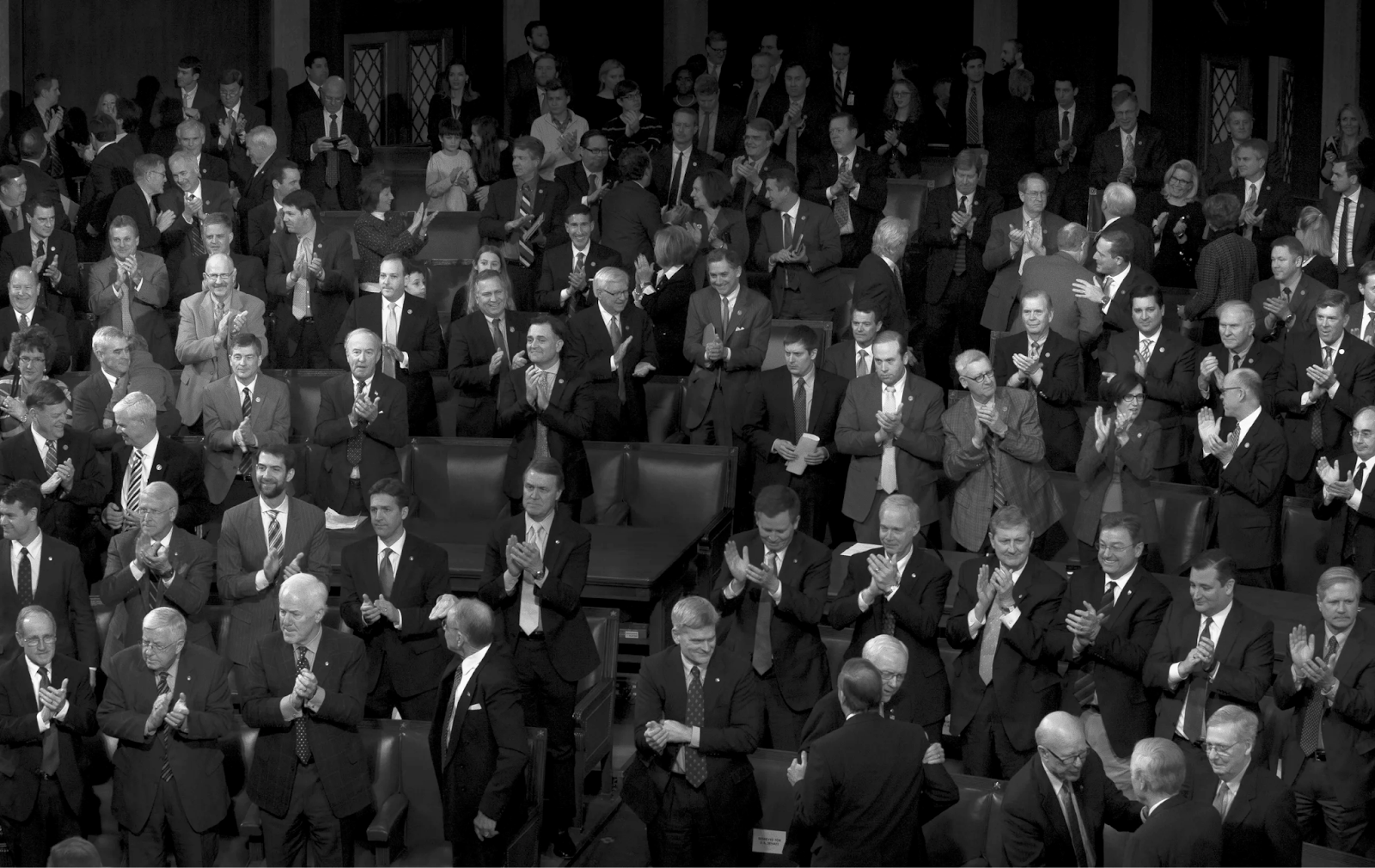
THIS PHOTOGRAPH WAS TAKEN SEVEN YEARS AGO ON JANUARY 6, 2017

DOES THIS SAME DATE SEVEN YEARS LATER IN 2024 AND THE FOLLOWING PHOTOGRAPH HAVE ANYTHING IN COMMON WITH EACH OTHER?


YOU BET THEY DO...


PHOTO: January 6, 2017. Republicans applaud after Congress certifies Donald Trump’s victory in the Electoral College. The American tragedy now being wrought will not end with him. (Gabriella Demczuk)


"What's Past is Prologue..."

November 23, 2016


FROM THE PANOPTICON REVIEW ARCHIVES

(Originally posted on March 2, 2016):


All,

Keep in mind that the following article ("The Real Danger of Donald Trump") was written a mere six months ago(!)

NOW (after winning seven of the ten Republican primaries tonight in resounding fashion) look at how much closer we are to the very real possibility that a genuine fascist could become the next President of the United Hates in November. Don't laugh, or even think about blithely dismissing this once extremely remote possibility. A looming catastrophe of monumental proportions is now only 8 months away from actually happening. If Trump is able to win a mere 2-3 more midwestern states (given that like Romney in 2012 it is absolutely assured that he will win at least 95% of the entire South--a grand total of 13 states-- plus 5 more in the Plains states region of Wyoming, Montana, Utah, North and South Dakota in addition to 3 more in Nebraska, Alaska, and Idaho). Add the certainty that like Romney in 2012 Trump would also easily win three of the 10 midwestern states (Indiana, Kansas, and Missouri), and all of a sudden we are looking at a grand total of 24 states (which is exactly the same number of states Romney won in 2012). It is also likely under this horrific scenario that if Trump is also able to win back the state of Florida that Obama was barely able to win against Romney by a little less than 1% of the vote he would suddenly be much closer to actually winning the Presidency. Then all Trump would need to win the election is two more states TOTAL in the rest of the country, If you don't think this is possible given how thoroughly reactionary and rabidly rightwing most of the national white vote in this country actually is (in 2012 60% of that national voting demographic went to Romney as Obama only won a feeble 39% nationally of this vote and actually lost the white vote in both New York and California!) you are deluding yourself.


So don't think for a nanosecond that the worst possible scenario could not possibly occur at this point and that an extremely wealthy and openly bigoted white male supremacist and certifiable meglomaniac could win the White House and turn a horrific fantasy into a nightmarish reality very soon ...Stay tuned...


Kofi

 
https://archive.nytimes.com/takingnote.blogs.nytimes.com/2015/09/16/the-real-danger-of-donald-trump/

Taking Note - The Editorial Page
Editor's Blog


The Real Danger of Donald Trump
by Lawrence Downes
September 16, 2015
New York Times


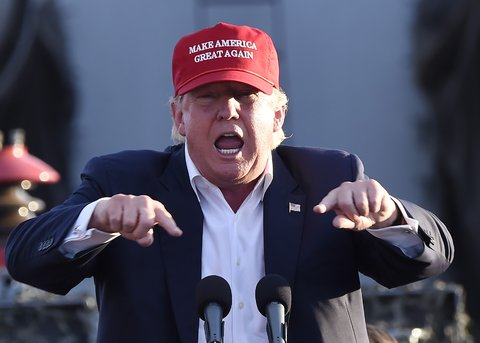
PHOTO: Donald Trump.Credit Robyn Beck/Agence France-Presse — Getty Images


The Real Danger of Donald Trump


Some may find him amusing, but he is stirring up hatred that will take a long time to die down.


The caller to Brian Lehrer’s WNYC radio show on Wednesday morning was pining for a strongman, a president who would do what was necessary to get rid of immigrants, whom she blamed for taking jobs and money away from real Americans.

“We’re very angry about what’s going on in the world today. We’re very angry about all the immigration,” she said. “He does speak for the people. I don’t understand why everyone doesn’t realize that there are a lot of angry people out here that are tired of listening to the politicians step all over us.”


She was speaking, of course, of Donald Trump, whose vehement anti-immigrant message is working brilliantly for him. Heading into tonight’s second Republican debate, he is the 2016 campaign’s main object of fascination and intimidation — the gas planet around which the discussion will likely revolve, while his rivals spin, tumble and flail.

Because Mr. Trump is caustic and bombastic, many people find him delightful and refreshing. Late-night comedians have been praying for him to stick around, because the jokes write themselves.

But the problem with this particular clown is that his words are not clownish. The language he uses about immigrants is dehumanizing and vile. The audiences that adore him are animated not just by infatuation, but by the age-old catalysts of fear, resentment and hate.

This is what moves the Trump effect into the realm of the frightening, rather than amusing or fascinating.

When did that move happen? For me, it was his rally on Monday in Dallas, where he told an adoring crowd he was disgusted with what was happening to America. He called it “a dumping ground for the rest of the world.”

The garbage he was referring to is people, the same kind of people we describe more poetically on a plaque at the foot of the Statue of Liberty.

Mr. Trump’s rivals are talking, in all seriousness, of undoing the Constitution and building a border wall. A Fox News host compares immigration to “a tumor or a disease.” Two young thugs in Boston attack and urinate on a homeless Latino man, saying Mr. Trump inspired them. A Trump supporter outside the Dallas rally grabs a microphone and yells at anti-Trump protesters: “Clean my hotel room, bitch!” Another, referring to Mr. Trump’s mass-deportation plan, says: “This isn’t going to be painless. They’ve been inflicting pain on us for 20 years.”

It’s not clear that Mr. Trump will end up with any power to pursue his racist agenda — his ambitions seem a lot narrower, more TV-based. But the toxic support he is stirring up, the polluted ideas he is spreading, the hate he is emboldening his supporters to voice with his blaring, surround-sound campaign — that evil will live after him. We will be cleaning up after Mr. Trump for a long time.


Vice President Joe Biden spoke reassuringly to a Latino group on Tuesday, saying that Mr. Trump and his fellow Republicans were taking pages from an old playbook that always fails.


“This will pass,” he said. This “sick message” has been tried on America before, and we always — “always, always, always, always” — overcome it.


Yes, we do, but it keeps coming back, and keeps doing damage.

I think of some recent examples, close to home.

Long Island, where I live, has been transformed in recent years, like many other American suburbs, by an influx of Latino immigrants. The demographics of Long Island’s two counties, Nassau and Suffolk, are similar. But where Nassau had a cool, pragmatic county executive, who talked of unity and sensible solutions, Suffolk had a county executive who liked to blame immigrants for overburdened housing, schools and hospitals, and for supposedly lawless acts like gathering on sidewalks to look for work. His words inflamed and incited community passions; his claims that immigrants were a blight on the county found a receptive audience.


And Suffolk, not Nassau, became nationally notorious for repeated attacks on Latino immigrants, including one horrific murder. Even the county police department was accused of patterns of racial abuse. Other politicians have risen to power in communities where people feel uneasy and resentful and are looking for a target for their anger. Sheriff Joe Arpaio of Maricopa County, Ariz., has perennially been elected despite — or rather because of — his history of oppressing Latinos in his jurisdiction.


Mr. Trump has made the nativists restless, on a national scale. Those in media and entertainment who are distracted by his comedic potential are missing the point. Jimmy Fallon, doing a skit with Mr. Trump, normalizes his toxic message, with giggles. (I’m hoping that Stephen Colbert, who has Mr. Trump on his show next week, will do better at avoiding this moral trap, but I’m not holding my breath.)

The Trump effect leads to a question I’ve been pondering. Is politics like physics, where adding gas to a container creates pressure and heat? If you keep pumping inflammatory speech into the public discourse, do you eventually get ignition?


Sunday, January 7, 2024

The Insidious Ongoing Role of Higher Education Elites in the Corrupt Expansion of Censorship, White Supremacy, and Settler Colonialism in Israel, Palestine, and the United States

https://truthout.org/articles/harvard-presidents-ouster-makes-visible-the-rising-power-of-the-far-right/

Harvard President’s Ouster Makes Visible the Rising Power of the Far Right

The same forces targeting Palestine solidarity work are trying to end all campus discussions of anticolonial politics.

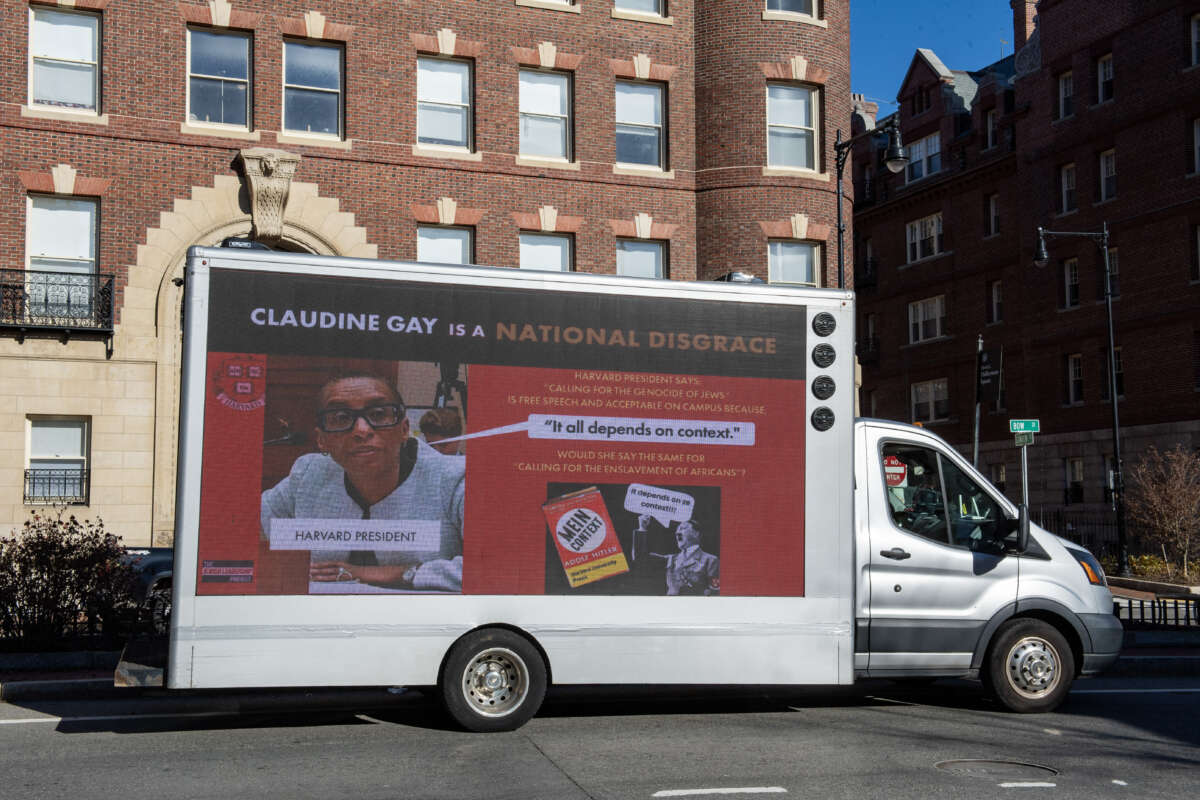
A truck calling the president of Harvard a "national disgrace" drives around Harvard University in Cambridge, Massachusetts, on December 12, 2023. JOSEPH PREZIOSO / AFP via Getty Images

The recent resignation of Harvard’s first African American president, Claudine Gay, which was brought on by an orchestrated campaign mobilized by the far right, made visible the threat of organized fascism on university campuses. Claiming victory, the far right propagandist Christopher Rufo posted on social media: “SCAPLED: Harvard President Claudine Gay Resigns” (and quickly clarified that he meant to write “SCALPED”).

Antisemitism across the U.S., including at universities, is a critical concern. But attempts to identify and counter actual antisemitism are now being muddied by a disingenuous Zionist campaign to suppress all who express solidarity with Palestine by falsely labelling any criticism of the settler-colonial state of Israel and its policies as antisemitism. The organizing logic of this far right project is to surveil, silence and discipline those on university campuses across the U.S. who are speaking up against Zionist settler colonialism and witnessing the violence carried out by Israel. This is done by threatening students and faculty and by targeting their current or prospective employment. Students and faculty who express solidarity with Palestinians have been consistently doxxed and harassed, turned into objects of far right and Zionist hate campaigns.

On October 7, 2023, fighters from Gaza took control of Beit Hanoun crossing and breached the wall Israel had erected alongside the Gaza Strip to keep its 2.3 million residents under permanent imprisonment. Israel responded by bombarding Gaza, and protests emerged across the globe in solidarity with Palestine. Across university campuses, student protests sought to draw attention to the apartheid conditions imposed by Israel’s colonial occupation, outlined the role of colonization as the foundational driver of violence, and called for a ceasefire. In a statement authored by the Harvard University Palestine Solidarity Committee and signed by 33 other student organizations, Israeli settler colonialism has been described as the root cause of the violence. This analysis is aligned with the analysis of the violence offered by Amnesty International: “The root causes of these repeated cycles of violence must be addressed as a matter of urgency. This requires upholding international law and ending Israel’s 16-year-long illegal blockade on Gaza, and all other aspects of Israel’s system of apartheid imposed on all Palestinians.” 

An organized campaign by Zionists, working alongside far right propagandists, has targeted protests that stood in solidarity with Palestine and critiqued Israeli settler colonialism, manufacturing a campus crisis. At the City University of New York (CUNY), the chancellor deployed additional security on campus in spaces where Arab, Muslim and Jewish students gather, and several events expressing solidarity with Palestine were cancelled. The chancellor’s letter to the campus community noted, “University property and platforms, including CUNY computers and email addresses, cannot be used to promote political activities or agendas.”

Frank Wu, the president of Queens College at CUNY flagged a social media post by the school’s Muslim Student Association to the New York City Police Department. At Columbia, the student chapter of Jewish Voice for Peace and local Students for Justice in Palestine group were both suspended.

Related Story:

Ivy League Presidents at Congress Hearing Threw Student Protesters Under the Bus

Not one of the university leaders questioned the baseless premises of many claims, says professor Nivedita Majumdar.

It is critical to note here that a range of students, organizations and activists speaking in solidarity with Palestine have issued statements challenging the disinformation crafted around them. For instance, they have debunked the lies that have circulated falsely alleging that Palestine protest groups have called for genocide of Jews. Devoid of facts, however, the disinformation campaign waged by Zionists has continued to amplify affect to create a moral panic, mobilizing the organizing forces of Zionists alongside the repressive tactics of the far right to target academic freedom, police organizing and crush dissent.

Responding to the protests, the hedge fund billionaire Bill Ackman wrote a post on X calling on Harvard to release the names of the student members of the organizations that had signed onto the statement, building a campaign of fear by threatening their career prospects.

Zionist donors are driving efforts to target students and faculty who express support for Palestine, exerting pressure on universities by pulling funding or threating to pull their funding for allowing pro-Palestine protests. Consider the role of the Wexner Foundation in pulling funding from Harvard. The foundation produced the “Wexner Analysis: Israeli Communication Priorities 2003” as a strategic blueprint for pro-Israel activists seeking to covertly influence U.S. public opinion around Israel, working in conjunction with the public relations firm the Luntz Research Companies and The Israel Project.

The Zionist billionaire donor Seth Klarman, owner of the investment company The Bauman Group, with a building on Harvard’s campus named after him, wrote an open letter with Mitt Romney criticizing the Harvard leadership. The letter noted: “The expressions of hate and vitriol against Jews have continued and strengthened over the last week on Harvard’s campuses. The threatening, violent protests by pro-Palestinian groups on Harvard campuses become more heinous with each passing day.”

Klarman runs the Klarman Family Foundation, and is the co-founder and chair of the right-wing Israeli newspaper, The Times of Israel. The Klarman Foundation donates to a range of pro-Israel and Zionist advocacy organizations including The Israel Project, The David Project, Anti-Defamation League, Friends of the Israel Defense Forces, the Jewish National Fund, the Simon Wiesenthal Center, Stand With Us, the United Israel Appeal and the Zionist Organization of America. He was one of the largest donors to the 2020 Biden campaign.

For the far right, a crisis is an opportunity. Over the last three years, the GOP has been organizing a repressive campaign across university campuses targeting the teaching of critical race theory, starting with Donald Trump’s memo ordering the Office of Management and Budget to stop funding training for federal employees. According to CRT Forward (an initiative launched by the UCLA School of Law Critical Race Studies Program), since September 2020, across 44 states in the United States, far right extremist politicians have been running campaigns seeking to censor the teaching of critical race theory, having introduced 783 “anti-Critical Race Theory bills, resolutions, executive orders, opinion letters, statements, and other measures.”

Far right propagandists are trying to broaden the current repression of Palestine solidarity activists to escalate the repression of all scholars and activists who discuss postcolonial and anti-colonial politics, arguing that calls for Palestinian sovereignty on Western university campuses emerge from the pedagogy of postcolonial and decolonization studies. Here’s Christopher Rufo, tweeting on October 14:

Conservatives need to create a strong association between Hamas, BLM, DSA, and academic “decolonization” in the public mind. Connect the dots, then attack, delegitimize, and discredit. Make the center-left disavow them. Make them political untouchables.

The narrative is reiterated by Bari Weiss. In a speech to the Federalist Society titled “The last line of defense,” Weiss pins the crisis of protests demonstrating solidarity with Palestine to decolonization. She states:

In other words, everyone can now see how very deep these ideas run, and we see clearly that there are not just metaphors. Decolonization isn’t just a clever turn of phrase, or a new way to read novels. It is the sincerely held political view that serves as a predicate to violence.

Claudine Gay’s resignation comes as a result of an orchestrated racist campaign that started with a hearing before the House Committee on Education and the Workforce on December 5, 2023, when the presidents of Harvard, the University of Pennsylvania and the Massachusetts Institute of Technology were pressed on the policies of the universities in addressing antisemitism on their campuses. This had earlier led to the resignation of the University of Pennsylvania President Liz Magill. The hearing, one of the most watched hearings of all time, sends out a warning to other higher education institutions about the consequences for not repressing campus support for Palestine.

The architecture of the hearing was based on the false premise that since October 7, there have been widespread calls for Jewish genocide across U.S. university campuses. There is no empirical evidence to back this up, and the politicians participating in the December 5 hearing couldn’t provide evidence to substantiate the claim.

Critical to the manufactured frenzy around the hearing was the questioning and subsequent social media posts produced by the far right MAGA politician, Elise Stefanik, who has platformed the extremist antisemitic Great Replacement theory (the same ideology that resulted in the Buffalo mass shooting), peddled in antisemitic narratives, circulated QAnon conspiracy theories and actively disseminated the Trump lie about a stolen election.

The structure of Stefanik’s questioning sets up a discursive trap, repeating “Does the call for the genocide of Jews on your campus constitute harassment, yes or no?”

Implicitly referring to Palestinian solidarity protests, and mislabelling slogans voiced in the protests — “From the river to the sea, Palestine will be free,” and “Intifada” (some version of it) — as calls to genocide, the five-hour questioning was built to censor campus speech in solidarity with Palestine. The communicative act of mislabelling Palestinian slogans for freedom as antisemitic, terrorist, and as calls to genocide forms the racist discursive infrastructure of white settler colonialism that works actively to erase the voices of the colonized claiming sovereignty while carrying out genocidal violence. At the core of the questioning was the demonization of Palestinians and solidarity with the Palestinian struggle.

For large cross-sections of Palestinian and Global South voices, the call “From the river to the sea, Palestine will be free” expresses the human right to justice and liberty, challenging the apartheid condition and Israeli occupation of Palestine. Similarly, the reference to Intifada is a call for resistance, mobilized to challenge a colonial occupation and protected by international law.

Once the campaign saw its first trophy with the resignation of the University of Pennsylvania President Liz Magill, a victorious Stefanik posted on social media: “One down. Two to go.”

Stefanik claimed that this is the first of more congressional hearings on “all facets of their institutions’ negligent perpetration of antisemitism including administrative, faculty, and overall leadership and governance.” In a piece published in the right-wing British tabloid The Daily Mail, she states, “We must DEFUND the rot in America’s higher education.”

Claiming credit for the resignation of President Gay, Stefanik tweeted: “TWO DOWN,” accompanied by three red siren emojis. She further tweeted “I will always deliver results…” By falsely framing pro-Palestinian protests as antisemitic, by falsely identifying the cause of antisemitism as diversity, equity and inclusion (DEI) programs, and by stoking manufactured frenzy around DEI diversity, equity and inclusion programs, Stefanik seized the opportunity to consolidate her position within the Republican Party.

The manufactured crisis over false rumors about “calls to Jewish genocide” is synergized with the broader far right campaign attacking the teaching of critical race theory on university campuses, turning to DEI programs.

Rufo claimed that, “Powerful forces — including Elon Musk, Bill Ackman, and many others behind the scenes — are boosting our story about the Claudine Gay plagiarism scandal. They do not want to let this one go. They realize that DEI is death to merit, accomplishment, and the American spirit.” Weiss chimes in, arguing that, “Lots of organizations claim to be defending young Jews on campus. Simple litmus test: do they oppose DEI? If not, do not take them seriously.”

Yet what continues to be ignored is the actual threats against antisemitism across the U.S. — which arise not from support for Palestine but from white supremacy. In 2014, the white supremacist Frazier Glenn Miller Jr. shot and killed three people outside a Jewish community center and retirement home in suburban Kansas City. In 2019, the white supremacist John Earnest opened fire, attempting a mass killing of Jews attending services inside a synagogue in Poway, California, killing one person and injuring several. The white nationalist Robert Bowers shot and killed 11 worshippers at the Tree of Life synagogue in 2018, the deadliest antisemitic attack in U.S. history. Each of these attacks was driven by white supremacy, with Bowers specifically drawing on Great Replacement theory, blaming Jews in the U.S. for catalyzing “an invasion of nonwhite immigrants who would slaughter the white race.” Note the mainstreaming of the Great Replacement theory, an extremist ideology that has resulted in a growing wave of white extremist terrorism in the U.S. and abroad, including in Norway and Christchurch.

The study and discussion of anti-colonial theory at universities exists in continuity with anti-colonial struggles in communities and on the streets. In spite of the far right extremism seeking to terrorize universities, the actual work of decolonization will continue. As long as conditions of oppression, exploitation, apartheid and occupation continue, the voices of the global majority will stand in resistance.