Discourse that allows us to express a wide range of ideas, opinions, and analysis that can be used as an opportunity to critically examine and observe what our experience means to us beyond the given social/cultural contexts and norms that are provided us.
In Private Remarks to Arab Americans, Biden Aide Expresses Regrets on Gaza
In
a closed-door meeting, the aide offered some of the administration’s
clearest notes of contrition for its response to the Gaza war, a sign of
rising Democratic pressure on President Biden.
PHOTO: A protest outside the Henry Hotel in Dearborn, Mich., where Biden administration officials met on Thursday with Arab American leaders. Credit: Nick Hagen for The New York Times
In
a closed-door meeting with Arab American leaders in Michigan this week,
one of President Biden’s top foreign policy aides acknowledged mistakes
in the administration’s response to the war in Gaza, saying he did not
have “any confidence” that Israel’s government was willing to take
“meaningful steps” toward Palestinian statehood.
The
remarks came after months of public and private admonitions from the
Biden administration for Israel to take a more surgical approach in a
conflict that has killed more than 27,000 Palestinians, according to
health authorities in Gaza. On Thursday, Mr. Biden himself declared that
Israel had gone “over the top” in its response to the Hamas attack on Oct. 7.
The
Biden aide, Jon Finer, a deputy national security adviser, offered some
of the administration’s clearest expressions of regret for what he
called “missteps” it had made from the beginning of the violence, and he
pledged that it would do better.
During
the meeting on Thursday with Arab American political leaders in
Dearborn, Mich., Mr. Finer said, “We are very well aware that we have
missteps in the course of responding to this crisis since Oct. 7,”
according to a recording of the gathering obtained by The New York
Times. A National Security Council official confirmed the recording was
authentic.
Mr.
Finer added: “We have left a very damaging impression based on what has
been a wholly inadequate public accounting for how much the president,
the administration and the country values the lives of Palestinians. And
that began, frankly, pretty early in the conflict.”
PHOTO: Protesters in Dearborn on Thursday criticized the Biden administration’s continued funding of the Israeli military. Credit: Nick Hagen for The New York Times
The
war in Gaza has become part of a cascade of political problems for Mr.
Biden, who has remained publicly supportive of Israel and resisted
demands within the Democratic Party to call for a cease-fire. His
position since Hamas killed about 1,200 people in Israel on Oct. 7,
along with his remarks casting doubt on the death toll from Israeli
airstrikes and calling the loss of life “a price of waging war,” has
angered young people, Black voters and progressives who are more
sympathetic to the Palestinian cause.
Mr.
Biden himself has acknowledged the pro-Palestinian protesters who have
become a frequent presence at his public events. Last month, a campaign
rally on abortion rights in Virginia was repeatedly interrupted by protesters urging Mr. Biden to call for a cease-fire.
After
that rally, Mr. Biden met privately with about 40 invited attendees and
urged them not to view demonstrators as political enemies, saying that
they deserved sympathy and that their cause was “really important,”
according to three people who attended the meeting.
A Biden campaign spokeswoman declined to comment.
But
the recording of the Dearborn meeting provides an unusual
behind-the-scenes glimpse at the administration’s attempts to shore up
support in the critical battleground state of Michigan, which has a
large Arab American population in Dearborn and other Detroit suburbs.
Mr. Biden’s support in the state has eroded, polls show. His allies
there have warned the White House in recent months that he runs the risk
of losing the state, which he carried in 2020.
Mr.
Finer and several other senior Biden administration officials,
including Samantha Power, the administrator of the United States Agency
for International Development, traveled to Dearborn on Thursday for a
series of meetings, including the one in which Mr. Finer’s comments were
recorded.
Those sessions came a week
after Biden campaign aides, including Julie Chávez Rodríguez, the
manager of his 2024 bid, quietly traveled to the city and met with a few
officials, including Representative Rashida Tlaib, a Palestinian
American progressive who is at the forefront of Democratic calls for a
cease-fire.
However, Mayor Abdullah
Hammoud of Dearborn and several other local officials declined to meet
with Ms. Chávez Rodríguez. Mr. Hammoud later issued a statement saying
he wished to speak with policymakers instead of campaign officials.
White House officials then scrambled to arrange a visit.
During
the Thursday meetings, Mr. Finer articulated the American government’s
efforts to bring a halt to the war in Gaza. Building a formal diplomatic
relationship between Israel and Saudi Arabia, he said, is a critical
step toward creating a Palestinian state. Doing so, he added, requires
politically difficult sacrifices from both countries and the United
States.
PHOTO: Jon
Finer, at right in a purple tie, during a briefing on Ukraine in the
Oval Office in October. He is the second-ranking official on the
National Security Council. Credit: Brendan Smialowski/Agence France-Presse — Getty Images
“We
will have to do things for Saudi Arabia that will be very unpopular in
this country and in our Congress,” Mr. Finer said. “Will Israel be
willing to do the hard thing that’s going to be required of them, which
is meaningful steps for the Palestinians on the question of two states? I
don’t know if the answer to that is yes. I do not have any confidence
in this current government of Israel.”
Mr.
Finer also said the Biden administration should have been faster to
publicly condemn statements made by some Israeli officials that, in his
words, compared “residents of Gaza to animals.” He said officials had
not done so because they were trying to work with the Israeli
government.
“Out
of a desire to sort of focus on solving the problem and not engaging in
a rhetorical back-and-forth with people who, in many cases, I think we
all find somewhat abhorrent, we did not sufficiently indicate that we
totally rejected and disagreed with those sorts of sentiments,” Mr.
Finer said.
He did not clarify which Israeli officials he was referring to, but in the conflict’s early days, Yoav Gallant, the Israeli defense minister, said,
“We are fighting human animals, and we are acting accordingly.” Some
other Israeli officials have also faced criticism for dehumanizing
language.
Mr. Finer’s most
explicit note of contrition was for a statement released under Mr.
Biden’s name on Jan. 14, marking 100 days since the conflict began. The statement
focused on the plight of American and Israeli hostages being held in
Gaza and made no reference to Palestinians who had been killed.
“It
did not in any way address the loss of Palestinian life during the
course of the first 100 days of the conflict,” Mr. Finer said. “There is
no excuse for that. It should not have happened. I believe it will not
happen again. But we know that there was a lot of damage done.”
Mr.
Finer, who declined to comment, is the second-ranking official on the
National Security Council, under Jake Sullivan, who is Mr. Biden’s
national security adviser.
Adrienne
Watson, a spokeswoman for the National Security Council, said: “The
president and Mr. Finer were reflecting on concerns we have had for some
time, and will continue to have as the Israeli operation proceeds,
about the loss of Palestinian lives in this conflict and the need to
reduce civilian harm.”
The
Michiganders who attended the Thursday meetings with Biden
administration officials described them as intense and said they were
disappointed that the delegation from Washington had not committed to
policy changes.
For example,
administration officials declined to say whether they had advised or
would advise the president to call for a cease-fire, which attendees
asked for.
“You’re not going to get that answer,” said Steve Benjamin, the director of the White House’s public engagement office.
But
the officials committed to issuing a letter clarifying the
administration’s support of the work of the United Nations Relief and
Works Agency, which the United States temporarily cut funding for
after Israel accused some of its staff members of participating in the
Oct. 7 attack. The Biden officials did not engage with questions from
the Michigan leaders about the president’s electoral prospects in the
state.
“We emphasized that beyond
communication, there needs to be a change in policies,” said Abraham
Aiyash, a Democratic state representative who is the majority leader in
the Michigan House of Representatives. “We were clear that there would
be no follow-up meetings in any capacity if there was not a shift in
policy based on the tangible steps that we outlined for them today.”
Abbas
Alawieh, a former congressional aide who attended the meeting, said it
was “outrageous” that it had taken more than 100 days after the war
started for the administration to engage with Dearborn, and that Mr.
Biden had not visited himself.
PHORO: Abraham
Aiyash, a Democratic state representative who is the majority leader in
the Michigan Statehouse, has called for the Biden administration to
change its policies toward Israel. Credit: Nick Hagen for The New York Times
Mr. Biden met with Arab and Muslim American leaders in October, amid growing tensions inside and outside the White House,
and apologized for questioning the Gaza death toll and for other
messaging from the administration. But he largely defended his support
for Israel’s war, pointing to foreign policy considerations.
In
November, administration officials also met by videoconference with
Palestinian American leaders who expressed concern about surveys showing
the plunging support for Mr. Biden in their communities. The officials
told them that polling numbers did not dictate the president’s foreign
policy decisions.
“People feel not just a vague sense of betrayal, but a bone-deep sense of betrayal by President Biden,” Mr. Alawieh said.
Assad
I. Turfe, the deputy Wayne County executive, who also heard from the
Biden aides on Thursday, said Mr. Biden should be judged by how soon the
conflict in Gaza is resolved.
“The
Biden administration must act swiftly and decisively to end this
violence, honoring the principles of justice and human rights,” Mr.
Turfe said.
On Tuesday, a group of
Arab American and Muslim leaders in Michigan, led by Ms. Tlaib’s sister,
announced a campaign to persuade Democrats angry about Mr. Biden’s
stance on Israel to vote “Uncommitted,” against the president,
in the state’s Democratic primary election on Feb. 27. Though such a
move would most likely have little practical effect, it could embarrass
the president if enough voters chose to participate.
Former
Representative Andy Levin of Michigan called the campaign “a
constructive thing for the president” and said he was encouraging fellow
Democrats to vote Uncommitted — though he declined to say how he
planned to vote in the primary.
“On Gaza, we’re going to have to keep pushing him,” Mr. Levin said in an interview.
Osama
A. Siblani, the influential publisher of The Arab American News, a
Dearborn newspaper, had meetings with both Ms. Chávez Rodríguez and Mr.
Finer’s delegation. He said Arab American voters in Michigan felt
betrayed after backing Mr. Biden in large numbers in 2020, arguing that
they had “received nothing” since then “but lip service.”
“I’ve
been involved in this community day in and day out every single day for
40 years,” Mr. Siblani said. “I can tell you right now, I cannot
convince my community to vote for Biden if I kiss their feet. They will
not do it.”
ABOUT THE AUTHORS:
Reid J. Epstein
covers campaigns and elections from Washington. Before joining The
Times in 2019, he worked at The Wall Street Journal, Politico, Newsday
and The Milwaukee Journal Sentinel.More about Reid J. Epstein
A version of this article appears in print on Feb. 10, 2024, Section A, Page 1 of the New York edition with the headline: U.S. Faltered With Israelis, An Aide Says. Order Reprints | Today’s Paper
In Palestine, the law has been used as a tool of oppression to legitimize and advance the dispossession of the Palestinian people for more than a century. From the theft of Palestinian land by legal mechanisms to the non-recognition of Palestinians as a people with the inalienable right of self-determination, the law is yet another weapon wielded against the Palestinian people by Israel and its patrons. Activist, attorney, and Rutgers University professor Noura Erakat joins The Chris Hedges Report to discuss the use of lawfare against Palestine and her new book, Justice for Some: Law and the Question of Palestine.
"Racial democracy is, at the same time, cultural democracy and the question of cultural democracy in America is posed in a way never before seen or considered in other societies. This uniqueness results historically from the manner in which American cultural developments have been influenced by the Negro presence. Since a cultural philosophy has been cultivated to deny this truth, it remains for the Negro intellectual to create his own philosophy and to bring the facts of cultural history in focus with the culture practices of the present. In advanced societies it is not the race politicians or the civil rights leaders who create the new ideas and the new images of life and man. That role belongs to the artists and the intellectuals of each generation. Let the race politicians, if they will, create political, economic, or organizational forms of leadership; but it is the artists and creative minds who will, and must, furnish the all important content. And in this role, they must not be subordinated to the whims and desires of politicians, race leaders, and civil rights entrepreneurs whether they come from the Left, the Right, or Center...Which is to say, in advanced societies the cultural front is a special one that requires special techniques not perceived, understood, or appreciated by political philistines. There are those among the latter who give lip service to the idea that Culture and Art belong to the People, but what they actually give to the people (not to speak of what they give to Negroes as people) is not worthy of examination. It is the Negro creative intellectual who must take seriously the idea that culture and art belong to the people--with all the revolutionary implications of that idea. " --"Cultural Leadership and Cultural Democracy" from The Crisis of the Negro Intellectual by Harold Cruse, 1967
Amiri Baraka, 1934-2014
IN THE FUNK WORLD (by Amiri Baraka, 1996)
If Elvis Presley/is King Who is James Brown, God?
appropriation:3. To take to or for oneself; take possession of. To make one’s own. The act of appropriating.
expropriation: 1. To take (property, ideas etc.) from another, especially without his permission. 2. To deprive (a person, business etc.) of property. To be separated from one’s own. —The Random House Dictionary of the English Language
A critical analysis of the structural relationship between the African American artist and the political economy of culture in the United States must begin with a theoretical investigation of the social and cultural history of aesthetics and “race” in this country. However, the major problem with the teaching of this history is that the writing of it is monopolized by “white Americans” who don’t know anything about the subject.
For example, it is painfully clear that 98% of all the books written about ‘culture’ in the United States don’t have the slightest idea who the following people are or what they’ve “contributed” to American culture: ‘Native Americans (“Indians”), African Americans (“Negroes”), Asian Americans (“Orientals”), Latino Americans (“Hispanics”). As a result these same writers can’t really talk coherently or accurately about the actual historical experience of the Euro Americans (“white people” of English, Irish, Scottish, Italian, French, German and Eastern European descent). Obviously this creates tremendous confusion when it comes to any clear understanding of the complex meaning of these various histories. This is largely because of a profound ignorance of even the empirical details of what the cross-cultural contacts and conflicts of the many heterogeneous groups that make up the North American continent actually represent. Thus it is not surprising that the ideology of racism (the most powerful instrument of oppression in the world today outside of capitalism itself) dominates contemporary discourse about culture, aesthetics and ‘identity’ in the United States.
THE RELENTLESS HEGEMONY that this ideology wields continues to distort, obscure, and confuse the issue when it comes to a critical assessment of the major role that appropriation plays in cultural theory and praxis today. This is no less true within so-called “avant-garde” circles than it is in the academic/institutional oligopoly known as the “cultural mainstream.” In fact, what both of these aesthetic communities have in common is an equal disdain for, yet voracious exploitation of, other cultural ideas, practices, traditions and values stemming from different social/cultural groups (e.g. African Americans). These reactionary attitudes and philosophical limitations constitute the basis of the historical expropriation of black cultural forms in all the arts (i.e. music, dance, literature, visual arts, ‘performance art’, theater, etc.) by white artists and critics who seek to not only use (or appropriate) the techniques, methods and conceptual ideas of African Americans but to co-opt, absorb and consume them as their property through the systematic ‘legal’ and criminal theft of their cultural productions.
This is carried out by the massive structural domination of the art market by huge corporations owned and administered by predominately upper-class white males who, through bureaucratic managerial control, inherited wealth, and monopolistic manipulation of the vast economic network of marketing, distribution and exchange outlets (the various sites of Capital in the political economy of culture in this country as well as globally), determine what the schools and mass media teach about “who did what, when, where and how” when it comes to American cultural history.
There is nothing necessarily conspiratorial or sinisterly “planned” with respect to this on-going condition. It is simply the way things are when it comes to political, economic and social reality in the United States. The fact that the cultural/artistic communities (‘mainstream’ and ‘avant-garde’) largely support and accept the rather heinous status quo only exposes the vested interests of the “art world” when it comes to their own privileged position within the system. So the point is not merely that individual white artists “stole” their own “personal” aesthetic styles (and much of their content) from blacks but that as a necessarily privileged group of artists (by dint of their “race”, class, and sometimes gender) they were able to do much more than merely “appropriate” information (i.e. creatively use thematic and stylistic material as aesthetic source, cultural reference or energy conduit). The truth is that white artists have always sought to own the economic rights to, and residual benefits of, African American cultural artifacts and conceptions. What made this possible for them is the surplus value of what black artists and cultural workers have produced (in the form of usurious “contracts”, absurdly exploitive royalty arrangements and rigidly segregated markets at the points of both material production and exchange).
THE MOST BLATANT and notorious example of all this is the recording industry whose monumental profiteering off the creative genius of such legendary and seminal musicians, composers and singers as Scott Joplin, Louis Armstrong, Duke Ellington, Bessie Smith, Billie Holiday, Chuck Berry, Little Richard, Theolonious Monk, Miles Davis, Charlie Parker, Otis Blackwell, Louis Jordan, Charles Mingus (and just about every blues artist in history) is scandalous. These are just a very few of the huge number of black artists who have revolutionized music as an art form in the 20th century and who have been mercilessly exploited. Who is the great Jimi Hendrix but a man whose extraordinary talent and vision has been plundered by a whole cottage industry of artistic and financial parasites who continue to bilk millions of dollars from his estate, while doing third-rate imitations of his artistry? In this context, who is Eric Clapton? Who are Mick Jagger & Keith Richard? Who is every ho-hum heavy metal guitarist since 1971? What does the multi-billion dollar music industry represent under these conditions? It’s important to note that this is not simply a matter of “trashing” your favorite white musician/songwriter either. After all, I’m not interested in examining the motives or intent of personalities involved in this process. What’s significant is the political, economic and cultural context that they are a part of, and what they decide to do about these conditions as far as their own cultural work is concerned.
In this light it’s easy to see the implications of the infamous “cover song’ tradition of the 1950s and early 1960s by white artists (a situation in which a popular white artist records the song and/or music of a black artist that often results in black artists not being paid royalties for their work and simultaneously being stymied from getting airplay and openly selling their music to a wider audience). Everyone from Pat Boone to Elvis Presley have cashed in on this little strategy. And while the economics and academic recognition of this situation have improved to a certain degree (more people are aware of what is happening and why) it still remains a major concern within the African American cultural community. Just ask the attorneys representing Bo Diddley, Chuck Berry, Little Richard, and the estates of Otis Redding, Sam Cooke, and yes, James Marshall Hendrix, all of whom are currently involved in massive lawsuits against their respective recording companies. I’m sure there are many more examples.
Another cultural area where this syndrome of white appropriation turns into its ugly linguistic cousin is literature, where three generations of black writers in this century have been ignored, neglected and ripped-off with hardly anyone in academia or the avant-garde batting an eyelash. How else does one explain the colossal ignorance surrounding the important literary contributions of such major ‘modern’ and ‘postmodern’ writers as Langston Hughes, Jean Toomer, Nella Larsen, Richard Wright, Chester Himes, Ann Petry, Melvin B. Tolson, Adrienne Kennedy, John A. Williams, Ishmael Reed, Bob Kaufman, Clarence Major, William Melvin Kelley, Charles Wright, Samuel Delany, Gayl Jones, Jayne Cortez, Calvin Hernton, David Henderson, June Jordan, Al Young and even Leroi Jones/Amiri Baraka (whose towering achievements are far too often dismissed as the infantile rantings of a ‘bitter nigger’). There are many other people I could mention but I think you get the point. How many of you reading this essay have heard of/read Sterling A. Brown, W.E.B. DuBois, C.L.R. James or Ida B. Wells? On the other hand how many of you know the work of W.C. Williams, Norman Mailer, William Faukner, Thomas Pynchon, Ezra Pound, Emma Goldman, Gertrude Stein, Virginia Woolf, Allen Ginsberg, and Jack Kerouac? Many more, I’ll bet.
The fault for all this lies of course with the public educational system whose curriculums and policy decisions throughout the country mirror the already established ideology of the bourgeois class that does indeed “run” the nation. The mere fact that the American literary canon is made up almost exclusively of European and white American males makes this clearly self-evident. The expropriation of the oral tradition in ‘American literature’ begins with the poetic and narrative strategies of Thomas Woolfe and William Faulkner in the 1920s and reaches its apex in the Beat Generation poets of the 1950s (check out Kerouac, Ginsberg and Corso for starters). Again the issue is not the individuals who choose to use/appropriate material from other traditions and folk forms, but the supporting political economy that promotes and markets their cultural productions as “representative” or “central” to a certain aesthetic expression. At the same time the culture industry ignores or renders invisible the work of the seminal forces in the field.
THIS HISTORICAL DYNAMIC continues today with the myriad innovations in popular dance, painting (graffiti, mural art, etc.), ‘performance art,’ multimedia and film by black artists all being mined by white American artists with scarcely any real critical attention being paid to the nature of their technical and expressive achievements. One very significant example of this is the lack of serious critical analysis and commentary surrounding the powerful new hybrid/synthetic form known as RAP. Most white critics and journalists seem more interested in determining whether young black people inventing the form are “underclass criminals” or simply “obscene illiterates.” This is cultural racism of a particularly insidious and manipulative kind, especially in light of the tremendous popularity (as both form and artifact) that RAP enjoys among middle class white suburban youth (records don’t consistently go double platinum without this demographic audience). The corresponding fact that many white and black scholars are beginning to write in literary and cultural journals about the aesthetics and cultural politics of the form also exposes the dangerously reductive and racist attitudes of such middlebrow publications as Newsweek, The New York Times, New Republic, and The New Criterion. Between the “gliberals” (thanks, Ishmael!) and the neoconservatives, African American art is getting slapped around (and expropriated) from all sides.
But this historical assault on the intellectual and spiritual vitality, creative innovation, and liberating vision of African American art in all its forms cannot and will not stop the contemporary black artist any more than the imitators of Armstrong, Hughes, Hurston, Ellington, Parker, Ellison, Wright, Baldwin, Young and Holiday were able to stop their legendary contributions to the 20th century cannon (sic) of world culture. WORD!
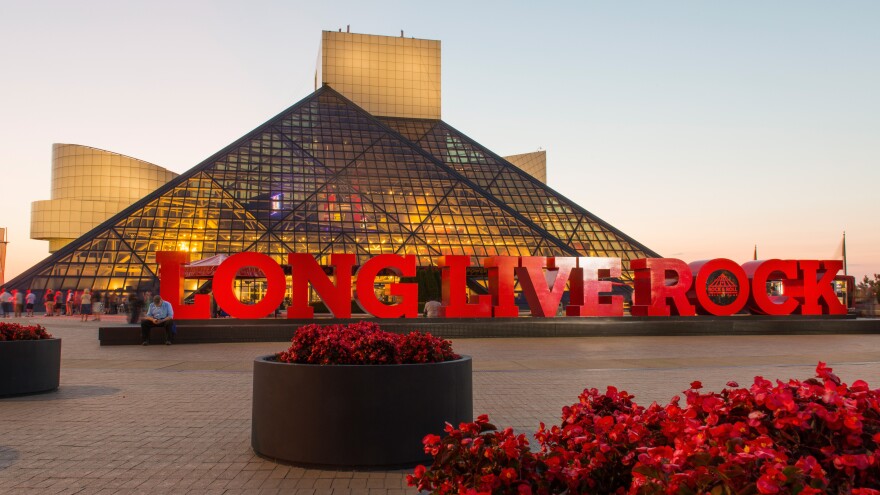
Analysis: Jann Wenner's Rock Hall is crumbling — is it worth fixing?
by
Sheldon Pearce
September 23, 2023
National Public Radio
Duane Prokop/Getty Image. With all of this condemnation swirling, it's worth wondering what about enduring monuments like the Rock Hall keeps stirring people up.
"In the Old World, two titans who sought to make themselves gods
conspired to control history and their place in it. They anointed
themselves arbiters of sound — one an impresario, the other a scribe,
both shadow figures in search of permanence. They devised a hall that
would house The Greats and took turns inducting those they deemed
worthy: above all else, those around them. And they did so in secret,
away from prying eyes and pointed questions. They thought themselves
enlightened men, bringing art appreciation to the philistines, when
really they longed to be kingmakers, therein casting their shadows
across an unwitting realm. They erected their tabernacle in Ohio.
In 2004, one of those titans, Atlantic Records co-founder Ahmet Ertegun, inducted the other, Rolling Stone
co-founder Jann Wenner, into the Rock & Roll Hall of Fame, another
institution that they helped to co-found. Ertegun spoke of Wenner as the
ultimate authority of popular music, uniquely attuned to the ways that
it reflected American realities and uniquely qualified to be its judge.
"More than anyone else, he first identified rock as a politically and
socially evocative form of music that would change our world," he said.
Mick Jagger, among the greatest beneficiaries of Wenner's particular
judgment, added, "Jann almost single-handedly pioneered the idea of
popular music and rock and roll in particular as a vibrant art form not
just a collection of flash-in-the-pan mediocrities." Perhaps Wenner did
change the world but it kept on spinning, and when the asteroid struck,
every subsequent decision he made carbon-dated him.
Wenner, who, for decades, oversaw the publication that established the world we now know as classic rock, has made himself the subject of ire while promoting his upcoming book, The Masters,
which features conversations between Wenner himself and a few
hand-picked artists: Jagger, John Lennon, Bono, Jerry Garcia, Pete
Townshend, Bruce Springsteen and Bob Dylan. If you're noticing a
pattern, that's part of the problem. When pressed,in conversation with David Marchese for TheNew York Times,
on the exclusion of Black and women geniuses, Wenner defended the
decision by saying none of the women he encountered while at the
magazine were "articulate enough"; ditto for Black artists like Marvin
Gaye and Curtis Mayfield. Wenner, who stepped down as chairman of the
Rock Hall nominating committee in 2019, was removed from the Hall's
board of directors shortly after the comments. His is a particular
privilege: To still be in the Hall despite being complicit in denying so
many artists far more deserving. He is, rightfully, being skewered from
all angles, but Wenner is, and always has been, merely an avatar for a
crumbling framework.
Wenner saying the quiet part out loud is a demonstration of
how white male gatekeepers have stymied women artists and artists of
color, up to the highest reaches of the most influential music magazine
in American history, and within the inner circle of those who get to
decide what music is enshrined. But this crude perspective had long been
made baldly and painfully evident by his editorial decisions at the
helm of said magazine and as the chairman of the Hall. Though warranted,
they overlook several more important questions: Why is the Rock Hall
the American public's most widely recognized canon for popular music?
Are its practices even in the best interest of preserving art? Moreover,
is such a canon even needed?
To understand the Rock Hall's vision, it is first important to
understand its founding, and that it was built primarily by esteemed
executives in a highly segregated music business, the kind of white men
that 2015 inductee Bill Withers once referred to as "blaxperts"
(self-proclaimed interpreters of Black culture socially removed from its
community), with emphasis on competition and consecration. When Ertegun
convened the key players — Seymour Stein of Sire Records, the
entertainment attorney Allen Grubman and Wenner — he pitched them
something akin to Cooperstown, the Baseball Hall of Fame. The initial
ceremony, in 1986, was constructed around a lavish, exclusive black-tie
dinner at the Waldorf-Astoria, $1000 a plate, according to famed critic Robert Hilburn.
With competition and elitism in mind, the selection process was
cemented, and since then the system and its players have remained
shrouded in secrecy. What we do know: Artists become eligible 25 years
after their first recording. A nominating committee of 30 execs, lawyers
and critics decide the yearly field of about 15 artists before another,
larger committee chooses the final set of inductees. This kind of
voting is common for award ceremonies. The Tony Awards have even smaller
committees, but are much more transparent aboutwho is participating.
Award shows like The Grammys have categories, which, theoretically,
makes the criteria more straightforward. Though genre categories get
murkier every year, there is at least some understanding of what kind of
thing should be nominated for the best album in each genre, and the
existence of multiple categories should allow for coverage of the
sprawl. There are longstanding questions about not only what is "rock"
enough for the Rock Hall but also about what, exactly, qualifies an
artist for inclusion. And while the purpose of an award ceremony and its
show is to reward individual excellence and entertain, the Rock Hall
has loftier objectives — not simply to honor but to immortalize.
Despite frequent protests to the contrary, the kind of artists that
the Hall chooses to immortalize come from within Wenner's narrow field
of vision. Just as in rock itself, racism and sexism have been ugly
blemishes on the rock press, and on Rolling Stone in particular,
through its storied history. (It's interesting that he did not see the
irony of granting the "masters" distinction to white practitioners of a
Black-born art.) Inan oral history
of the women who transformed the magazine into a professional
operation, former editor Barbara Downey Landau noted that there was a
sign over the desk of Wenner's secretary that said "Boys' Club," and a
Black photographerdidn't shoot a cover until 2018. In Joe Hagan's Wenner biography, Sticky Fingers, former Rolling Stone
publisher Claeys Bahrenburg summarized Wenner's ideals in the disco
heyday of the late '70s: "Every day it was strictly rock-and-roll white
bands. He would no more put a black person on the cover than a man on
the moon." At the Rock Hall, these tendencies resurfaced. (Wenner once
said Rolling Stone owned the Hall.) When he stepped down in 2019, he told theTimes,
"People are inducted for their achievements. Musical achievements have
got to be race-neutral and gender-neutral in terms of judging them."
Wenner's comments and his subsequent expulsion from the Rock Hall
come in the wake of significant criticism of the Rock and Rock Hall of
Fame Foundation's practices in recent years, and a public reevaluation
of its canonizing. "If so few women are being inducted into the Rock
Hall, then the nominating committee is broken," longtime Hall critic
Courtney Love wrote in a March op-ed forThe Guardian.
"If so few Black artists, so few women of colour, are being inducted,
then the voting process needs to be overhauled. Music is a lifeforce
that is constantly evolving — and they can't keep up."
The following month, one woman voting for Rock Hall inductees,
Allyson McCabe (who contributes to NPR), echoed those sentiments in a
very public resignation from the Foundation.Writing for Vulture,
she called her invitation tokenism, adding that the process was opaque
and the methodology seemed, at best, inconsistent and, at worst, biased
and preferential. "I felt uneasy looking at the ballot each year, the
way the genre's definition seemed to be applied differently in the bios
depending on who was doing the rocking. Implicitly, the 'real' rockers
were still white guys with 'real' rock instruments," she wrote.
With all of this condemnation swirling, it's worth wondering what
about enduring monuments like the Rock Hall keeps stirring people up.
It's easy to understand why artists care — if not for the sake of
hagiography then for the approval — but what about us in the audience?
If the thing is so broken, why do we continue to concern ourselves with
the way it functions, or the results of its dysfunction? There is a very
human impulse to not only have others endorse the music we enjoy but to
have its impact dignified in a way that feels meaningful. That goes
even more so for music we believe expresses something profound about the
human condition. We see it year after year with the Grammys, in various
cycles of outrage: a need to see institutions validate our taste and
its effect on the way we see our world, and, by extension, an equally
powerful need to satiate our desire to argue. There is no version of the
Hall that can be unanimously agreed upon. And even though we know it's
busted we don't really know how to fix it. That's because you can't
build a Hall without diminishing the impact of music that someone,
somewhere finds sacred.
To build a Hall with only superiority as the defining principle is to
misrepresent what art is for. It is something that makes sense for
sports, which are defined by quantifiable metrics like wins and
statistics, but not for music, which is incalculable. Music is something
you feel and we already have a system for attempting to measure the
music that is most popular for posterity: the Billboard charts. Some of Rolling Stone's own attempts at canonizing have shifted with its public (I was among the musicians, industry insiders and critics that voted for the updated Rolling Stone 500), as have the Rock Hall's, demonstrating the slippery notion of any sort of definitive music valhalla.
There is a more attractive version of the Rock Hall that puts the
museum before the haut monde, making itself out to be a curator of
watershed moments from an important but specific period in rock history
and not an authority on all of history. In that case, the Hall's
definition of rock can be whatever its committees want it to be, and the
doors open more broadly to artists with a subtler impact. Instead, the
Hall and its cabal want to have it both ways — venerate only what suits
them but define American music's legacy for everyone.
Somehow, despite the Hall's objections to certain kinds of music, it
has become cultural orthodoxy as popular music's pantheon, a distinction
it has leaned into consistently. In 2022, Dolly Partonasked
to be removed from the ballot because she felt she wasn't a fit. In
response to her request, the Hall shared a broader mission statement:
"From its inception, rock and roll has had deep roots in rhythm &
blues and country music. It is not defined by any one genre, rather a
sound that moves youth culture. Dolly Parton's music impacted a
generation of young fans and influenced countless artists that followed.
Her nomination to be considered for induction into the Rock and Roll
Hall of Fame followed the same process as all other artists who have
been considered."
If its goal truly has been to canonize a genreless sound that moves
youth culture, the Rock Hall has resoundingly failed. Its considerations
of R&B, country, pop and hip-hop have always felt warped. What's
more, beyond its marked inability to define rock's relationship to other
genres, the Rock Hall has done very little to make them feel at home
and not like outliers. Nevertheless, it positions itself as a holistic
institution that should be regarded as sacred. In truth, it was built to
do exactly what it does: omit and disallow..."
This is hardly any kind of revelatory news in any way whatsoever because Jann Wenner was ALWAYS an extremely racist and sexist/misogynist ASSHOLE, JERK, and PRICK like so many others in the "music industry" specifically and the so-called "art world" in general in this country ("then and now" as the saying goes). This is the vile and rancid legacy of pervasive and openly transparent lies, hypocrisy, arrogance, racial and gender hatred, pathological dishonesty, and rank stupidly which always dominated the predominately white and male supremacist cultural milieu of the period that Wenner grew up in and became an abusive and dominant figure of during the 1960s (when the "official dogma" was that Rolling Stone magazine was doing what it claimed to be doing because they genuinely cared about "the rest of us"). That was NEVER true and not only the notoriously fullashit Jann Wenner and his ilk but especially "black people and women" ALWAYS knew it...and still do. After all why do you think Wenner entitled his new book THE MASTERS?
Kofi
Jann Wenner Defends His Legacy, and His Generation’s
The co-founder of Rolling Stone magazine on the legacy of boomers and why he chose only white men for his book on rock’s “masters.”
PHOTO: Jann Wenner. Credit: Dana Scruggs for The New York Times
In 2019, Jann Wenner officially left Rolling Stone, the magazine he co-founded in 1967, but he hasn’t left it behind. Since stepping away from the iconic publication, where I briefly worked as an online editor a decade ago, Wenner, 77, has written two books rooted in his time there. The first, a hefty, dishy memoir called “Like a Rolling Stone,” was a best seller after it was published last year. The second, “The Masters,” which will be published on Sept. 26, consists of interviews that Wenner conducted during his Rolling Stone years with rock legends like Bob Dylan, Mick Jagger, Bono and others, as well as a new interview with Bruce Springsteen.
Those interviews — lengthy, deeply informed, insightful — are the kinds of pieces that helped Rolling Stone earn the reputation it held for so long as the music publication. Under Wenner’s guidance, the magazine also developed a reputation as a source of crucial and hard-hitting investigative journalism. But it has taken some reputational hits over the years. Chief among them a widely read investigative piece on an alleged rape at the University of Virginia — which turned out to never have happened.
As befits a man who has been held up as an avatar of his generation’s achievements and failings, Wenner has left behind a complex legacy. But it’s one that he’s happy to defend. Talking to Wenner, who spoke from his home in Montauk, N.Y., I couldn’t help but suspect that he missed the cut-and-thrust of his journalism days. He was very willing, eager even, to engage in discussion about his approach to interviewing his famous rock star friends, his own and his magazine’s possible missteps and what the baby boomers really achieved.
You
developed personal friendships with a lot of the people you interviewed
in “The Masters.” I’m curious how you think those friendships helped
the interviews, and are there any ways in which they hindered them?
By
and large, they helped. Because the interviews I did, they’re not
confrontational interviews. They’re not interviews with politicians or
business executives. These are interviews with artists. They’re meant to
be sympathetic, and they’re meant to elicit from the artist as deep as
possible thinking that they’re willing to reveal. I think that the
friendships were critical. I mean, the example of Mick Jagger — he just
didn’t give interviews to anybody, and he still doesn’t. It’s because we
were friends, I got him to do it. I had a particular kind of
relationship with Bob Dylan. Jerry Garcia, we were old buddies from
years ago. So, it really works. The only place it hurt was with Bruce.
That was the interview I did for the book, not for the magazine. And my
friendship with Bruce is very deep at this point. It makes it difficult
to ask questions that you know the answers to. You’re trimming your
sails to the friendship.
In the Maureen Dowd profile
of you last year, you said that the Rolling Stones look like “Lord of
the Rings” characters. Did Mick Jagger give you a hard time about that?
Oh, yeah.
What did he say?
He
couldn’t believe I had said that. I had to say, Look, I’m so sorry. I
was just, in the pursuit of publicity, trying to be super clever and
please forgive me. Of course, he did. But it was one of those careless
remarks. A friend shouldn’t say that kind of thing. You don’t want to
read it in Maureen Dowd’s thing in The New York Times. Oh, Mick Jagger looks like he’s Gandalf the wizard. He was absolutely right and I felt terrible.
Many
of the famous people Jann Wenner interviewed over the years were his
friends, including Mick Jagger. “The friendships,” Wenner said, “were
critical.” Credit: Camilla McGrath
Looking for grammatical stuff, usage
stuff; changing a word here and there, if he’d want to use a different
word that’s more precise; maybe something was too intimate and he
decides he doesn’t want to put it on the public record. I’m happy to do
that with these subjects. As I said before, these are not meant to be
confrontational interviews. These are profiles in a way. If I have to
trade the level of trust that is necessary to get this kind of
interview, to let people put a few things off the record, nothing of any
value, maybe something about their kids or their family or not wanting
to put down somebody. I let John Lennon edit his interview, and
everything he said in that interview ——
Oh, is that true? This is a famous interview from 1970. He unloaded his public feelings about the Beatles. But I didn’t realize that you let him edit it.
Yes.
He went through, and he made changes here and there. Basically, it’s
interview subjects clarifying what they want to say, making it more
precise. Because it’s a long stream of yap and verbiage and you
sometimes don’t think through every word. I want them to have the
opportunity to say precisely what they meant.
I
think it’s fair to say that the average reader assumes that what shows
up in the publication is basically what was said. But you’re saying,
actually the subjects go over the transcripts. And, for example, you got
pilloried for reviewing Mick Jagger’s “Goddess in the Doorway,” giving
it five stars, when the critical consensus on that album was that it was
kind of a dud. The broader question is, when it comes to interviews
with the people that you admire, who are also your friends, are you
shading into something that’s a little more like fan service, or a kind
of branding, than objective journalism?
Look,
nothing was ever substantively changed from the original interviews.
These are all minor changes that really get to accuracy and readability
and all that stuff. Secondly, these were not meant to be confrontational
interviews. They were always meant to be cooperative interviews.
Bob Dylan and Wenner in 1995. Credit: Anton Corbijn/Contour by Getty Images
Hunter,
well, you know, sui generis. Hunter, in fact, was as accurate a
reporter as I’ve ever had, but it’s just that his stories went beyond
facts, into areas of the truth and spirituality and pharmacology that
none of us are really able to judge on our own. My mission always,
journalistically speaking, was the truth is the most important thing. As
we all know now, if somebody really wants to hoax you, there’s very
little you can do about it. Except have the kind of hypervigilance that
would mean you could probably publish nothing.
So
almost a decade later, there are no lessons that you drew from that
experience? In your mind, it’s just wrong place, wrong time? That seems
like sort of a glib response.
There
are two main things in the story. One was the account of this gang rape
given to us by this source, Jackie. That turned out to be a
fabrication. Because we didn’t want to identify her, we didn’t demand to
meet people to corroborate her story. Our mistake was to let her out of
that demand, not wanting to put her through the trauma again. That was
one story that ran through the long piece. The other story, having
nothing to do with Jackie, was about the handling of rape on that campus
by other people — handling rape in general across the country. It was a
conscientious, serious attempt to do that issue, and that was like the
third piece by that particular individual on sex crimes and one of our
second or third pieces about campus rape. So then the hoax was
discovered and we lived with the consequence of that. It was one of the
most miserable professional experiences I’ve ever had. I don’t mean to
be glib about it, but I don’t feel wholly to blame for this, or that
it’s some terrible black mark. I think the lesson I learned is, yes, it
does happen to everybody. The other thing is, of course, we could have
been tighter. So, you know, there’s a series of circumstances. I can’t
pull out the hara-kiri knife for that one.
To go back to the book now, in the introduction to the book ——
Am I let off the hook, David? Am I forgiven?
That’s not for me to decide.
History will speak.
History
will speak. This is also a history-will-speak kind of question. There
are seven subjects in the new book; seven white guys. In the
introduction, you acknowledge that performers of color and women
performers are just not in your zeitgeist. Which to my mind is not
plausible for Jann Wenner. Janis Joplin, Joni Mitchell, Stevie Nicks,
Stevie Wonder, the list keeps going — not in your zeitgeist? What do you
think is the deeper explanation for why you interviewed the subjects
you interviewed and not other subjects?
Well, let me just. …
Carole King, Madonna. There are a million examples.
When
I was referring to the zeitgeist, I was referring to Black performers,
not to the female performers, OK? Just to get that accurate. The
selection was not a deliberate selection. It was kind of intuitive over
the years; it just fell together that way. The people had to meet a
couple criteria, but it was just kind of my personal interest and love
of them. Insofar as the women, just none of them were as articulate
enough on this intellectual level.
Oh, stop it. You’re telling me Joni Mitchell is not articulate enough on an intellectual level?
Hold on a second.
I’ll let you rephrase that.
All
right, thank you. It’s not that they’re not creative geniuses. It’s not
that they’re inarticulate, although, go have a deep conversation with
Grace Slick or Janis Joplin. Please, be my guest. You know, Joni was not
a philosopher of rock ’n’ roll. She didn’t, in my mind, meet that test.
Not by her work, not by other interviews she did. The people I
interviewed were the kind of philosophers of rock.
Of
Black artists — you know, Stevie Wonder, genius, right? I suppose when
you use a word as broad as “masters,” the fault is using that word.
Maybe Marvin Gaye, or Curtis Mayfield? I mean, they just didn’t
articulate at that level.
How do you know if you didn’t give them a chance?
Because
I read interviews with them. I listen to their music. I mean, look at
what Pete Townshend was writing about, or Jagger, or any of them. They
were deep things about a particular generation, a particular spirit and a
particular attitude about rock ’n’ roll. Not that the others weren’t,
but these were the ones that could really articulate it.
Don’t
you think it’s actually more to do with your own interests as a fan and
a listener than anything particular to the artists? I think the problem
is when you start saying things like “they” or “these artists can’t.”
Really, it’s a reflection of what you’re interested in more than any ability or inability on the part of these artists, isn’t it?
Marchese pushed back on that assertion by citing Joni Mitchell. “It’s not that they’re not creative geniuses. It’s not that they’re inarticulate, although, go have a deep conversation with Grace Slick or Janis Joplin. Please, be my guest. You know, Joni was not a philosopher of rock ’n’ roll. She didn’t, in my mind, meet that test. Not by her work, not by other interviews she did. The people I interviewed were the kind of philosophers of rock,” said Wenner. “Of Black artists — you know, Stevie Wonder, genius, right? I suppose when you use a word as broad as ‘masters,’ the fault is using that word. Maybe Marvin Gaye, or Curtis Mayfield? I mean, they just didn’t articulate at that level.” Wenner said he based that assertion on intuition, reading interviews and listening to music. “I mean, look at what Pete Townshend was writing about, or Jagger, or any of them. They were deep things about a particular generation, a particular spirit and a particular attitude about rock ’n’ roll. Not that the others weren’t, but these were the ones that could really articulate it.” He said that he could have reconsidered his position and “just for public relations sake, maybe I should have gone and found one Black and one woman artist to include here that didn’t measure up to that same historical standard, just to avert this kind of criticism. Which, I get it. I had a chance to do that. Maybe I’m old-fashioned and I don’t give a [expletive] or whatever. I wish in retrospect I could have interviewed Marvin Gaye. Maybe he’d have been the guy. Maybe Otis Redding, had he lived, would have been the guy.” Not long after the story was published this morning, many readers (including many journalists) took to X, formerly known as Twitter, to criticize Wenner’s stance. @SopanDeb This interview with Jann Wenner is a grab bag of outrageous, unethical journalist practices that would get almost every reputable journalist fired. Wenner proudly admits to letting sources read and edit interviews before publishing them. Wenner and Marchese also had an exchange about the former’s admission that he allowed his subjects to edit the transcripts of their interviews, an unethical practice in journalism. Wenner defended the practice, saying that his interviews are “meant to be sympathetic” and revelatory discussions with artists, not politicians or business executives. “Look, nothing was ever substantively changed from the original interviews. These are all minor changes that really get to accuracy and readability and all that stuff. Secondly, these were not meant to be confrontational interviews. They were always meant to be cooperative interviews,” Wenner said. “These are profiles in a way. If I have to trade the level of trust that is necessary to get this kind of interview, to let people put a few things off the record, nothing of any value, maybe something about their kids or their family or not wanting to put down somebody.” Speaking of putting down others, Wenner said he apologized to Jagger following a New York Times profile last year during which he told Maureen Dowd that the Rolling Stones rockers look like Lord of the Rings characters. “He couldn’t believe I had said that,” Wenner said of Jagger. “I had to say, ‘Look, I’m so sorry. I was just, in the pursuit of publicity, trying to be super clever and please forgive me.’ Of course, he did. But it was one of those careless remarks. A friend shouldn’t say that kind of thing. You don’t want to read it in Maureen Dowd’s thing in The New York Times. Oh, Mick Jagger looks like he’s Gandalf the wizard. He was absolutely right and I felt terrible.” PHOTO: Jann Wenner Cindy Ord/Getty Images
"I'm for truth, no matter who tells it. I'm for justice, no matter who it's for or against."
W.E.B. DuBois (1868-1963)
"There is but one coward on earth, and that is the coward that dare not know."
Dr. Martin Luther King, Jr. (1929-1968)
"Change does not roll in on the wheels of inevitability, but comes through continuous struggle. And so we must straighten our backs and work for our freedom. A man can't ride you unless your back is bent. "
James Baldwin (1924-1987)
"Precisely at the point when you begin to develop a conscience you must find yourself at war with your society."
Aimé Césaire (1913-2008)
"A civilization that proves incapable of solving the problems it creates is a decadent civilization. A civilization that chooses to close its eyes to its most crucial problems is a stricken civilization. A civilization that uses its principles for trickery and deceit is a dying civilization."
Nina Simone (1933-2003)
"There's no other purpose, so far as I'm concerned, for us except to reflect the times, the situations around us and the things we're able to say through our art, the things that millions of people can't say. I think that's the function of an artist and, of course, those of us who are lucky leave a legacy so that when we're dead, we also live on. That's people like Billie Holiday and I hope that I will be that lucky, but meanwhile, the function, so far as I'm concerned, is to reflect the times, whatever that might be."
Amilcar Cabral (1924-1973)
"Always bear in mind that the people are not fighting for ideas, for the things in anyone's head. They are fighting to live better and in peace, to see their lives go forward, to guarantee the future of their children ....Hide nothing from the masses of our people. Tell no lies. Expose lies whenever they are told. Mask no difficulties, mistakes, failures. Claim no easy victories..." .
Angela Davis (b. 1944)
"The idea of freedom is inspiring. But what does it mean? If you are free in a political sense but have no food, what's that? The freedom to starve?”
Duke Ellington (1899-1974)
“Jazz is the freest musical expression we have yet seen. To me, then, jazz means simply freedom of musical speech! And it is precisely because of this freedom that so many varied forms of jazz exist. The important thing to remember, however, is that not one of these forms represents jazz by itself. Jazz simply means the freedom to have many forms.”
Amiri Baraka (1934-2014)
"Thought is more important than art. To revere art and have no understanding of the process that forces it into existence, is finally not even to understand what art is."
Frederick Douglass (1817-1895)
"Power concedes nothing without a demand. It never did and it never will. Find out just what any people will quietly submit to and you have found out the exact measure of injustice and wrong which will be imposed upon them, and these will continue till they are resisted with either words or blows, or both. The limits of tyrants are prescribed by the endurance of those whom they oppress.” --August 3, 1857
Cecil Taylor (1929-2018)
“Musical categories don’t mean anything unless we talk about the actual specific acts that people go through to make music, how one speaks, dances, dresses, moves, thinks, makes love...all these things. We begin with a sound and then say, what is the function of that sound, what is determining the procedures of that sound? Then we can talk about how it motivates or regenerates itself, and that’s where we have tradition.”
Ella Baker (1903-1986)
"Strong people don't need strong leaders"
Paul Robeson (1898-1976)
"The artist must take sides. He must elect to fight for freedom or for slavery. I have made my choice. I had no alternative."
John Coltrane (1926-1967)
"I want to be a force for real good. In other words, I know there are bad forces. I know that there are forces out here that bring suffering to others and misery to the world, but I want to be the opposite force. I want to be the force which is truly for good."
Miles Davis (1926-1991)
"Jazz is the big brother of Revolution. Revolution follows it around."
C.L.R. James (1901-1989)
"All development takes place by means of self-movement, not organization by external forces. It is within the organism itself (i.e. within the society) that there must be realized new motives, new possibilities."
Frantz Fanon (1925-1961)
"Now, political education means opening minds, awakening them, and allowing the birth of their intelligence as [Aime] Cesaire said, it is 'to invent souls.' To educate the masses politically does not mean, cannot mean, making a political speech. What it means is to try, relentlessly and passionately, to teach the masses that everything depends on them."
Edward Said (1935-2003)
“I take criticism so seriously as to believe that, even in the midst of a battle in which one is unmistakably on one side against another, there should be criticism, because there must be critical consciousness if there are to be issues, problems, values, even lives to be fought for."
Antonio Gramsci (1891-1937)
“The challenge of modernity is to live without illusions and without becoming disillusioned. There must be pessimism of the intellect and optimism of the will.”
Susan Sontag (1933-2004)
"Do stuff. Be clenched, curious. Not waiting for inspiration’s shove or society’s kiss on your forehead. Pay attention. It’s all about paying attention. Attention is vitality. It connects you with others. It makes you eager. Stay eager."
Kofi Natambu, editor of The Panopticon Review, is a writer, poet, cultural critic, and political journalist whose poetry, essays, criticism, reviews, and journalism have appeared in many literary magazines, journals, newspapers, and anthologies. He is the author of a biography MALCOLM X: His Life & Work (Alpha Books) and two books of poetry: THE MELODY NEVER STOPS (Past Tents Press) and INTERVALS (Post Aesthetic Press). He was the founder and editor of SOLID GROUND: A NEW WORLD JOURNAL, a national quarterly magazine of the arts, culture, and politics and the editor of a literary anthology NOSTALGIA FOR THE PRESENT (Post Aesthetic Press). Natambu has read his work throughout the country and given many lectures and workshops at academic and arts institutions. He has taught American literature, literary theory and criticism, cultural history and criticism, film studies, political science, creative writing, philosophy, critical theory, and music history and criticism (Jazz, Blues, R&B, Hip Hop) at many universities and colleges. He was also a curator in the Education Department of Detroit’s Museum of African American History. Born in Detroit, Michigan, Natambu currently lives in Berkeley, California with his wife Chuleenan.