Wednesday, April 28, 2010
Friday, April 23, 2010
Dorothy Height: 1912-2010
 Dorothy Height (1912-2010)
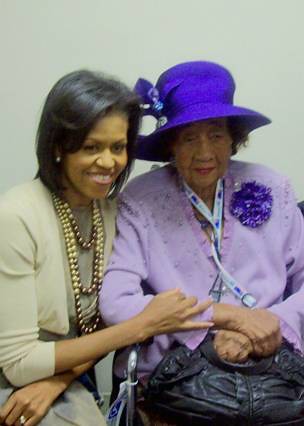 Dorothy Height with First Lady Michelle Obama in 2009-- Photo Credit: Anne Brewer
 Dorothy Height at press conference with fellow Civil Rights colleagues and leaders James Farmer of CORE and Whitney Young of the Urban League in 1963
 Dorothy Height watching Dr. King give his famous 'Dream' speech at 1963 March on Washington on platform dais in front of Lincoln Memorial

 Paul Hosefros/The New York Times Dorothy Height in 2003

Interview with Dr. Dorothy Height on her 97th birthday in 2009--Sponsor:The CLIO Exchange
http://www.nytimes.com/2010/04/21/us/21height.html?nl=us&emc=politicsemailema4
All,
The legendary Dorothy Height (1912-2010)--community organizer, social activist, organic public intellectual, dynamic, indispensable leader on major questions of both race and gender, and civil and human rights champion--has gone on to join the ancestors at age 98. She left a very strong and indelible legacy and her many extraordinary contributions to the most important social movements of the 20th and 21st centuries will never be forgotten...
Kofi
Dorothy Height, Largely Unsung Giant of the Civil Rights Era, Dies at 98
By MARGALIT FOX April 20, 2010 New York Times
Dorothy Height, a leader of the African-American and women’s rights movements who was considered both the grande dame of the civil rights era and its unsung heroine, died on Tuesday in Washington. She was 98.
The death, at Howard University Hospital, was announced jointly by the hospital and the National Council of Negro Women, which Ms. Height had led for four decades. A longtime Washington resident, Ms. Height was the council’s president emerita at her death.
One of the last living links to the social activism of the New Deal era, Ms. Height had a career in civil rights that spanned nearly 80 years, from anti-lynching protests in the early 1930s to the inauguration of President Obama in 2009. That the American social landscape looks as it does today owes in no small part to her work.
Originally trained as a social worker, Ms. Height was president of the National Council of Negro Women from 1957 to 1997, overseeing a range of programs on issues like voting rights, poverty and in later years AIDS. A longtime executive of the Y.W.C.A., she presided over the integration of its facilities nationwide in the 1940s.
With Gloria Steinem, Shirley Chisholm, Betty Friedan and others, she helped found the National Women’s Political Caucus in 1971. Over the decades, she advised a string of American presidents on civil rights.
If Ms. Height was less well known than her contemporaries in either the civil rights or women’s movement, it was perhaps because she was doubly marginalized, pushed offstage by women’s groups because of her race and by black groups because of her sex. Throughout her career, she responded quietly but firmly, working with a characteristic mix of limitless energy and steely gentility to ally the two movements in the fight for social justice.
As a result, Ms. Height is widely credited as the first person in the modern civil rights era to treat the problems of equality for women and equality for African-Americans as a seamless whole, merging concerns that had been largely historically separate.
The recipient of the Presidential Medal of Freedom and other prestigious awards, Ms. Height was accorded a place of honor on the dais on Jan. 20, 2009, when Mr. Obama took the oath of office as the nation’s 44th president. In a statement on Tuesday, he called Ms. Height “the godmother of the civil rights movement and a hero to so many Americans.”
Over the years, historians have made much of the so-called “Big Six” who led the civil rights movement: the Rev. Dr. Martin Luther King Jr., James Farmer, John Lewis, A. Philip Randolph, Roy Wilkins and Whitney M. Young Jr. Ms. Height, the only woman to work regularly alongside them on projects of national significance, was very much the unheralded seventh, the leader who was cropped out, figuratively and often literally, of images of the era.
In 1963, for instance, Ms. Height sat on the platform an arm’s length from Dr. King as he delivered his epochal “I Have a Dream” speech at the March on Washington. She was one of the march’s chief organizers and a prize-winning orator herself. Yet she was not asked to speak, although many other black leaders — all men — addressed the crowd that day.
Ms. Height recounted the incident in her memoir, “Open Wide the Freedom Gates” (PublicAffairs, 2003; with a foreword by Maya Angelou). Reviewing the memoir, The New York Times Book Review called it “a poignant short course in a century of African-American history.”
Dorothy Irene Height was born on March 24, 1912, in Richmond, Va. Her father, James, was a building contractor; her mother, the former Fannie Burroughs, was a nurse. A severe asthmatic as a child, Dorothy was not expected to live, she later wrote, past the age of 16.
When Dorothy was small, the family moved north to Rankin, Pa., near Pittsburgh, where she attended integrated public schools. She began her civil rights work as a teenager, volunteering on voting rights and anti-lynching campaigns.
In high school, Ms. Height entered an oratory contest, sponsored by the Elks, on the subject of the United States Constitution. An eloquent speaker even in her youth, she soon advanced to the national finals, where she was the only black contestant. She delivered a talk on the 13th, 14th and 15th Amendments — the Reconstruction Amendments —intended to extend constitutional protections to former slaves and their descendants. The jury, all white, awarded her first prize: a four-year college scholarship.
As Ms. Height told The Detroit Free Press in 2008, “I’m still working today to make the promise of the 14th Amendment of equal justice under law a reality.”
A star student, the young Ms. Height applied to Barnard College and was accepted. Then, in the summer of 1929, shortly before classes began, she was summoned to New York by a Barnard dean.
There was a problem, the dean said. That Ms. Height had been admitted to Barnard was certain. But she could not enroll — not then, anyway. Barnard had already met its quota for Negro students that year.
Too distraught to call home, as she later wrote, Ms. Height did the only thing possible. Clutching her Barnard acceptance letter, she took the subway downtown to New York University. She was admitted at once, earning a bachelor’s degree in education there in 1933 and a master’s in psychology two years later.
Ms. Height was a caseworker with the New York City Welfare Department before becoming the assistant executive director of the Harlem Y.W.C.A. in the late 1930s. One of her first public acts at the Y was to call attention to the exploitation of black women working as domestic day laborers. The women, who congregated on street corners in Brooklyn and the Bronx known locally as “slave markets,” were picked up and hired, for about 15 cents an hour, by white suburban housewives who cruised the corners in their cars.
Ms. Height’s testimony before the New York City Council about the “slave markets” attracted the attention of the national and international news media. For a time, the publicity was enough to drive the markets underground, though they later re-emerged.
In 1946, as a member of the Y’s national leadership, Ms. Height oversaw the desegregation of its facilities nationwide. In 1965, she founded the Y’s Center for Racial Justice, which she led until 1977.
While working for the Y in the late ’30s, Ms. Height was chosen to escort the first lady, Eleanor Roosevelt, to a meeting of the National Council of Negro Women. There, Ms. Height caught the eye of Mary McLeod Bethune, the council’s founder, who became her mentor.
As the council’s president during the most urgent years of the civil rights movement, Ms. Height instituted a variety of social programs in the Deep South, including the pig bank, in which poor black families were given a pig, a prize commodity. In the mid-’60s, she helped institute “Wednesdays in Mississippi,” a program that flew interracial teams of Northern women to the state to meet with black and white women there.
Ms. Height, who long maintained that strong communities were at the heart of social welfare, inaugurated a series of “Black Family Reunions” in the mid-1980s. Sponsored by the National Council of Negro Women and held in cities across the United States, the reunions were large, celebratory gatherings devoted to the history, culture and traditions of African-Americans. Hundreds of thousands of people attended the first one, in Washington in 1986.
From 1947 to 1956, Ms. Height was also the president of Delta Sigma Theta, an international sorority of black women.
Besides the Presidential Medal of Freedom, awarded by President Bill Clinton in 1994, Ms. Height’s many honors include the Congressional Gold Medal, awarded by President George W. Bush in 2004. The two medals are the country’s highest civilian awards.
Ms. Height, who never married, is survived by a sister, Anthanette Aldridge, of New York City.
If despite her laurels Ms. Height remained in the shadow of her male contemporaries, she rarely objected. After all, as she often said in interviews, the task at hand was far less about personal limelight than it was about collective struggle.
“I was there, and I felt at home in the group,” she told The Sacramento Bee in 2003 “But I didn’t feel I should elbow myself to the front when the press focused on the male leaders."
Ms. Height received three dozen honorary doctorates, from institutions including Tuskegee, Harvard and Princeton Universities. But there was one academic honor — the equivalent of a bachelor’s degree — that resonated more strongly than all the rest: In 2004, 75 years after turning her away, Barnard College designated Ms. Height an honorary graduate.
http://www.google.com/imgres?imgurl=http://farm4.static.flickr.com/3209/2827300140_7e452f8384.jpg&imgrefurl=http://cchronicle.com/&usg=__rLQot7UpX7d9YdppYXVeqRvhOjQ=&h=426&w=304&sz=39&hl=en&start=18&um=1&itbs=1&tbnid=rcFpRHggRQn4rM:&tbnh=126&tbnw=90&prev=/images?q=Dorothy+Height+images&um=1&hl=en&sa=X&tbs=isch:1
The Incredible Height: The Life and Legacy of Dorothy Height
April 22, 2010
By Eryn-Ashlei Bailey
Dorothy Height left behind a legacy of activism when she passed on Tuesday morning April 20, 2010. She lived for almost an entire century and has played a major role in shaping what this country has become. Dorothy Height fulfilled her desire of always wanting to work towards justice while she was alive. Height worked alongside civil rights actors such as Dr. Martin Luther King Jr., Bayard Rustin, and other members of the Big Six civil rights activists. Her passing has left her community in mourning. She has impacted every American that is alive in the U.S. today. Her work will continue to affect Americans yet to be borne.
Height should be recognized for her contributions to gender and racial equality. W.E.B DuBois was one of the first civil rights leaders to recognize that black civil rights and women’s rights were related issues. DuBois was partially responsible for fusing the rights of black women with civil rights and catapulting women like Dorothy Heights to the forefront of the civil rights campaign. Height’s sorority, Delta Sigma Theta, participated in the legendary women’s suffrage march down Pennsylvania Avenue in Washington D.C. the night before Woodrow Wilson took office.
Heights initiated into Delta Sigma Theta in 1939 at Columbia University. The black sorority movement was essential for young black women attending college from post-slavery and into the 1970’s. As a black woman during such racial torrential times, Height’s sorority, Delta Sigma Theta, was a source of support, inspiration, and camaraderie with fellow scholarly black women who could encourage young Height.
First Lady Michelle Obama on the left of Dorothy Height; Photo Credit: Anne Brewer
During the time of Height’s collegial education, blacks were not allowed to quarter on white campuses. Hence, sororities organized to protect black students from persecution as well as to provide housing for those students who were not allowed to live on campus according to Paula Gidding’s book In Search of Sisterhood: DELTA SIGMA THETA and the Challenge of the Black Sorority Movement. According to Giddings: “ [Height's] position made her keenly aware of the issue of job opportunities for Black women.” A quote in Gidding’s book describes Height as “cultured, refined, well poised, and a clear thinker.” Gidding’s book follows Height’s work within the sorority and notes that in 1965, during the adrenaline rush of the civil rights movement, black sororities established more public service programs . Height was president of Delta Sigma Theta from 1957-1956.
Her membership in an African American sorority propelled her connections for her numerous endeavors. Dorothy Height attended meetings of Big Six members that fought for civil equality. She allied with Dr. Martin Luther King Jr. for the march on Washington for Jobs and Freedom in 1963. She had intended to speak but the plan didn’t come to fruition because of her gender. She aided in establishing the National Council of Negro Women, the Young Women’s Christian Association (YWCA), and the Center for Racial Justice. Heights dedicated energy to promoting a nuclear black family with her annual Black Family Reunion that has been held in Washington D.C. since 1986. She worked to bring equality to voting booths, education, and black men and women through employment, housing, and desegregation of public facilities.
The queen of the civil rights movement, Dorothy Height, has left a fine example for young civil rights activists who are committed to continuing her work. Issues of race and inequality have not disappeared in the U.S. With inspiration from Dorothy Height and countless other members of the civil rights movement, young people can carry forth with Height’s vision of equality with a renewed enthusiasm. One of Height’s particular areas of focus was education. Hence, the key to continuing the life and legacy of Height’s is educating oneself thoroughly. In so doing, one can change the world and reach incredible heights.
You can read more about Dorothy Height by picking up her memoir entitled: Open Wide the Freedom Gates.

Wednesday, April 14, 2010
Documentary Filmmaker Connie Field On Her New Film about South Africa and the Global Anti-Apartheid Movement
 From new film 'Have You Heard From Johannesburg?', which opens April 14 at New York City's Film Forum. Photo: Mike Tomlinson, IFL
http://www.documentary.org/content/have-you-heard-johannesburg-epic-song-freedom
All,
The following excellent article and interview by journalist and editor Chuleenan Svetvilas is an indepth examination of an extraordinary new eight-part documentary film that was produced and directed by acclaimed political filmmaker Connie Field. The film 'Have You Heard From Johannesburg? (the title and theme music is taken from a famous 1977 song by African American singer/songwriter Gil Scott-Heron) is an exhaustive eight and a half hour epic dealing with the heroic global anti-apartheid movement that over a 50 year period played the determining role in the dismantling of one of the most oppressive and truly evil regimes on this planet. Field's riveting and highly informative documentary dramatically reminds us that it took a disciplined, dedicated, and rigorously unified international struggle to assist the valiant South African revolutionaries of the African National Congress (ANC) and a number of other smaller and equally militant organizations within South Africa itself to finally bring down a ruthless white supremacist state that ruled for decades under frankly neofascist conditions.
Kofi
Published by International Documentary Association (http://www.documentary.org)
'Have You Heard From Johannesburg?': An Epic Song of Freedom
Film Review and Interview with Connie Field
by Chuleenan Svetvilas
 Photo: Impact Visuals, Archives & Special Collections at the Thomas J. Dodd Research Center
Connie Field was racing against time in 1996 when she first began working on her remarkable documentary series 'Have You Heard From Johannesburg?' Many of her interview subjects were quite old, and she knew filming needed to start as soon as possible. These people had played crucial roles in the epic story she wanted to tell: the history of the global anti-apartheid movement.
Fortunately, Field was able to capture the insight and observations of an incredible array of people before they passed away-- Govan Mbeki and Walter Sisulu, members of the African National Congress (ANC) who were imprisoned along with Nelson Mandela; Baroness Barbara Castle, a member of the British Parliament who was deeply involved in the anti-apartheid movement in England; and Ger Wagner, the CEO of Royal Dutch Shell Group, to name a few. More than 20 of Field's interviewees are no longer alive.
Field interviewed more than 130 people for the documentary, traveling to Australia, England, France, the Netherlands, New Zealand, Norway, South Africa, Sweden and all over the United States. Have You Heard From Johannesburg is told in seven parts; the first three stories are each about an hour long, followed by four feature-length (90 minutes, on average) stand-alone films, for a total running time of eight-and-a-half hours.
Parts One through Three are Road to Resistance, which focuses on the early history--the official implementation of apartheid in South Africa in 1948, the inspiring beginnings of a mass movement, and the imprisonment of ANC members, including Nelson Mandela; Hell of a Job, the extraordinary story of Oliver Tambo, the unsung hero of the ANC who lived in exile for more than 30 years, endlessly organizing and mobilizing support to end apartheid in his homeland; and The New Generation, which chronicles the struggles of young people in South Africa and the worldwide response to the apartheid regime's ruthless response to the Soweto uprising in 1976.
Parts Four through Seven are Fair Play, about the global movement to ban South Africa from competing in sports (from the 1964 Olympics to rugby matches in the 1980s); From Selma to Soweto, the story of the anti-apartheid movement in the United States, President Ronald Reagan's role in supporting the South African government through his policy of "constructive engagement," and the incredible impact of African-Americans on US foreign policy; The Bottom Line, about the successful worldwide grassroots campaigns to force corporations to stop doing business in South Africa and put intense economic pressure on the government to end apartheid; and finally, Free at Last, the culmination of decades of global grassroots movements, the South African government's increasingly oppressive response to protests, and the campaign to free Nelson Mandela.
The director and her team combed through more than 1,500 hours of archival footage and 6,000 photos to create the series. Since 2000, they have been organizing the footage and working on various edits. But as Field is quick to note, they also faced lean times on occasion and thus were in "low gear." Organizing the massive amount of material was daunting, but Field is no stranger to nonfiction film. She conducted hundreds of preliminary interviews before choosing five women to feature in her 1981 documentary The Life and Times of Rosie the Riveter, and she had directed (with Marilyn Mulford) Freedom on My Mind (1994), an Academy Award-nominated documentary about the struggle to register black voters in Mississippi in the 1960s. In 2007 she completed ¡Salud!, a documentary about Cuba's role in working toward healthcare equity worldwide.
In her latest project, Field uses familiar documentary elements--talking heads, archival footage and photos, and music--to bring to light a story that has never been told in its entirety. Oftentimes she juxtaposes her interviews with riveting film and television footage of her interview subjects when they were decades younger and on the frontlines protesting, giving speeches or interviews. Though the majority of her interviewees were part of the global anti-apartheid movement, Field also gives plenty of time to white South Africans who were members of the government or involved in business or sports during the apartheid era.
She does an admirable job pulling the stories together, sometimes with uneven results, but the entire series is well worth seeing. It is also is a cogent and timely reminder that people can indeed build a global movement and force an unjust government to change.
Have You Heard From Johannesburg? makes its world premiere at Film Forum in New York beginning April 14 and then opens in the San Francisco Bay Area at the San Rafael Film Center on June 25 and the Roxie Theater in San Francisco on June 27. The series will also be screening in London, Vancouver, Washington, DC and South Africa. Steps International is managing the international television distribution.
Field will soon be preparing a six-part, 52-minute (per episode) version for Europe (minus From Selma to Soweto because it's a US-based story). Other broadcasters are taking different packages. Active Voice is doing community outreach.
Documentary magazine caught up with Field by telephone as she was putting together the final edits to Free at Last and getting ready for her sound mix.
 Connie Field with Have You Heard From Johannesburg series editor Gregory Scharpen.
Documentary: Have You Heard From Johannesburg? takes a sweeping look at the worldwide struggle against apartheid in South Africa. How did you decide to make this subject the focus of your film?
Connie Field: The subject of it really is the global movement that affected apartheid; it's really not about apartheid. It's not about how things changed in detail inside South Africa. It's basically taking a subject that most everyone in the world could be appalled by. Then the question was, What then did the world do? Who did what? What were the obstacles?
And it starts basically with the United Nations' creation of the declaration of human rights [in 1948]. That was the same year that apartheid was instituted, when the Nationalist government came to power in South Africa. So it's really about that and it's about the working together of both the internal movement and external movement because it's an incredible example of how that can work. And it's also an extraordinary story about how a liberation movement for the people living under apartheid goes about galvanizing the entire world to work with them. The ANC was probably the most successful movement ever to do that.
D: Is one of your goals to try to inspire people and remind them that mass movements can work?
CF: Well, yes. As Howard Zinn used to always remind us, often it's people's history that doesn't get told. And this story, to my chagrin, has never gotten told. There have been various books over the past ten years, but nothing that focuses on it from a global perspective.
D: Was that one of the challenges of making this film?
CF: Yes, it was a big challenge, but I don't think that I thought about that. I was interested in this incredible story, and it would also be the kind of story that I could get some funding for because I have a background in this kind of thing. There was no way to get a sense of the scope of it because it's not like I could read a book, like the history of the Civil Rights Movement and choose my focus, which is a lot easier.
I started filming early because I was very afraid that the elders in this group of interviewees would die before I had a chance to figure out the story. So I started shooting in 1997. I knew that I would be going to the National Endowment for the Humanities, which had funded my past work, so I knew I had to write very detailed scripts. In essence I thought if I could write the real scripts based on real material, as opposed to when you write a script before you've ever done anything, it would help the filmmaking process; unfortunately it didn't. So I ended up shooting first and gathering material.
D: Did you conceive of this as a series from the beginning?
CF: Yes, but a shorter one. I conceived of it as a four-part, one-hour [per episode] series. That was my first conception, then it grew to a three-part, two-hour [per episode] series and then it morphed into a 12-part one-hour [per episode] series, and now it is what it is.
Every time you're discovering a story, like the story we did on the United States, From Selma to Soweto [originally released in 2007 as Apartheid and the Club of the West]. We were just editing, and we said, Oh my goodness, this is a whole story here. I was trying to narrow down what I was going to focus on. I decided I was only going to deal with what got done outside of South Africa that really had an effect on South Africa. So that was the guiding force. I also focused on the campaigns in South Africa that had biggest impact outside of South Africa.
The US story fit that concept because once the United States sanctioned South Africa, it was a big political blow to the regime that had always depended politically on the United States at the United Nations and various places. As you see in the story, this was done over Ronald Reagan's veto. It's a very significant story in the United States because it's the first time African-Americans had really shaped US foreign policy to this degree. That's also why I put the divestment movement inside that episode.
The divestment movement was part of the strategy to economically strangle the apartheid regime. Divestment was the movement in the United States--it was stronger here than anywhere else because our economic system is privatized. Here, the pensions are in private funds and invested in the stock market. In Europe, where you have social welfare states, people's pensions are with the government. So you had all kinds of opportunities to have an effect that way that wasn't true in other parts of the world. It was the base movement inside the United States that also built the movement that then affected Congress.
D: How did each episode develop?
CF: We just laid everything out chronologically--and that structure never worked because we would have something happening over here that didn't culminate until two episodes later. It was just not the way to organize this. In essence I've done it as a hybrid, between chronological and thematic.
D: Were you thinking of doing something similar to Eyes on the Prize?
CF: Yes, I had that in mind. When Eyes on the Prize was done, people understood how important the Civil Rights Movement was. I don't think people have any notion of this [anti-apartheid movement] particularly. It's not in the global lexicon, though it should be. It was one of the most important human rights struggles of the last century.
D: How did Eyes on the Prize influence this project?
CF: It didn't, really. This [project] was a process of discovering the stories, which was not true for a lot of Eyes on the Prize; there had been numerous things written about the Civil Rights Movement. So I was constantly discovering, Oh, this happened...Oh, this is what went on here. It was not a tamable beast. It was a different process.
 From Have You Heard from Johannesburg. Photo: Maribuye Centre Archives
D: Rather than interview academics or historians, you made the conscious decision to interview people who were involved in either fighting or upholding apartheid.
CF: I always do that. I learned to do that with Rosie, and it's a style I haven't quit since then. I base the films on the participants, on the people who lived that history, not the people who are commenting on it.
D: Music is a critical part of the film. The title of your film comes from Gil Scott-Heron's seminal song "Johannesburg" How did you decide on that title and theme music for the series?
CF: I like music titles. I like that song. That song was an early song from the '70s. I liked what it meant: Have you heard from them? The story is about them organizing the world and the world joining with them. It's not about the world coming in to save the South Africans. So that song expresses that.
I always collect music as a part of the story, music from the period and of the places as being a critical part of the story.
D: Did you do most of the interviews?
CF: I did all of them. I do all my own interviewing. It's stressful as a director because I had to do about three a day, and you have to prepare a lot and be so focused. When I made the film ¡Salud!, it was like taking a vacation, even though for that film we had to go to places that had no roads, and live in houses that had no electricity and no running water. But that was a vacation compared to this.
D: Was there a reason that you didn't interview Nelson Mandela?
CF: Well, two reasons: One, it wasn't super easy to interview him and the second thing, he's actually a very small part of this story because he's in prison the whole time the story takes place. So I just figured it wasn't really necessary to bother him. I didn't really need it for the story, and he has so many things pressing on him that I just didn't feel I had to be one of them, so I didn't pursue it. I hope he sees it.
D: What were some of the obstacles to making the film?
CF: We were very under-funded. This is a huge project and it's international, so we really did it on a shoestring. It meant that I made it the way I make other things: I keep the very top level very lean and save my money for spending it on cinematographers and editors. It's also why I did this all myself; I was the producer and the director. I didn't have enough money to do it otherwise, to hire other producers. Also, I’d been very lucky to work with a couple of extremely loyal young people. Without them, it would have been really depressing. Twelve years ago, I first hired Greg Scharpen to do the archiving, and he then became an Avid assistant and eventually the series editor. Sage Brucia, a terrific graphic designer, has been with me for six years. They stuck around for a really long time and for not a lot of money.

 From Have You Heard From Johannesburg. Photo: Peter Magubane
D: So how were you able to support yourself?
CF: Well, I did another film that I got well paid for [¡Salud!]. It paid our rent. My staff is very generous with me. We used to have a great situation in our building before Saul Zaentz sold it in 2004. He never raised the rent for almost 20 years. I was able to get a ton of space for very little, so I didn't have much overhead. All of those factors allowed me to continue on what we had and make it stretch.
D: Will you be screening at Encounters, the doc fest in South Africa?
CF: I don't know. I'm really looking for places that will show the whole thing. I'm hoping to get set up in South Africa and hopefully the Ford Foundation will help out with that. I want to present it in Johannesburg, Durban and Cape Town in three different venues. It'll probably be a free showing. I'm hoping that will happen in July and August. I'm also hoping to go to Zanzibar in July with the whole thing.
I know that the features [Parts Four through Seven] are stand-alone, but if you see the Oliver Tambo story [Part Two: Hell of a Job], all those become more meaningful. The first three parts give you a lot of context to have a lot more meaning than just seeing the features by themselves.
I'm hoping that the people who write about film will write about the whole story so that that whole story will start to be out there in the universe. Nobody has given this stamp out there in the world that says this is an important thing that happened and people should know about it.
Chuleenan Svetvilas is a writer and editor based in Oakland, California.
Saturday, April 10, 2010
Justice John Paul Stevens Retires from the Supreme Court Leaving President Obama With An Opportunity To Nominate A New Justice
 Win McNamee/Getty Images
Justice John Paul Stevens at the White House in August 2009
http://www.nytimes.com/2010/04/10/us/politics/10stevens.html?nl=us&emc=politicsemailema1
All,
The retirement of Supreme Court Justice John Paul Stevens--by far the most consistently progressive and socially responsible figure in the Court over the past 30 years and the acknowledged leader of the minority liberal wing in the Court--is a major political loss for real progressivism on the Court and thus represents a serious challenge and absolute imperative for Obama to aggressively replace him with a genuine liberal/progressive nominee...
Most importantly Obama must be willing to go all the way and FIGHT HARD for him/her when the notorious Republican right inevitably tries to eliminate and destroy the nominee--a process which will of course begin immediately...
If the President doesn't have the vision and guts to do so we will all live to regret it bigtime...
Kofi
Retirement of Justice Stevens Is Political Test for Obama
By Sheryl Gay Stolberg and Charlie Savage
New York Times
WASHINGTON — The announcement by Justice John Paul Stevens on Friday that he would retire at the end of this term gives President Obama the rare opportunity to make back-to-back appointments to the Supreme Court during the first two years of his presidency.
But it also presents Mr. Obama with a complex political challenge: getting a nominee confirmed in the thick of a midterm election season, when Republicans, fueled by the intensity of their conservative base, are angling to knock him down, and Democrats, despite having lost their 60-vote supermajority in the Senate, are eager to flex their muscles after passing a landmark health care bill.
Justice Stevens’s announcement, delivered to the White House on Friday morning in a one-paragraph letter that began “My dear Mr. President,” set off an immediate scramble among the parties and a raft of advocacy groups that have been assembling dossiers on potential successors.
The three leading candidates — Mr. Obama is considering about 10 names all told, the White House says — present the president with a spectrum of ideological reputations, government backgrounds and life experiences. His choice will shape the battle to win Senate confirmation of his nominee.
In effect, the president must choose to be bold or play it safe.
Merrick B. Garland, 58, an appeals court judge here, is well liked by elite legal advocates and is widely considered the safest choice if Mr. Obama wants to avoid a confrontation with the minority party. A former federal prosecutor who worked on the Oklahoma City bombings, he is well-known in Washington’s legal-political community, where some view him as a kind of Democratic version of Chief Justice John G. Roberts Jr.
Elena Kagan, 49, is solicitor general but has never been a judge and does not have a lengthy trail of scholarly writings, so her views are less well documented. But as the dean of Harvard Law School, she earned respect across ideological lines by bringing in several high-profile conservative professors, and she is a favorite among some in the extended Obama circle, who see her as smart and capable. Her relative youth means she could shape the court for decades to come.
Diane P. Wood, 59, a federal appeals court judge in Mr. Obama’s home city, Chicago, is seen as the most liberal of the three. She has been a progressive voice on a court that is home to several heavyweight conservative intellectuals. As a divorced mother of three, she brings the kind of real-life experience that Mr. Obama considers important. But her strong support for abortion rights would provoke a confrontation with conservatives. On Friday, the anti-abortion group Americans United for Life warned that a Wood nomination “would return the abortion wars to the Supreme Court.”
In making his selection, Mr. Obama confronts a vastly altered political landscape from the one he faced just 11 months ago, when he nominated Sonia Sotomayor to fill the seat left vacant by the retirement of Justice David H. Souter.
With the election of Senator Scott Brown, Republican of Massachusetts, Democrats can no longer hold off a Republican filibuster. And while Democrats are emboldened by the health care vote, the passage of the legislation — which is already facing legal challenges from Republicans who say it is unconstitutional — has left the Senate more polarized than ever and created a climate in which the courts could easily become an election issue.
For the court, Justice Stevens’s departure will be the end of an era. He is the longest-serving justice by more than a decade, and he is the last remaining justice to have served in World War II. (He joined the Navy, where he served as a cryptographer, the day before Pearl Harbor was attacked.) His leaving will not, however, change the composition of the court; although he was appointed in 1975 by President Gerald R. Ford, a Republican, he has become one of its most reliably liberal members during his nearly 35-year tenure, as the court drifted ever rightward.
Still, for Mr. Obama, who taught constitutional law at the University of Chicago (where he was a colleague of Judge Wood), the vacancy is an unmistakable chance to put his stamp on the direction the court takes for the next several decades. Mr. Obama is already engaged in an unusual public confrontation with the court over its recent decision in the Citizens United case, which lifted strict limits on corporate spending in elections. On Friday, during a brief appearance in the Rose Garden, he made clear that the case was very much on his mind.
He vowed to “move quickly” in announcing a nominee. Senior advisers said they expected a decision within the next several weeks. The president said he would look for a candidate who possessed what he described as qualities similar to that of Justice Stevens: “an independent mind, a record of excellence and integrity, a fierce dedication to the rule of law and a keen understanding of how the law affects the daily lives of the American people.”
And, in what legal scholars took as a clear swipe at the Citizens United decision (for which Justice Stevens wrote the dissent), the president said he would look for a justice who “knows that in a democracy, powerful interests must not be allowed to drown out the voices of ordinary citizens.”
The White House already has a Supreme Court nomination team in place, with the selection process run by the new White House counsel, Robert F. Bauer, and overseen by Rahm Emanuel, the chief of staff. Once a nominee is picked, Mr. Bauer’s wife, Anita Dunn, who is Mr. Obama’s former communications director, will coordinate with advocacy groups. Vice President Joseph R. Biden Jr., who was chairman of the Senate Judiciary Committee during some of its most contentious confirmation fights, is also likely to play a crucial role.
On Capitol Hill, Senator Patrick J. Leahy, the Vermont Democrat and the current chairman of the Judiciary Committee, said in an interview that Justice Stevens told him privately several weeks ago of his intentions. Mr. Leahy said he had had “long conversations” with the president and wanted a vote before the August recess so that a new justice could be installed by the start of the fall term.
“When I was the most junior Democrat in the Senate, I voted for John Paul Stevens,” Mr. Leahy said. “He was a Republican nominated by a Republican president who was going to be up for election, and we voted for him, and proudly.”
That kind of bipartisanship is highly unlikely this time. While both sides agree that Republicans are unlikely to use a filibuster to block a Supreme Court nominee, conservatives will at the very least use the debate to make the case for Republican candidates. They say they will calibrate their fight to how liberal they perceive Mr. Obama’s choice to be.
“If it’s someone like Merrick Garland, I don’t think there’s going to be a big fight,” said Curt Levey of the Committee for Justice, a conservative advocacy group. But Mr. Levey said a more liberal nominee, like Judge Wood, would “be a field day for the conservative groups.”
But leaders of liberal groups, like Nan Aron of the Alliance for Justice, are suspicious of conservative assurances that a more centrist nominee would face little opposition. They note that Justice Sotomayor was perceived by many on the left as far more centrist than they would have preferred, and yet Republicans portrayed her as a “judicial activist,” and 31 voted against her.
“No matter who he sends up,” Ms. Aron said, “I think Republicans are loaded for bear and will oppose.”
Democrats were divided Friday over whether Mr. Obama would pick a fight with Republicans or shrink from one. But Walter E. Dellinger III, who was acting solicitor general under President Bill Clinton, predicted passion, as much as politics, would play a role in Mr. Obama’s decision.
“I think that in choosing a Supreme Court justice,” Mr. Dellinger said, “the president is less likely to compromise and more likely to go with his heart than on any other matter.”
Peter Baker contributed reporting.
President Must Have the Courage To Choose a Progressive Supreme Court Nominee

http://rawstory.com/rs/2010/0404/scholar-justice-make-dent-wing-majority/
All,
IF Ms. Heins is correct in asserting that Obama "won't have the courage to rebuild the liberal wing of the Supreme Court" then he will deserve his self imposed fate as a spineless political coward and empty charlatan who openly sold out the nation to curry favor with a dangerously demented and oppressive national rightwing element and their superwealthy and overtly criminal corporate sponsors who are-- and will remain-- fierce political, economic, and ideological enemies of any semblance of mass democracy in the United States...In that case only we will be the losers...Stay tuned...
Kofi
Exclusive: Obama ‘won’t have the courage’ to rebuild the liberal wing of the Supreme Court
By Gavin Dahl April 4th, 2010
The Raw Story
President Barack Obama should have the courage to try to rebuild the liberal wing of the Supreme Court but he probably won't, free speech attorney Marjorie Heins told Raw Story in an exclusive interview conducted Saturday.
When Obama appoints a new Justice to replace John Paul Stevens, "that Justice wouldn't make a dent in the 5 justice right-wing majority that ruled in Citizens United," Heins said.
Heins, founder of Free Expression Policy Project, and longtime director of the ACLU arts censorship project, pointed out Anthony Kennedy's going to be the swing Justice regardless of whom Obama appoints to replace Stevens. "Obama has had a record of being very slow with judicial appointments below the Supreme Court level," said Heins. "And that's of course where most cases are decided and that's a real problem. At the Supreme Court level, he won't be slow, but he'll probably be very cautious." "In the days when we had Black and Douglas and Brennan and Marshall there really was a liberal wing on the Supreme Court," she continued. "And now what we really have is a right wing and a moderate wing, we don't really have a liberal wing anymore. Or liberalism has moved so far to the right that we can't recognize it. Obama should have the courage to try to rebuild the liberal wing, but he probably won't because he doesn't want to create any more controversy and opposition than necessary in Congress."
This weekend Justice John Paul Stevens confirmed that he plans to retire during Obama's first term as president. Sen. Arlen Specter (D-Pa) told Fox News Sunday he hopes Stevens waits a year, to avoid gridlock while Senate business is so backed up due to battles over health care legislation.
"I think we need someone who will step into Justice Stevens' shoes, who will be very tough on the issues of executive power," Specter said. "A federal court this past week declared the warrantless wiretapping unconstitutional. I think we need the kind of balance that Justice Stevens has provided to offset the majority on the court which is in favor of executive power." Justice Stevens, in his passionate Citizens United v. FEC dissent, wrote of the majority's threat to democracy, because one of the fundamentals of free speech is that all, not just the richest or most powerful, need to be heard. Vast majorities of Americans who identify as members of each of the major political parties are unhappy with the Supreme Court's decision, which fundamentally changes campaign finance laws in the United States. In a detailed article posted to the Free Expression Policy Project website immediately after the Supreme Court decision, Heins highlighted Stevens' description of the majority's argument as "aggressive judicial activism" suffering from "glittering generality."
Heins guesses he wrote the Citizens United dissent in the way he did because he wants it to be remembered. "Stevens is about to turn ninety and still plays tennis," she said, laughing. "He's incredible. One of the ironies of course is Stevens was the author of Pacifica, the case that allows the FCC to censor what it thinks is indecent on the airwaves."
Stevens is considered a first amendment champion now, but in 1978, just after he was appointed to the court, Heins says, "He didn't get it. He wrote this Pacifica decision which he ought to apologize for some day, and perhaps he even will. But certainly in Citizens United he's trying to make a very strong statement against this kind of -- beyond judicial activism -- it's very unusual what the Supreme Court did."
The key swing vote on the Supreme Court used to be Justice O'Connor, Heins points out, but now it is Kennedy. "Kennedy is usually pretty good on first amendment issues although in this case his interpretation was 'oh the first amendment doesn't allow us to make distinctions between speakers.' That's what Stevens was referring to as a 'glittering generality.' Of course government can make distinctions between speakers! Corporations are not individuals and they don't have the same rights as individuals, but Kennedy did not agree with that."
Supreme Court Justice Stevens Retires and a Search for a Replacement Begins
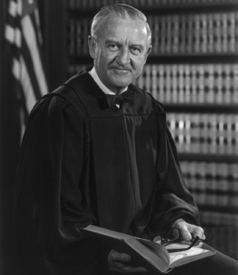 Official portrait of Justice John Paul Stevens, taken on January 27, 1976. (Photo: Library of Congress)
http://www.truthout.org/supreme-court-justice-stevens-will-retire-june58430
Supreme Court Justice Stevens Will Retire in June
09 April 2010 by Michael Doyle and David Lightman
McClatchy Newspapers
t r u t h o u t
Washington - Supreme Court Justice John Paul Stevens announced his retirement Friday, setting up a long-anticipated confirmation battle during the most sensitive of political seasons.
Stevens, who'll turn 90 on April 20, said that after 34 years on the high court it was time to step down.
"It would be in the best interests of the court to have my successor appointed and confirmed well in advance of the commencement of the court's next term," Stevens said in a letter to President Barack Obama.
A Supreme Court representative conveyed Stevens' letter to the White House at about 10:30 a.m. Friday. White House Counsel Bob Bauer called Obama with the news, reaching the president aboard Air Force One as Obama was returning from the nuclear treaty signing in Prague.
Stevens' departure in June at the end of the 2009-10 term will remove from the court its most senior justice as well as the linchpin of what's now the liberal wing. Stevens' retirement also will ensure that the Supreme Court is front and center during the upcoming midterm congressional elections.
For conservatives and liberals alike, the pending court vacancy will become a way to mobilize the troops as well as to wage proxy fights over hot-button issues, including abortion and wartime security.
For Obama, the vacancy provides a challenge and an opportunity.
Republicans are eager to unite around an issue that will engage their conservative base. The president's Democratic Party controls 59 seats, one short of the number that's needed to stop a filibuster. In a break with tradition, some senators have signaled that they wouldn't be reluctant to filibuster a Supreme Court nominee.
Stevens' departure also provides Obama a second chance to shape the court with a relatively young justice who'll be interpreting the Constitution for the next several decades. Because of Stevens' relatively left-of-center position, the new justice may not tip the court's overall ideological balance.
"I hope that senators on both sides of the aisle will make this process a thoughtful and civil discourse," said Democratic Sen. Patrick Leahy of Vermont, the chairman of the Senate Judiciary Committee.
"Americans can expect Senate Republicans to make a sustained and vigorous case for judicial restraint and the fundamental importance of an evenhanded reading of the law," cautioned Senate Minority Leader Mitch McConnell, R-Ky.
The experience of the president's first court choice, Justice Sonia Sotomayor, may foreshadow the political conflict to come. Thirty-one Republicans opposed her, including some who'd traditionally crossed party lines to approve Democratic choices in the past.
Nine Republicans voted for Sotomayor.
Gary Jacobson, a political scientist at the University of California, San Diego, put it this way: "Given the track record of the Senate Republicans, anybody Obama supports is going to be attacked. They're geared up for battle. The question is can Republicans oppose the nominee without embarrassing themselves too much."
Having named Sotomayor as the first Hispanic justice on the Supreme Court, Obama now could make more history.
The nine-member court has never had more than two women serving at a time. Obama can change that if he reinforces Sotomayor and the 77-year-old Justice Ruth Bader Ginsburg with a female nominee. Several possibilities exist.
A very serious contender is Solicitor General Elena Kagan, the first woman to hold that prestigious post as well as the first female dean of Harvard Law School. An appellate judge who was considered seriously last year, Diane Wood of the Chicago-based 7th U.S. Circuit Court of Appeals, knows Obama from their teaching at the University of Chicago Law School.
The president might name a second Hispanic justice, Judge Kim Wardlaw of the 9th U.S. Circuit Court of Appeals.
Michigan Gov. Jennifer Granholm comes from the non-appellate world, which Obama has said he'd like to make use of.
Alternatively, the president might try to name the first Asian-American to the court. Although only seven Asian-Americans are serving on the federal bench, the president could search elsewhere; for instance, by tapping his top State Department lawyer, former Yale Law School Dean Harold Koh.
Regardless of whom the president nominates, a fight is all but guaranteed. Currently, only six of Obama's 15 appellate court nominees have been confirmed.
The last unanimously approved Supreme Court justice was Anthony Kennedy, 22 years ago. The deeply conservative top Republican on the Senate Judiciary Committee, Sen. Jeff Sessions of Alabama, was himself rejected by Democrats when he was nominated to the federal bench, and midterm election years generally only harden positions.
Stevens' retirement announcement wasn't unexpected. He'd hired only one law clerk for next year, instead of the customary four. He would've had to serve roughly another year to become either the oldest or the longest-serving Supreme Court justice.
The longest-serving justice will remain William O. Douglas, whose seat Stevens took after President Gerald Ford nominated him in 1975.
At the time, Stevens was serving on the 7th U.S. Circuit Court of Appeals. A Northwestern University Law School graduate and Navy veteran of World War II, he was deemed a conventionally moderate Midwestern Republican at the time.
Stevens "has earned the gratitude and admiration of the American people for his nearly 40 years of distinguished service to the judiciary, including more than 34 years on the Supreme Court," Chief Justice John Roberts Jr. said Friday. "He has enriched the lives of everyone at the court through his intellect, independence and warm grace."
McClatchy White House Correspondent Margaret Talev also contributed to this report.
Ideology and Politics in the Supreme Court: The Imminent Danger of a More Rightwing Court

http://www.truthout.org/a-supreme-court-shift-right58439
All,
We had all better hope this is not the case! If so it will be an unmitigated DISASTER for us all...
Kofi
A Supreme Court Shift to the Right?
09 April 2010
by Ruth Marcus
Op-Ed
t r u t h o u t
Washington - Here is an unsettling thought for those who waited eight years to have a Democratic president appointing judges: Barack Obama could well end his first term with a more conservative Supreme Court than the one he inherited.
This is, I hasten to admit, premature speculation -- even with the not-so-surprise announcement that Justice John Paul Stevens, the anchor of the court's liberal wing, is retiring.
First, the president's only nominee so far, Justice Sonia Sotomayor, has not even finished her first term. Where she turns out to be on the ideological spectrum in comparison to the justice she replaced, David Souter, is unknown.
Second, the accuracy of this conjecture will depend hugely on who the president selects to fill the vacancy.
Finally, as the examples of Souter (named by President George H.W. Bush) and Stevens (selected by President Gerald Ford) demonstrate, predictions about a new justice's future performance can make weather forecasting look like an exact science.
Nonetheless, it's entirely possible that a more conservative court could be Obama's paradoxical legacy -- particularly if he only serves a single term. The likelihood of the court shifting to the right is greater than that of its moving leftward.
In part, this could have been predicted even before Obama took office. It reflects less about him than it does the identity of the departing justices, one liberal followed by another. The next oldest justice is Ruth Bader Ginsburg, 77. Conservatives are reaping the benefits of Bush father and son having selected justices who were relatively young. Justice Clarence Thomas was 43 when tapped, Chief Justice John Roberts was 50, and Justice Samuel Alito was 55.
It would likely only be in the case of a departure by 74-year-old Justice Antonin Scalia -- not likely to occur voluntarily during Obama's presidency -- or Justice Anthony Kennedy, 73, that the president would have an opportunity to dramatically alter the court's ideological makeup.
But there's little in Obama's record as president to suggest that he would expend enormous capital to secure the most liberal possible justice. From the point of view of liberal groups, Obama's nominees to the lower federal courts have been, overall, disappointingly moderate.
In selecting Sotomayor, Obama acted with an eye less to ideology than to ethnicity; the selection does not offer much of a clue into what the president is looking for, as a matter of constitutional interpretation, in future justices. The conservative howling about Sotomayor's alleged radicalism had as little basis in reality as do the parallel assertions about Obama.
As Tom Goldstein of ScotusBlog put it after analyzing Sotomayor's appellate record, "Our surveys of her opinions put her in essentially the same ideological position as Justice Souter." From her conduct on the bench so far, there's no reason to change that assessment.
By contrast, it's likely, although not certain, that a Stevens replacement will be more conservative than the retiring justice. If so, this would be largely in line with history. In an interview with Jeffrey Rosen for The New York Times Magazine in 2007, Stevens noted, "including myself, every judge who's been appointed to the court since Lewis Powell (chosen by Richard Nixon in 1971) has been more conservative than his or her predecessor." Stevens excepted Ginsburg, who replaced the more conservative Byron White.
In any event, Stevens' replacement is almost certain not to be as influential a player on the left as the departing justice. As the court's senior associate justice, Stevens spoke immediately after the chief justice during the court's discussion of cases; he had the power to assign opinions and some influence with swing justices such as Kennedy and, before her departure, Sandra Day O'Connor.
I'm not arguing, by the way, that Obama would go wrong by picking a Stevens successor likely to edge the court to the right. Indeed, there is a plausible argument that a justice viewed as more centrist might have more chance of bringing along conservative colleagues on a particular issue. Two of those mentioned as possible replacements, Judge Merrick Garland of the federal appeals court in the District of Columbia, and Solicitor General Elena Kagan, are viewed as more moderate than Stevens. Either would be a superb choice.
But my prediction stands: The court that convenes on the first Monday in October is apt to be more conservative than the one we have now.
Ruth Marcus' e-mail address is marcusr@washpost.com.
(c) 2010, Washington Post Writers Group
All republished content that appears on Truthout has been obtained by permission or license.
Subscribe to:
Posts (Atom)