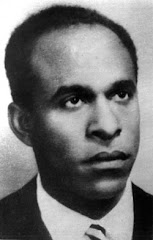
2026 IS THE CENTENNIAL YEAR OF SIX MAJOR WORLD HISTORICAL FIGURES ALL BORN IN 1926: Miles Davis, John Coltrane, Fidel Castro, Chuck Berry, Oscar Brown, Jr. and Michel Foucault
The Electric Miles (Parts 1 and 2)
Greg Tate. Flyboy in the Buttermilk: Essays on Contemporary America. New York: Simon & Schuster, 1992, pp 68–85.

MAJOR ELECTRIC AGE MILES DAVIS RECORDINGS
(1968-1975):


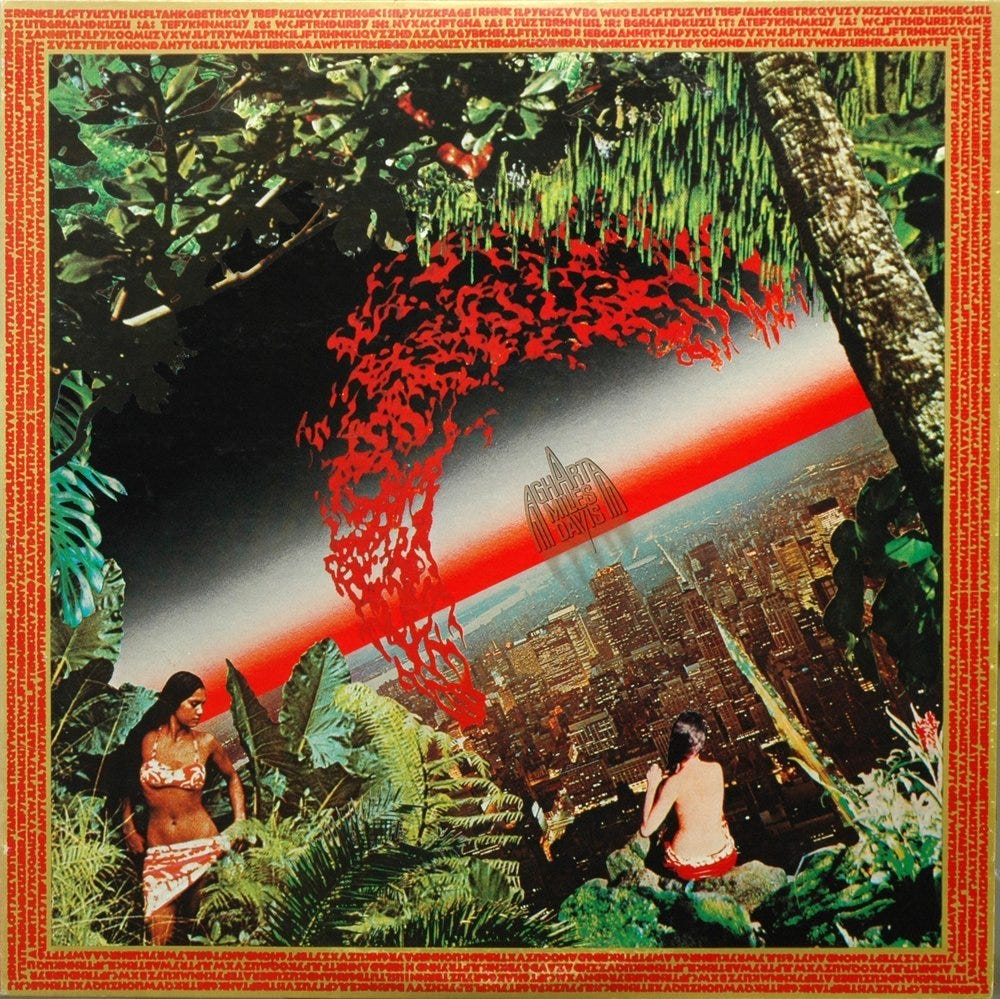
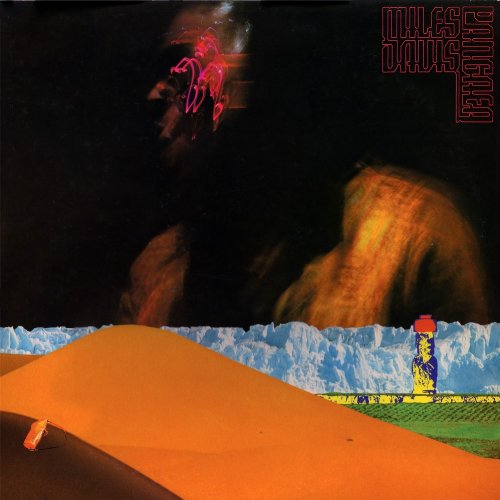
Part 1
Before we begin, look: exhaustive essays on Miles Davis usually bore me to no end too. Mainly because like many other Miles freaks, I've got a few theories of my own—theories so inspired by devotion as to border on church dogma, theories so anxiously air-tight they favor choking off dissension from within the ranks, theories so conceived in arrogance all some other critical bozo will receive for repeating them is my Olympian nod of approval. Like religious passion, musical hero worship has often been known to induce such high hysteria—and on the subject of especially Miles's electric music, I won't deny raising the spectre of Cain over a few of my brother critics' heads. Not that I'm alone in this: ask some of the M.F.'s I know (Miles Freaks, okay?) what they think of the three bios out on my man, and they'll tell you, dem's fighting words jack!
Given the gauntlet before me, I'll explain upfront why I'm throwing my two cents into this ring. The first reason is down beat asked me to put my head on the chopping block. The second is that I've got a few axes to grind. Because to my mind the music Miles made between 1969 and now demands revisionist history, and no writer in my reading has made sense out of its revolutionary aesthetics or adequately appreciated its visionary beauty. Nor have many, if any, of Miles's critics shown enough background in black pop to place his electric music within the cultural context which spawned it. Moreover, when it comes to his last mid-'70s band, I don't think many of my, uh, esteemed colleagues could make heads or tails of Agharta or dig it in reference to Funkadelic and a punk revolution that was just around the corner. And don't let me get started on how none of them realized Miles's lead axe of the period, Pete Cosey, is the Cecil Taylor of the guitar (just hold on to that catchy bit of hype for later), or how they slept through the fact that Miles presaged current directions in modern pop and "classical" forms, or how deviously he revamped his own past and black music's avant-garde through the use of electronics.
Besides feeding all that grist through the critical mill, what we're about to do here is explain the continuity between electric and acoustic Miles, and then beyond that, make a case for his much disparaged Agharta as the work of a genius not in decline, but in ferocious forward motion, on fertile ground.
In his 1967 essay "The Changing Same (R&B and New Black Music)" Amiri Baraka (LeRoi Jones) prophesied a black music unity which would be "Jazz and blues, religious and secular ... New Thing and rhythm and blues." Seven years after its release, Miles's Agharta remains the closest anyone has yet come to seeing Baraka's prophecy of black populist modernism made manifesto. And the evolutionary process through which Miles will come to deliver this Unity Music sermon from the mount begins not with Bitches Brew, but with the 1966 release of Miles Smiles. On that LP Ron Carter and Tony Williams so radically transform—indeed, so radically subvert—the role of bass and drums in improvised music as to make the solo skeins of Miles, Wayne Shorter, and Herbie Hancock come off like a tightwire act run through a rain forest: adventuresome perhaps, but given the setting more a quixotic excursion than one undertaken by musicians in full command of their senses.
Operating in telepathic and telekinetic union, Carter and Williams mutate the LP's uptempo song forms into mazes where the bassist's line, pulse, and meter shifts and Tony's symphonic drum rituals impose syllogisms which dictate rather than follow the soloist's logic. Confronted by these puzzling equations. Miles, Wayne, and Herbie respond with linear, if contorted, harmonic suspensions—superbly balanced ones which don't play off the Carter/Williams axis so much as they cut across and through it. In a way, their brainy bypass surgery reminds you of the two-dimensional floorplans astrophysicists make up to map three-dimensional space. Because when there's no fixed center of gravity, space warps and curves like crazy, and when there's no set groove, what Carter and Williams lay down can't really be navigated, but at best only graphed, like space-time.
The impact of Carter and Williams's relativity theorems on Miles's music was instantly felt in the band's next two releases, Sorcerer and Nefertiti. These LPs, however, bear the stamp of not only the Einstein and Heisenberg of bass and drums, but Ornette Coleman as well. Jumping ahead a bit and taking the physics metaphor a quantum leap further, we can say that these two poles of attraction made Miles's polite chamber jazz world collapse, implode, then expand towards infinity from the inside (or as Wayne Shorter once put it, "... from the soul on out to the universe"). To be more musically specific about these transformations is to say this: the difference between the music on Miles Smiles and the two subsequent dates is that on the latter the melodies function more like elliptical motifs than like heads made to kick off a string of solos. On Sorcerer and Nefertiti melodic interpretation as much as harmonic improvisation is the rule—with the melodies continually being recycled into the improvs as structural devices. These lend symmetry and shape to the moody mise-en-scene which unfolds on both records, phrase by eerily lyrical phrase. Once again Carter and Williams play a game of disorderly conduct by design. Only wise to their antics now, the soloists don't compete. Instead they open up expansive passages which possess the thematic resolve of the melodies at every turn. And inasmuch as this music makes freedom, composition, chaos, and lyricism coexist in a collective improvisational organism—well, given all that, it refers us back to Ornette, whose music not only influenced Miles's direction in this regard but also, I believe, inspired the odd-man-out lines in Wayne Shorter's writing and playing. Coleman and Lester Young have been overlooked as influences on Shorter, though all three's strange phrasing is alike in seeming alienated, innocent, and knowing at the same time. Miles's is too, but then I've always had this other theory that the two musicians most responsible for Miles's style were Prez and Lady Day, especially on ballads.
As amazing as the level of playing and writing in the quintet was, equally so was the way in which each member's conception gave itself over to the fabric of the music. Ron Carter, for example, brought a rhythmic feeling which throbbed like the human pulse rather than just grooved you to death. And by working it into his extraordinary harmonic technique, made free improvisation sound as cyclical as eight-to-the-bar. Shorter's writing gave the band an intellectual persona equal parts rational, mystical, and romantic, while his playing provided crazed models of mathematic concision. Whether comping or improvising, Hancock gave the music orchestral breadth, and Tony's drumming, a force of nature unto itself, came across like a cross between a hurricane, a forest fire, and a cast of thousands conducted by somebody like Ellington, Disney, De Mille, Rostropovich, or hey, Tony Williams himself.
As an arranger and leader, what Miles did in making this cabal of artful astrophysicists cohere is create a context where the sublime funk of Kind of Blue and the firepower of Milestones could be fused, accelerated, and then fissioned across four years and now nine albums—records whose breadth of texture, mood, and composition remain unparalleled in small band jazz. As a trumpeter, Miles made the band focus on how much emotional energy could be compressed, expressed, and released through pure tonality and imaginative phrasing. Like Lester Young's, Miles's solos have come to possess a quality of the inevitable, almost as if their beginnings contained their middles and ends. And as Miles's playing has assumed this capacity, so too has his way of organizing a band into a cellular organism. In all of Miles's bands since the one Trane fell into, the parts have come to sum up the whole, as the players became the tunes and the tunes then became absorbed into the ensemble's communal sound. As Ellington achieved with orchestras, Miles has done with smaller units: turned them into palettes which somehow work for him more like the democratic process than like pigments did for Picasso. Though for all of that, his charisma has also made each band seem like the product of his genius alone.
This enigmatic quality isn't of course Miles's and Duke's alone, since all the great jazz leaders have had it, as have the baadest urban bluesmen—like Howlin' Wolf, Muddy Waters, and Chuck Berry—and the major black pop innovators as well: Berry Gordy, James Brown, Sly Stone, Jimi Hendrix, Stevie Wonder, Marvin Gaye, George Clinton, Maurice White, and Bob Marley. Now, speculation as to why Miles stepped out of a black musical universe where Ellington to the nth degree was the directive into a parallel one where funk was its own reward has assumed motives on Miles's part that are racial, social, sexual, psychological, economic, and even musical. 1 think all probably apply, though only when understood as integral to the music rather than as proof of the music's supposed lack of integrity. Because to a brilliant hustler like Miles, all games are the same, everything is related, nothing is really left to chance, and like a good offensive runner, he knows how to cover his ass and when to take orders from the sidelines, if not, in fact, from his accountant.
On the purely musical side however, I think Miles left post-bop modernism for the funk because he was bored fiddling with quantum mechanics and just wanted to play the blues again. The blues impulse is charismatic because of its sexual energies, but as a ritual process, as a rite of passage, the blues are alluring because they make the act of confession a means of publicly redeeming your soul, as Mass does for Catholics and as speaking in tongues does for those in the holy-roller church. As an art form the blues are seductive because they give soulfulness and simplicity the same constructivist value harmonic complexity has in European symphonic music and bebop. This is what makes the blues the most difficult black music to perform convincingly, because not only do you have to convert its cliches into your own style, but you've also got to mean every note since the only thing more tired than some tired blues is some fake funk—and that's because when you come looking for the Holy Ghost and find nothing but some lame hypocrites thumping on a back-beat in the name of The One, well, your soul it do get weary. Leading us to reconsider Bootsy Collins's axiom: "Fake the funk and your nose got to grow" (see "The Pinocchio Theory"). Proof that Miles's funk wasn't fake, wasn't just the fetish work of a clone, is in the fact that all the real funkateers I know dig Miles as much as they do some P-Funk, and that's because the feeling in Miles's funk is just as for real while the schizzy musical fusions are maybe twice as surreal.
What Miles heard in the musics of P-Funk progenitors, James Brown, Jimi Hendrix, and Sly Stone, was the blues impulse transferred, masked, and retooled for the Space Age through a low-down act of possession. And in them all he probably recognized pieces of himself. Like James Brown he was a consummate band-leader who knew his way around the boxing ring, like Sly he was a bourgeois boy who opted to become a street fighting man, and like Jimi he was a musician whose physical grace seemed to declare itself in every bent note and sensual slur. Visual evidence of Sly's and Jimi's impact on Miles can be seen in the dress styles he adapted from them: the multiple-hued fabrics and talismanic flow of attire. Now, I could try to be all cool and academic like only music is what matters here, but that would be about some bushwah. Because when you're out to unravel a legend, study of myth and material is inescapable, the two having assumed like proportions over time. And what any longtime Miles freak will tell you is that for every Miles Davis album, there's a crapload of Miles Davis anecdotes equally astonishing to the average human mind. And when Miles began exploring Sly's and Jimi's musical frontiers he also, so the stories go, made his way through a few human mine fields they'd cut across before him. So that we don't, however, degenerate into rank gossip here, we'll keep the discussion pretty much musicological—though with the understanding that when myth intervenes, we'll lay that sucker into it too.
With Bitches Brew Miles crossed over the threshold of bebop into Sly's and Jimi's stereovision New Jerusalems. While the music on Miles in the Sky, Filles de Kilimanjaro, and In a Silent Way marks his progressive march to the brink, it also depicts, in retrospect, how cautiously the move was being made. In fact, for my money, the least interesting things about those LPs are their overt pop borrowings. Miles in the Sky haunts for how it extends upon the elliptical heads concept; Kilimanjaro is provocative for how much static tension Miles generates using James Brown riffs, for Tony Williams's ambient drumming, and for how the voicings on "Tout de Suite" spookily predict Herbie Hancock's Mwandishi band. (If you ever want to experience musical deja vu, play "Tout de Suite" back-to-back with "Water Torture" from Hancock's Crossings, then hear that against the third and fourth sides of Agharta—curiouser and curiouser.) As for In a Silent Way, it just may be the epitome of the beautifully designed and recorded artifact, being something like a Taj Mahal of music: that rare, manmade thing of beauty which rivals nature in its fixed and dreamlike universal perfection.
The difference between these records and Bitches Brew is the difference between Alex Haley's Roots and the novels of Gabriel García Márquez. Where Haley prosaically told a people's hellish collective history and redemption, Márquez through more poetic language uses history as a means into his folk's collective unconscious, that Jungian hideaway where the spooks really sit beside the doors to the kingdoms of heaven and hell. Where J.B. and especially Jimi and Sly took music isn't something that can be summed up in a few quotidian riffs any more than a Márquez novel can be experienced through synopses. It's at once a thought process, a textural language, and a way of reordering tradition and myth unto itself. On evidence of Bitches Brew and the music thereafter, Miles seems to have believed that to go as out there as them he would first have to lose some ego and enter their worlds not as a master but as a disciple. And in time as he became a master of their language, he would affirm Jung's observation that in ritual sacrifice, the sacrificer gives of himself to become one with the sacrificee.
On musical terms though, Bitches Brew is an orchestral marvel because it fuses James Brown's antiphonal riffing against a metaphoric bass drone with Sly's minimalist polyrhythmic melodies and Jimi's concept of painting pictures with ordered successions of electronic sounds. Bitches Brew can also be heard as a devilishly Milesish takeoff on John Coltrane's spiritual energy music and that music's saxophone, percussion, and bass batteries, modal improvs, tone clusters, and cosmic yearnings, thus making the double-set rank as an act of comic blasphemy with Richard Pryor's Preacher routines or with certain African genesis myths in playing prankster with God's tongue by dragging the heavens back into the province of the vernacular—namely the streets—and the language of the streets, the dozens, sermons made scatologies which find their musical parallel in what funk did to gospel. The streets though aren't just a funky run of avenues where mom-and-pop stores front for numbers runners and storefront churches pimp for jackleg preachers. They're also a place of mystery and romance, and given that Miles knows them and their music inside out, it's not surprising that the melodies on Bitches Brew croon, sway, and reveal them selves like those of such balladeers as Smokey Robinson, Marvin Gaye, Curtis Mayfield, and Stevie Wonder—all of whose gorgeous melodies and harmonies have yet to overcome the precious corn of Tin Pan Alley in the ears of other improvising composers—excepting Zawinul, Cecil Taylor, and Bennie Maupin, whose overlooked The Jewel in the Lotus ranks beside Miles's Great Expectations, Weather Report's Mysterious Traveller, and Cecil's Solo in channeling the charm of exotic musics into forms which are as tightly knit, free-flowing, and fetchsome as Stevie's, Smokey's, Curtis's, and Marvin's vocal arrangements.
In 1970 Miles recorded two live dates, Black Beauty—Miles Davis at Fillmore West and Miles Davis at Fillmore East. I've never cared for the latter because two bands are fighting for control on it: Miles's and Circle, the collective Chick Corea and Dave Holland formed with Anthony Braxton and Barry Altschul when they left Miles. In this battle of the bicameral bands, Miles's night-trippers dig into blues and ballads like they were victims for slaughter; the Holland/Corea twins meanwhile run away from the murder site to throw temper tantrums which are quite gonzo given the context, but lacking in the anthemic-cathartic qualities of say, Trane.
Black Beauty is another story altogether, debuting a 19-year-old bassist named Michael Henderson, who brings with him lessons learned from Motown's legendary James Jamerson and from maybe a few listenings to Ron Carter and Buster Williams besides. As far as focus and intensity, the performances of Zawinul's "Directions" and Shorter's "Masquelero," which open and close the double-set, get the prize hands down—primarily for the brassy blur of blips Miles phrases in implosive runs akin to Hendrix's experiments with backlooped guitar, and for Corea's explosive solos, which come about as close as anybody ever will to cutting Cecil Taylor and McCoy Tyner on Rhodes electric piano.
On evidence of the music that Miles released following Bitches Brew, it's clear he was out to create not only a new trumpet voice, but also a new improvisational process—one which would enable his electric band to make music equal, on its own terms, to the music of the quintet. What he discovered, however, as he progressed further into electronics, was that those terms would first compel him to overturn his prior aesthetic sensibilities, and to enter into a zone of musical creation as topsy-turvy as the world of subatomic physics—which is to say, one governed by laws as seemingly random as those of material reality seem fixed and eternally observable.
Part 2
Discussed in Part 1 of this essay was how Ron Carter and Tony Williams proposed a quantum model of the bebop universe—one wherein freedom and structure became wedlocked to the improvisational/compositional urge underlying all jazz. As in the labyrinthine narratives of Jorge Luis Borges, this seeming chaos of order and precision had a character half-polymath and half-mad, one part whimsical in nature, one part obsessive about functional design. From the resultant music we can deduce Miles gained insights from Carter and Williams into the ways in which jazz could be disintegrated and rearranged without having ever seemed to change face. What funk and black rock brought to Miles's speculations isn't unlike what considerations of gravity bring into speculations about four-dimensional space-time—namely a feeling for how the earthly parts of our being impact upon our perceptions of the cosmos, spacially and temporally. And similarly to modern physicists, Miles found in embarking upon his electric journey the relativity of his quantum experiments to the everyday ebb and flow of Afro-American popular culture.
Though the soundtrack Jack Johnson was recorded before either Fillmore date, it stands as the culmination of everything Miles had been reaching for since Filles de Kilimanjaro. A masterpiece, a landmark, a signpost, and a synopsis, the record sums up the first leg of Miles's electric reincarnation. What makes it a masterpiece is no less Miles's constructivist trumpet bursts than Michael Henderson's extraordinary bass playing on "Right Off," where Henderson's lines function as both an anchor and a flow chart, giving the music mucho cool, bottom, and movement. This performance can be heard as either 20-or-more minutes of imaginative grooving, or as 20-or-more metamorphic and metalogical minutes of extremely composed bass improvisation. In terms of instrumental prowess, it is rivaled only by mentor James Jamerson's work on Marvin Gaye's What's Going On, Boogie Mosson and Bootsy's more condensed rides with P-Funk, and Marcus Miller's throwdown on "Fat Time" from The Man with the Horn. Two models besides Jamerson which Henderson might have used were Carter (behind the infinity patterns on "Madness" from Nefertiti) and Buster Williams (check the fluid undergirding he gives Hancock's aqua-velvet arrangements on The Prisoner).
Jack Johnson is a signpost because it's a prelude to every major act of fusion in the '70s; on "Right Off" we hear where Zawinul learned to weave funk and bop into an organic continuum, hear John McLaughlin wail with Billy Cobham bashing away behind him, and hear Herbie Hancock break down on electric keyboards like solo and rhythm parts were one and the same. On "Yesternow"—whose creepy bass part is ripped right off of James Brown's "Say It Loud, I'm Black and I'm Proud"—we not only get a taste of Miles's direction from here on out, but can catch wind of Return to Forever and the harmolodic funk of Ornette Coleman and James Blood Ulmer (dig the overlays of polytonal thematicism against pulse). Besides all this prophetic stuff however, Jack Johnson is a bitch because of Miles's brilliant use of space and swinging single notes, and for the funked-up rhythms and passing chords he provokes McLaughlin into. (Their dialog here goes beyond call-and-response into formulating a communications system as complex as the
Yoruba people's talking drums.)
Following Jack Johnson came Live-Evil, which tracks like a gonzo invasion of the ghetto by technically advanced booty snatchers from a parallel universe. This music finds counterpart only in the mutant funk rites George Clinton was taking to the stage around the same time—though I'll give Frank Zappa and Captain Beefheart their propers for wallowing in similar sties on the other side of the tracks. Listening to this music is like listening to a "History of the Blues" as told by Richard Pryor, George Romero, and Sun Ra. In it wretched excess is the norm, sinister-but-sarcastic sums up the tone, and blues riffs are continually being splattered like blood bags and revived as cartoon zombie figures. The trick about the music is that its textures rather than musicianship make it sound like garbage, like maggot-brained cosmic slop or, if you will, like cosmic debris (to cross-reference a funka-zappic tune or two). Because of this, to truly love the music you have to want in on this filthy mess as a way of life. I favor Clinton's and Miles's worlds over Zappa's and Beefheart's because Don and Frank run romper runs by dictatorship whereas Miles and Uncle Jam are more like groundskeepers at insane asylums for black and white radicals. Leading us back to the notion of genius through democracy rather than fascism. Miles took this principle even further than George, however, by nailing "The One" through collective subversion rather than perverse collective arrangements.
In this sense Live-Evil is also a riotous avant garde revival of New Orleans polyphony like the Art Ensemble of Chicago, using the blues to speak in tongues ancient and to the future. Besides, what Gary Bartz's sax does with Ornette and Shorter is all-out funk personified; what McLaughlin does to the blues and ragas is mondo pervo; Jack DeJohnette suspends backbeats in a levitation act like Houdini wouldn't believe; Keith Jarrett comps with Worrellian weirdness; Henderson's bass lines are as absurd as the adventures of Plastic Man; and Airto is a hoot. As for Miles, nobody outside of Hendrix and Jeff Beck has ever played a more hilarious wah-wah pedal.
Between bands in 1972, Miles conjured up a session which took its cues from Sly's There's a Riot Goin' On, Stockhausen's Telemusik/Mixtur date, and once again, The Streets (though this time we're talking the streets of the world). In On the Corner Sly's Riot vocalese turns up in Miles's raspy, guttural trumpet (only as Sly's singing sounds like Miles talks; who's influencing whom I wonder?). Sly's synaptic minimalism figures heavy in the big-band-converts-into-drum choir arrangements (only you get hints of this hookup in "Sivad" on Live-Evil, too, and Stockhausen's theories on random, mixed, and reprocessed sounds are a presence in "Gemini/Double Image," where two contrite melodies cross each other for a showdown on a sci-fi set). But from Ian Carr's new bio we learn Miles got excited over the Telemusik/Mixtur work because of how distortion converted acoustic sounds into electronic colors. Miles subverted this process to transform African, Indian, and funk rhythms into a One-World Festival. Anybody who thinks Talking Heads came up with anything new in terms of synthcraft and uncanny rhythm mixes on Remain in Light better check this one out, not to mention Bernie Worrell, Junie Morrison, Stevie Wonder, Edwin Birdsong, Leon Sylvers, and Greg Phillinganes—to name a few bloods overlooked in the race to crown Byrne and Eno the Kings of electric swing (Paul Whiteman and Benny Goodman, look alive).
Except for Miles's incendiary improvs, 1973's In Concert is little more than a sad rehearsal date put out for public consumption. The album which followed—Get Up With It—though is notable for three reasons: the protopunk "Rated X" which lays the groundwork for Agharta, and two 30-minute-plus works, "He Loved Him Madly," a wake held in honor of Ellington, and "Calypso Frelimo," a "dub fugue" in honor of the freedom fighters who liberated Mozambique from Portuguese oppression. The Ellington funeral is ambient music for the hereafter. Its colors, moods, and textures derive from Tibet, India, Micronesia, and Memphis. The three guitars favor sitars and soul band strokes; Miles's organ smears remind one of Tibetan harmonium voicings, while Henderson's bass sinks to lows as gut-plummeting as those in gamelan music. Across this aural sarcophagus Miles's horn sobs and hobbles like a bereaved widow in a shroud. Beyond mourning Duke, the piece seems to suffer more from wanting to join him in the afterlife.
"Calypso Frelimo" is a fugue because it is orchestrated with antiphonal coordination through its 32-minute thematic evolution. It is dub because, as in that Jamaican craft, musical ideas are restructured by their echoes, or if you will, by shadows of former selves. The work is also a suite in three movements: allegro, adagio, and allegro non troppo. As in reggae, the tonal center is a single bass drone, though in the adagio section, Henderson's suspenseful line variations and declensions dramatize the polytonal modulations of organist Miles and guitarists Pete Cosey and Reggie Lucas.
Cosey's staccato guitar simultaneously functions like a second set of congas to Mtume's, a second rush of cymbals to Al Foster's, a second steel drum simulacrum to Miles's Gnostic organ, a second rhythm guitar to Lucas's, and as one of three solo voices. In effect, the ensemble music isn't dissimilar to that of Sunny Adé or Steve Reich—especially in terms of its conversion of multiple melodies into polyrhythms and subtly swelling formal metamorphoses. Where Miles's work goes beyond theirs is in having his trumpet and Cosey's guitar improvise a swinging infinity of new colors, lines, lyrically percussive phrasings, and needlepoint-by-laser stitchings out of the given melody. The singularly transcendent thing about jazz is that it allows one human being's voice the right to assume universal proportions through self-expression in a collective framework. And because Cosey and Miles can continually solo, and enhance rather than rupture the communal fabric of the calypso, they celebrate jazz as a way of life and as an aesthetic model for the human community.
Where these principles take on their highest form of expression outside of Miles is in the music of Ornette Coleman's Prime Time and the Art Ensemble of Chicago. Where Miles goes beyond them on Dark Magus, Pangaea, and Agharta is in having an entire band of improvising composers onstage creating a pan-ethnic web of avant garde music locked as dead in the pocket as P-Funk. Heard in its 100-minute entirety, 1974's Dark Magus tracks as a surrealist collage of the crossroads where African rites and urban Afro-American means converge. In this it resembles the work of black artists Romare Bearden, Bettye Saar, and David Hammons, and poet Jayne Cortez. In the music we hear a patchwork assemblage of guitar and saxophone multiphonics riff over a logjam of percussion until squelched by more Gnostic organ and inaudible hand signals from Miles. What keeps this frenzied jungle boogie in sync are the systolic bass vamps of Henderson, who by this time had assumed as dominant a role in the band as the bass had in black pop, thanks to Larry Graham. Miles's horn work here is the finalized fusion of Stockhausen and Sly, scribbling blurbs of feline, funky sound which under scrutiny take on graphic shapes as wild and willed as New York subway graffiti. On Dark Magus Cosey's guitar leads are a cross between Miles, backlooped Hendrix, and Trane's sheets-of-sound. On Pangaea and Agharta his lines sizzle into exotic scales distorted to run subterranean channels while orderly tracking to thematic resolution.
Like Miles and Cecil Taylor, Cosey is a constructivist whose improvs affirm fellow architectonic-anarchist Taylor's belief that music from a man's innards will systematize that gut-bucket spillage on its own terms. For Cosey those terms derive from years studying the guitar systems of the country bluesmen, and from applying the microtonal intervals of sitars and koras to electric guitar. (In conversation recently, Cosey told me he has "32 systems for tuning the instrument," meaning Glenn Branca can sit down and Robert Fripp has got a lot of scales to go.) Cosey's improvs extend upon the orchestral guitar techniques of Hendrix by likewise moving successive waves of harmonic distortion (that's noise to you, mom) which have the logic and density of symphonies and the filth of the blues. Where his vast scalar armament takes him beyond Hendrix is in the elongation of microtonal scales into multidirectional hooks and tentacles of curvaceous, screeching sound. What's even more amazing is that he makes these monstrous creations swing like a Basie band arrangement or a tenor solo by some of his former employers named Sonny Stitt and Gene Ammons. For what it's worth, protopunk axemaniac Robert Quine claims Cosey as an influence, and hearing Agharta, Dark Magus, and Pangaea will make you think Keith Levene, Andy Gill, Adrian Belew, and Robert Fripp oughta own up too. Besides Hendrix, the only music which comes close to his in terms of all-out heavy metal furor and invention is the Sex Pistols' Never Mind the Bollocks, hardcore punk's Bad Brains, and what Eddie Hazel roared out of the gate with on Funkadelic's "Super Stupid" in 1971.
While Cosey and promethean firebreather Sonny Fortune dominate Agharta and Pangaea as soloists, these LPs are also magnificent ensemble works. Because by 1975 Miles, through his decades-old practice of paying cats to practice on the bandstand, had created the world's first fully improvisational acid-funk band— by which I mean one capable of extemporaneously orchestrating motifs from Santana, Funkadelic, Sly, Stockhausen, Africa, India, and the Ohio Players (check how their 1974 hit "Fire" gets revamped on Agharta's first side). The band's cohesion amidst sonic chaos knows no parallel in fusion, funk, rock, or either the black or white avant garde. And while others may have achieved similar ends since, these furthermuckers (sic) were making it up night after night on the road, making new music every time they hit like they'd been possessed by whatever god or demon demands that black musicians push themselves all the way out there and then some. In the final analysis, this is music in the spirit of jazz to me, r&b, New Music, and by way of abstraction, even the gospel truth.
Miles Davis at the age of 21 in 1947.
Photo by William Gottlieb

Miles Davis: The "Electric" Years

by Scott McFarland (August 1997)
by Scott McFarland (August 1997)
Let me just state off the bat that Miles’ music, from Bitches Brew on, is my favorite music on this planet (for a lot of reasons, some of which I’ll touch on in my closing paragraph). I’m going to structure this writeup around the albums which have been released from what I believe to be Miles’ most exciting and fertile years (1969 through 1975) : classics like Bitches Brew, A Tribute to Jack Johnson, On The Corner, Get Up With It, and Pangaea.
By the time 1969 rolled around, Miles had been looking towards and striving for new sounds for a while. His famed 60’s quintet had been together with only one personnel change for a five year-plus run; this band had consisted of Tony Williams on drums, Herbie Hancock on keyboard, Ron Carter on bass, and Wayne Shorter (who replaced George Coleman in 1964) on saxophone. Five years is a long time for a jazz unit to be together. What once seemed inventive and exciting had probably started to sound like cliché to Miles. That band featured great tone and instrumental virtuosity - but by Miles’ own account simplicity and directness had been lost. One can compare the straightforward, soulful reading of Wayne Shorter’s "Footprints" done on his own Adam’s Apple album (it’s also available on Blue Note’s excellent The Best of Wayne Shorter) with the version done by Miles’ quintet on Miles Smiles, where the tune becomes a backdrop for the usual pseudo-Spanish tinkling around and theatrical flourishes that characterized that band’s sound, at the tune’s expense, for an example of this.
Miles had been moving in a simpler, more "modal" (a term that he helped to popularize during the 50’s) direction for a while. Miles In The Sky from 1968 started with a brilliant, 16-minutes plus track "Stuff" which cycled and floated in a gentle soulful manner and sounded unlike anything that anyone else was up to at the time. Filles de Killemanjaro from 1968 marked the end of the old quintet, with Chick Corea and Dave Holland coming into the band partway through the album - the music occasionally rumbled and exploded, but was also marked by long, rather lovely modal sections. To me it sounds like ambient jazz. The buzz on this album in retrospect is that Miles was "flirting with rock forms". (This is actually one heck of an album - well worth purchasing. In addition to its other charms, and great playing by all concerned, Chick Corea’s lovely, peaceful cycling through the lengthy "Mademoiselle Mabry" is more than worth the price of admission).
Miles continued to flirt with what were certainly different forms, perhaps related to rock, or to soul. His next LP, In A Silent Way, was hailed as a groundbreaking effort although I feel it’s a bit overrated. The music was somewhat hypnotic and repetitive. Joe Zawinul and John McLaughlin had been recruited to play on the album, and their presence together with the restraint shown by the other musicians (for once, Tony Williams does not run rampant on the drums - he plays simple "rock" rhythms primarily) yielded what was again a very "ambient" album.
Miles wanted his music to get more basic, more in touch with a blues feeling. In his autobiography he states "See, when I used to listen to Muddy Waters in Chicago down on 33rd and Michigan every Monday when he played there and I would be in town, I knew I had to get some of what he was doing up in my music. You know, the sound of the $1.50 drums and the harmonicas and the two-chord blues". At this point he started to focus in on the more modern and aggressive sounds that would inform the rest of his works. His girlfriend Betty Mabry introduced him to Jimi Hendrix, and the two of them hit it off immediately. Miles appreciated the power in what Jimi was doing, as well as appreciating its grounding in blues and other black forms. Sly Stone and James Brown were also by Miles’ account big influences on what was about to become his new sound. Things were about to get a lot more African. "My Funny Valentine" was about to go out the window.
In August of 1969 Miles assembled numerous massively talented musicians into a New York City studio for the Bitches Brew project. He brought in "musical sketches" moreso than tunes - as he had 10 years previously during the Kind Of Blue sessions. The musicians would jam on themes according to Miles’ direction (during three "all-day" sessions), and the jams would be edited into pieces. It was an abstract way of working, a bit different than anything done previously by an artist with commercial viability - the tape recorder would deliberately be used, in "artistic" fashion, to shape the pieces after the fact. Hence musicians could explore ideas at length, without a burden of knowing that everything that they played during a "take" would necessarily be presented to the public with their name on it.
What makes the album superb is the playing. The music swings gently, in multiple directions at once. It is a new kind of swing. Jack DeJohnette and the other drummers on this recording deserve a world of credit for their subtle, tugging playing. Multiple electric keyboards, usually two per track, swing and swagger across this musical landscape (Chick Corea, Joe Zawinul, and Larry Young are at the keys). John McLaughlin contributes electric guitar playing which is occasionally possessed of brilliance. Bennie Maupin’s bass clarinet, Wayne Shorter’s sax, Airto’s percussion, and the basses of Dave Holland and Harvey Brooks also contribute towards the music’s tonal palette. On top of it all we have Miles. His playing had always been minimalistic, and he had always been comfortable playing blues-based forms. Here he found his most natural expression, and contributed forcefully to the music. He laid down the real stuff, the essence of music, on his trumpet and topped the whole thing off brilliantly.
A rough guide to the Bitches Brew album - Side 1, "Pharoah’s Dance", is an abstract keyboard-oriented piece. Due to its absence of a memorable central theme, it’s a strange choice to open the album with, but it is a nice slice of music and of subtle swing. Side 2, "Bitches Brew", is massive. The composition, a combination of ambient theme and deep groove, comes together perfectly. Side 3 features the deeply rhythmic, gently bouncing "Spanish Key" (built on an interesting drum figure) and the shorter, slightly chaotic "John McLaughlin" (McLaughlin claims to have been as surprised as anyone when the LP came out and he saw that Miles had named this tune after him). Side 4 features the gritty, juke-joint-ish, artfully extended funk of "Miles Runs the Voodoo Down" and the album’s closer "Sanctuary" which builds towards a frightening climax. The pieces provide landscape portraits more than they do traditional tunes or "featured player" improvisation. It was a new way of playing, based on cooperative effort which was centralized and focused on rhythm. In that regard the album reminds one of African cultures and of their music.
It was one heck of a record and was promoted as being such. Miles proceeded to put out a couple of live 2-LP sets during the next year. Black Beauty was the first (I’m not sure that it was released in the U.S. at the time). It’s a fairly honest and straightforward recording of his band in April of 1970 with Chick Corea, Jack DeJohnette, Dave Holland, Airto, and Steve Grossman. The sound is a bit cacaphonous; it’s the sound of jazz players raising flashy, energetic hell on electronic instruments. The band keeps things swinging along throughout the whole set. Chick Corea fans will especially want to hear this as his electronic keyboard is the most prominent voice in much of the music, and as always he plays extremely well. The recording gets a bit "psychedelic" in part through his use of effects. It reminds me a bit of the German rock scene from the early 70’s; it’s easy to imaging getting stoned to this record and digging it. I consider it a good but not great album.
At Fillmore came out next and drew some attention. It documents a 4-night stint opening for Laura Nyro at the Fillmore West; each 25-40 minute set is edited down to an approximately 20-minute album side. The intention was apparently to show that the band had an organic flow and that even when they played the same material night after night that it would be a "unique" experience. In retrospect the approach seems silly; who wants to hear the same basic set, chopped and diced different ways, four times in a row? The band sound is a bit difficult and cacaphonous and the editing only makes things more confusing. Of course there are some good moments; I always love it when that keyboard riff (sounds like a clavoline, usually) kicks in to start off the deep Bitches Brew groove. However, I believe that this album is basically a mess.
At this point in time Miles was opening for rock performers, dressing in his flashy manner of the time, and was generally thought to be courting a rock audience. The majority of critics, pundits, and listeners didn’t seem to understand what was going on with him. Miles was occasionally criticized from this point on for deserting jazz, and for "losing the beauty which had been present in his music".
The intended follow-up to Bitches Brew was Live-Evil. The majority of this 2 LP set consists of some lengthy jams done at the Cellar Door in Washington DC (these were augmented with a few new studio recordings). The live tracks are oriented around Jack DeJohnette’s aggressive and energetic funky drumming, Keith Jarrett’s pulsing, squealing, and frequently soulful keyboards (for a guy who has since gone on to decry the popularization of electronic instruments, Jarrett could really raise some hell when he was in the mood to), Michael Henderson’s repetitive basslines (Henderson had just joined the band - his playing here is not as dead-on as it later became), guest star John McLaughlin playing some fantastic electric guitar solos, and Airto putting some funky percussion on in places. Davis and sax player Gary Bartz play (and play well), but also lay out for huge periods of time while this band grooves. This, to me, really does sound like a "fusion" of rock (and soul) and jazz. The aggression and form of rock are present, but the players still have a tendency to meander and show off in the general style of jazz players. If you are in the mood for extended jam pieces (and it seems as if in the early 70’s, everybody was), these are pretty good for the most part. The opening track, "Sivad", might burn a hole through your stereo system with its relentless funk for a while before it moves into the soulful, minimalist piece later known as "Honky Tonk". "What I Say" is a nice 21-minute slice of frenetic modality, too. Sides 3 and 4 feature a band grooving at length in a manner that has its charms, but probably isn’t the kind of thing that you’d want to start your morning with every day.
Miles cut what I regard as his next masterpiece in 1970, during five sessions which were fused into 2 sidelong pieces. A Tribute to Jack Johnson was done as a soundtrack for a film about the legendary heavyweight boxing champion. Side 1, "Right Off", is an extraordinary jam. In addition to some bouncing bass (Michael Henderson, I believe), rock-solid drums (Billy Cobham, I believe), and some rollicking organ (I won’t hazard a guess), John McLaughlin’s electric rhythm guitar playing is right on the mark. Imagine Keith Richards crossed with Jimi Hendrix crossed with a classically trained guitarist - he sounds something like that. The rhythm of the piece is deep and constant, and greatly hypnotic. Just try to shut the music off in the middle - see if it keeps playing in your head. Each member of the group displays a perfect, close-to-the-bone devotion to the groove and the whole things rocks massively. Side 2, "Yesternow", is spacier. It seems put together from a few different takes (it actually includes some of the "In A Silent Way" music towards the end). It generates some ghostly groove and eventually makes way for a memorable freak-out guitar solo by Sonny Sharrock (with Chick Corea working Sonny’s echoplex box, apparently).
Sharrock remained uncredited on this album, as did many other of the players present on the sessions. For some reason, only the players signed to Columbia received credit on the cover. I was told some of the participants by Sharrock once - I probably don’t remember everyone that he mentioned to me, but I do remember the names Chick Corea, Jack DeJohnette, Dave Holland, and himself as participants in addition to the musicians listed on the cover (Davis, Steve Grossman, Michael Henderson, Billy Cobham, John McLaughlin, and Herbie Hancock).
Miles continued to play and continued to record. His music was starting to bewilder the buying public, who had been confronted with a stream of 2-LP sets that didn’t conform to their expectations of what Miles Davis should be doing (namely, playing lyrical trumpet over a jazz background). Some of his sessions, like the ones which eventually came out in 1974 on Big Fun, had to wait for years before being released. Big Fun has 4 side-long pieces : "Great Expectations/Mother Laranja" which is a 27 ½ minute slice of almost prototypical Miles, based on a repeating phrase over a flowing backdrop; "Ife", a long static piece with a repetitive bassline which is really a drag (it sounds more like an experiment in audience tolerance than it does music); "Go Ahead John" which is a small-band jam featuring John McLaughlin on guitar (playing choppy strokes with wah-wah, just like Reggie Lucas & Pete Cosey would go on to do), with some nice soloing over Jack DeJohnette’s busy drumming (which is heavily phased for the sake of funkiness); and "Lonely Fire" which is a bit aimless. The music throughout this album is not Miles’ best, but Teo Macero’s production here is quite creative, and the record ends up being a decent ambient-styled listening experience thanks to the strength of Sides 1 & 3.
Some other early 70’s sessions came out even later, in the early 1980’s, on a couple of 2-LP sets : Circle in the Round and Directions. Among the highlights to be found on those sets are the killer McLaughlin/Cobham-fueled funk of "Duran", the impressionistic, multiple keyboard-based floating of "Ascent", an alternate take of "Sanctuary", and an extended take on the David Crosby tune "Guenneviere" which flows wonderfully and sounds like the missing fifth side to Bitches Brew. Both are good collections with some important stuff on them (lined up alongside a lot of moderately interesting stuff).
Next up was another change of direction : 1972’s On The Corner. Now this is abrasive stuff. It grooves, and it grooves hard, and it makes no apology for doing so. Miles was getting deeply into funk and also more deeply into dissonance. The album plays like one continuous suite of chattering funky percussion and deep bass topped with sitar, trumpet, and whatever else was on hand as a vehicle for self-expression. It is a "black thing" for sure, and a deep dark one at that. I’ve always felt that this album was a primary influence on the Public Enemy sound which started in the late 80’s and has had a large effect on popular music ever since (even the most "popular" artists these days are prone to augmenting their songs’ chorus structures with screeching background noise, or at least with light abrasion. I hear it all over the place). Miles was simultaneously interested in deep funk ala Sly Stone and James Brown, and musical abstraction ala Stockhausen. The end result was a fairly startling album. The cover art, with a funky "street" illustration by Corky McCoy, and a complete absence of personnel listings, was also a notable departure from the norm.
The album was not promoted heavily by Columbia and was not embraced heartily by the listening public or by critical reaction. Miles was not going to be "the next big thing" commercially, was not going to outsell the ranks of white boys playing electrified blues guitar which is what a lot of people were into at the time. Fortunately, he kept at his music anyway (rather than backtracking or waiting for the general populace to catch up with him), because the best was yet to come.
Miles’ staffed his next working band with musicians whose backgrounds were in the kind of funky music that Miles wanted to be working with, rather than in a jazz tradition. Michael Henderson was still on bass, and Al Foster came on to augment him with his fat, rock-steady drumming style. Mtume (who now lays down those funky soundtracks for the TV show "New York Undercover"), the son of Miles’ old pal saxophonist Jimmy Heath, came in on percussion (and managed to outdo his well-known predecessor, Airto). A band with these players, plus Reggie Lucas on guitar (it’s been said that he managed to play guitar "like a water drum" - his playing was perfect for this band - think choppy strokes and wah-wah pedal), Dominique Gaumont on guitar, Carlos Garnett (a sax player who seemed to understand what was going on and could fit into the music well), Cedric Lawson (a keyboard player), and a sitarist and tabla player augmenting things, toured in 1972 and had the live In Concert released subsequently. It showed a band which had dispensed with any perceived need for the bop-like chatter of jazz and would get down deeply into groove for extended periods of time. They jam on pieces which Miles had cut or would soon cut on "studio" albums, energetically and loosely. It’s like On The Corner come to life (the instrumentation is similar), but longer and with different themes. It’s not a perfect album; the music gets interesting and kicks out jams for a few minutes at a time, but tends to stay in one place for longer than might be preferable. It alternates between impressing the listener and annoying the listener. Fidelity is limited, too. Still, it’s an uncompromising furtherance of something that was new, and documents this period well. It’s just come back into general U.S. release.
1973 saw more touring, and the occasional bit of studio recording by Miles’ band. In 1974 a unit of Davis, Henderson, Foster, Mtume, Lucas, and Gaumont, plus new feedback-freakout-oriented guitarist Pete Cosey, with Dave Liebman and/or Sonny Fortune on sax and flute, cut the majority of tracks to be released on Get Up With It. (Some sessions from preceding years were used as well). This record could be seen as the culmination of Miles’ career; it’s some serious business. The key to the album is Henderson’s bass - his playing is perfect and huge. Foster’s drumming provides the perfect foil to him, and you’ve got a thoroughly grounded musical maze starting already. Then add Mtume’s shifting, inventive percussion to that, and stack two rhythmic guitar players on along with one feedback-oriented player (who does some nice soloing on this album) - now you’ve got some great shifting funk going on. Then put Miles on in a surly mood, playing some serious, no-frills trumpet and raising some hell on organ too. It’s quite a trip. I shouldn’t forget Dave Liebman’s contributions - there are some who say that he was partially responsible for "Mayishia", a thoroughly perfect musical act in two parts on here. And Sonny Fortune plays well, and some other names pop up on the recordings as well. Side 1 of this record is a bit strange, a tone-poem dedicated to Duke Ellington who had recently passed away. Side 2 contains "Mayishia" and the strong, deeply funky "Honky Tonk" (actually recorded years previously with a whole host of famous musicians), as well as the bizarre "Rated X". Side 3 is an out-of-control madhouse piece called "Calypso Frelimo" which shows this band at their most anarchic, but clears way for another killer bassline after a while. Side 4 features the dense, energetic "Mtume" (an amazing cut which typifies this band’s sound) and the funky "Billy Preston", along with a relatively traditional piece, "Red China Blues". Each side is about 30 minutes long. If I had to describe this record with one word, the word I would choose would be "massive". This is one that you’ll be taking the measure of for years and years..
That band (more or less - different sax players came through the band, and Gaumont left) cut a number of live albums. Dark Magus from early 1974 is a pretty good one. It’s only with the current wave of Miles reissues actually come into print in America. The sound is starting to center on Al Foster’s fat and flexible drumming, which is in a class of its own. Side 1 opens with a hot theme which turns up again on next year’s Pangaea as "Zimbabwe". There are large chunks on the album where the band starts improvising around some fairly flat figure, but through their now-patented "collective improvisation" method manage to build the sound up into something nice. It makes you aware, though, of how truly awesome they could be when they got themselves wrapped around memorable material. It’s amazing how contemporary this music sounds, all the more so as it comes from a live concert. It could be heard as a stream of sublime drum’n’bass music being DJ’d on stage by Miles Davis using real players instead of records.
Miles and the boys played at Osaka Festival Hall in Japan on February 1, 1975, one set in the daytime and one at night. The daytime set was issued on 2 LPs as Agharta. I’ve never been totally crazy about Agharta as a whole; to me most of the second half sounds a bit flat and directionless. However, the opening 33 minutes or so of "Prelude" (thanks to compact disc technology, we can now hear this continuously without having to flip a record over partway through) is a great extended exploration of funk and soul, and I rank it with my favorite Miles live performances. I love the whole of the nighttime set, Pangaea, which remained unissued in the U.S. until some kind soul rectified this in 1991. It’s consists of two lengthy pieces, each of which is the length of an LP. The first, "Zimbabwe", lays down a thick groove and plays around that. The second, "Gondwana", is built around a peaceful, circular figure. It flows lazily and naturally for a great length of time, and contains some rather nice flute playing by Sonny Fortune. The CD liner notes accurately note that this piece is reminiscent of some of Sun Ra’s music.
To me, this music (especially Pangaea) has a real naturalistic flow to it. He and his band had found their niche. The same type of "collective improvisation" which had been used to create Bitches Brew was being used to create natural, straight-forward music (groove music, really). These guys put up a nice, thick wall of sound which could be easy to get into, and easy to stay with for a while.
After that, Miles retreated into his house and rarely came out of it for the next 5 Years, making no new music and no formal appearances. Miles was suffering from health problems, didn’t feel like making new music, and spent much of his time doing drugs.
Miles died in 1991 after making a comeback in the early '80s (most impressively on a live set from '82 We Want Miles, where the compositions contain brilliance and the playing is dead-on). He left behind him an amazing legacy of music, and an interesting autobiography (done with Quincy Troupe) entitled "Miles: The Autobiography" where he explains himself, his life, and his music in a straightforward manner (I recommend the book highly for anyone interested in any of Miles’ music, or in jazz history, or just in interesting stories). He was a funny guy and the book reflects this, while touching on his relationships with some of the most significant figures in 20th Century music. The key to understanding Miles is to realize that he was a reserved individual and a minimalist. He would just as soon not say anything unless he had something he really wanted to say, and when he did speak, he tended to tell the truth regardless of how anyone might react to it. And his music reflected this aspect of his personality totally.
In closing, why do I love Miles’ electric music so much? Why do I consider it the greatest music yet made on this planet? Well, of course one’s enjoyment of music is entirely subjective, but I present for your consideration the following virtues regarding Miles’ music :
- You can dance to it. (Try "Black Satin" on On The Corner).
- You can relax and unwind to it. (Try "Mayishia" on Get Up With It).
- You can use it to get your adrenaline pumping. (Try "Fast Track" on We Want Miles).
- You can sit and reflect on it. (Try "Gondwana" on Pangaea).
- You can nod your head to it. (Try the bass break in "Calypso Frelimo", on Get Up With It. If even more head-nodding is desired, try Sides 2 & 4 of that album as well).
- You can make love to it. (Try "Miles Runs the Voodoo Down" on Bitches Brew. If your partner doesn’t dig it you can always masturbate to it. Or try "Ascent" from the Directions collection for something a bit more romantic, in its own strange way).
- It reflects the black experience and consolidates previously disparate musics into a coherent whole. (Try Bitches Brew and On The Corner).
- So many artists have been influenced by this music that you may as well cut out the middle-man and go straight to the source, for the real deal.
- It’s timeless; you can still listen to it decades from now without shame. In fact, it may make more sense to most of us decades down the line.
- It’s genuine art, created through an individual’s (considerable) experience, intellect, and desire for self-expression. Plus it’s lovely and it swings like a mother.

MILES DAVIS
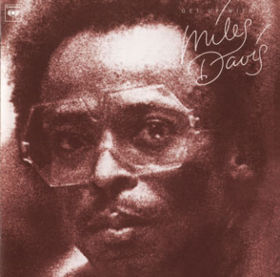
Get Up With It (Columbia, 1974)
An appreciation by Christopher Laramee
(June 2013)
An appreciation by Christopher Laramee
(June 2013)
Recorded at various sessions between 1970-74, what is technically a hodge-podge collection of jams (stylistically, chronologically) has somehow become, over time, one of the Dark Magus' towering achievements. A heck of an ALBUM LISTEN for starters, its unheralded ranking in Davis' pantheon has done the record's reputation nothing but good over the long haul. Over-familiarity and endless reissuing of seemingly every other album he made between 1960 to 1975 has had a tendency to dilute their impact. Kind of Blue, Bitches Brew, On the Corner and Sketches of Spain, to name a few of the acknowledged bangers among many, have mos def lost a bit of lustre due to the near constant influx of yet another "DEFINITIVE" version appearing shortly after the earlier version(s). But people seem to gobble 'em up, so what do I know?
As with most of Miles' post-1958 output, Teo Macero is the producer/conductor/editor and all around general glue holding the shit together. His technical mastery in assembling seamless edits from disparate sessions, jams and versions deserves its very overdue tip of the hat from the music industry. Fuck the Grammys and lifetime achievement awards and all that, Buildings and institutions should be erected and dedicated in his honor. Check out a list sometime of the records he's worked on. You'll see what I'm saying.
And the list of players on this particular platter are no slouches. One of the few constants throughout these jams is Michael Henderson on the Fender bass. His solid lines anchor the madness occurring around him, be it a tranquil modal wander like the epic "Maiysha" or the Stockhausen inspired breakbeat organ-voodoo of stunner "Rated X." Mtume's hand percussion is a layer present on all of these songs too and deserves attention for the shine he gives, pushing the performances upwards and onwards- not for nothing does he get a track named for him. Reggie Lucas and Pete Cosey ply their guitars with attention to shimmer and attack, but stand at the ready to ramp up the volume and hit some dirt noise and angular funk with slack-jawed glee. Miles' Bitches Brew compatriot John McLaughlin shows up as well on the aforementioned "Rated X" to scour and preen. Al Foster, Bill Cobham and Bernard Purdie hit the skins to rude effect. With rhythm kings like those dudes at your disposal, you can relax and stretch out knowing something's gonna happen.
The one single defining factor effecting this collection is Davis' adoption of organ and piano textures, played by the man himself, in addition to his jittery wah-wah trumpet bleats. Opening up the songs with his minimal vamps (excepting "Rated X," which sounds like he jammed coke straws in all the keys, just to let it wail). Yeah, as loathe as I am to drop it like that, this is a VERY seventies cocaine record, albeit scoured of a lot of twaddle thanks to Mr. Macero's scissor job. Interesting to note that shortly after the record's release, Miles disappeared into his apartment, his Ferrari and various elevators and broom closets, babbling and brooding to himself and no-one else for close to ten years of paranoia chants.
That's what makes this double record, which is essentially a salvage job, so alien and, let it be noted, more interesting than the rest of his seventies albums by a long shot. Drug addiction and general burnout had made Miles a basket case and the record company (Columbia) was quite ready to get something else out before he shut down. It's stature over the years as one of his most maligned and misunderstood releases makes sense due chiefly to the fact that there is no over-arching concept to it, nothing to tie it together conceptually like say, On the Corner or Bitches Brew. This is the the 1970-1975 Miles Davis mixtape that you can throw on randomly and find something strange and funky at any point. The fact that it was released as just another album only adds to its weird contours and textures. True head music for the people, only the people weren't listening by this point. So it was simply released and forgotten about quickly.
But let's not get side tracked. This here album rewards many repeated listens, strictly due to the power of the collective improvisations boiling and simmering with a leisurely violence never too far from the surface. Opener "He Loved Him Madly," for Duke Ellington, rolls along like at a fittingly stately crawl, ambient before there was such a thing. Fucking Eno(!!) has expressed as much, publicly saying this particular track had a hand in pushing him along the path of creating some truly vague system music. When the high priest of drool rock says that, you'd best recognize. After all is said and done, this track is one of the highest examples one could proffer of true majesty, a slow burn for the heavy-lidded and the spiritually gifted. Bow down to the exit sign, someone said at some point.
My favorite jam of the bunch has to be the Latin-tinged "Maiysha." A relaxed yet dissonant stroll that unfurls itself slowly over its near fifteen minute running time. Miles switches between the organ and the trumpet here, never hurrying things along too much. At times almost too unbearably gorgeous to believe, the first three quarters floats on a gentle breeze before it changes gears into some more jagged funk, Miles' organ smears itself over the proceedings at random points, with some nice parry and thrust guitar workouts rebounding before the edit silences the whole thing quickly. Again, it cannot be overemphasized how much the edits shape and color this album. Random cut-offs bump the pastoral into the visceral. The modus operandi here seeming to be that there is none, other than grabbing the best bits and throwing them together and weaving a patchwork that loosely hangs together. BANG! GET IT OUT THERE! The commercial imperative to get some more Miles product on the shelves being the number one goal for everyone involved.
This is not a bad thing though. When I say the commerce imperative is not a bad thing in this (and many other cases), I mean that there was just a desire to put some physical product out there. But it also helps that Miles had pretty much absolute creative control at this point due to his very favorable contract with Columbia. "Honky Tonk"'s afterburner bar room blues fuckery sitting astride the afore-mentioned "Rated X"'s jittery bleat? A stretch for anyone to pull off on the most inspired of days but here it works in the most casual of ways. Take it or leave it. It's just another album. If only.
Being one of the truly experimental albums of the 1970's to my ears, Get Up With It can only be truly be explained by being brushed by some kind of accidental magic. Teo going through some tapes and splicing together takes of half-together jams to satisfy Miles and the suits. That's alright though. Why stress it too much and microscope the shit to death? There's some hot grooves there, wacked noise wig-outs and tropical back rubs to calm a guy down. Miles commands them to get the fucker out and so it happens. Done.
As with most of Miles' post-1958 output, Teo Macero is the producer/conductor/editor and all around general glue holding the shit together. His technical mastery in assembling seamless edits from disparate sessions, jams and versions deserves its very overdue tip of the hat from the music industry. Fuck the Grammys and lifetime achievement awards and all that, Buildings and institutions should be erected and dedicated in his honor. Check out a list sometime of the records he's worked on. You'll see what I'm saying.
And the list of players on this particular platter are no slouches. One of the few constants throughout these jams is Michael Henderson on the Fender bass. His solid lines anchor the madness occurring around him, be it a tranquil modal wander like the epic "Maiysha" or the Stockhausen inspired breakbeat organ-voodoo of stunner "Rated X." Mtume's hand percussion is a layer present on all of these songs too and deserves attention for the shine he gives, pushing the performances upwards and onwards- not for nothing does he get a track named for him. Reggie Lucas and Pete Cosey ply their guitars with attention to shimmer and attack, but stand at the ready to ramp up the volume and hit some dirt noise and angular funk with slack-jawed glee. Miles' Bitches Brew compatriot John McLaughlin shows up as well on the aforementioned "Rated X" to scour and preen. Al Foster, Bill Cobham and Bernard Purdie hit the skins to rude effect. With rhythm kings like those dudes at your disposal, you can relax and stretch out knowing something's gonna happen.
The one single defining factor effecting this collection is Davis' adoption of organ and piano textures, played by the man himself, in addition to his jittery wah-wah trumpet bleats. Opening up the songs with his minimal vamps (excepting "Rated X," which sounds like he jammed coke straws in all the keys, just to let it wail). Yeah, as loathe as I am to drop it like that, this is a VERY seventies cocaine record, albeit scoured of a lot of twaddle thanks to Mr. Macero's scissor job. Interesting to note that shortly after the record's release, Miles disappeared into his apartment, his Ferrari and various elevators and broom closets, babbling and brooding to himself and no-one else for close to ten years of paranoia chants.
That's what makes this double record, which is essentially a salvage job, so alien and, let it be noted, more interesting than the rest of his seventies albums by a long shot. Drug addiction and general burnout had made Miles a basket case and the record company (Columbia) was quite ready to get something else out before he shut down. It's stature over the years as one of his most maligned and misunderstood releases makes sense due chiefly to the fact that there is no over-arching concept to it, nothing to tie it together conceptually like say, On the Corner or Bitches Brew. This is the the 1970-1975 Miles Davis mixtape that you can throw on randomly and find something strange and funky at any point. The fact that it was released as just another album only adds to its weird contours and textures. True head music for the people, only the people weren't listening by this point. So it was simply released and forgotten about quickly.
But let's not get side tracked. This here album rewards many repeated listens, strictly due to the power of the collective improvisations boiling and simmering with a leisurely violence never too far from the surface. Opener "He Loved Him Madly," for Duke Ellington, rolls along like at a fittingly stately crawl, ambient before there was such a thing. Fucking Eno(!!) has expressed as much, publicly saying this particular track had a hand in pushing him along the path of creating some truly vague system music. When the high priest of drool rock says that, you'd best recognize. After all is said and done, this track is one of the highest examples one could proffer of true majesty, a slow burn for the heavy-lidded and the spiritually gifted. Bow down to the exit sign, someone said at some point.
My favorite jam of the bunch has to be the Latin-tinged "Maiysha." A relaxed yet dissonant stroll that unfurls itself slowly over its near fifteen minute running time. Miles switches between the organ and the trumpet here, never hurrying things along too much. At times almost too unbearably gorgeous to believe, the first three quarters floats on a gentle breeze before it changes gears into some more jagged funk, Miles' organ smears itself over the proceedings at random points, with some nice parry and thrust guitar workouts rebounding before the edit silences the whole thing quickly. Again, it cannot be overemphasized how much the edits shape and color this album. Random cut-offs bump the pastoral into the visceral. The modus operandi here seeming to be that there is none, other than grabbing the best bits and throwing them together and weaving a patchwork that loosely hangs together. BANG! GET IT OUT THERE! The commercial imperative to get some more Miles product on the shelves being the number one goal for everyone involved.
This is not a bad thing though. When I say the commerce imperative is not a bad thing in this (and many other cases), I mean that there was just a desire to put some physical product out there. But it also helps that Miles had pretty much absolute creative control at this point due to his very favorable contract with Columbia. "Honky Tonk"'s afterburner bar room blues fuckery sitting astride the afore-mentioned "Rated X"'s jittery bleat? A stretch for anyone to pull off on the most inspired of days but here it works in the most casual of ways. Take it or leave it. It's just another album. If only.
Being one of the truly experimental albums of the 1970's to my ears, Get Up With It can only be truly be explained by being brushed by some kind of accidental magic. Teo going through some tapes and splicing together takes of half-together jams to satisfy Miles and the suits. That's alright though. Why stress it too much and microscope the shit to death? There's some hot grooves there, wacked noise wig-outs and tropical back rubs to calm a guy down. Miles commands them to get the fucker out and so it happens. Done.
MAJOR ELECTRIC AGE MILES DAVIS RECORDINGS
(1968-1975):
Miles in the Sky (1968):
In a Silent Way (1969):
Bitches Brew (1970):
Live at the Fillmore East (1970):
Isle of Wight Festival (1970):
The Cellar Door Sessions (1970):
A Tribute to Jack Johnson (1971):
Live-Evil (1971):
On The Corner (1972):
Black Beauty: Live at Fillmore West (1973)
In Concert (1973):
Get Up With It (1974):
Big Fun (1974):
Dark Magus (1974):
Agharta (1975):
Pangaea (1975):
Studio Albums (1968-1974):
Miles in the Sky (1968)
In a Silent Way (1969)
Bitches Brew (1970)
A Tribute to Jack Johnson (1971)
On the Corner (1972)
Big Fun (1974)
Get Up With It (1974)
In a Silent Way (1969)
Bitches Brew (1970)
A Tribute to Jack Johnson (1971)
On the Corner (1972)
Big Fun (1974)
Get Up With It (1974)
Major Live Performance Albums (1970–1975):
Miles Davis: Live at the Fillmore East (1970)
Miles Davis: Isle of Wight Festival (1970)
Cellar Door Sessions (1970)
Live-Evil (1971)
In Concert (1973)
Black Beauty: Live at Fillmore West (1973)
Dark Magus (1974)
Agharta (1975)
Pangaea (1975)
Essential Archival Releases & Box Sets:
Extensive vault material and unreleased concerts from this period have since been issued. Notable releases include:
Miles Davis Quintet – Live in Europe 1969:
The Bootleg Series, Vol. 2 (2013)
Miles at the Fillmore – Miles Davis 1970:
The Bootleg Series, Vol. 3 (2014)
The Cellar Door Sessions 1970 (2005)
The Complete Bitches Brew Sessions (1998)